
You may be in front of your screen, rereading the same sentence for the third time, or stuck in a meeting that lasts while your jaw opens itself. The yawning also arrives at the wheel, especially in the early afternoon, when the road seems long and the vigilance decreases. At home, after a short night, he often invites himself without warning, with this very clear impression that your body is asking for something.
When you say "I shove all the time", the question is not only whether it is annoying. The real question is medical, is it a simple signal of fatigue, or the marker of an imbalance to be detected? The answer is built step by step, from the banal to what deserves to be verified, without dramatizing or trivializing.

Contents
- Understand why I'm always waking
- The yawning, a reflex to multiple functions
- The big causes to explore step by step
- Signs to be alerted and gravity criteria
- Concrete measures to be adopted today
- What professional consult and when
- Caregiver and Caregiver care journal
Understand why I'm always waking
The yawning has something very ordinary, almost familiar. In France, sources of medical extension recall that an adult yawns on average 5 to 10 times a day, and that we can count about 250 000 during a lifetime, which already shows that this reflex is part of the normal functioning of the body [Doctissimo]. So it's not a strange sign in itself.
But the embarrassment appears when yawning repeats itself, becomes necessary, or becomes visible to others. A helping person at the table, a colleague sees him during a video conference, a spouse spot him at night on the couch. In these situations, the question is no longer just why I yawn, but what is my body trying to tell me?
From the ordinary daily to the signal not to be ignored
Historically, yawning has long been linked to very concrete states of everyday life, such as boredom, fatigue, awakening or sleep. A Francophone synthesis also reminds us that it is universal, ancient, observed in humans very early in life and in many vertebrate species [HALIn other words, this reflex is nothing unusual at first.
The challenge is repetition. When yawning becomes frequent, it can signal a sleep debt, a medication effect, or more rarely a medical problem to explore. In the family setting, this nuance counts a lot, because a relative who yawns constantly is not necessarily in his or her head, he or she may be compensating for something real.
If yawning changes rhythm, changes context or comes with other symptoms, it deserves to be noted as a clinical sign, not as a mere habit.
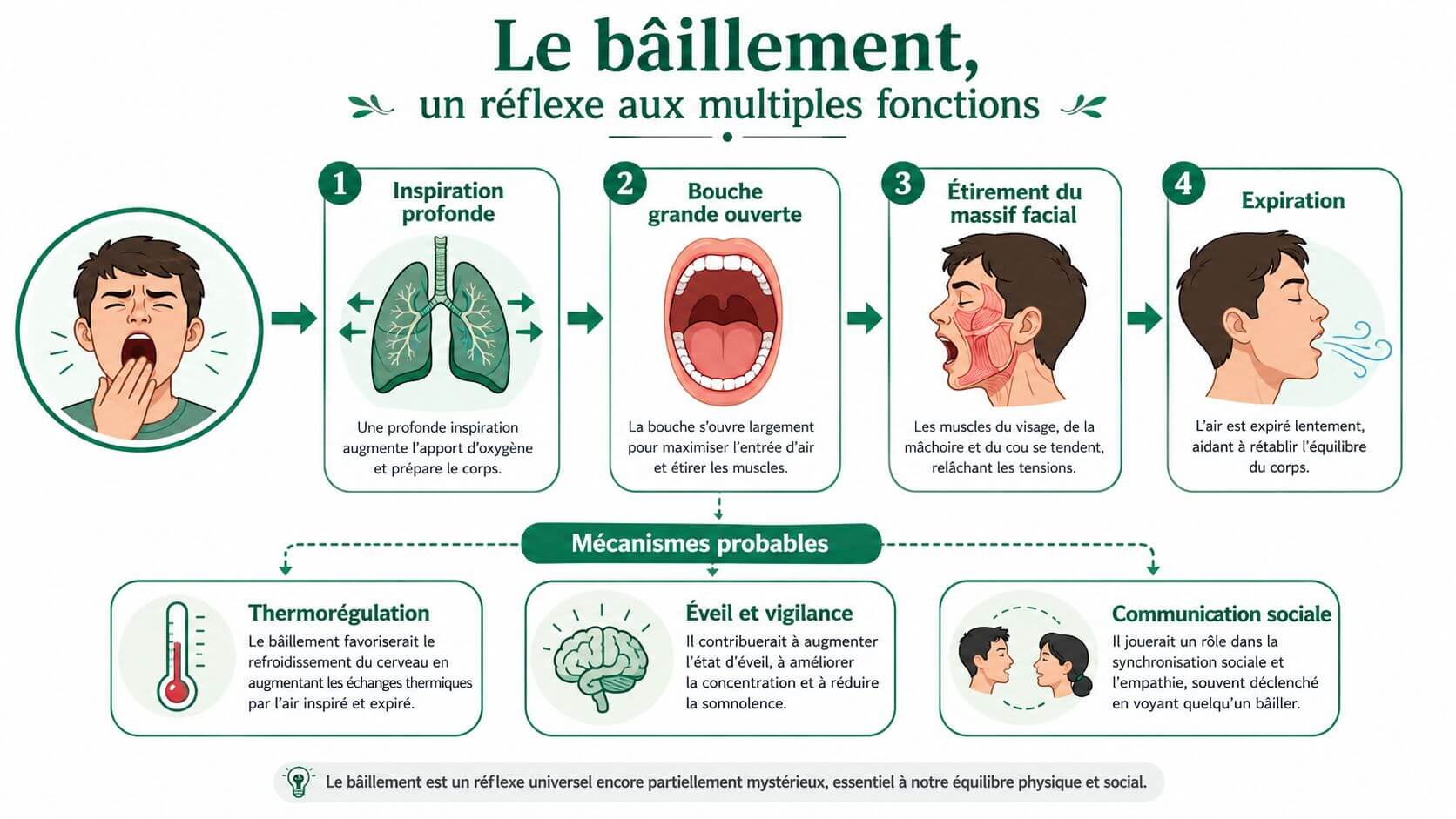
The yawning, a reflex to multiple functions
A yawning is first a very recognizable gesture. The mouth opens widely, a deep inspiration occurs, the muscles of the face stretch, then the air comes out. This simple sequencing explains why yawning is so visible, and why it attracts so much attention around us.
What we know about the mechanism
The exact mechanisms remain discussed, but several probable functions emerge. The yawning seems to participate in the cerebral thermoregulation, to the modulation of vigilance, and perhaps to certain aspects of social communication. The French surveys also indicate quite typical moments of appearance, at awakening, before bedtime and around lunch, with peaks measured in the morning in some surveys [HAL]. It's no coincidence that many people say yawn when the body moves from one state to another.
The useful point, in practice, is to distinguish an isolated yawning from a repeated and involuntary yawning. The first remains banal, the second becomes clinically speaking when it hinders the day, the exchanges or the concentration. French sources recall that beyond about 20 yawns a day, the social discomfort becomes noticeable [HAL].
Why this threshold changes reading
This threshold is not a verdict, it's a landmark. It helps to move from a blurred impression, I'm wailing a lot, to a more useful observation, I wail at specific moments, in what contexts, and with what other signs. It's exactly this type of tracking that lets you know if you just need to correct sleep, or ask for a medical opinion.
An isolated yawning does not worry. A succession of yawnings in the day, especially if it settles, deserves to be explained.
The big causes to explore step by step
When someone says, "I wail all the time," the first track to look at often looks like a battery that doesn't fully recharge. Sleep debt It is the simplest cause to understand. Sleeping too little, sleeping late, working at night or in staggered hours can be enough to make appear repeated yawns. Public health France links the drowsiness of everyday life to these rhythms of life, but also to certain pathologies of sleep [Public health France].
From Daily to Medical Causes
Before thinking about a disease, you have to look at the ground. A broken day, too heavy a meal, too much caffeine, or mental fatigue that settles up can increase the yawning without any serious problems behind. Stress and anxiety also count, especially when breathing becomes higher and faster, a little as if the body remained in alert mode.
The drugs then deserve careful verification. ISRS, the dopamine agonists and opiates, are known to cause yawning. A practical point is available on the side effects of the gabapentin in this article of the TribulysOn the French side of pharmacovigilance, reports show that this symptom may occur after the introduction of treatment, sometimes rapidly, with a median age of onset of 47 years and a median time to onset of 24 hours after the start of the medicinal product [Doctissimo].
Then come the more targeted medical causes. Obstructive sleep apnea syndrome is a diagnosis to be evoked before a non-repairing sleep, snoring, diurnal drowsiness or respiratory pauses observed by the entourage. Restless Legs Syndrome, chronic bronchopneumopathy, anaemia or heart failure can also give this feeling of fatigue that comes back all the time. The right reflex, both at home and in consultation, is to connect the yawning to the rest of the picture, not to look at it alone.
Neurological causes are rarer, but they must remain in mind when the profile changes. Very frequent yawning, in salves, or associated with other signs may cause a search for a epilepsy, Multiple sclerosis, Stroke stroke, a tumour or other complex brain damage [RFCRPV]. The idea is not to conclude quickly, but not to miss a signal that no longer sticks with a simple fatigue.
For a caregiver at home, the most useful grid is in four words, sleep, treatment, general context, neurology. Noteing these elements in a link book helps to see if yawning follows a new medicine, a bad night or other symptoms.
Signs to be alerted and gravity criteria
The yawning remains commonplace in many very simple contexts. At the end of the day, after a hearty meal, in a warm room, or at awakening, there is often nothing worrying. The body is just trying to move from one state to another, and the reflex remains consistent with the situation.
When repetition changes the symptom value
What deserves rapid attention is a change of profile. Salvation yawns, repeated without obvious fatigue, occurring at rest or during an unusual effort, are more meaningful than isolated yawning. It is also necessary to be careful if it is associated with shortness of breath, chest pain, dizziness, speech disorders, a decrease in alertness, cold sweats or nausea.
The neurological context counts a lot. Unusual headaches, weakness on the one hand, visual disorders, facial paralysis, sudden confusion or discomfort with loss of consciousness justify a call to 15. In this situation, yawning is no longer the main problem, it becomes a sign among others of a potentially urgent state.
When a common symptom changes frequency and is added to another warning sign, it is necessary to act on the whole, not wait for it to pass by on its own.
| Sign | What this may mean | Adapted reaction |
|---|---|---|
| Occasional yawning at awakening | Ordinary fatigue, change of pace | Monitor, correct sleep |
| Repeated yawning for no clear reason | Sleep debt, medication effect, sleep disorder | Make an appointment with the attending doctor |
| Wounding with malaise, confusion or neurological disorder | Potentially urgent | Call 15 |
For a relative who also complains of fatigue at the change of position, the article on the symptoms of theorthostatic hypertension can help distinguish several close tables, available on Tribulys.
Concrete measures to be adopted today
Start with what can really correct a yawning related to fatigue. The most useful remains a Sleep hygiene simple, with regular bedtime and uptime, a quiet, dark and rather cool room, and short naps if needed, ideally before the advanced afternoon. The yawning is not always a lack of will, it often reflects a brain that does not recover enough.
A four-learned action plan
First lever, sleep. Cut the screens a little before bedtime, keep a steady rhythm several days in a row, and see if yawning decreases in the morning or early afternoon. If you easily fall asleep in front of the TV but stay awake in bed, this gap is already worth noting.
Second lever, breathing. Slow, nasal and regular breathing can help when yawning is accompanied by broken tension or alertness. The idea is not to block the reflex, but to reset a quieter, less saccadated breathing.
Third lever, feeding and hydration. Adequate hydration during the day, less alcohol in the evening, and less heavy meals can reduce the feeling of exhaustion that causes yawning. If the diet is unbalanced or fatigue evokes anaemia, a point with the doctor and the article on the diet in case of anaemia can be useful, available on Tribulys.
Fourth lever, treatments. Check with the pharmacist or the doctor for medicines that may promote yawning, in particular antihistamines, some antidepressants, the opioids and sedative drugs. If a treatment has been recently added or modified, note the date and time, this is often where the index is located.
Small, simple test. For seven days, note the time of yawning, the context, the sleep of the previous night and the medications taken. If the rhythm changes frankly when you correct the sleep or screens, you already have a solid track.
What professional consult and when
The first contact remains the treating physician. It is best placed to connect yawning to sleep, mood, treatments and the rest of the symptoms, then decide whether to go further. Without a warning signal, the consultation can be programmed quickly but without urgency, especially if the symptom lasts, hinders daily life or is accompanied by marked drowsiness.
The logical path according to the clinical picture
The generalist will first look for a common cause, with a focus on sleep, drug intakes, daytime fatigue, mood and history. He will often complete with a cardiopulmonary and neurological clinical examination, then with a first-intentional assessment depending on the context. When the sleep appears to be in question, he can direct to a pneumonologist or sleep specialist, with examinations such as ventilatory polygraph or polysomnography.
If the table suggests a neurological cause, referral to a neurologist becomes a priority. Suspicion of epilepsy, multiple sclerosis or stroke may lead to brain MRI, sometimes supplemented by other examinations as appropriate. If the complaint is associated with cardiac or respiratory signs, an ECG or echocardiography may also be discussed.
| Dominant profile or symptom | Specialist to be consulted as a priority | Recommended time |
|---|---|---|
| Isolated yawning, fatigue, disturbed sleep | Treating physician | Next appointment available |
| Snoring, drowsiness, non-repairing alarms | Pneumologist or sleep specialist | Quick consultation |
| Salvation with neurological signs | Neurologist, or emergency so brutal | Without waiting if the signs are recent |
| Malaise, loss of consciousness, confusion, chest pain | Emergencies | Call to 15 |
Caregiver and Caregiver care journal
When a close relative is much yawning, the quality of the observation counts as much as the quantity. A simple link book allows you to note what is happening without interpreting in place of the person. It is particularly useful at home, where several speakers take turns and where details are quickly lost between two visits.
What to note every day
Start with the essentials, the time, the context and the approximate number of episodes. Note if yawning occurs before or after a meal, after a nap, during an activity, or after a drug take. Add the perceived fatigue, the level of awakening, the hours of sleep at night, and any unusual changes in rhythm.
For fine clinical observation, be descriptive. Write if you notice difficulty swallowing, unstable gait, sweating, paleness, night waking, unusually floating look, or a decrease in alertness. The aim is not to diagnose, but to spot an evolution, especially if the same profile repeats for several days.
Practical rule for caregivers. Describe what you see, not what you assume. "Repeated yawning after dinner" is better than "he must be very sick".
How to use the notebook in the transmission
Every line wins to be clocked. A transmission between day shift and night shift becomes much clearer if it specifies, for example, "series yawning after the evening catch" or "no yawning during the morning, but great drowsiness after lunch". This type of detail helps the physician identify a connection with sleep, treatment, or a particular context.
During a consultation, bring the notebook with the trigger events, schedules and recent changes. If the pattern changes, for example, more frequent yawning, more prolonged, or associated with alertness disorders, report it without waiting for the next visit. A coordination solution like Tribulys can centralise the liaison care journal, medicines and transmissions so that each stakeholder can see the same information at the same time.
If you recognize yourself in a I shove all the time persistent, do not stay alone with uncertainty. Tribulys Helps families and caregivers to keep track of observations, treatments and transmissions at home. Take the time to note episodes, then ask for a medical opinion if yawning becomes frequent, changes shape or is accompanied by other signs.
Put this organisation into practice with Tribulys
Keep your care journal, shared calendar, tasks, medication tracking and emergency information together. Start for free and invite the relatives and professionals involved in your loved one’s care.