
The scene is commonplace, and that's precisely what makes it difficult to interpret. A girl notes that her mother sits down more often, responds more slowly, and a little waking up since she was prescribed gabapentin. She wonders if it's age, pain, fatigue, or an effect of treatment.
This is exactly where the gabapentin side effects become a concrete subject, not theoretical. Between an expected discomfort and an alert signal, the border may be blurred when you experience the situation at home, in the midst of other medications, oblivion, and the habits of the day. This guide helps to recognize what is common, which deserves close supervision, and what needs to be called quickly, with simple benchmarks to pass on to the health care team.
Contents
- When a loved one changes without knowing why
- Understanding how gabapentin works
- Side effects classified by frequency
- Neuropsychiatric effects and warning signs not to be trivialised
- Populations at risk and special situations
- Hazardous interactions and respiratory risk
- Document effects and alert professionals with Tribulys
- Your home action checklist
When a loved one changes without knowing why
The first alert doesn't always look like an alert. A loved one becomes drowsy after lunch, walks by holding the wall, or forgets what he came to say. One can believe in a bad night, a poorly controlled pain, or a passenger's move.
With gabapentin, however, this type of change deserves to be looked at closely. French sources place sleepiness, the dizziness andataxia in the foreground of the effect profile, with a mechanism consistent with a Central nervous system depressant which increases the risk of falls and lower vigilance. In other words, the medication can calm nerve pain, but it can also slow down which allows you to stay stable, alert and coordinated.
Practical rule. If the change occurs shortly after the initiation of treatment or after a dose increase, you should think of an adverse reaction before talking about a "normal" development.
This is particularly important for caregivers. At home, it is often they who see the first sign, even before the patient talks about it in consultation. A simple, dated observation, transmitted at the right time, is better than an isolated feeling and difficult to reconstruct later.
Understanding how gabapentin works
Gabapentin does not act as a simple painkiller that cuts pain. It alters the way neurons transmit certain signals, which can calm neuropathic pain, but also slows down related functions such as vigilance, balance or breathing. It's a bit like a painkiller. loosening vicewhich relaxes the painful area, but also releases other tensions of the nervous system.
Why a useful effect can become an embarrassing effect
When nerve transmission slows down, the pain may decrease, but the person may also feel less lively. In some patients, this results in a more hesitant walk, a slow speech, or a cottony head impression. It is not necessarily annoyance if the person lives alone, is already taking several treatments, or has a history of falling.
The French data accurately describe a profile dominated by the drowsiness, the dizziness andataxia, with frequent effects of confusion, depression, paraesthesia, coordination disorders, nystagmus, walking disorders and dperipheral oedema SPC ANSM. It's not a decorative list, it's the map of areas to watch at home.
The right reflex is not to assume that it will pass by itself. The right reflex is to connect the symptom to its context, beginning of treatment, increase, forget, other medicine added, alcohol, or unusual fatigue state.
This logic also helps not to confuse an effect of the medication with another cause. An elderly person, for example, may seem simply tired when he or she has an intolerance to the treatment. Conversely, poorly calmed pain can mask gabapentin-related sleepiness.
Side effects classified by frequency
In the face of a gabapentin prescription, the real question at home is not only "what effects can happen?". It's mostly "what should we spot first, and what if the person changes after the catch?". French records and French syntheses provide a useful hierarchy for organizing this monitoring. Effects very common touch more than 10 % patients, the effects common concerning 1 to 10 %, and some effects remain rare or of unknown frequency, as recalled by data from Vidal.
The numbers to keep in mind
| Effect | Frequency range | Main source |
|---|---|---|
| Somnolence | more than 10 % | Vidal |
| Dizziness | more than 10 % | Vidal |
| Fatigue | more than 10 % | Vidal |
| Coordination disorders | more than 10 % | Vidal |
| Weight gain | 1 to 10 % | Vidal |
| Balance disorders | 1 to 10 % | Vidal |
| Double vision | 1 to 10 % | Vidal |
| Digestive disorders | 1 to 10 % | Vidal |
To give a more concrete benchmark, French-language journals show that these effects are not theoretical. A Cochrane synthesis in French reports that about 66 % exposed patients have at least one adverse event, and 12 % Discontinue treatment due to an adverse reaction. Another French analysis, based on more than 4 000 patients, estimate adverse events to 63 % treatment with 49 % sub-comparator, with a number necessary to harm 7,5 to cause an additional side effect Cochrane.
What it changes every day
Effects very common require simple but regular monitoring. Somnolence can be seen if the person falls asleep more easily, responds less quickly, or appears to be slowing down after taking. The dizziness and coordination disorders often see in everyday gestures, for example when she hesitates to rise, misses a step, or stands on the wall as if to keep the balance. The right reflex at home is to observe the time of onset, duration, and connection to a dose increase, an oversight, or the addition of another medication.
Effects common It is worth a little bit of a different watch, because they sometimes slip into the everyday without noise. weight can gradually rise, the oedema may weigh the legs, double vision may interfere with reading or walking, and digestive disorders may reduce appetite or general comfort. A simple notebook, or a coordination tool like Tribulys, helps to note what changes between two consultations, without relying solely on the impression of the moment.
The rare but striking effects do not wait. Loss of consciousness, difficulty breathing, or frankly unusual behavior requires to react without delay.
When to call quickly? If the person falls, becomes very confused, no longer stands as usual, or has an effect that worsens after each dose, a health care professional should be advised. If the doubt is about immediate safety, the call should not be postponed.
The useful sorting is not to classify everything as "serious" or "no serious". It consists of linking the symptom to its intensity, its evolution, and to the context of taking, to know whether one can monitor, seek advice, or act without delay.
Neuropsychiatric effects and warning signs not to be trivialised
Some of the effects of gabapentin slip behind very ordinary words, such as "it's weird today" or "it's not in its usual state". Confusion, depression, hallucinations, suicidal ideas and abnormal movements can be relegated to the background as they really change patient safety. The French sources mention them, but the difficulty at home is to recognize them in time.
When it's no longer fatigue
A normal fatigue is like a need for rest. A neuropsychiatric effect often appears after the introduction or increase of treatment, seems disproportionate, or does not fit the usual character of the person. A close relative who no longer manages to follow a simple conversation, who sees or hears unusual things, or who starts to speak inconsistently should be reassessed quickly.
The paraesthesia, the coordination disorders and walking disorders If the tingling takes over, a useful benchmark is that of the drug, which can also lead to an effect of the drug, especially if the table changes with the dosage. guide on tingling in legs and feet, which helps distinguish nervous sensations from more diffuse symptoms.
Move fast. Call the doctor during the day if the mental state changes sharply, if the person becomes confused, or if the relatives no longer recognize it in its usual functioning.
Call immediately if loss of consciousness, expressed suicidal ideas, marked hallucination, or brutal aggravation occur.
Weaning also deserves to be taken seriously. In France, stopping can lead to early symptoms such as anxiety, insomnia, nausea, tremors, headache, depression and malaise. This is precisely what complicates repeated oblivion, because it can produce a confused picture between the return of symptoms, malaise related to discontinuation, and residual effect of treatment.
Populations at risk and special situations
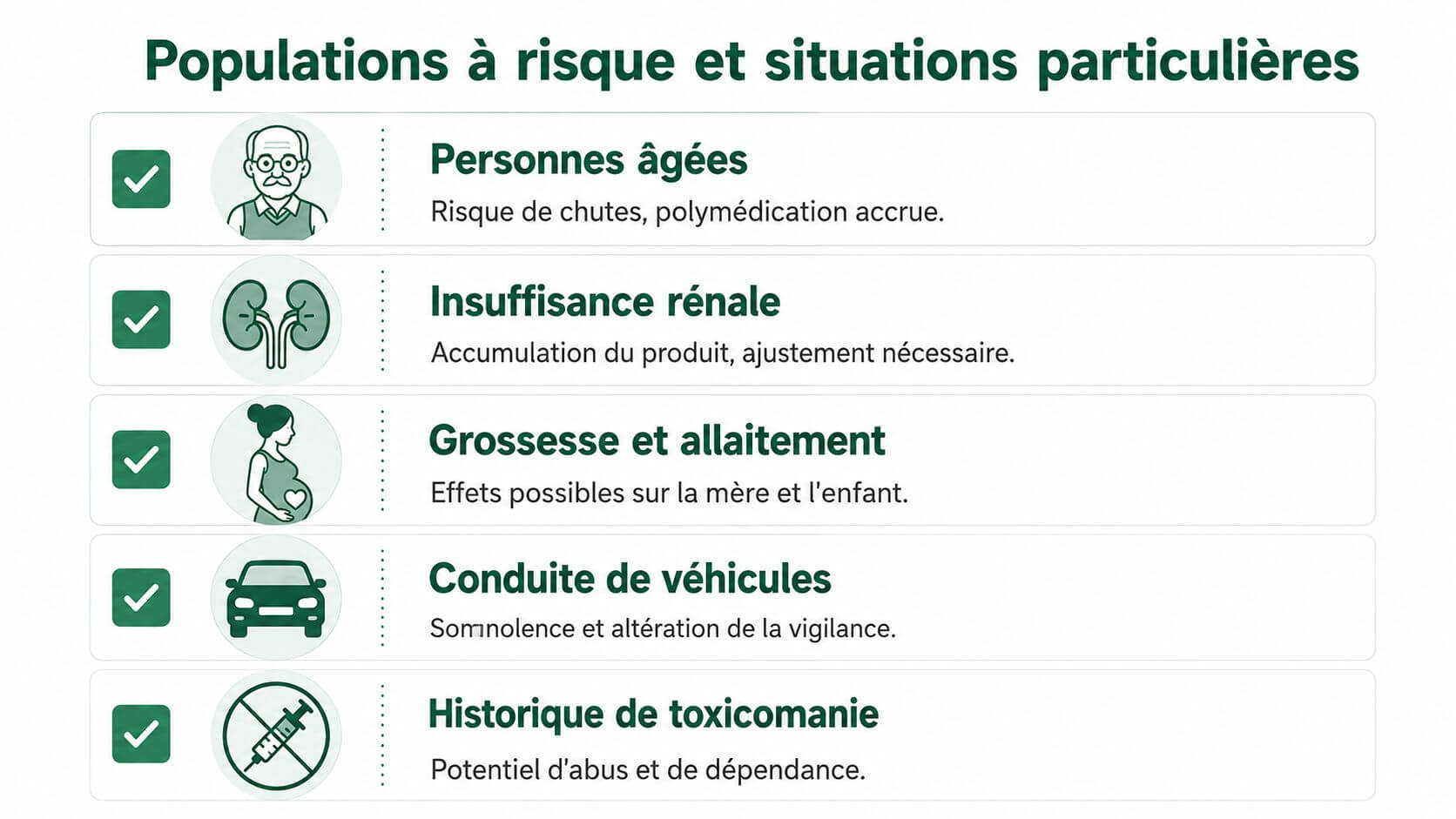
Some situations make the benefit-risk ratio tighter. It's not that gabapentin becomes "forbidden" at once, it's that the follow-up must become more attentive, more concrete, and more shared between the patient, the caregiver and the prescriber.
Profiles to be closely monitored
Older persons, the central risk is the fall, because sleepiness, dizziness and low alertness combine with the problems of balance. The expected conduct is to observe the rise-and-sleep, the hesitant steps and the episodes of disorientation, then to tell the prescriber quickly.
Renal impairmentThe problem is the accumulation of the product and therefore a tolerance that can deteriorate. In these patients, it is necessary to check that the doses have been adjusted and report any unusual slowdown, especially if the person becomes more confused or drowsy.
Pregnancy and lactation, the decision is not made at the feeling. Early reporting to the doctor is essential, because it is necessary to re-evaluate the treatment and do not allow self-medication or improvised adjustments to take the hand.
Drivingsleepiness is sometimes enough to make driving inappropriate, even if the person feels pretty good. A simple doubt about vigilance must cause the foot to rise, especially at the beginning of treatment.
History of substance abuse, the subject is not moral, it is clinical. The use must be carefully framed, because vigilance in the face of potential abuse or dependence is not discussed lightly.
Orthostatic somnolence or rising discomfort can also blur interpretation. A useful reminder on the signals to be monitored is that evidence of orthostatic hypotension and its symptoms, because a fall doesn't always have one cause.
Security point. If the close one cumulates several sedative treatments, the observation at home must be strengthened, because the risk is not only drowsiness, it is the sequence of sleepiness, imbalance, fall and loss of autonomy.
Hazardous interactions and respiratory risk
The most important association to watch is the other central nervous system depressants. opioid, Benzodiazepine oralcohol, gabapentin may increase sleepiness and, in some cases, may go as far as respiratory depression. The risk is not abstract when you see the person breathing more slowly, becoming difficult to wake up, or losing clarity.
The French sources mention many cases of respiratory depression with gabapentin, and they also remind that withdrawal symptoms may occur in patients with gabapentin. 48 hours after stoppage BDPM. This is an important point in fragile people followed at home, because an oblivion, a misexplained interruption, or a combination with other sedatives can cause surveillance to shift.
Concrete signs to watch at home
We have to look at the respiratory frequency, the unusual nature of snoring, breathing pauses, the blueness of the lips, and the aggravation of a confusion already present. A close relative who sleeps deeply but wakes up difficult, or who speaks in a way much more confused than yesterday, must be reported without delay.
The call to the doctor may suffice if the picture remains moderate, without visible distress, and if the change is above all an increase in somnolence. 15 is necessary if the breathing appears to be slow, irregular, or if the person no longer responds correctly.
The right sorting is done on observable signs, not on vague intuition. If you can count, describe, date and compare, you make the risk more legible for the professional.
Alcohol deserves special attention because it adds a sedative effect without warning. In a house where many people care, it is necessary that the information circulates, otherwise everyone believes that someone else has already noticed the change.
Document effects and alert professionals with Tribulys
A poorly rated side effect often ends up being underestimated in consultation. The patient forgets a detail, the caregiver remembers the opposite, and no one has the same chronology. A shared and timed notebook changes the quality of the exchange, because it turns an impression into precise observation.

How to rate what really matters
Start with three simple elements: the dose, the symptom and the time. A sentence such as “morning dose, marked drowsiness around 11:00, unsteady walking, no fall” is far more useful than “something is wrong”. Also distinguish what the person feels from what the caregiver observes, because the two do not always tell the same story.
A coordination tool such as Tribulys helps keep this trace in a common space, with medication, reminders, messages, and observations accessible to those following the person. It also helps alert the treating physician or the IDEL without waiting for the next consultation, especially if forgetfulness is repeated or if a symptom becomes clearer from one day to the next.
What to Transmit without Interpreting
- The observed fact, e.g. vertigo after taking or abnormally deep sleep.
- Time, because a symptom after taking does not have the same range as a symptom at the end of the day.
- The context, like another medicine added, an evening with alcohol, or a decreased appetite.
- Developmentsstable, improving, or worsening.
The most important thing is not to change the dose alone. The role of the caregiver is not to drive the treatment instead of the prescriber, but to provide reliable data so that it decides quickly and correctly. For a more structured transmission framework, this is shared transmission book gives a good benchmark of what to record without losing the essentials.
Your home action checklist
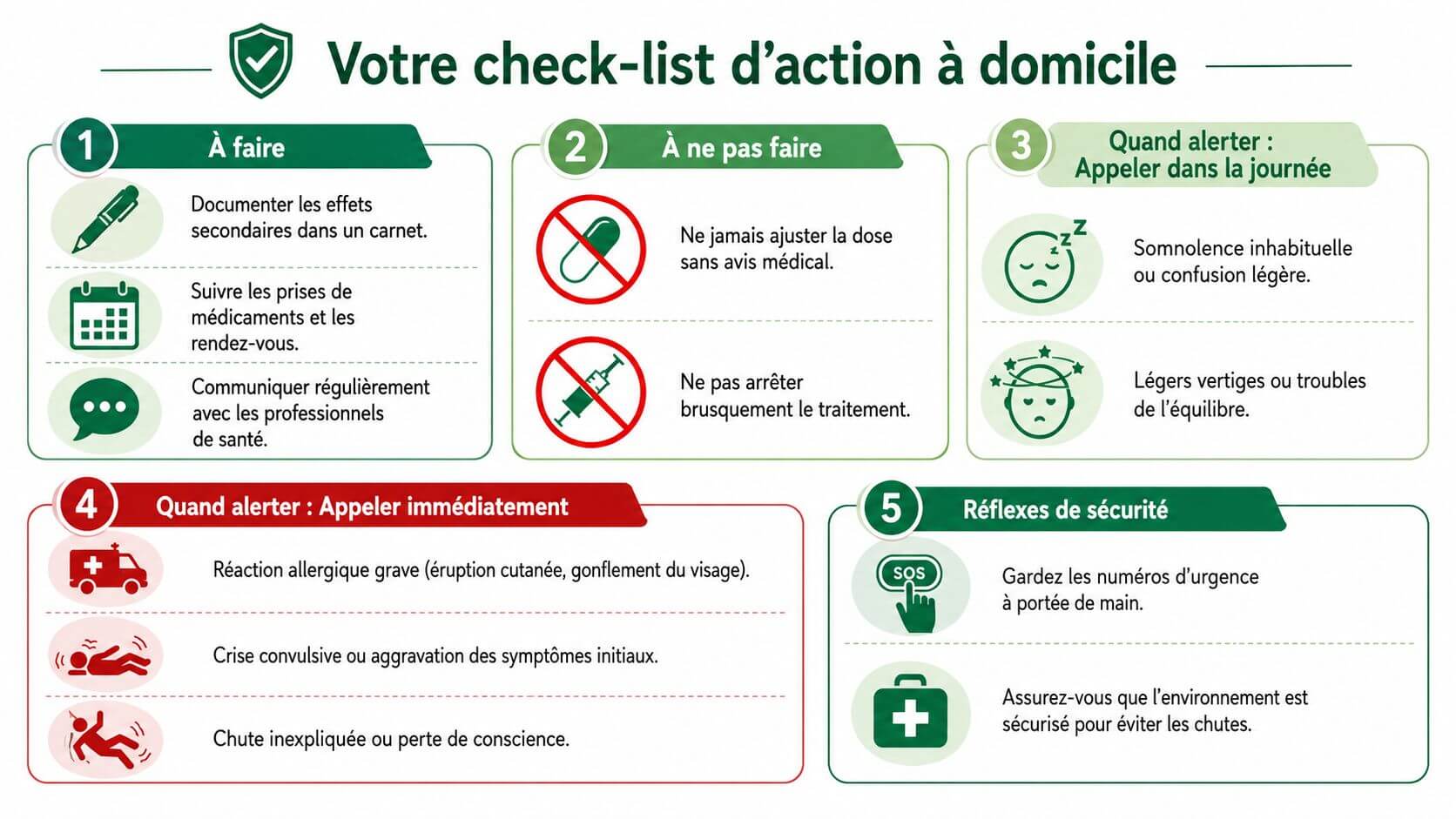
Keep a simple rule, observe, note, transmit. If drowsiness, dizziness, confusion or unstable walking appear, note the time, the dose, and the course, then notify the appropriate professional. Never adjust the dose alone, and do not abruptly stop the treatment.
Calling in the day if somnolence becomes unusual, if confusion increases, or if balance deteriorates. Call immediately if the person falls, loses consciousness, has a severe reaction, or breathes badly.
Gabapentin remains useful for many patients, provided that home follow-up is clear and shared. If you coordinate a loved one, Tribulys can help you centralize the take, observations and exchanges with caregivers, so that the gabapentin side effects There are no mere impressions between two consultations.
Put this organisation into practice with Tribulys
Keep your care journal, shared calendar, tasks, medication tracking and emergency information together. Start for free and invite the relatives and professionals involved in your loved one’s care.