
It's two o'clock in the morning. A parent stands up to go to the toilet, leans on the wall, blinks his eyes, then says he sees flies in front of him. The caregiver hesitates. Should we wait for it to pass, lengthen it, call the doctor, or trigger an emergency? In this kind of scene, the real problem is not just the unease. It's the uncertainty about what to measure, what to monitor, and when to ask for help.
The most useful, in orthostatic hypertension symptoms, it is not to stay at the level of the list. You have to understand the logic of the body at the rise, recognize what looks like a orthostatic hypertension, which rather evokes a orthostatic hypotensionIn the case of an elderly person, who is polymedic, or who is followed at home, this difference changes everything, because a malaise at rising can be a mere passing episode or the sign of an abnormal tension response documented in the French-language hospital-university literature, with a excess morbidity and cardiovascular mortality by 51% compared to subjects with normal response to orthostatism (French synthesis reference).
Contents
- Unease at dawn that interrupts the night
- Understanding orthostatic hypertension in one image
- Typical and atypical symptoms to watch on a daily basis
- Do not confuse with orthostatic hypotension or POTS
- Measure voltage at rise and recognize warning thresholds
- Coordinate the tribe and caregivers around the constants
- When to alert, when to watch, when to adjust
- Install a simple and sustainable routine on a daily basis
Unease at dawn that interrupts the night
A close relative gets up too fast, takes a few steps, then stops clean. He says that he has an empty head, that he sees blur, or that his heart hits hard. For the family, this moment often looks like an unexpected breakdown, as if the body had trouble restarting at the moment when it is necessary to go from the neck to the standing.
The first reflex to have
The right reflex is not to guess, it is to look at the scene with method. The body needs a very quick adjustment when you stand up, a bit like an engine that has to inject the right amount of energy back at the right time. If this adaptation is loose, the symptoms can appear in a few seconds to a few minutes after the recovery, then decrease when the person is lying back or resettling (French clinical resource on orthostatic symptoms).
In home life, this idea counts more than the exact word placed on the episode. Vertigo, veil in front of the eyes, sudden weakness, malaise, headache, nausea, palpitations, all this can be part of the picture. Francophone sources also remind that these signs are often related to poor brain tolerance or sympathetic, with sometimes a quick recovery at bedtime (French thesis in the 75+ age group).
Practical rule: If the malaise starts immediately after lifting and becomes less severe when the person is longer, think first of an orthostatic disorder before concluding a simple fatigue.
This scenario serves as a red thread. The goal is not to scare. It is to give the family a simple map, what to observe, what to measure, and what to transmit to the doctor to prevent the episode from getting lost between several calls, several memories and several versions.
What a loved one can notice right away
- exact time rising, especially if discomfort occurs at night or early in the morning.
- The position when the signs appeared, sitting, standing, or walking.
- Visible symptoms, for example visual veil, paleness, sweating, leaning against the wall, speech slowed down.
- Recovery, especially if the person is better by lying down or after drinking.
Understanding orthostatic hypertension in one image
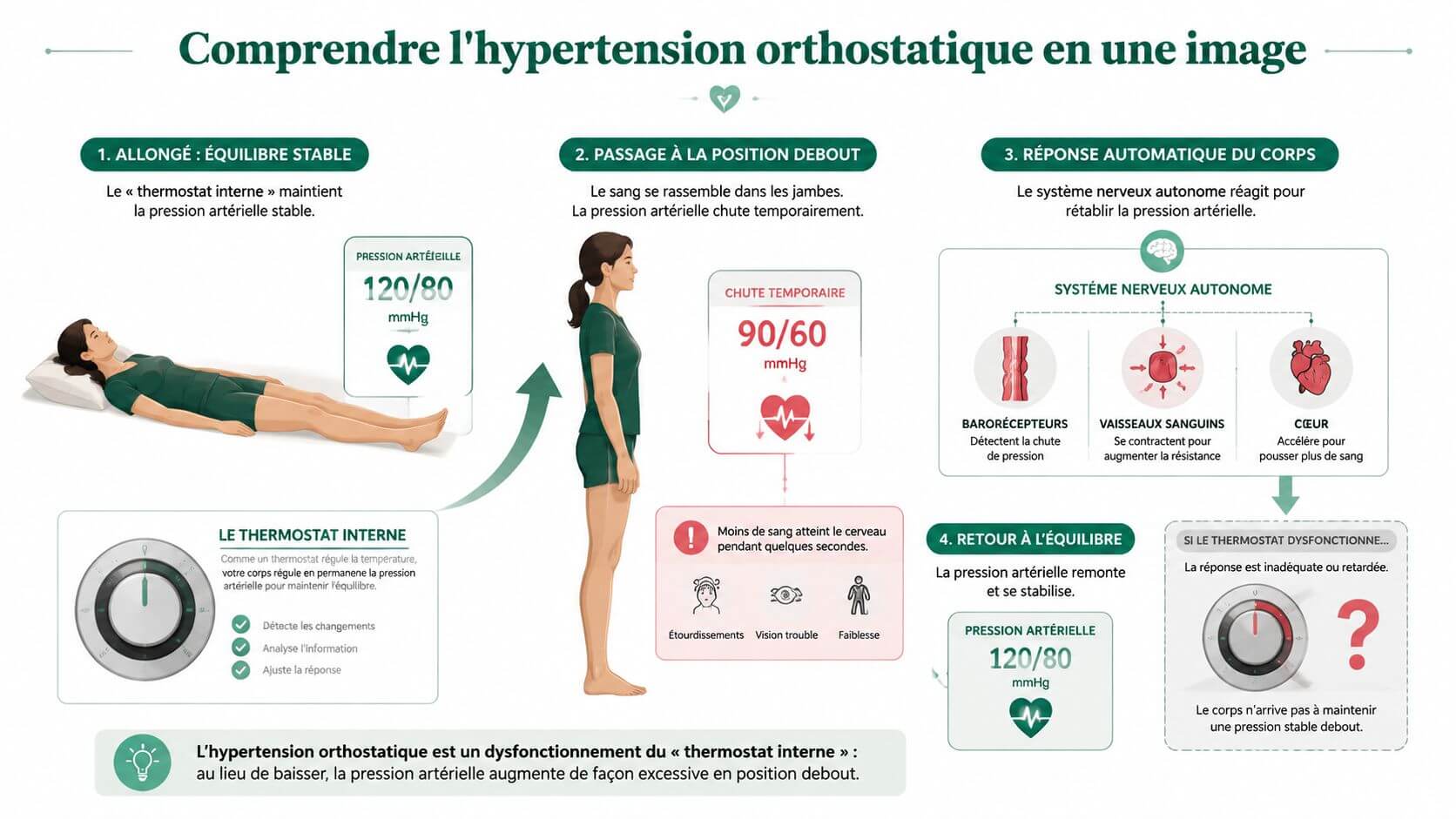
I-I-Iorthostatic hypertension means a raised blood pressure. When the person moves from the lying position to the standing position, the systolic pressure increases instead of remaining stable. The reference definition generally retains an increase of at least 20 mmHg between 1 and 3 minutes The clinical descriptions also indicate that it is often asymptomatic, while being able to be accompanied by headache, dizziness, palpitations and tinnitus.
The compensation mechanism that's coming up
The simplest is to imagine it as a Clearing mechanism When you get up, the autonomic nervous system adjusts the circulation to keep a correct infusion of the brain and upper body. In some people, this response does not just correct the fall due to the change of posture, it does not just correct the fall due to the change of posture. overcompensation. The tension then rises instead of stabilizing.
This logic helps to understand why orthostatic hypertension is not just high voltage. The starting point is not a value taken at random in the day, but the lying-up transition. That's why an isolated measure, without context, can miss the problem.
Why the disorder often remains discreet
At home, many relatives first think of orthostatic hypotension, because an unease at the rise spontaneously makes them think of a drop in tension.orthostatic hypertension may be asymptomatic, and when it manifests itself, it may take the appearance of headaches, palpitations, visual disturbances or nausea. French-language analysis of diagnostic confusion reminds us that this painting easily blurs the marks.
This distinction is very important for elderly or polymedics. A person may seem to be simply stunned while lifting actually triggers an abnormal tension response. So the right benchmark is not only the symptom, it is also the time when it appears and the sense of tension variation. A family doctor then relies on this chronology to ask what to measure at lifting, and then to decide whether to monitor, alert or adjust.
Typical and atypical symptoms to watch on a daily basis
At home, spotting often starts with a very simple scene. The person gets up, and a few seconds later appears a malaise, visual disorder, weakness or discomfort that requires to stop.orthostatic hypertension, the key point is not only the symptom, this is the moment when it occurs, right after lying-up, like an engine that coughs at the start before stabilising.
The signs that speak the most
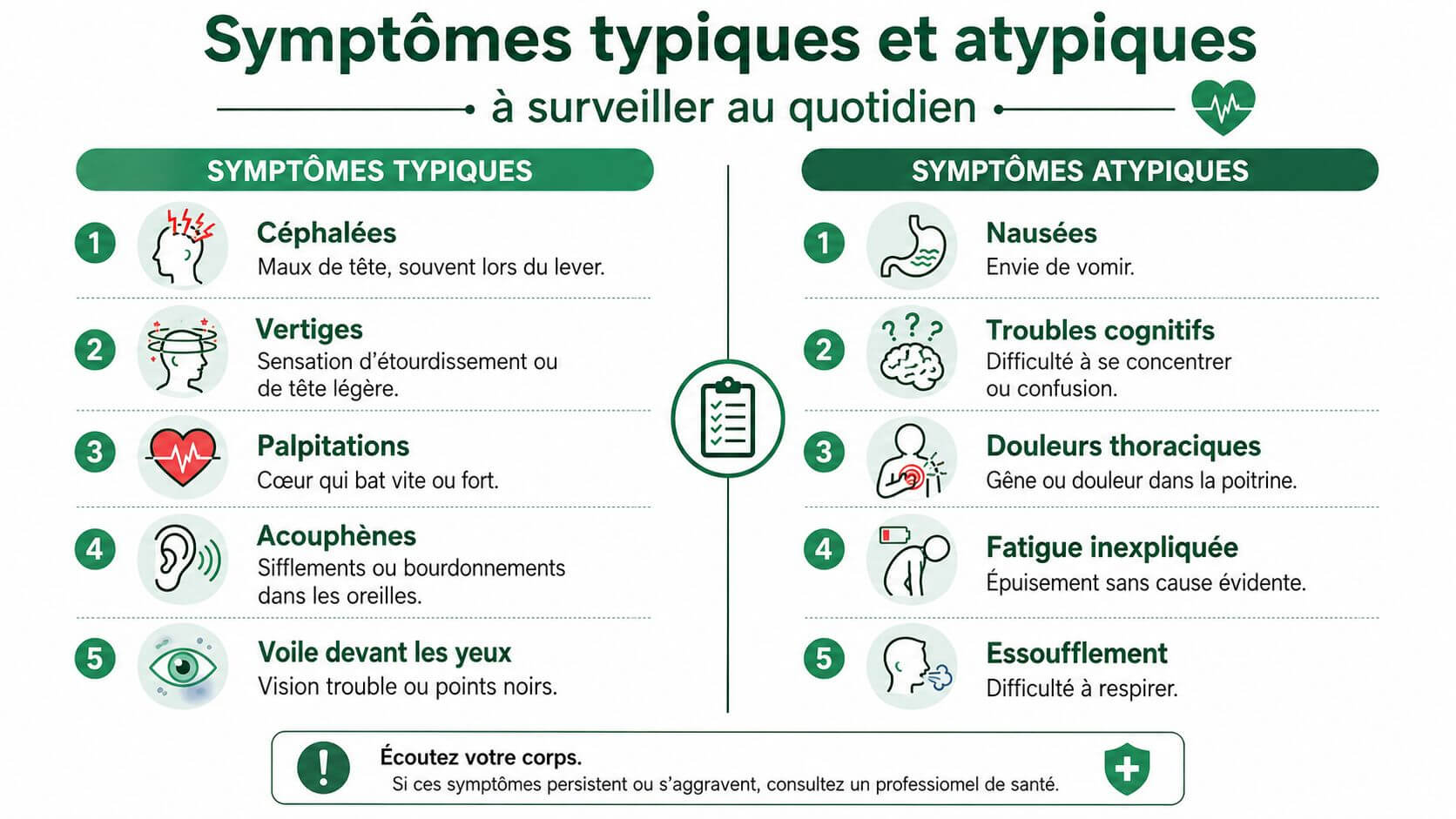
The most telling demonstrations are the dizziness, the dizziness, veil in front of the eyes, the weakness, the cognitive impairment and sometimes the syncope. A French thesis on patients seen in day hospital for falls reports that orthostatic hypertension is most often asymptomatic, but that it may also result in headache, nausea, dizziness and syncopal discomfort, with a symptomatology in connection with a cerebral hypoperfusion (French thesis).
In practice, this may sound like someone simply saying, “My head feels strange when I stand up”, or “I cannot see as clearly for a few moments”. These brief complaints should be taken seriously if they recur on standing, as they often reflect a temporary change in blood flow to the brain rather than a vague feeling of illness without a clear trigger.
We can also hear about palpitations or d-tinnitus. Francophone synthesis cites them as one of the possible signs of orthostatic hypertension, with headaches and dizziness (hospitalo-university French synthesis).
What can guide the family at home
- Headache. They attract attention if they appear at the rise, especially with a feeling of pressure or beating.
- Vertigo and visual veil. They suggest that the brain does not receive the postural transition.
- Palpitations and tinnitus. They remind of a marked sympathetic response, sometimes perceived as a heart that gets wrapped up.
- Nausea or malaiseThey are not trivial if they return immediately after the recovery.
The concrete triggers to remember
Reversible causes are very important in the home. dehydration, the fever, the vomiting, the heat,Prolonged disqualification and especially the medicines These symptoms can be promoted by diuretics, antihypertensive agents, antidepressants, neuroleptics, antiparkinsonian and opiate treatments, as a French clinical resource on orthostatic manifestations (French clinical resource on orthostatic symptoms).
When a sign appears in this context, the right question is not only "what is the symptom?", but also "what changed before it happened?". Unusual heat, too rapid lifting, inadequate hydration or recently modified treatment can explain an episode better than too fast an interpretation.
Do not confuse with orthostatic hypotension or POTS
The most common trap is to mix three different paintings. They all have a connection with the rising, but they do not go in the same direction. One raises the tension, the other causes it to fall, and the third reads above all on the acceleration of the heart.
| Criterion | Orthostatic hypertension | Orthostatic hypotension | POTS |
|---|---|---|---|
| Meaning of variation | Tension Get up to rise | Tension fall to rise | Heart accelerates to rise |
| Dominant symptoms | Often absent, sometimes headache, palpitations, visual disorders | Vertigo, empty head, blurred vision, nausea, presyncope or syncope | Malaise, intolerance to effort, palpitations |
| Chronology | Measurable 1 and 3 minutes after lifting, according to the reference definition | May appear in a few seconds to a few minutes after reorganization | Linked to standing passage and orthostatism |
| Profile | Elderly, polymedic, sometimes hypertensive | Elderly, after bed rest, dehydration, treatment | Orthostatic table with predominant tachycardia |
| Frequent error | Take a headache when you get up for a simple high tension | Believing that malaise necessarily means high blood pressure | Confounding a heart acceleration with a purely tensional problem |
The direction of variation changes everything
I-I-Iorthostatic hypotension is described as a Failure of stand-alone compensation The body does not vasoconstrict quickly enough, the brain infusion decreases, and the patient may experience dizziness, blurred vision, sweating, palpitations, nausea or syncope (Francophone resource on physiopathology and causes). Conversely, orthostatic hypertension corresponds to a postural tension increase, often without any marked symptoms.
The POTS adds another logic. In field practice, heart rate often attracts attention. If the close one describes above all a heart that gets bogged down when rising, comparison with the other two disorders helps to avoid reading error.
Key point: a person who feels bad at lifting does not automatically have a low voltage. The direction of variation must be measured, not assumed.
Why this distinction helps the house and the firm
A misinterpreted symptom may lead to a bad response, for example, to a false reassurance, or on the contrary to overinterpret a malaise as a hypertensive thrust. When the family knows how to distinguish the meaning of the problem, the message sent to the doctor becomes more useful, shorter and more reliable.
Measure voltage at rise and recognize warning thresholds
At rising, a tension that moves too fast can look like an engine that starts badly. The measuring gesture is used to see if the body adjusts to the lying-up passage, or if it goes in the wrong direction. For the comparison to be reliable, it is necessary to measure under conditions close to one rise to the other, as described in the Standardised method reported in the CMAJ.
The simple gesture to reproduce at home
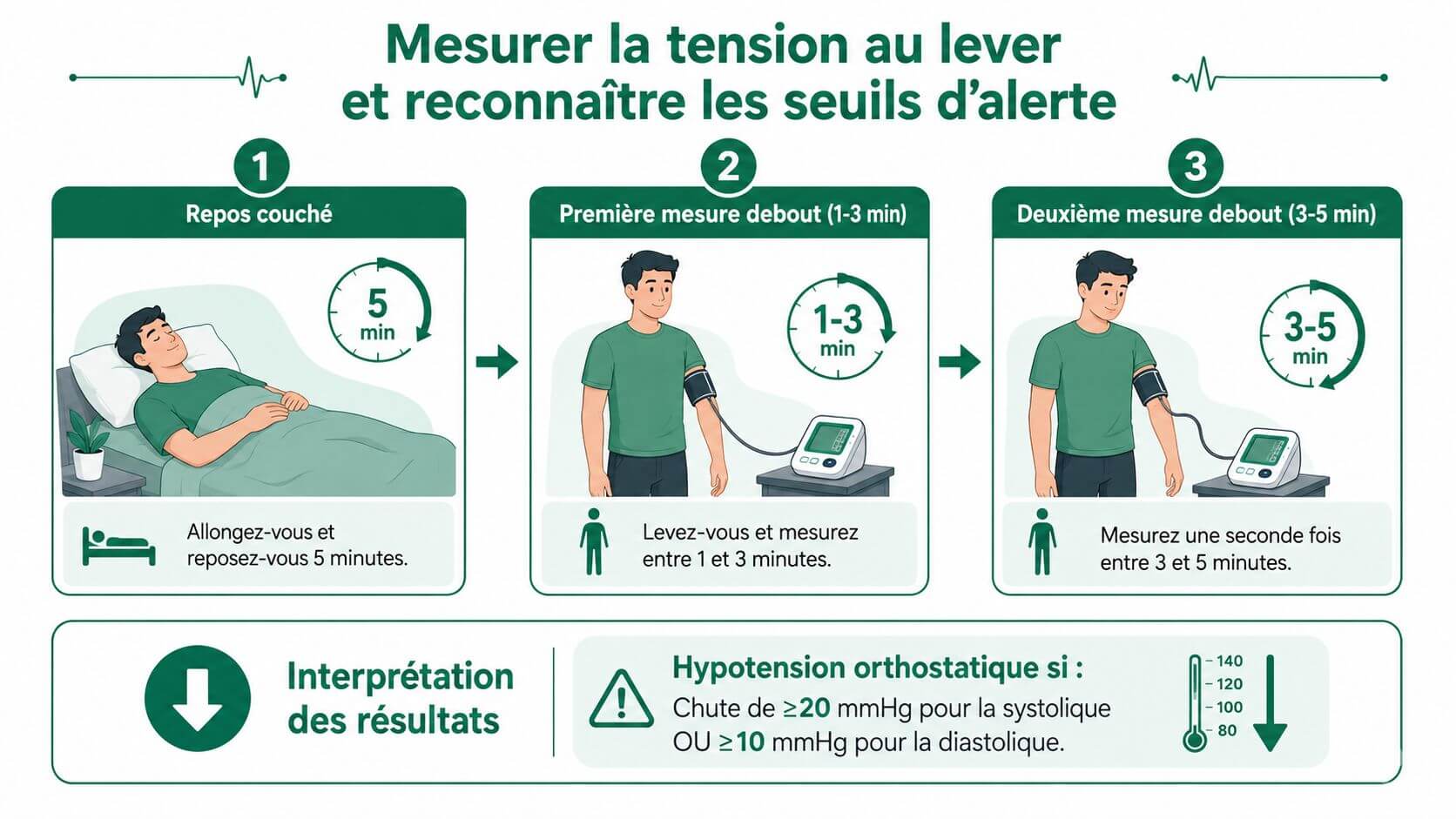
We start sleeping, at rest, without talking or getting up too soon. After a few minutes of calm, we take a first step. Then the person rises, and we remeasure after the installation standing, keeping the same apparatus and the same conditions as possible.
A second standing check helps to see if the tension is normalizing or if the variation persists. It is this going-and-coming that counts, not an isolated number out of context.
The threshold to be knownorthostatic hypotension corresponds to a lasting fall of more than 20 mm Hg Of systolic or at least 10 mm Hg Diastolic after lifting.orthostatic hypertension, the systolic tension rises by at least 20 mmHg between 1 and 3 minutes After the lift. These benchmarks are used to read the meaning of the postural response, not only its absolute value.
What to write in the notebook
The survey becomes more useful when it tells the whole scene. A single value says little, while a value with its context helps to understand what happened at the rise.
It should be noted the time, the starting position, the measured values and the symptoms felt. Vertigo, visual veil, headache, palpitations or simple discomfort when awakening do not have the same range depending on the time of the day, the previous rest or a change of treatment. If you are looking for practical support for this gesture, this guide on home tension can serve as a shared benchmark.
The right pace of monitoring
At home, we monitor more easily after a change of treatment, in an elderly person, or after repeated falls. Apart from these situations, regularity counts more than the accumulation of isolated catches. A single episode is rarely understood without recovery the next day or at the next rise.
The idea is simple, repeat the measurement under stable conditions, then compare. Thus, a malaise at the rise becomes a exploitable information, instead of remaining a memory difficult to interpret.
Coordinate the tribe and caregivers around the constants
At home, the challenge is not limited to taking up tension. Above all, it is necessary to circulate the information between those who observe, those who care, and those who make decisions. One relative sees a malaise at the rise, another knows the medication, the nurse notes a passage, then the doctor sometimes receives only a fragment of the story.
Why the news gets lost so fast
Messages go in SMS, reminders drown in calls, and the paper notebook stays in another room. When connecting a value, symptom and drug intake, one piece is often missing. The decision then comes later, or with an incomplete view.
A reliable follow-up constants, medicines, IDEL passages and daily transmissions are based on a simple point. Everyone has to look at the same information. This is the logic of the care journal, but with a more shared and clearer reading, thanks to a transmission logbook digital as this useful benchmark for organizing exchanges.
What a shared tool is changing in practice
- Dated constants. The voltage measured at rise remains visible with time and context.
- Followed medicines. A forgotten take no longer disappears in the oral memory, it leaves a trace.
- Common agenda. The passages of the nurse, the kine or the doctor no longer overlap by chance.
- Emergency file. Allergies, treatments and key contacts remain accessible when the family is not there.
- Private messaging. Observations do not disperse between several family groups, and Secure health messaging helps keep this information in the right place rather than in text messages or calls that are not found.
Why it counts especially here
Orthostatism requires fine coordination, because a rising symptom only makes sense if it is related to a recent posture, value, medication or change. When the transmission is structured, the family does not need to remember at the same time. It can record, share, and then let the professional decide with stable elements.
When to alert, when to watch, when to adjust
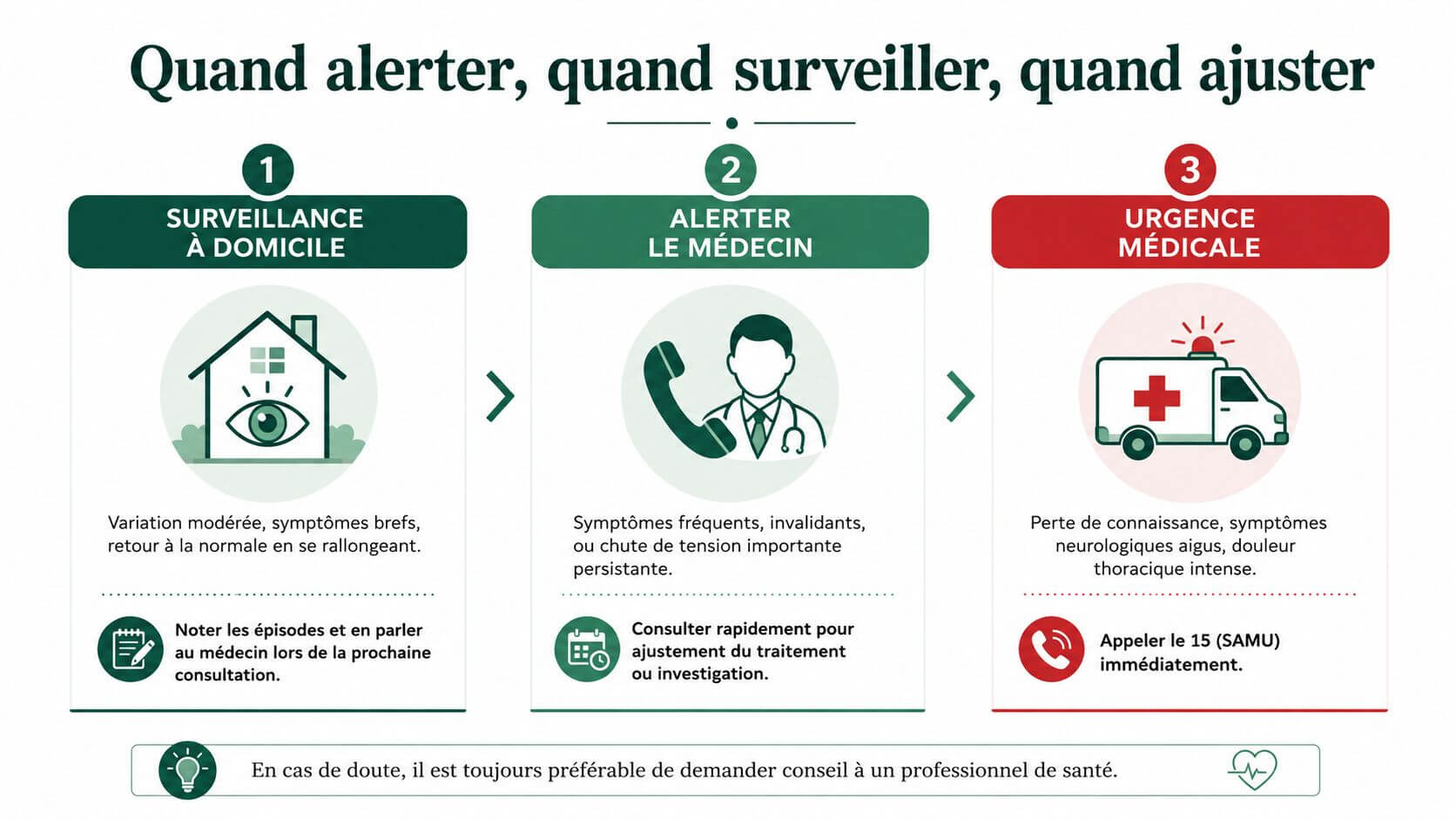
At dawn, the caregiver needs a simple sorting, like a signal light. Green to watch, orange to call the doctor, red to trigger the emergency. The decision is mainly based on the duration of the discomfort, its repetition, its intensity, and on what comes back after having lengthened.
Home surveillance
If the symptoms remain short, the person quickly recovers to an elongated position, and there is no other worrying sign, the home surveillance is adapted. It is then necessary to note the episode, check the hydration, and keep track of what happened to tell the doctor at the next consultation. transmission logbook or a shared tool like a digital transmission notebook helps not to lose the thread between the passages of each.
This step is also used to secure the lifts, especially at night. A chair close to the bed, stable support, and a few seconds of break before standing can limit a new episode.
Alert the doctor
The attending physician should be contacted during the day if the discomforts often come back, become uncomfortable, or if the person does not recover as usual. medicine It is also important to note that some treatments may promote these episodes, as a French clinical resource. The goal is to adjust the management before falls settle.
It is also necessary to warn if the values taken at the rise appear to be consistent with the malaise, but that the situation does not improve despite rest. In this case, the doctor can link the symptom, posture, and recent context, rather than judge for a moment.
Medical emergency
One loss of consciousness, intense chest pain, acute neurological symptoms, or prolonged malaise require calling the 15 I'll be right back. The person must remain lying down if possible, without rising, while preparing the start time of the signs and the values already measured, if they exist.
When the doubt persists between monitoring and calling, it is better to describe precisely what happened than to minimize the episode. The doctor can then sort with facts, as we follow the pieces of a file that must not be lost in several hands.
Install a simple and sustainable routine on a daily basis
The best follow-up is the one that can be done again without exhausting. A useful routine takes few steps. It starts with the measurement at the rise when it is relevant, continues with a clear note of values and symptoms, then ends with a reliable transmission to the family and caregivers.
An easy-to-repetit sequence
Each morning or during a suspicious episode, we follow the same order. First, we observe it rise. Then we measure if necessary. Then we note what happened, including the medications taken, hydration, and recovery after rest.
The most important point is to keep the logic of the useful signal. A figure alone is not enough, nor is it a symptom alone. Together, they draw a much stronger image for the doctor, especially in an elderly, multi-mediated, or fall-prone person.
The role of the tribe around the patient
The patient stays in the center, but he is not alone. Around him, there is often a small tribe relatives and caregivers who must share the same facts at the right time. When everyone sees the same information, the mental load drops, the transmissions become clearer, and home follow-up remains human rather than chaotic.
The most useful thing, in essence, is not to monitor harder. It is to monitor together, with simple gestures, consistent measures and a clear relay to the doctor.
If you are coordinating a parent or patient at home, Tribulys It can centralize constants, drugs, transmissions and alerts in the same place. For a difficult lifting episode, it prevents information from being lost between several relatives, and it helps to prepare a more accurate exchange with the doctor.
Put this organisation into practice with Tribulys
Keep your care journal, shared calendar, tasks, medication tracking and emergency information together. Start for free and invite the relatives and professionals involved in your loved one’s care.