
The complaint often comes at the wrong time. Your loved one gets up from the couch after sitting down, laying his foot on the floor and saying that his leg is "dead". You help him to lean, you observe his step, then the tingling decreases. But if they return to bed, during the walk or always on the same side, the situation deserves a more structured observation.
One fall asleep leg Therefore, it is not always a simple postural inconvenience. For a caregiver, the main thing is to recognize the probable mechanism, note the context, identify the warning signs and organize the follow-up without turning each episode into a source of anxiety.
Contents
- The mechanism of a fallen leg
- Frequent causes of tingling
- Distinguish the benign discomfort from medical emergency
- Relieving and preventing nerve compression
- Coordinate follow-up with the Tribulys application
- Preparing for medical consultation
The mechanism of a fallen leg
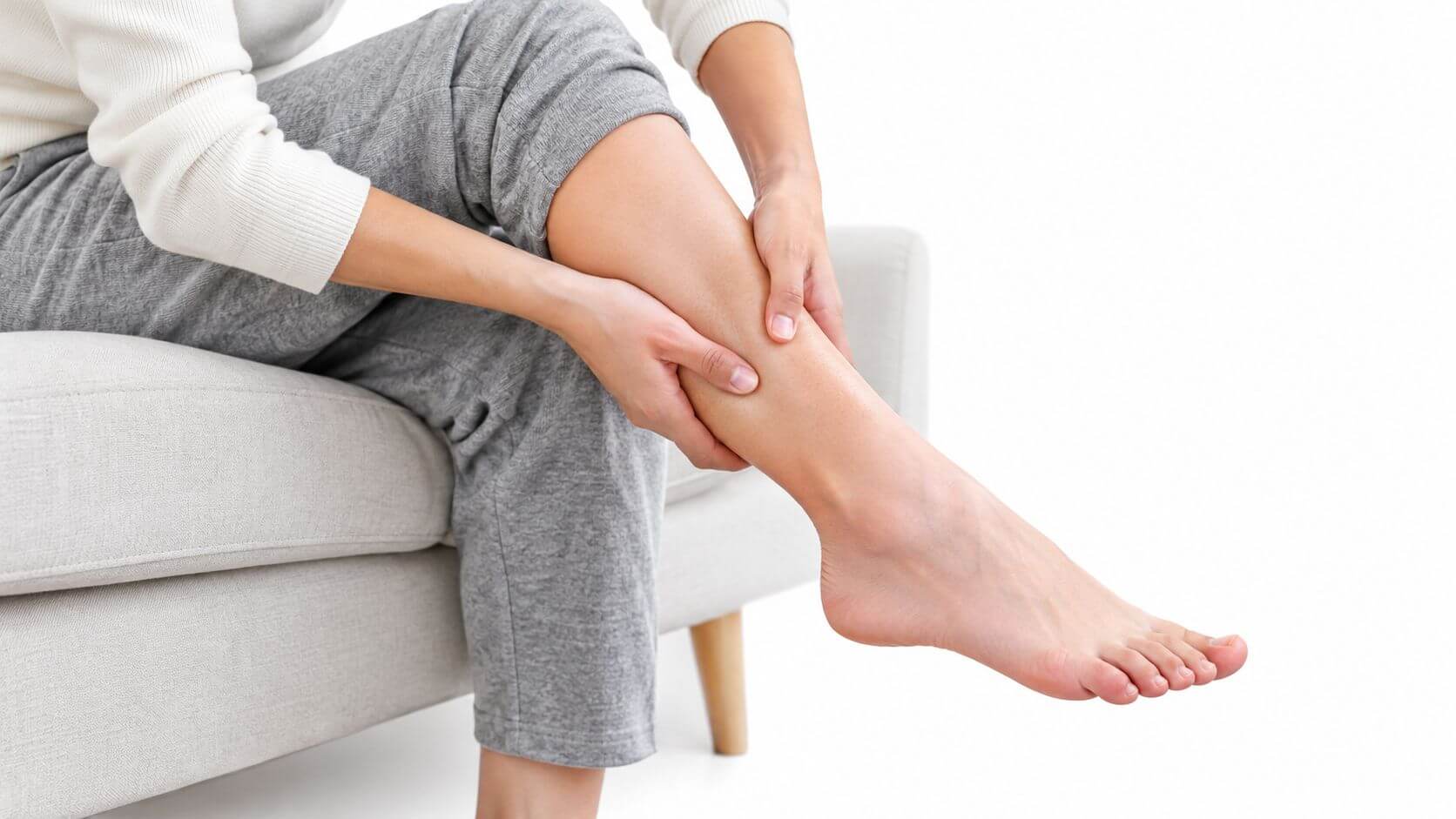
After a prolonged position, your loved one gets up and describes a "cottony" leg. The phenomenon looks like a water hose bent under a piece of furniture. As long as the pressure persists, the passage is less effective. When it disappears, the circulation gradually resumes. Around a peripheral nerve, crossed legs, a squatting station or a prolonged support can disrupt the transmission of nervous messages and its microcirculation. Then appear tingling, numbness or a sensation of vibration, according to this clinical explanation of the positional mechanism.
The course is often recognizable. Sensitivity decreases first, ants occur, then the leg seems to vibrate when the posture changes. In a transient episode, gently move the foot, ankle and limb usually helps the nerve signal to regain its normal functioning in a few minutes.
What the caregiver can check
Start by having the feeling described. Is it a loss of sensitivity, tingling, burning, pain coming down from the back, or a weakness that changes the walking? These words do not mean the same situation. Note also the side concerned, the position at the time of the episode and the time it takes to recover.
Then observe three elements:
- The trigger, does the episode follow a maintained posture or a precise pressure?
- Recovery, do sensitivity and walking become normal again after the change of position?
- Repetition, does the same scenario come back, or does numbness extend and persist?
Practical benchmark: A momentary compression blurs the nervous message like a slightly crushed cable. A leg that remains insensitive, becomes weak or prevents normal walking does not automatically correspond to a simple sleep.
The MSD Manual describes the nerve compression associated with prolonged positions and distinguishes this phenomenon from a more important one. The caregiver does not seek to make a diagnosis. He releases the pressure, secures the lifting, notes the evolution and shares these observations with the relatives or the healthcare professional. A common survey, possibly organized in Tribulys, helps to compare episodes and prepare the follow-up.
Frequent causes of tingling
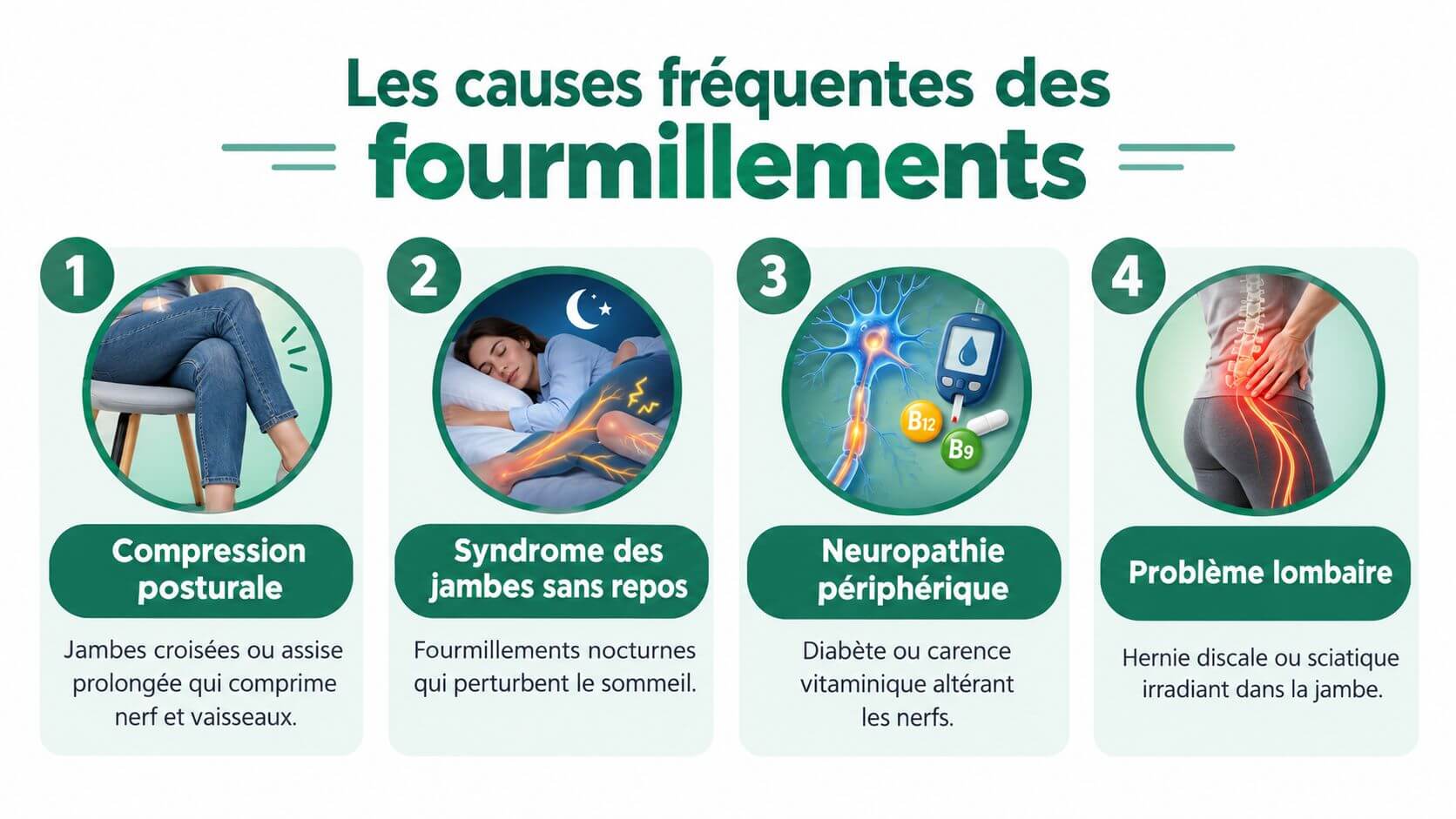
The posture explains part of the episodes, but it is not enough when the tingling comes back in the evening, wakes up the person or appears during the walk. Irradiation from the bottom of the back can orientate towards a sciatica or other spinal disease. A feeling of heavy or swollen legs may evoke a venous problem, while an irrepressible need to move the legs, especially at night and at night, corresponds more to the Restless Legs Syndrome.
Read the symptoms in their context
The French data show why a caregiver has to go beyond the explanation "it's simply not sitting well". A national survey estimated the prevalence of restless leg syndrome over 12 months. 8.5% in adults, with a 95% confidence interval 8.0 % to 9.0 %. She also found 10.8 % of women against 5.8% in men, with an increase in disorder until 64 years, then a decrease in the French national survey published on PubMed.
The following table helps to organize the observations without concluding too quickly:
| Situation observed | What can evoke it? | What the helper notes |
|---|---|---|
| After cross legs or prolonged sitting | Positional nerve compression | Position, duration, side reached, recovery |
| Evening or night with need to move | Restless leg syndrome | Time of appearance, disturbed sleep, relief by movement |
| Pain that descends from the back to the leg | Rachidian or sciatic irritation | Starting point, journey, associated pain |
| Recurring fluctuations at walking or rest | Neuropathy or other medical cause | Frequency, extension, balance disorders |
| Heavyness, swelling or discomfort at the end of the day | Possible venous cause | Leg aspect and evolution in the day |
In the French work on back pain, among people reporting back pain over 12 months, 45,6 % reported radiation to the leg or numbness or tingling of the leg. This represented 17.6% of the total population studied, while sciatica prevalence was 19.2% in men and 17.1% among women Based on the Inserm document on back pain. These numbers do not identify the cause of an individual episode, but they show that leg symptoms may be part of a lumbar or neurological problem.
For a caregiver, the right reflex is to look for a scheme. An discomfort only after a posture usually disappears when the pressure stops. Repeated night discomfort, irradiated pain, modified walking or persistent loss of sensitivity warrants a medical opinion. You can also consult this practical guide on tingling in legs and feet to structure the questions to be asked and the items to be monitored.
Distinguish the benign discomfort from medical emergency
The most useful criterion is not the isolated intensity of tingling. It is the association with other signs, the brutality of appearance, the persistence and the loss of function. A person who quickly regains a normal sensation after having decrossed his legs is not in the same situation as a person who can no longer lift his foot or who has difficulty speaking.
Triage Guide for Caregivers
| Symptoms observed | Emergency level | Recommended action |
|---|---|---|
| Furnishings after prolonged position, disappearance after change of position, no other symptoms | Low, if the pattern remains usual | Reposition gently, secure the walk and note the episode |
| Recurrent numbness, persistent or always on the same side | Medical advice to be organised | Contact the treating physician and prepare a history of episodes |
| Weakness of a limb, devious face, speech disorder or sudden confusion | Emergency | Call the emergency services immediately |
| Numbness associated with urinary disorders or significant difficulty in walking | Emergency | Request a rapid medical assessment |
| Chest pain or respiratory discomfort with leg symptoms | Emergency | Call the emergency services immediately |
| Painful, swollen or unusually altered leg, especially with respiratory discomfort | Emergency | Do not massage the area and request immediate care |
French clinical sources recommend urgent management in case of weakness, speech problems, facial deviation, urinary disorders or chest pain, as these may accompany stroke, bone marrow compression or phlebitis see this reminder on the numb leg and warning signs. The caregiver should not wait until the tingling "passes" if a neurological or respiratory function is reached.
What justifies immediate and urgent consultation
A repetitive episode deserves a rendezvous even if the person does not show any signs of emergency. Note the side concerned, the precise area, time, duration, position, current activity and the possible presence of lumbar pain, weakness or balance disorders. This description helps the doctor distinguish a local compression from a more diffuse nervous problem.
The restless leg syndrome has a particular clue: tingling and impatience appear mainly at night or at night, with a need to move to get relief. This profile is different from a leg that sleeps only because it has been compressed by a chair or position.
Relieving and preventing nerve compression
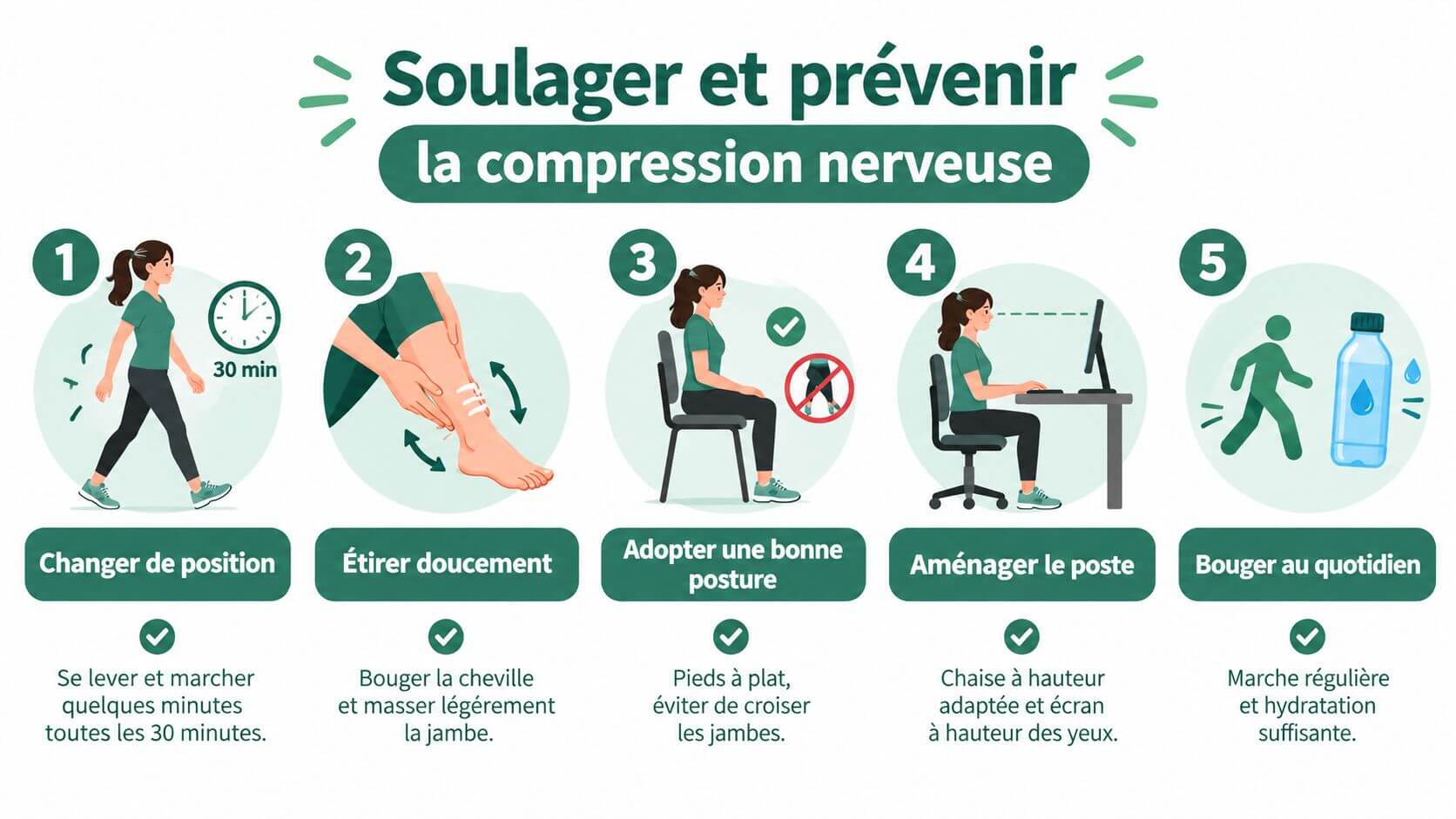
When the sensation appears after a posture, start with Stop compression. Help the person to change position, to lay his feet steady and to rise only if his balance allows it. If he is fragile, use his usual help, ask for a relay and avoid pulling it by the arm.
Mobilize then without forcing. Slow movements of the ankle, a soft bending-extension of the toes or a light massage can accompany the return of sensations, provided that no severe pain, unusual swelling or suspicion of trauma is present. The aim is not to "unblock" the leg by energetic manipulation, but to let the nerve regain normal conditions.
Adapting the daily environment
The most useful adjustments are often simple. A chair that is too low, a hard edge under the thigh, a poorly positioned footrest or a seat that makes it necessary to cross legs can maintain unnecessary pressure. Sickness Insurance recommends correcting gestures and postures in daily and professional activities to prevent nerve compressions. in its ergonomics advice on the prevention of the carpal canal.
For a close seated or bedside, check regularly:
- Feet, placed flat or supported without localized pressure.
- Knees, not held in a cross-position for a long time.
- Headquarters, sufficiently stable and adapted to the size of the person.
- The bed, without hard edge that always compresses the same place.
- The wheelchair, with support and alignment verified by a professional if necessary.
The mobility breaks must remain adapted to the person's abilities. A short accompanied walk, some ankle movements in the chair or a change of support can break a prolonged posture. The Ministry of Solidarity presents home replacement and relaying as respite solutions for caregivers. These relays can also facilitate the organization of regular breaks and mobilizations. in the benchmarks for respite.
Before changing an exercise or using a treatment, ask the doctor, physiotherapist or nurse for advice. Medicines for neuropathic pain can cause side effects, including drowsiness or dizziness, a point discussed in this content on the gabapentin and its side effects.
Place the video in an educational setting, without reproducing a movement that triggers pain:
Coordinate follow-up with the Tribulys application
The follow-up becomes difficult when several people intervene with the same relative. One notes the tingling at breakfast, another observes a hesitant walk in the evening, while a third knows the position that triggered the episode. Without common transmission, these observations remain dispersed and the doctor often receives an incomplete impression.
Tribulys can serve as a coordination support for shared tasks, the agenda, the link book and the health constants. The family members can record a timed observation, assign a task to a family member or an intervenor, and then leave a trace searchable by authorized persons. The platform is presented as an application for family caregivers and home care professionals, with coordination and transmission functions. in this resource Tribulys for family caregivers.
What the application does and does not do
Accuracy avoids bad expectations. constants may record tension, weight, pulse or saturation, but no correlation analysis between these constants and numbness episodes currently exists in the application. There is also no cross-analysis functionality to date.
The Tribulys calendar plans events and appointments. It does not detect a prolonged position and does not automatically warn that a person has been seated for too long. Similarly, no medical advice published with professionals on the specific prevention of nerve compression is integrated into the application.
Shared tasks can, however, be used to organize a pause or mobilization reminder, without automatic detection or medical recommendation. No real return of use on this specific job is available in the current data. The responsible member therefore checks the situation, adapts the action to the instructions of the healthcare team and closes the task only after having completed it.
An example of concrete coordination
A simple organization can follow this thread:
- Record episode, with time, side, position, duration and associated signs.
- Share observation, so that the family and stakeholders can see the same information.
- Schedule appointment, if the episodes repeat or change profile.
- Follow medical recommendation, always distinguishing the planned task from a diagnosis.
The emergency card can centralize allergies, treatments and useful contacts. The care journal keeps the transmissions dated, while the calendar includes consultations and passages. This organization does not replace the clinical examination, but it reduces the risk that a symptom change will remain isolated in a text message or an oral exchange.
Preparing for medical consultation
An appointment becomes more useful when the family brings a specific story. "His leg often falls asleep" hardly describes the situation. A series of comparable episodes helps the doctor to examine possible links with posture, sleep, walking, back, medications or other signs.
The information to be collected
During the days prior to the consultation, note:
- The moment, morning, afternoon, evening or night.
- The side, right leg, left leg or both.
- The area, foot, calf, thigh or ride from the back.
- The context, sitting position, crossed legs, walking, rest or elongated position.
- Duration, until the full return of sensitivity.
- The associated signspain, weakness, imbalance, swelling, need to move or urinary disorder.
- Response to the change of position, with complete or incomplete recovery.
- Treatment and treatment, especially if drowsiness, dizziness or less secure walking appears.
An example makes the transmission clearer: "Tuesday, 20 hours, tingling left foot after 45 minutes cross legs, recovery in 3 minutes after changing position". This note can be entered in the liaison book and shared with the nurse.
Do not modify a drug from these observations. The survey prepares the medical discussion, without allowing it alone to identify the cause.
Transform notes into readable transmission
In a primary link bookenter a short, factual and dated observation. Describe the action and result: "Floating left foot after prolonged sitting, changing position, then walking possible" or "Persistent numbness with weakness, medical advice requested". Write "bad traffic" only if a professional has established it.
Prior to the appointment, combine episodes, mobility tasks performed, past consultations and available constants. An export of relevant transmissions or documents can help to track the evolution, without creating an automatic correlation between the data.
For a person who combines physical activity, back pain and medical follow-up, RacePlan clinical program can provide a framework for discussion of progression and stress-related symptoms. This resource does not replace the professional's assessment of the file.
The notebook must answer three questions: when the symptom appears, under what circumstances it occurs and what happens next. Sudden weakness, speech disorder, facial deviation, chest pain or urinary disorder warrants an assessment without waiting for an ordinary appointment.
Tribulys centralizes transmissions, shared tasks, the agenda, drug intakes, constants and useful documents. The family and stakeholders thus have the same information to prepare exchanges with the doctor and organize the appropriate mobility reminders.
Put this organisation into practice with Tribulys
Keep your care journal, shared calendar, tasks, medication tracking and emergency information together. Start for free and invite the relatives and professionals involved in your loved one’s care.