
You are looking for the right paper at the bottom of a bag already too full, while a message from the nurse waits on the phone, a relative asks you where the next appointment is noted, and another speaker says he has not seen any instructions pass. In those moments, the problem is not the lack of information, it is their dispersion. primary link book offers a simple, readable and stable logic, and this logic can also help to organize a shared home without multiplying calls, duplicates and omissions.
Contents
- Why so many caregivers are still looking for their cues
- Understand what a primary link book is
- Key information to be entered in the book
- Paper book or digital version
- Who writes what in the care tribe
- Choose the right template or template
- Centralize and secure daily monitoring
- Take action and avoid common traps
Why so many caregivers are still looking for their cues
A day of helper often looks like a series of partial alerts. A text message arrives at breakfast, a post-it stays on the fridge, a call is missed during a race, then the notebook in the kitchen is not read by anyone. Each has a piece of the puzzle, but the overall picture is still missing.
The real concern is the flow of information.
When messages disperse, the same instruction can be repeated twice, or not at all. A close friend notes a detail, the home helper understands it differently, and the independent nurse leaves again without the information useful for the next day. Good will exists, coordination remains fragile.
The primary link book then brings a simple rule, a single trace, to the right place, for all the actors concerned. The French public framework recalls that the home liaison book must remain on site, be presented with the consent of the person, and serve as a tool for daily exchange between stakeholders, family and assisted persons. In the first level of school, the same support has long been a stable benchmark, very present in primary school, more rare in high school, and without form imposed by the code of education. Public Service and care journal Frame
Simple Rule, if the information does not have a unique place, it ends up being lost between people who think they have already transmitted it.
In the shared home, this logic works as a common dashboard. Each speaker reads the same version of the facts, as a crew consults the same card before leaving. The logbook then serves as a practical reference, before calling the doctor, before relaying a statement, or before leaving a replacement.
This guide is a step-by-step process. It starts from the school notebook and then shows how to adapt its logic to the everyday life of a home where several people are involved, with clearly distributed access and a possible transition from paper to digital. The goal remains simple, creating a single support point that everyone can read, complete and transmit.
Understand what a primary link book is
At the primary school, the care journal serves as a point of support between the teacher and the family. It gathers useful messages about the life of the school, absences, exits, the behaviour of the child, a request for an appointment or an absence to report. In fact, it mainly avoids blurred transmissions, those that everyone thinks they have given at the right time.
In the shared home, the logic remains the same. The notebook serves as an operational hub for a small team, with a common view of what has been done, observed, decided and transmitted. It does not replace the medical record, a daily free journal, or a simple notepad placed on a table.
The difference can be seen quickly on the ground. The medical file organizes health actions and decisions. The care journal tells more widely during the day. The care journal keeps the trace short, useful and usable by the next person. For a caring relative, it is often the first medium to open before calling the doctor, relaying a statement or preparing a replacement.
A well-kept record may contain a line like, Partly taken meals, marked fatigue, monitoring instructions until the evening. This type of writing goes right to the goal, without forcing the reader to recompose the situation from scattered fragments.
If you are looking for a concrete basis to start, this guide on the Home Help care journal in PDF shows how to structure a single and legible support.
Good reflex, if a passing intervenor understands the situation in a few lines, the notebook already fulfils its function.
His interest is also due to his discipline. A useful notebook keeps information dated, short, hierarchical, and then easily taken over by the next person. When he mixes too many subjects, he loses his readability and complicates coordination rather than facilitating it.
Key information to be entered in the book
A well-thought-out notebook begins as a shared kitchen dashboard. Everyone quickly finds out what to do there, without pasting scattered pieces of information. primary link book The priority is the same, to make the relay readable right away.
The first headings serve as a stable reference point. The identity of the person, the useful contacts, and then the information that avoids the basic questions at the time of the passage are recorded. Then come the elements that change from day to day, because this is where the continuity of the follow-up is concerned.
Headings that save time
In a shared home, the main categories remain simple to set.
- Identity and useful contacts, to know who to call first.
- Current and hourly salaries, to avoid oblivion or duplication.
- Observations of the day, for example on general condition, appetite, hydration or sleep.
- Highlights, like a fall, an inappropriate appointment or an unusual change.
- Each speaker's instructions, so that the relay is clear.
- End-of-pass transmission, to leave a legible trace before the next speaker.
The support works better when the headings are already placed. As shown in the Spced model, a structured notebook offers inside pages divided into predefined headings, such as absences, advice or observations, with also detachable bulletins for the school calendar. The logic is transposable to the daily of a shared home, as it reduces hesitations when writing and rereading. Examples of primary link books.
A good card does not try to tell everything. It keeps what helps the next person to act without interpreting.
What changes in digital version
The digital switch adds mostly traceability. Inputs can be timed, sharing becomes instantaneous, and some tools allow to add reminders or visual parts such as wound photos. In return, you have to write more synthetically, because a poorly filled screen remains as untapped as a draft page.
Useful method, a line must say what has been observed, what has been done, and what remains to be monitored.
For an already transmission oriented tooling, a support like the transmission logbook helps to think the headings according to the logic of relay passages, which avoids confusing useful detail with information overload.
Paper book or digital version
The support is chosen according to the daily life of the home. paper book remains very simple to take in hand. digital version becomes more useful when several people intervene at different times and you have to find information without reading the entire file.
Compare without bias
| Criterion | Paper booklet | Digital version |
|---|---|---|
| Daily access | Very direct, placed at home | Shared at a distance, searchable according to rights |
| Technical dependence | None | Need for a reliable device and access |
| Search for information | Reading page by page | Quick search in history |
| Change tracks | More difficult to follow | Simpler time stamping and history |
| Risk of loss | Higher | Reduces if data is saved |
| Adapted to helpers not comfortable with digital | Yes | Variable depending on the ease of each person |
The paper is suitable for morning gestures, an evening instruction, or a quick note left to the nurse at 7:00 a.m. It is taken as a board of display placed in the kitchen, everyone sees what has been written, then the relay can go back without searching for a password.
Digital is useful if the on-call physician consults late, if an episode of fever is to be noticed quickly, or if the team wants to find a change of treatment without delay. In this case, the screen plays the role of a common notebook, but with easier entries to find and share according to the access rights.
Digital structure, it does not replace exchange
A digital tool does not do relational work instead of people. It gives a framework, tracks actions and limits them. But the follow-up remains solid only if the messages are clear and everyone respects the same writing discipline.
The right support is not the one that does the most, it is the one that the whole care tribe really uses.
The choice must also remain consistent with the format. A shared spreadsheet must not become a false notebook, and an application must not reproduce too heavy forms. The support imposes its logic, and the correct model follows this logic instead of contradicting it.
In a shared home, this consistency also helps to establish a simple governance of access. Who reads, who writes, who validates, and when the shift from paper to digital remains useful for the group.
Who writes what in the care tribe
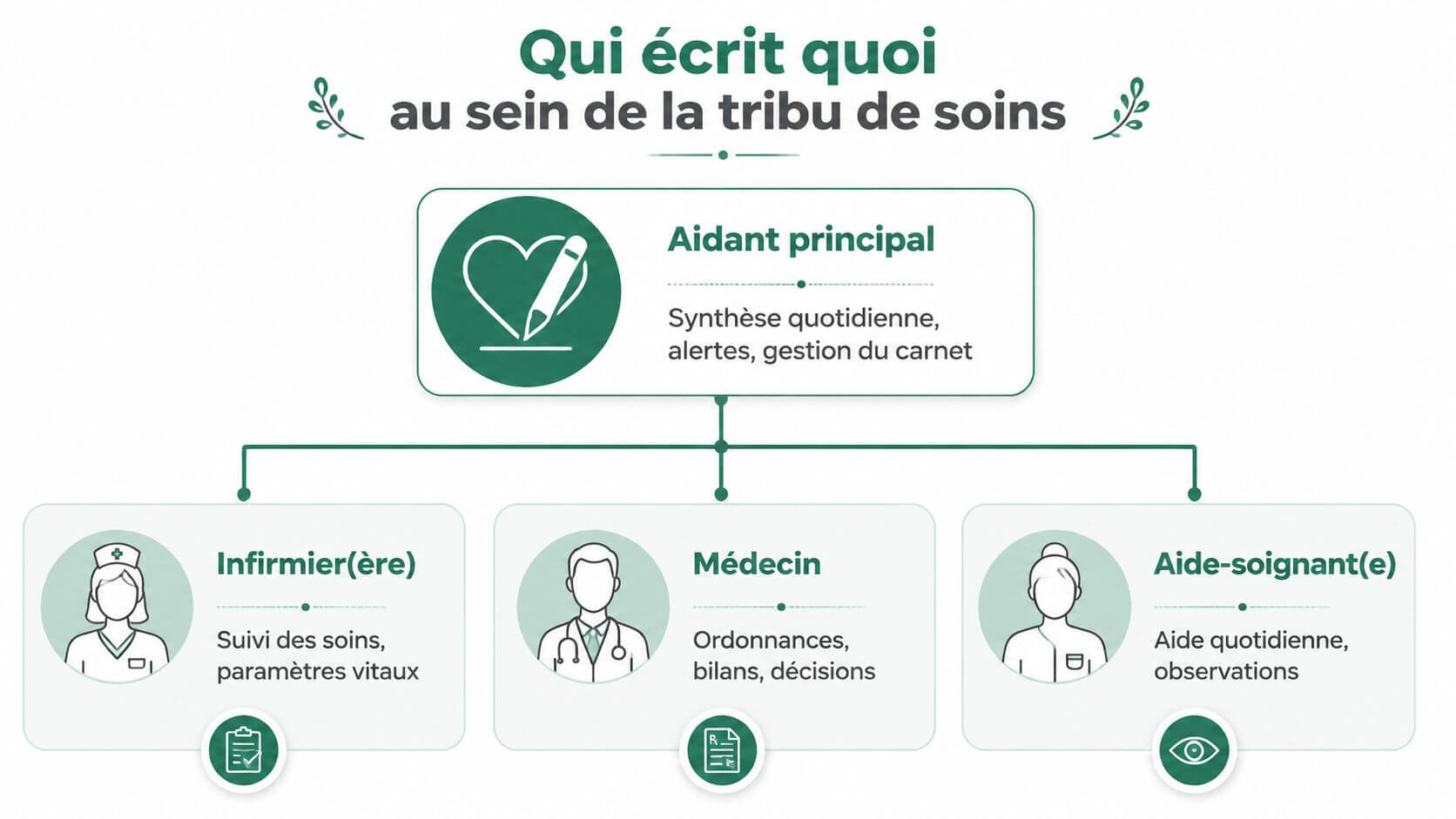
When more than one person intervenes, the accountability of each input becomes the main issue. Each person writes at his/her level, depending on what he/she sees and decides, so that the relay is readable for the next person. The notebook then functions as a shared dashboard, where each note has an author and an implicit recipient.
Divide roles without walking on
| Role | What he notes most often | What's his track for? |
|---|---|---|
| Principal Helper | Daily summary, alerts, coordination elements | Give the overview |
| Nurse | Constants, technical care, observation | Follow care actions |
| Home help | Humor, food, mobility, daily incidents | Making the experience of the day visible |
| Treating physician | Decisions, adjustments, medical priorities | Setting the clinical course |
| Extended family | Specific information, visits, constraints of presence | Complete without scrambling |
The mini-scenario is speaking. At 7 a.m., the caregiver notes a tension taken and the general condition of the morning. At 9 a.m., the home care worker reports that the breakfast was taken correctly. At 12 p.m., the son transmits to the caregiver a useful detail about the night. At 6 p.m., the principal caregiver summarizes what to watch before the next day.
This type of distribution avoids messages written with multiple hands in the same space. Each one keeps its area, as in a shared house where each room has its use. The notebook remains legible because the roles are laid in advance, including when tracking moves from paper to digital with differentiated access.
The principle to keep in mind is a simple formula, an info, an editor, a target reader. This framework limits duplication and reduces the risk of a useful directive being lost in a secondary remark.
A clear sentence is better than a long exchange
In a well-kept notebook, one writes for the person who takes over, not for himself. So one must point out what changes, what deserves attention, and what calls for a precise action. The rest often has its place elsewhere.
Choose the right template or template
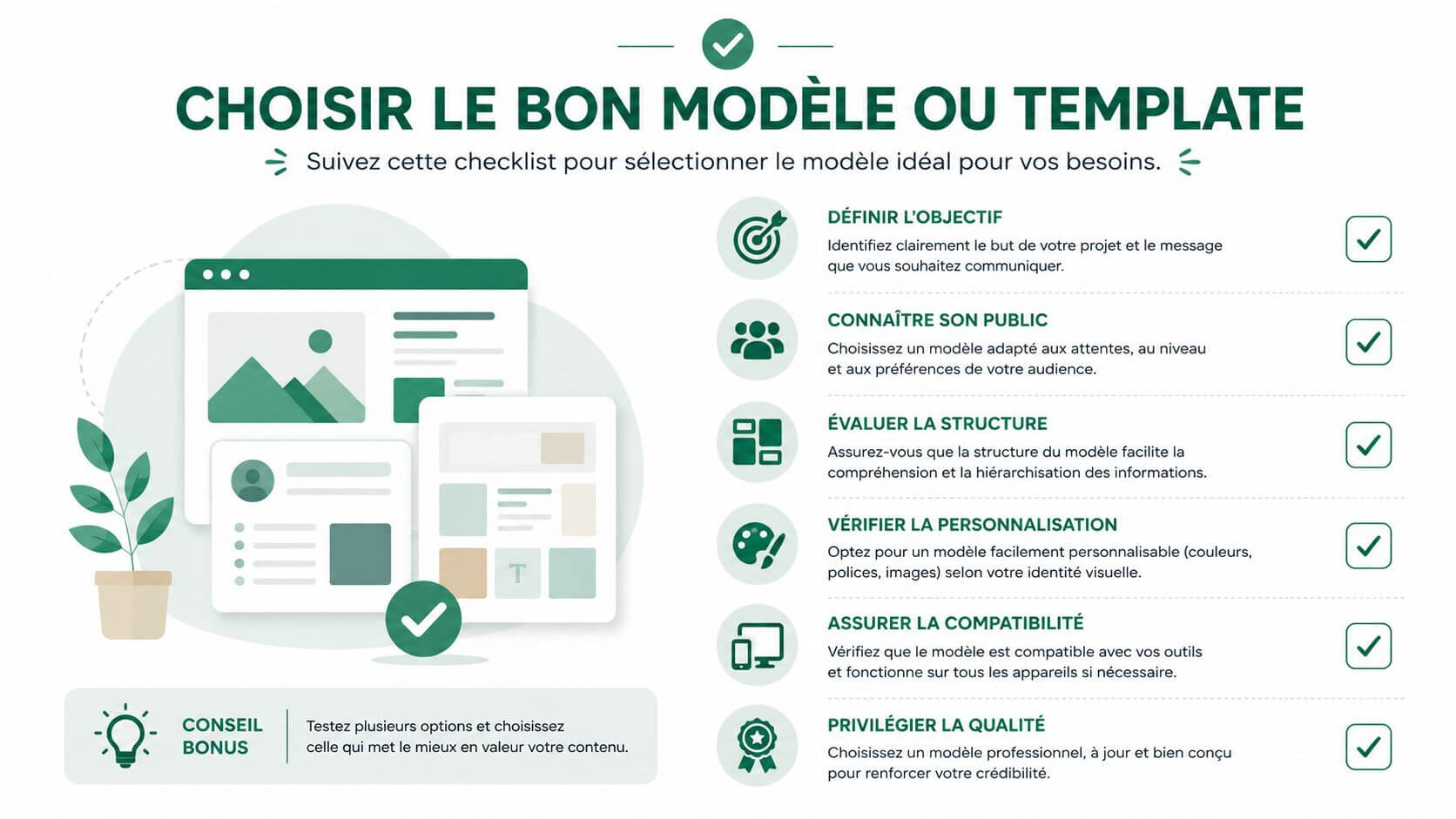
The right model depends on the actual configuration of the home. The number of participants, the frequency of crossings, the level of technical care, the confidentiality constraints, or the presence of a vulnerable adult do not require the same format. A practical model is not necessarily the most comprehensive, it is the one that leaves room for the right information without overloading people.
Three formats that often come back
- A5 spiral paper format, with preprinted boxes. It works well when usages are simple and users want to write fast.
- Shared spreadsheet, with timed columns. It helps centralize short and readable transmissions at a distance.
- Dedicated application, with appointment modules and alerts. It is best suited when coordination is frequent and updates need to travel fast.
For an example of a digital solution structured around shared home follow-up, Tribulys proposes a Shared link book With dated entries, alerts and differentiated roles, this clearly illustrates the logic of a tool designed for family and professional coordination.
Points of vigilance before deciding
A too generic template often forgets the constraints of the field. It is also necessary to check the compatibility with the GDPR, predict a degraded mode if the digital fails, and keep a structure simple enough to be understood from the first visit. If the replacement person takes more than two minutes to find what they are looking for, the model is probably too heavy.
The correct format therefore depends less on the taste of the team than on its ability to maintain regularity. If several people have to write and read every day, it is better to have a sober, direct, and easy to repeat model without long training.
Centralize and secure daily monitoring
Centralisation consists in defining a main repository, known to all, with access and updating rules. It is the dashboard of the shared home, where everyone knows where to look and what to complete. Without this framework, messages are dispersed, forgetfulness is multiplied and follow-up is lost in reliability.
Three possible levels of centralization
The first level remains the single physical folder at home. Everyone knows where he is, who can read it, and when to open it. This solution often suffices when the speakers pass on the spot and the information circulates mainly in the presence of the person receiving care.
The second level is based on a shared folder online, like a family cloud space or a shared spreadsheet. It allows you to consult remotely, keep a continuity between two passages, and archive more properly. The vigilance then relates to the rights of access and the quality of what is entered.
The third level corresponds to a coordination implementation related to family or professional supervision. It becomes useful when you need to assign roles, trace accesses, and maintain the history of changes. In all three cases, the same logic applies, limiting the data to the necessary, reserving access to the data subjects, and keeping a clear record of who wrote what and when.
Secure without complicating
The GDPR requests that only what is useful be retained, that health data be protected with appropriate solutions, and that the consent of the persons concerned be respected. In practice, this means avoiding multiple copies, not mixing sensitive information with unsecured tools, and choosing a separate channel for more sensitive exchanges, such as a Secure health messaging.
Good reflex, the larger the tribe, the more it takes a support that leaves a clear trace and a readable access rule.
Concrete example. A independent nurse consults the notebook before she passes, a home care worker notes what she observes in the afternoon, and an adult child at a distance reads the evening summary again to prepare the next day. Each acts within its perimeter, without encroaching on that of others.
Take action and avoid common traps
The transition to action takes place in a few steps, provided they are done in the right order. First choose the format, designate a reference book, fix the essential headings, then train each speaker to his/her role. Then, put in place a weekly review and a monthly archive.
Operational checklist
- Choose a clear format, paper or digital, depending on actual usage.
- Designating a book reference, responsible for verifying that the support remains alive.
- Defining essential headings, without drowning the page in detail.
- Train each stakeholder in their role, to limit duplication.
- Set an update frequency, so that the notebook does not become decorative.
The most frequent errors and their correction
The first trap is the single book never read. The patch consists of setting a mandatory reading moment, for example at the beginning of the passage. The second is the accumulation of information without sorting. There, you have to prioritise, summarize, and move the long elements elsewhere.
The third, more sensitive trap is the mixing of sensitive medical data into an unsecured tool. The patch passes through a suitable medium and limited access. You also need to update the emergency coordinates and transmit the notebook during a hospitalisation, otherwise the relay breaks.
- Alert signal 1conflicting information between speakers.
- Alert signal 2, loss of the notebook or inability to access it.
- Alert signal 3, the refusal of a helper to use it because it is too complex.
An imperfect but regularly kept notebook is better than a sophisticated tool abandoned after a month.
Tribulys centralizes the care journal, transmissions, schedule and follow-up of drugs in the same shared space, with differentiated roles and dated traces. If you coordinate a close relative at home and want to switch from scattered exchanges to clearer follow-up, go see Tribulys and compare its functioning with your current usages.
Put this organisation into practice with Tribulys
Keep your care journal, shared calendar, tasks, medication tracking and emergency information together. Start for free and invite the relatives and professionals involved in your loved one’s care.