
In France, 217 100 burglaries Main and secondary residences were still recorded in 2023, i.e. 595 break-ins per day or one every 2 minutes and 25 seconds. In this context, installing an alarm itself is nothing like a handyman's gadget, it is a concrete arbitration between Cost, responsiveness and usability reliability. When the housing is standard, the wiring is not already in place, and you want to go fast without paying for a full installation, the well-set wireless kit holds the road very well.
The real subject is not just to place sensors. What makes the difference in everyday life is placement, radio range, management of false alerts and testing discipline after installation. A well-configured alarm dissuades because it is visible, audible and consistent in use, not because it promises theoretical security.
Contents
- Why install an alarm yourself in 2026
- Choose the right kit and prepare your equipment
- Place the power plant, detectors and siren
- Configure application and notifications
- Avoid false positives and make installation reliable
- Actual cost of DIY and when to switch to remote surveillance
- Maintenance, updates and legal issues
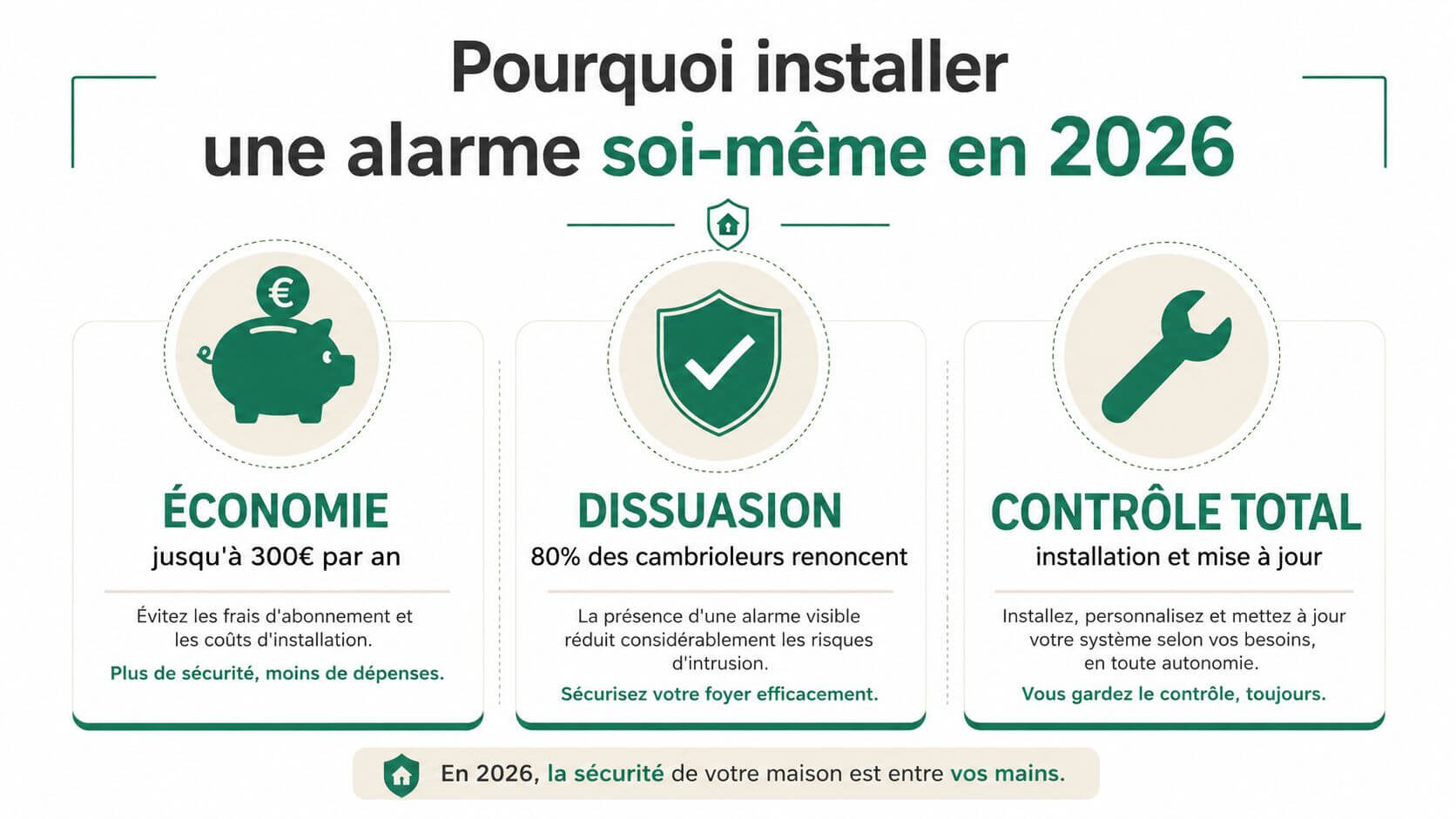
Why install an alarm yourself in 2026
The first argument is simple, the risk still exists, and it remains massive. The Ministry of the Interior has identified 212 100 housing robberies in 2025, down by 3 % compared to 2024, but the volume remains high, which is enough to justify serious domestic protection. The alarm does not remove the risk, it attacks it where it is most sensitive, when the intruder chooses its target.
The data relayed by specialised media are in the same direction. 13 % the risk of a house being chosen, 47 % the risk of entry by break-in for Apartments, of 34 % for the housesand of 58 % The probability that a burglary will succeed when it is present. In other words, the equipment is not decorative, it changes the behaviour of the burglaries.
A useful DIY, not a tool collector gesture
Self-installation becomes credible because it responds to a very French constraint, mastering the budget without sacrificing the level of protection. For an apartment, a house on the ground floor, or a dwelling where you want to cover first the most exposed accesses, a well-sized wireless kit is often enough. The installation itself also allows you to adjust the system to the reality of the land, rather than to a generic scheme sold by default.
Practical rule, If the alarm often triggers for bad reasons, the home bypasses it. If it gets forgotten until the day it serves, it fulfills its role.
The DIY quickly reaches its limits as soon as the housing multiplies annexes, secondary access, dependencies, or as a result of 24/7 telemonitoring becomes a real need. In these cases, the question is no longer whether the equipment can be placed, but whether a high level of reliability can be maintained over time.
Choose the right kit and prepare your equipment
Before you pull out the drill, you have to frame the need. wireless is suitable for most DIY housing because it avoids cable passage, while a system wired becomes relevant especially in a configuration already thought for him. The right choice depends less on the product sheet than on the housing plan, the access to be monitored and the time that is agreed to be spent on setting.
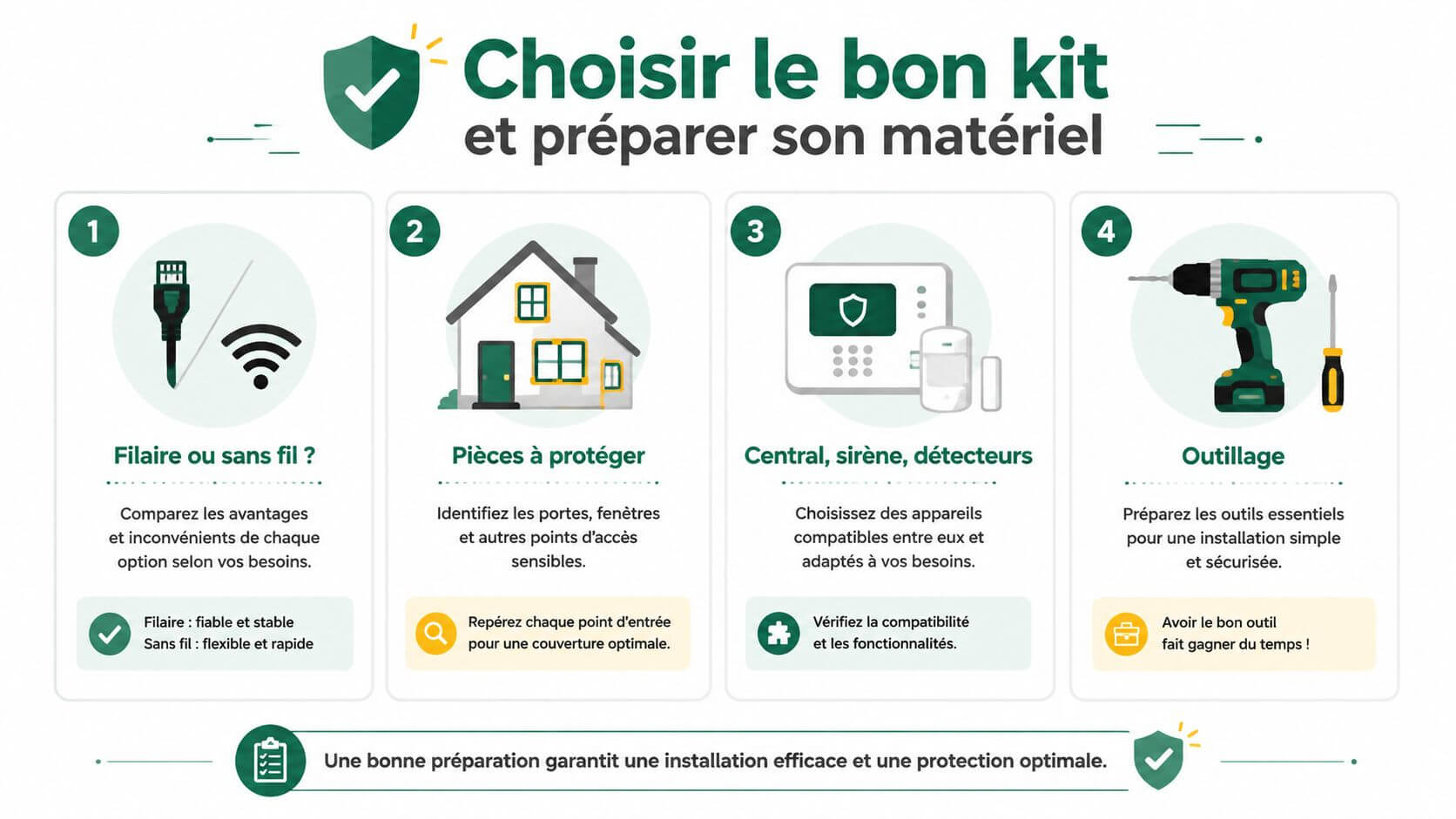
The budget also counts in the arbitration. A French price guide estimates the average cost of installing a house alarm to 1 400 €, with a range of 400 € to 3 500 €, while a wireless kit placed itself starts around 500 €. The contrast explains why many households first look at the DIY, especially when they want to keep their hands on the initial investment. Moreover, the detail of the items of expenditure deserves to be compared before purchase, including via a request for quote for home alarm.
The perimeter to cover first
Starts with the entry points. Entrance door, service doors, low windows, window window, accessible Velux, adjoining garage, everything that offers a quick passage deserves priority coverage. If the accommodation has animals, it is necessary to check that the motion sensors accept a setting or immunity compatible with this presence, otherwise false alerts arrive quickly.
Connectivity deserves the same attention. For a secondary residence or an intermittent dwelling, the presence of a GSM backup is much more reassuring than a simple Wi-Fi. When the domestic network falls, the alarm should not become silent.
The list of materials to be prepared
A clean installation is based on few tools, but you have to have them before you start.
- Adapted drills and drills, for full walls, partitions or support of the mermaid.
- Bubble level, indispensable to place a straight plate and avoid poorly aligned sensors.
- Adapted horses and screws, Because a placo doesn't treat itself like brick.
- Precision screwdriver, useful for enclosures and small attachments.
- Stable staircase, especially if the siren or a detector has to rise up.
- Dry hair and masking tape, practical for pre-drilling tracking.
One last point deserves to be taken seriously. The radio range announced by the manufacturer almost never corresponds to the useful range once the bearing walls, the metal and the real obstacles come into play. It is better to predict wide, then check sensor by sensor, than to build a theoretical plan too optimistic.
Place the power plant, detectors and siren
Physical laying must follow a logical order. Central is first placed in a central, discreet place, and close to an area power supply. It must remain easy to reach for maintenance, but not visible at first glance from the outside.
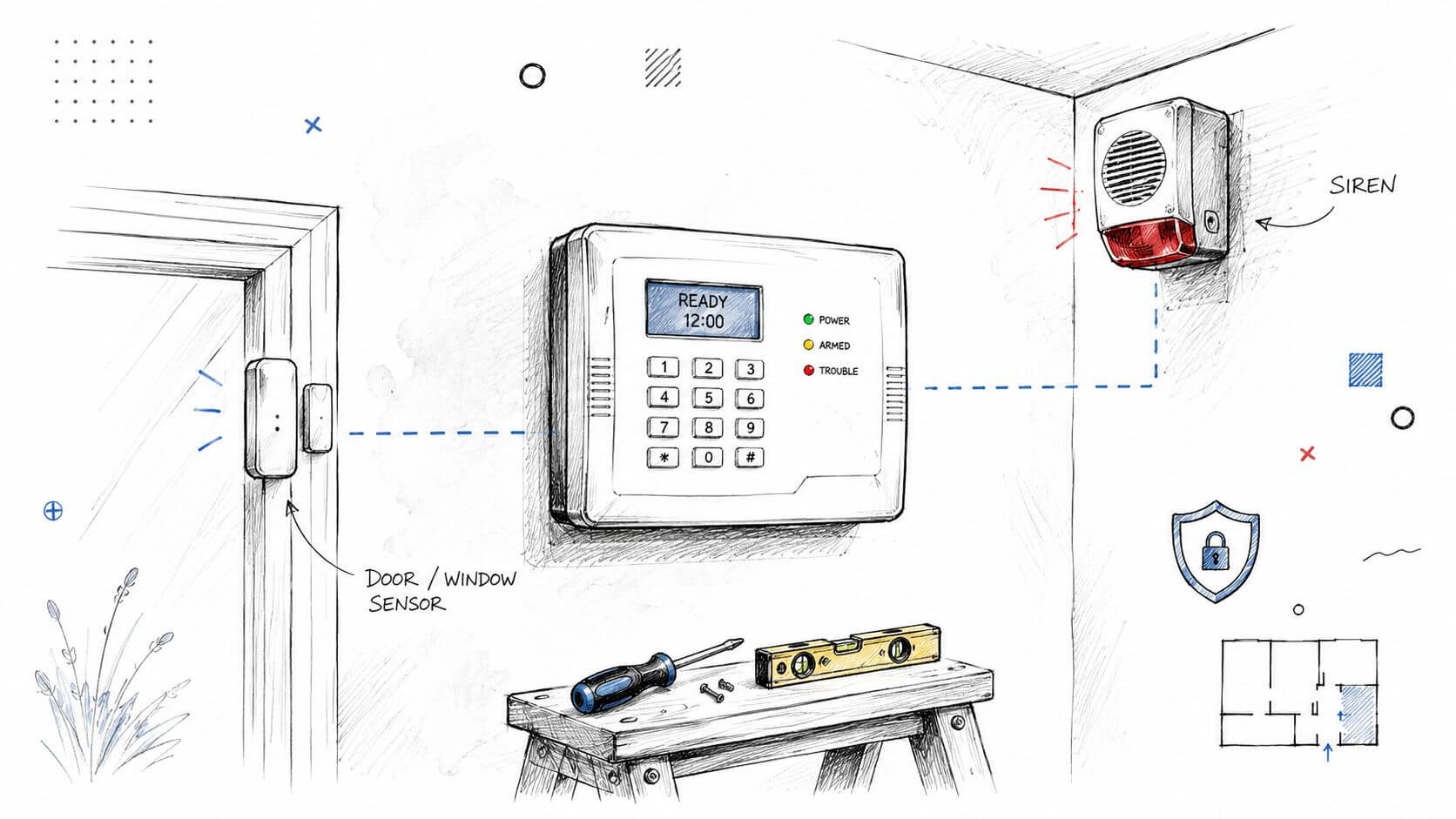
The opening detectors then come. They sit on the exterior doors and windows, respecting the alignment between the Sleeping andopening. A gap of about 10 mm is recommended to ensure reliable interlocking, and one must avoid the near, because a well-positioned but poorly aligned sensor ends up missing the actual event.
The right placement for motion sensors
The French tutorials recommend the installation of motion detectors to 2 to 2.5 m high. This height allows to cover the passage without putting the sensor too close to the ground, where small animals and some moving objects complicate reading. You have to target the corners of the main rooms, not the middle of a hazardous corridor.
Avoids heat sources, radiators, bays that are very exposed to the sun at the end of the day, and areas where a curtain can move with a simple current of air. The sensor must not see an unstable scene, it must see a clear human passage.
Insert the batteries before closing the case. This detail seems trivial, but it avoids remounting an element already attached to the wall.
The mermaid stands in height, audible from the outside, but difficult to reach without a ladder. If it is wired, it is necessary to provide a discreet and protected cable passage, because a wire too visible becomes a useless weakness. The aim is not to make pretty at all costs, but to make the access complicated for someone who wants to neutralize the system quickly.
The assembly always ends with a complete visual control. Use the bubble level for the wall plate, check that the screws do not pass through an electric sheath, then test the openings and movements in real conditions. An alarm that has not been tested piece by piece remains a promise, not a safety device.
Configure application and notifications
Once the hardware is fixed, the software configuration determines the user comfort. Download the manufacturer's application, create the account, and then associate each accessory one by one. Most often, the pairing is done with an association button or QR code, and it must be done calmly, zone by zone, without burning the steps.
The name of the elements changes every day. An entry called Entrance door, a window named Glass bay living room, an identified sensor Garage Avoid confusion when the alert falls on the phone. A clear message is better than a list of anonymous devices than anyone reads again.
Scenarios and rights of access
The user codes must be differentiated from the beginning. The main code is for the administrator, another can be created for a relative, and the temporary codes are very useful for a craftsman or a point worker. When the person leaves, the code goes with him.
Push notifications must be activated on the smartphone, then tested in real life. An alert that arrives too late, or never, breaks confidence in the system. If the power plant proposes a Emergency GSM, it is better to activate it for situations where Wi-Fi is cut off, especially in an unoccupied dwelling.
Choosing the right warning modes
The total mode remains the simplest for absences. Partial mode works better at night, when you want to preserve the internal traffic without deactivating the entire system. A silent alert, relayed to a trusted relative, may also be suitable in some dwellings, but it only makes sense if someone is actually reachable.
The most important thing remains the consistency between the intended use and the actual configuration. An overly complex system often ends with functions never used. A sober, well-named and well-notified system is much more reliable.
Avoid false positives and make installation reliable
False alerts are not technical details. They destroy the trust of the home, irritate neighbours and sometimes cause useful sensors to be deactivated. Classic causes are known, such as moving curtains, air passage, direct heat, humidity, sensors too close to an obstacle, or radio range degraded by a carrier wall or metal plate.
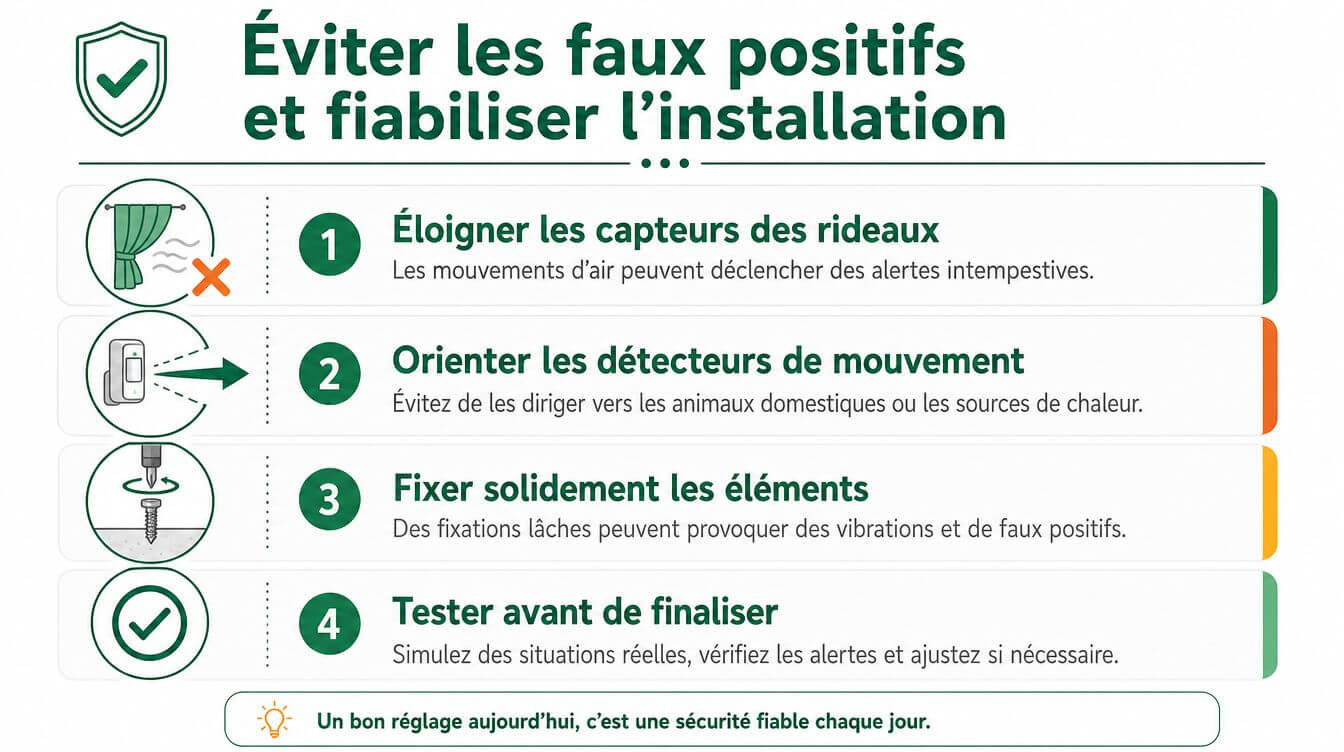
The technical guides also remind that a self-installed kit requires development. Between radio obstacles, heat sensitive areas, sensitivity settings and the manufacturer's test mode, one is closer to a fine setting than to a simple installation. This is where many projects are played, not when screwing the first sensor.
Test before trusting
Opens every door once. Walks in each room with different trajectories. Checks that each notification is coming well, and looks at the actual latency between triggering and receiving on smartphone.
The test must not be symbolic. It is necessary to simulate the uses of everyday life, then observe what triggers wrongly. If a sensor reacts to a curtain or a source of heat, it must be corrected immediately, not in three weeks.
Simple method, A small trigger log helps to identify recurring problems. It is quick to see whether the problem comes from a precise sensor, area or bad habit of use.
The siren has a very concrete role in the security chain. 8 out of 10 burglars check the presence of an alarm before taking action, and the triggering of the siren would often cause the intruders to leave the scene in less than 2 minutes. This behaviour only has an effect if the system sounds for good reasons, at the right time, without turning into a poorly adjusted comfort alarm.
Actual cost of DIY and when to switch to remote surveillance
The DIY is profitable only if one looks at the total cost, not only the price of the box. A wireless kit purchased and installed itself limits the initial expense, while a telesurveillance formula adds a recurring subscription and, often, a more complete service logic. For a home that primarily wants to protect access to simple housing, the first scenario generally remains the most rational.
The average monthly subscription for a house alarm in France is announced around 30 €/month, which explains the attractiveness of the kits for those who want to master the starting budget. The right reflex is to compare the cost of entry, maintenance, and the level of intervention expected in case of alert, rather than focusing on the only price displayed at the time of purchase. The detail of the subject deserves to be compared with a home alarm rate before you decide.
Concrete arbitrators
| Criterion | DIY, wireless kit | Remote monitoring |
|---|---|---|
| Initial budget | Weaker, especially if you pose yourself | Often higher at the entrance |
| Subscription | Not mandatory | Recurrent, with associated service |
| Autonomy | Strong, but based on configuration | More framed |
| Human intervention | Limited to the user and close friends | More direct depending on the supply |
| Adaptation to housing | Very good for a simple plan | Interesting for complex cases |
The tipping becomes relevant faster in a large house with outbuildings, separate garage, or intermittent use. As soon as it is necessary to manage several access points, remote areas or further human follow-up, the hybrid or professional solution often takes the advantage. For a well-covered studio, apartment or single-storey house, the DIY usually remains the best ratio mastery, simplicity and cost.
Maintenance, updates and legal issues
A reliable system is maintained. The simplest way is to test a different detector each month, replace the batteries before winter if the equipment requires it, and check the battery life of the power plant in case of power outage. The manufacturer's application must also be updated as soon as possible, because an old firmware sometimes ends up creating delays or incompatibilities.
Points not to be overlooked
- Test regularly, to verify that a sensor has not de-aligned.
- Watch the batteries, Because a weak light always comes at the wrong time.
- Update the application, in order to maintain reliable notifications.
- Prevent the neighbourhood, if repeated tests are likely to lead to a real intrusion.
In legal terms, it is also necessary to check the local rules before installing an external mermaid, especially in condominiums or according to the applicable urban planning regulations. When cameras are associated with the system, the reporting and information obligations of the persons concerned must be carefully looked at. A good reflex is to reread the practical consequences of a forced door and insurance coverage via useful markers on the forced door and insurancethen keep track of the settings and tests.
In the end, a system that lasts in time is based on four simple gestures. Test, update, replace what is fatigued, and never let a false alarm settle down like a habit.
Tribulys helps family and professionals coordinate what really matters at home, with clear tools to centralize information, tasks and alerts. If you are also looking to better organize security, tracking and transmissions around a home, go see Tribulys and find out how to structure all this without dispersing yourself.
Put this organisation into practice with Tribulys
Keep your care journal, shared calendar, tasks, medication tracking and emergency information together. Start for free and invite the relatives and professionals involved in your loved one’s care.