
The PCH is not a CIF resource to report. You only report it to the CIF for the part that pays or compensates a third party outside the home, and this fraction then falls within the logic of the RSA.
You're often in blur at the time the notification falls. The mail from the CDMH is there, the CAF account too, and the real fear is simple, you don't want to trigger an unnecessary recalculation of your rights. The right answer is not to treat the PCH as a uniform income, but as a component-by-component helper. That's exactly what the family caregiver has to do if he wants to avoid a reporting error.
Contents
- The question that the family caregiver really asks
- What PCH is and why it's not a CAF income
- The five PCH aids and their tax status
- The actual CIF rule according to the nature of the paid third party
- The special case of cumulation AEEH and PCH child
- When and how to report or update your file
- Frequent errors and operational overview for the caregiver
The question that the family caregiver really asks
The scenario is always the same. A parent, spouse or child helper receives the notification from PCH, then looks at his or her CAF space and asks if it should be added to the resources. Fear is concrete, because a badly made statement can affect the RSA, the EEAH or simply create an unnecessary exchange with the caisse.
The rule is clear. PCH is not to be reported to the CAF as such, but the part that is used to pay or compensate a third party outside the home may be part of the analysis of resources for the AHR. This is where many are mistaken, because they confuse the PCH paid for disability with a conventional resource.
Simple rule, If the money directly compensates for the disability, it stays outside the CAF declaration. If it pays someone else, you have to look closely at the situation.
The right reflex is therefore not to answer "yes" or "no" without nuance. It is necessary to identify who receives the money, for what mission, and in what administrative framework. A family caregiver without pay does not have the same reading as an employee outside the home, and cumulation with the EEAH adds an additional layer. For a practical framework around the role of caregiver, you can also consult this light on the status of close helper.
What PCH is and why it's not a CAF income
The Provision of Compensation for Handicap It is an individualised aid designed to compensate for disability-related expenses. It is allocated in the departmental framework, via the CDMH and the Departmental Council, not as a classic family benefit from the CAF. In practice, this means that it meets a logic of compensation, not a logic of income.
This point changes everything. A compensation aid can finance human aid, equipment, facilities or special expenses, but it does not become a CAF resource. The fact that money flows into the welfare ecosystem is not enough to bring it into the household's resources.
The legal status to be retained
The PCH is tax-free and does not function as a replacement income. It is not intended to be added to the resources declared to the FCA for the calculation of family benefits, except in the particular case of the link with the FSA. This is why the payment of the aid must be distinguished from the nature of the payment.
To be noted, PCH is not a "default" aid, it is an aid to qualify.
For the caregiver, the trap often comes from the vocabulary. One speaks of "performance", so one imagines a resource. In reality, one is faced with an affected compensation, and this shade protects the CAF file as long as no one pays a third out of the home. For a useful overview of the aids and their practical articulation, see this guide on financial assistance related to the caregiver.
The five PCH aids and their tax status
PCH is not a single block. It covers several needs, and that is precisely why it should not be treated as a homogeneous income in dealing with the FCA. Some components remain neutral, others require a more careful reading when a third party is paid.
Here's the useful grid.
| Type of aid PCH | Imposable | CIF/RSA Resource | Special case |
|---|---|---|---|
| Human assistance | No | In principle no, except the share paid to a third party outside the home | This is the only component that can change the analysis |
| Technical assistance | No | No | Remains a pure compensation |
| Housing arrangements | No | No | Not to be confused with income |
| Transport costs | No | No | Neutrality in principle for CAF |
| Exceptional charges | No | No | Even logically, if the aid remains compensatory |
The sensitive point, then, ishuman aid. If it is used to pay an outside caregiver or to compensate a person outside the home, the CAF can look at it differently in the context of the AHR. If it finances equipment or facilities, it remains in the logic of compensation.
The correct reading is not "PCH equal declaration", but "what part of the PCH feeds a third party". It is this fraction that must be isolated, not the whole file. When a family caregiver mixes compensation, technical assistance and home planning in a single mental box, he or she is exposed to a statement that is too broad or too vague. To avoid this confusion when it is also necessary to talk about associated expenses, this reminder on the declaration of tele-assistance to taxes helps to separate the diets well.
The actual CIF rule according to the nature of the paid third party
The CAF does not only look at the presence of a PCH, it looks at who is paid and for what. It is the real dividing line, and it is it that determines whether the RSA resource base is concerned. Caregivers often err because they reason in total amount, while the administration reason in kind of flow.
Three situations to distinguish
Unpaid family caregiver.
No income is created by the PCH on this point. The benefit remains in the area of compensation and should not be declared as a resource.Family helper compensated.
The compensation paid for human aid does not have the same effect as technical aid. The corresponding share must be isolated if it enters the RSA base, but the entire PCH is not transformed into a resource.Employee or agency outside the home.
There, the logic is more direct. The salary or remuneration paid to an external third party is to be regarded as a flow that can count in resources according to the benefit concerned, especially for the RSA.
Practical advice, Never declare "PCH" as a whole. Report only the party that actually pays a third party if your situation requires it.
In the quarterly declaration, the idea is to start from the line corresponding to the resources or the aid to a third party, and then to attach the proof explaining the nature of the payment. The useful document depends on the case, notification, contract, bulletin or certificate of compensation. If the employee changes, if the mandate ceases or if the compensation ceases, the update must follow, not wait until the next period. For a broader reference on the aids and the carers, this resource dedicated to family caregivers is useful.
| Situation of third party | Amount taken into account for the RSA | Justification to be provided | CIF Resource Code |
|---|---|---|---|
| Unpaid family caregiver | None | PCH notification and CDMH file | None |
| Family helper compensated | Only the part related to the relevant compensation | Certification or notification of PCH human aid | Resource line or human aid according to the file |
| Employee or foreign service | The remuneration of the third party concerned | Payroll, contract or mandate | Third-party employment resource |
The special case of cumulation AEEH and PCH child
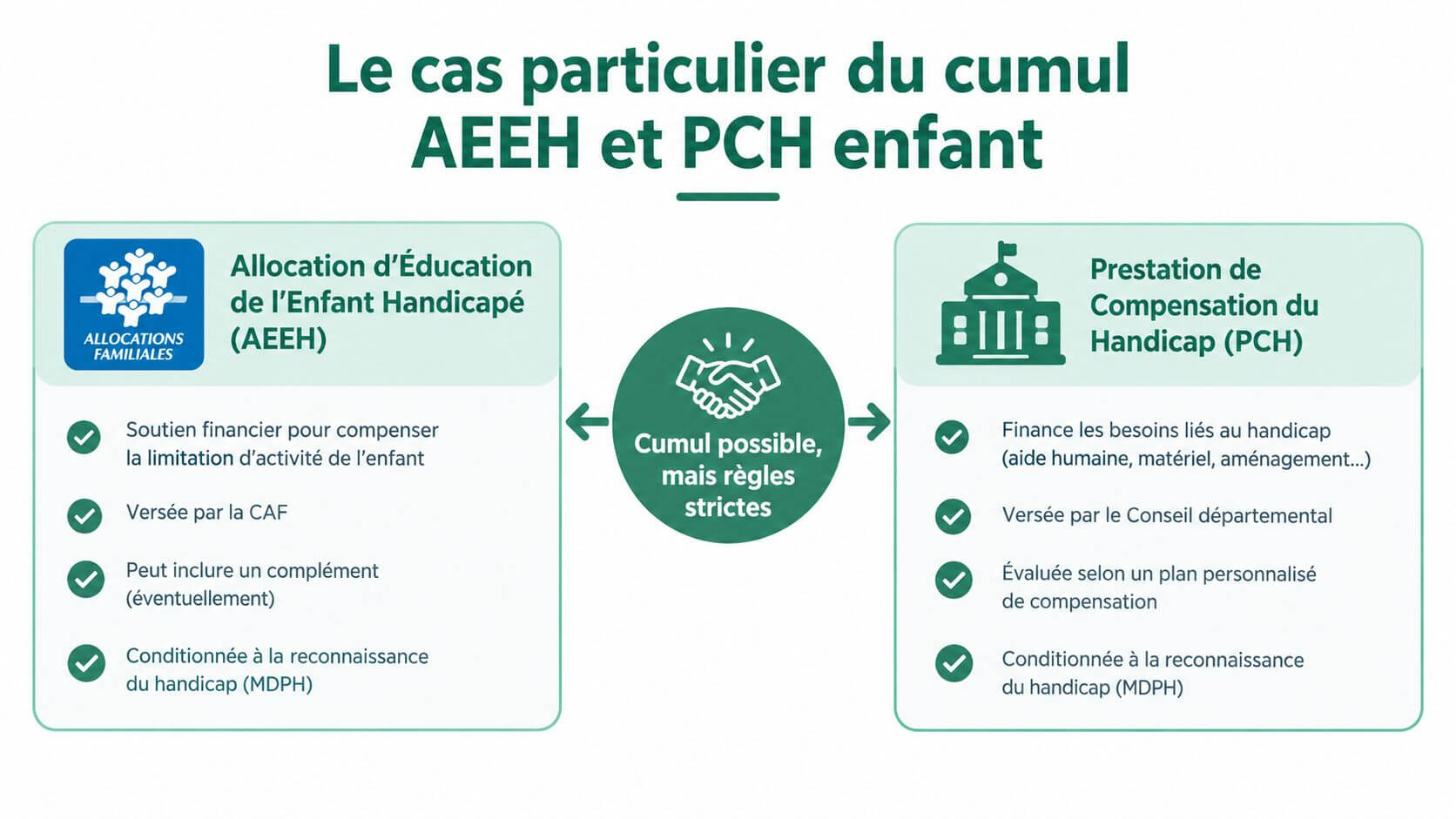
When the child is concerned, the answer changes.EEAH and the PCH child They are not the same help, and they do not obey the same administrative circuit. The EEAH falls under the responsibility of the CAF, the PCH of the Departmental Council, but their cumulation must remain consistent in the file of the home.
The real subject here is the articulation. If the home touches the basic EEAH with a complement, the PCH can intervene in parallel for human aid, but the file must remain legible. The order of priority and the clubbing are managed at the administrative level, not in an improvised CAF declaration.
The practical instructions are simple. Do not make a CIF self-reported by PCH child as if it were an ordinary resource, but correctly report the situation on the CDMH route and, if required by the resource declaration, within the period concerned. If the rate, supplement or aid situation changes, the household must report it immediately.
Cumulativeity is not a problem in itself, it is the oblivion of updating that creates difficulties.
The right reflex, in case of evolution, is to check the new level of help, compare with the previous notification and keep the proofs at hand. It is safer than waiting for a check mail.
When and how to report or update your file
The PCH is paid by the Departmental Council, but the party that concerns a third party may require an update to the CAF side. The time to remember is the time when the payment changes in nature, not just the time when the administrative decision arrives. As soon as compensation, salary or a change of intervener comes into play, the file must be corrected.
The way forward on caf.fr
Go in. My Accountthen Report a change. Select the section that corresponds to your resources or work situation, and then add the PCH line only if it pays a third party or changes the RSA base. If you are using an employee at home or a warrant, keep the document that proves the nature of the payment.
Parts to be stored are simple.
- CDAPH or CDMH notification, to prove the framework of the PCH.
- Payroll or warrant contract, if an outside person is paid.
- Attestation or compensation document, if the help goes through a family caregiver.
- RIB related to the payment, when it is used to trace a specific payment.
Some situations do not require any steps. If you only have technical aids, housing arrangements or extra costs that do not pay anyone, you do not make a CAF statement on this point. The file must remain clean, not overloaded.
Good reflex, Keep your credentials and exchanges for at least the time necessary for a check. A readable record is better than a late explanation.
If a check occurs, the right reflex is not to supplement at random. The link between the PCH decision, the nature of the aid and the actual payment must be shown, and any change in the amount or intervener must be reported immediately. This is the best way to avoid an undue amount or suspension.
Frequent errors and operational overview for the caregiver
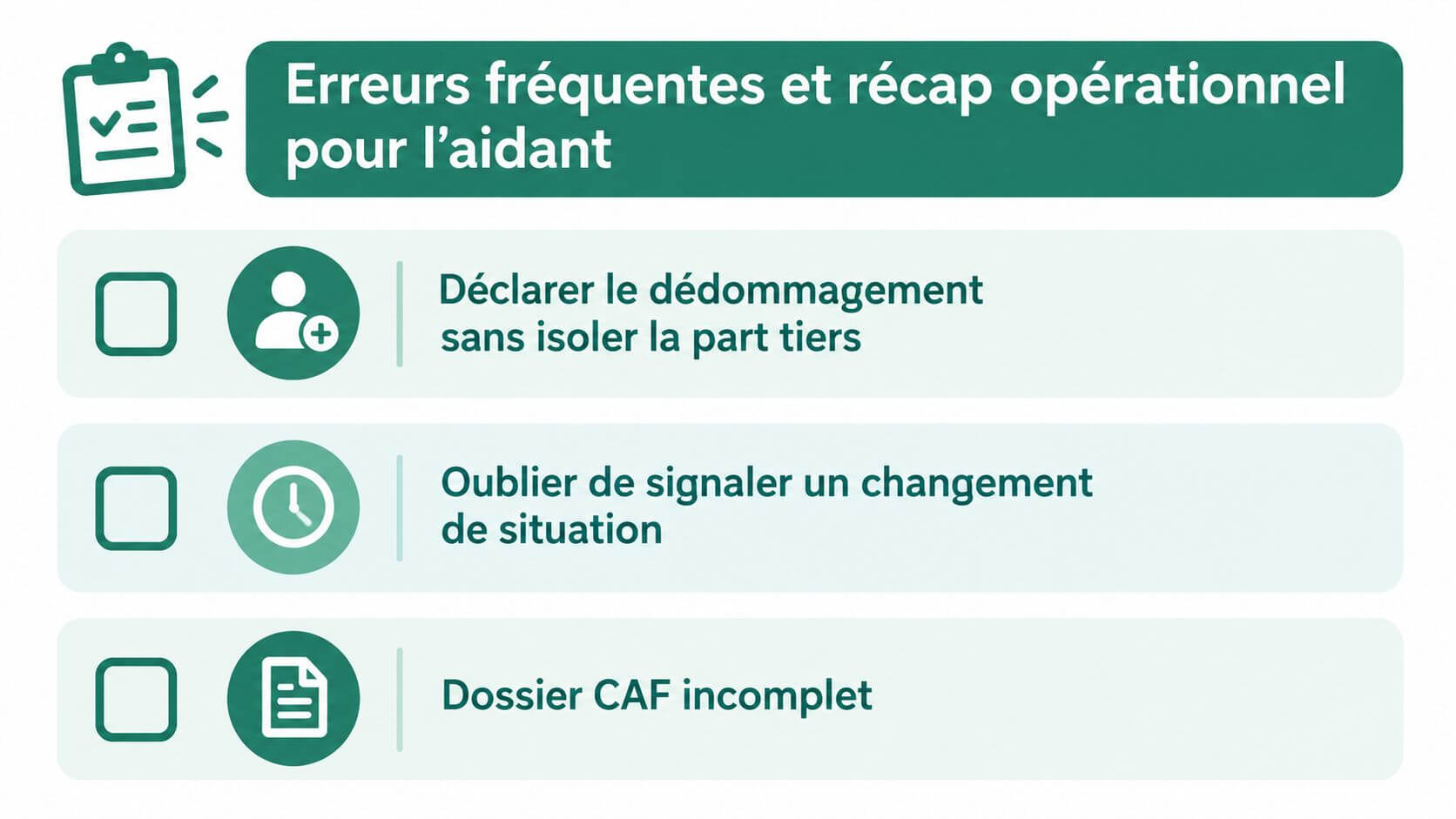
The errors in the file almost always come from the same logic, one declares too broad or not sufficiently precise. A family worker mixes the compensation with technical assistance, forgets to report that one employee replaced another, then discovers the problem at the time of a check. The CAF does not sanction anxiety, it corrects the imprecise statements.
The most frequent traps are easy to spot.
- Declare all compensation as a standard income. We need to isolate the part that really concerns a third party outside the home.
- Forget a change of helping person. As soon as an employee, agent or compensated caregiver changes, the situation must be updated.
- Confound PCH parenting and PCH human aid. The nature of the aid changes the reading of the file.
- Leave the EEAH and PCH child without clear articulation. Cumulativeity exists, but it must be properly documented.
The concrete risk is the indus try, the temporary suspension or the control mail. The expected correction is simple, declare only what must be, at the right time, with the right piece. The records that hold are those that clearly separate compensation, remuneration and resources.
This is the summary to be applied from this month.
- Check the PCH allocation and the exact nature of the aid.
- Identify the externalized human component, if it exists.
- Report only the relevant fraction to the FCA when a third party is paid or compensated.
- Update folder as soon as an employee or caregiver changes.
- Keep newsletters, contracts and notifications in one file.
- Report any change of situation without delay Instead of correcting after the fact.
The rule is not complicated. She's just asking for rigor, and that rigor protects your rights.
Tribulys helps relatives centralize documents, transmissions and planning when disability approaches are added to daily life. If you want to keep a legible file between the CDMH, CAF and human aid changes, go see Tribulys and check how to arrange your parts, alerts and credentials in the same place.
Put this organisation into practice with Tribulys
Keep your care journal, shared calendar, tasks, medication tracking and emergency information together. Start for free and invite the relatives and professionals involved in your loved one’s care.