
In April, the claimant's e-mail often falls at the wrong time. We're already dealing with appointments, drugs, APA papers, and now we still have to understand how to declare tele-assistance to taxes without making a mistake or losing the tax certificate. If you are a family worker, do not let this topic become another chore, it treats itself properly, provided you have the right method.
The right reflex is simple, keeping a clear rule, a single file, and a well-identified box. In France, tele-assistance enters into the personal services and entitles 50% tax credit of expenses incurred in respect of home employment, with declaration under the heading "Reductions and tax credits" and, most often, in Box 7DB or 7DL according to the situation (Reporting Guide Filer) The tax logic is codified, the administration automatically calculates the benefit on the basis of the amounts carried forward, and the main justification remains the claimant's annual tax certificate (guide Assystel).
The real problem, in families, is almost never the rule. It's the mess. An invoice in the mailbox, a statement in a text message, another document in the pile of the living room, and at the time of declaring, no one knows what amount to take back or if the help has already been deducted.
Contents
- Contents
- Why this guide changes the deal for caregivers
- The eligibility conditions to be verified
- Credentials to be collected by method of payment
- Where and how to carry forward the amount on the return
- Frequent mistakes that are expensive
- Centralize your credentials with a tracking tool
- Annual checklist and official resources
Contents
- Why this guide changes the deal for caregivers
- The eligibility conditions to be verified
- Credentials to be collected by method of payment
- Where and how to carry forward the amount on the return
- Frequent mistakes that are expensive
- Centralize your credentials with a tracking tool
- Annual checklist and official resources
Why this guide changes the deal for caregivers
The scenario is always the same, or almost the same. Early in April, the tax certificate arrives, and the caregiver finds himself making an arbitrator between the claimant, the person receiving care and his own tax return. At that point, he does not ask for theory, he asks for a clear procedure, because a poorly filed file often ends up in approximate reporting.
The starting point not to be missed
Teleassistance is not a separate expenditure, it falls within the scope of the personal services. This is important, because this connection opens the door to 50% tax credit mentioned by the guides consulted, with a carry-over under the heading dedicated to tax reductions and credits (Filer) The claimant then issues a Annual tax certificate, usually sent to April, and it is this amount which serves as the basis for the declaration, not a reconstituted memory figure (Filer).
Field rule: If you don't have the certificate, you don't have a file ready. You only have an idea of a file.
Why the carers better treat this as a small annual fence
In practice, the caregiver does not only manage a tax line. It also manages evidence of payment, exchanges with the claimant, sometimes financial participation of an ascendant, and documents that prove who paid what. That's where a simple system changes everything. If you keep a separate file for remote assistance, you avoid mixing this expense with another home helper or APA payment.
The objective is clear. You must be able to open a single file, find the right amount, check the right box, and then declare without improvising. If the situation concerns an elderly parent, keep the accompanying logic related to the APA, useful to understand why the line 7DL Even if the administrative details of this aid are covered by another dossier (APA and autonomy).
What you're going to have to lock
- Eligibility of the service, to avoid declaring a subscription that is not within the right framework.
- Tax proof, because it is he who determines the amount to be carried forward.
- The right box, depending on whether you pay for yourself or for an ascendant.
- The method of conservation, not to run after the coins in the following spring.
The rest is a matter of order. And order, in families, saves time and avoids unnecessary corrections.
The eligibility conditions to be verified
Before you fill out the box, check that tele-assistance fits into the tax framework first. A security subscription alone is not enough. You have to look at three things, the status of the claimant, the connection with the home, and the reality of the payment. For a family caregiver, this check mainly avoids the preparation of a bank statement, with pieces that do not fit together.
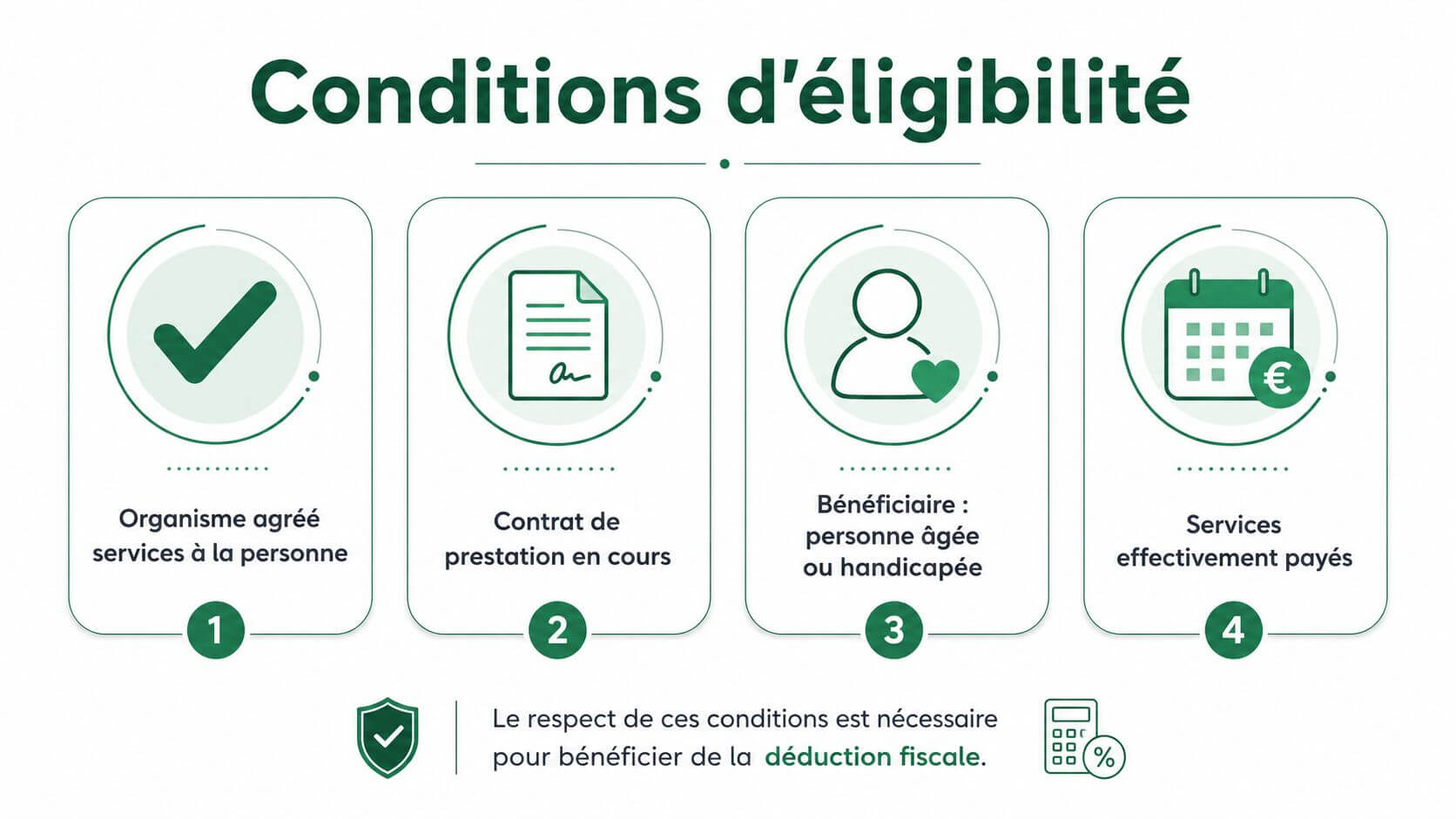
The base to control in a few minutes
Tele-assistance must be provided by an organization declared or approved services to the person. Without this framework, the tax credit does not hold. The service must also concern the home of the person, i.e. his or her usual place of life. This is the starting point chosen by the bodies specialising in tele-assistance and personal services (Assistel).
The other room to secure is the one.Annual tax certificate. If it is missing, you can have transfers, invoices and even a clean bank statement, but you will miss the easiest document to report. The field returns also converge on one point, the classic remote assistance and the visio-assistance the same declarative logic when they are well within the framework of personal services (Assistel).
Who can declare
The subscriber reports the expense if he pays it himself. A family caregiver can also take care of the tele-assistance of an ascendant, if it is he who bears the burden. The tax logic does not change, only the box to use varies according to the situation.
If you pay for a parent, always leave two simple questions, which pay, and for whom the service is subscribed. This duo avoids reporting errors.
If the parent benefits from the APA, one must keep a consistent reading of his or her autonomy situation. The right reflex is to check the beneficiary's file before postponing the amounts, especially when several aids coexist. To understand why this verification counts so much, a reminder on the APA and autonomy Helps to put things in order. Tele-assistance is not a conventional medical aid, it is a service to the person with specific tax treatment.
What you need to remember
- Registered or approved body, otherwise the tax credit becomes fragile.
- Usual home, not a theoretical address.
- Annual tax certificate, necessary to declare properly.
- Tele-assistance or visual assistance, the same logic when the service comes into the right frame.
If these points are combined, you can move on without wasting time.
Credentials to be collected by method of payment
The right proof depends on the method of payment. Families often keep everything, but without clear ranking, and that's where the errors happen. The right method is simple, you keep the piece that proves the amount actually supported, then you put the proofs of payment aside. When a family helper manages a parent's remote assistance, this sorting must be done from the start, otherwise the annual declaration quickly becomes blurred.
Direct payment to an approved provider
In the most common case, the claimant submits a Annual tax certificate. This is the reference document to be kept for the declaration, along with invoices and, if necessary, the payment statements sent by the organization. If you accompany a parent on a daily basis, I recommend that this paper be stored in the same file as the useful exchanges with the claimant, not in a separate stack that is eventually forgotten.
The amount to be reported is the amount that appears on the tax certificate. No need to repeat the total from transfers or levies, the claimant has already done this synthesis. Your role is to take this figure as it is and to keep it justified in case of application. A well-kept file avoids hesitation when completing the return, especially when several family members are involved in the follow-up.
Payment via CESU-type device
When the regulation passes through a CESU mechanism, the file must remain legible from beginning to end. Detailed invoices, the readings related to the scheme, and any annual document summarizing the benefits. The amount reported must be able to be linked effortlessly to the service actually paid, otherwise you may be exposed to duplicates or omissions.
The most common trap is to mix a classic tele-assistance bill and a CESU document as if they covered exactly the same thing. That's not the case. Place them separately in your family file, with a tab or pouch by payment method. In a caregiver's situation, this discipline avoids coming out twice the same expense at the time of reporting.
Practical advice: in a family file, I recommend a single sub-folder, and then two sub-headings, Direct Provider, and CESU. You immediately avoid confusion in the spring.
What to keep
- The annual tax certificate, in the case of the authorised provider.
- Detailed invoicesto verify the amount actually paid.
- CESU surveys or summaries, if you go through this circuit.
- Proofs of payment, to secure the folder in case of control.
The goal is not to accumulate papers. The goal is to be able to release the right piece in 30 seconds, without rereading the entire year of expenses. In a family caregiver context, a shared tracking book saves valuable time, because it centralizes supporting documents, payments and useful remarks before the annual declaration.
Where and how to carry forward the amount on the return
A bad line, and you're wasting time for nothing. Tele-assistance is declared in the right place, in the part "Reductions and tax credits", with the exact amount from the coins you kept. If you prepare the statement for a relative, keep the same reflex as for the rest of the family file, check first who paid, and then for whom the expense was incurred.
The online statement without detour
On impots.gouv.fr, go directly to the section "Reductions and tax credits". This is where the block reserved for services to the person, therefore for tele-assistance, is located. For a personal expense, the most common box is 7DB. For an expense incurred for an ascendant, the box 7DL serves as a benchmark in the guides consulted.
The administration then automatically calculates the tax benefit from the amounts seized. You do not have to recalculate by hand. Your job is to enter the right amount, in the right place, with the correct registrant.
The paper version and the form to be known
If you declare on paper, the correct support remains the form 2042 RICITele-assistance is included in the section dedicated to personal services, sometimes under the heading BDU Telecommunications and video assistance. The principle does not change, you carry forward the amount shown on the certificate or on the proofs of the device used.
In a paper statement, the trap is not the technique, it is the approximation. A helper who manages a parent's papers must take over the source document and copy the amount without improvising.
A method of terrain to avoid mistakes
Start by identifying who paid. Then check if tele-help is your home or an ascendant. Open the tax section only after this sort. This simple order avoids box errors when several family members participate in the settlement of the service.
The reflex that secures everything
Once the line is entered, compare the amount with the tax certificate before validating. If the numbers do not match, stop and take back the proof. In terms of remote assistance, it is always the basic document that settles, not an estimate made at the rush.
Frequent mistakes that are expensive
Telehelp errors are not due to a lack of good will. They come from a file that is badly stored, poorly shared, or reread too quickly. In the case of carers, the real problem is often the mix between personal payment, a parent's file and parts scattered in several emails.
The three traps I see most often
First trap, do not declare anything Because tele-assistance is considered a secondary expense. It's a classic mistake. The service falls well within the scope of services to the person, and it must be included in the declaration when it meets the conditions described above.
Second trap, twice the same expense. This happens when a close friend settles the bill, another adds it to the family file, then a second entry is made by habit. At this point, the problem is not tax, it is documentary. Only one file has to carry the expense, otherwise you create an unnecessary inconsistency.
Third trap, confuse the situation of the beneficiary with that of the registrant. The logic is not the same if you pay for yourself, for a parent, or if several children divide the rules. When tele-assistance concerns an ascendant, you must remain consistent with his or her file and with the aids already attached to his or her situation. If the ABS file exists, you must check the whole before entering anything.
The right reflex when a doubt arises
- Read the tax certificate before seizureNot after.
- Check who paid for it., then who benefits from the service.
- Isolate each payment flow, especially when the family participates in several.
- Put the associated aids aside, not to inflate the amount to be carried forward.
A statement of its own comes from a separate file. When the supporting documents are dispersed, the error comes quickly, even with a taxpayer in good faith.
The simplest way is to work with a common ranking. Shared storage cabinet avoid looking for the certificate at the last moment, or mixing the parent's bill with that of the caregiver. On the day of the return, you save time and you know exactly what amount to take back.
The bottom point remains the same, the administration calculates the advantage from the figure entered. If this number is false, the correction always falls on you. It is better to control the parts calmly at the beginning than to take back the file in the emergency the following spring.
Centralize your credentials with a tracking tool
In the case of carers, the real difficulty is not to understand box 7DB. It is to find at the right time the attestation, the proof of payment and the family summary. A shared tracking tool is used precisely for this, not to make complicated taxation, but to avoid the loss of information.
The principle of a shared expenditure book
You can create an entry dedicated to the tele-assistance in a shared notebook, then attach the annual tax certificate, invoices and proof of payment. The interest is simple, the whole family sees the same file in the same place, without dependent on a single phone or email box.
Tribulys can be used as organizational support for this type of ranking, as the platform centralizes exchanges, documents and follow-up around a person kept at home. In a telehelp file, it keeps a dated record of the document received, quickly retrieves the PDF in April, and prevents the room from ending at the bottom of a message thread.
The practical method to be adopted
- Create a “Telecare” information sheet, with the name of the provider.
- Attach the PDF of the tax certificate, as soon as he receives it.
- Add proof of payment, to keep the timeline complete.
- Sharing access with relatives concerned, if the declaration is prepared by several.
The gain is not abstract. When the file is centralized, the caregiver no longer searches in three different channels, and the amount to report in 7DB or 7DL is immediately found. You reduce the risk of forgetting a document, especially if several people take care of the parent on a daily basis.
To organize this ranking without starting from scratch, you can also rely on storage methods already designed for carers, such as those detailed in this Storage cabinet for families. The idea is not to digitize everything to perfection, it is to make the evidence available, readable and recoverable without stress.
Annual checklist and official resources
Each year, take the same sequence. Check that the claimant is well within the framework personal services, get it backAnnual tax certificate received in April, report the amount in the right box, 7DB or 7DL, then rank the whole with proof of payment. Keep the proofs, because the attestation is not attached to the declaration, but it must remain available in case of request (Assistel).
Resources to keep in hand
- impots.gouv.fr, for the reporting headings and official updates.
- The service provider's guides, when they detail the box to be used and the document to be reported.
- Information related to ABS, if the tele-assistance concerns an ascendant benefiting from this aid, to approximate the logic described in the dossier resources for family caregivers.
Also keep a simple calendar. April for the attestation, at the time of the declaration for the entry, then immediate archiving in the shared folder. This rhythm is enough if your parts are already filed.
If you want to stop looking for your proofs at the last moment, Tribulys helps you centralize the documents, exchanges and follow-ups around the person receiving care. For a properly declared telehelp, a shared file avoids forgetfulness and simplifies the tax preparation. Tribulys and put in place a unique space for your certificates, payments and helper marks.
Put this organisation into practice with Tribulys
Keep your care journal, shared calendar, tasks, medication tracking and emergency information together. Start for free and invite the relatives and professionals involved in your loved one’s care.