
When you help a parent at home, the drugs quickly end up invading the house. One box stays in the kitchen, another close to the armchair, the drumstick is open on the table of the living room and the prescription holds with a magnet on the refrigerator. Then comes the question that worries everyone: has the evening tablet ever been given, or will someone give it a second time?
I've installed a drug cart in a relative's house, and my advice is simple: do not consider it a storage cabinet. It must become the organised point of passage between the preparation, storage, distribution and confirmation of the catch. The trolley protects the products and gathers them. A clear routine, possibly supported by a co-ordination application, avoids oblivion and duplication.
Contents
- Why install a drug cart at home
- Choose your cart well for home maintenance
- Interior layout and layout of drawers
- Distribution Routine and Good Safety Practices
- Connecting the trolley to Tribulys for traceability
- Frequent errors and how to avoid them
- Setup checklist and first reflexes
Why install a drug cart at home
In the beginning, we think we are saving time. In fact, the most important change is elsewhere: all treatments finally have a unique address. The caregiver no longer searches for the boxes in several rooms and the nurse finds the same storage at each passage.
This centralization is particularly useful when several people are involved. A parent, a child, a nurse and a home care worker can all participate in daily life, but they must not each improvise their own method. The trolley becomes the common landmark, in an accessible room, with identified drawers and a controlled closure.
Practical rule: If a drug does not have a defined location, it will eventually be forgotten, moved or counted twice.
Only one storage point to avoid confusion
The cart consists of boxes, piles, useful prescriptions and small equipment. This organization quickly identifies what is missing, what needs to be renewed and what is no longer in line with the current order. It also limits duplicates, especially when an old box stays in a closet while a treatment has been modified.
In France, the medicine cart is part of a distribution logic that is organized as close as possible to the patient. Models for care services are often dimensioned for up to 24 beds, which illustrates a structured tour and not a simple storage space, as this French distribution trolley sheet.
Control access without complicating life
At home, storage must also take into account the environment. A close relative with cognitive problems can open a drawer out of curiosity, a child can enter the room and an animal can spill a box. Sensitive treatments, risk products and medicines that should not be taken without supervision therefore deserve a closed compartment.
The trolley does not regulate everything by itself. It is necessary to decide who owns the key or code, where the trolley remains parked and how the stakeholders report a catch. French safety recommendations require that the drugs and pilers be kept in a locked trolley, then that the trolley is itself stored in a closed room when it is not used, according to the Regional Health Agency's document on the drug circuit.
For a close helper, this logic adheres to the principles of Organized home care. The right location, the same routine and visible transmission often do more for safety than sophisticated poorly used equipment.
Choose your cart well for home maintenance
The best trolley is not the one that looks most like hospital equipment. It is the one that the caregiver can move, clean, close and open without unnecessary effort. At home, too large a model becomes an obstacle in the corridor. A model that is too light or without brakes becomes unstable as soon as you push it with one hand.
Start by measuring the actual journey. Look at the passage between the bed and the bathroom, the space around the chair and the area where the trolley will be parked. Also check the height of use. A person who prepares the sockets does not have the same needs as a helper who works standing.
The criteria that really matter
- Encumbrance: Choose a narrow format if the trolley is to pass through a corridor or bypass a chair. Discard too deep models as objects at the bottom become difficult to grasp.
- Mobility: demand stable castors and brakes that are really easy to operate. The trolley must remain stationary during preparation and grip.
- Closure: As soon as a sensitive or potentially dangerous product is present, hold lockable key or code drawers. A simple bonnet does not offer the same control.
- Modularity: prefer removable drawers, adjustable separators and identifiable bins. The requirements change, storage must be able to follow.
- Cleaning: Inox disinfects easily and is resistant to repeated use. A lighter material may be suitable, provided the surfaces support routine cleaning.
For a still mobile parent, I would prefer a compact cart with a few well-separated drawers. For heavy home maintenance, with large care equipment, it takes more width and separate shelves, but without turning the medicine cart into storage.
| Criterion | Point to be checked | Home arbitration |
|---|---|---|
| Size | Passage in the rooms and access from an armchair | Compact if space is forced, wider if equipment is numerous |
| Rollers | Accessible stability and brakes | Essential brakes during preparation |
| Closure | Key or code, central lock | Reinforced closure for sensitive products |
| Drawers | Separators and easy removal | Modularity if treatment often changes |
| Material | Resistance to cleaning products | Stainless steel for durability, light material if displacement takes precedence |
Do not choose a non-lockable cabinet, a brake-free trolley or a model whose drawers all open at the same time. To complete the organization of the sockets, you can also consult this guide on the pill box suitable for everyday use, but the stacker does not replace secure storage.
Interior layout and layout of drawers
A well chosen cart can become unusable if everything is mixed in. I have learned to organize drawers according to the time when the object is used, not according to its shape or the manufacturer's mark. The caregiver must be able to open the right compartment and immediately understand what to take.
Here is a simple distribution to adapt to the prescribed treatment.
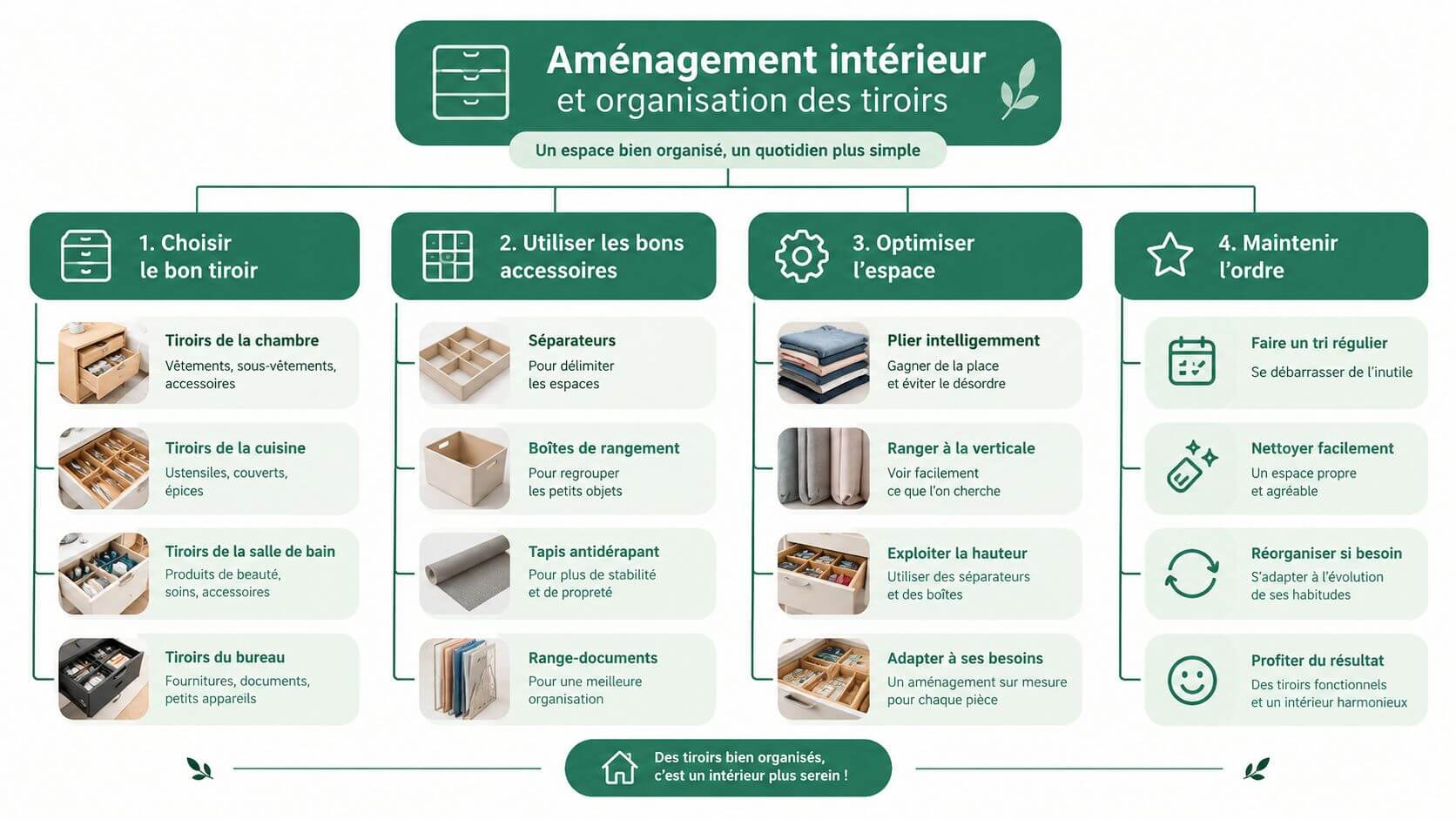
Storage by use
The top drawer accommodates the weekly stacker, the transmission sheet and the information necessary for the tour. It is the most consulted area, but it must not become a tote. Keep the documents up to date and immediately remove the old prescriptions.
The intermediate drawer receives the tablets and capsules that are not already placed in the stacker. Separate them by taking time, morning, noon, night and night, with trays or separators with a very readable label. Colours can help, but they must never replace the name of the medicine and its dosage.
The lower drawer is suitable for more bulky forms, such as syrups, creams, eye drops and inhalers. Add a cover dedicated to the tensiometer, blood glucose meter and syringes, so that the material is not mixed with the treatments.
Products that must remain separate
Narcotic drugs, insulin and any product requiring special monitoring should be kept in a separate and closed compartment. Thermosensitive medicines should not be left in the trolley if their storage requires the refrigerator. Instead, provide for an area identified in the refrigerator, with a clean and identified pouch.
Each container must bear a label with the name of the medicinal product, the dosage and the starting date The rule I recommend is short: a product, a location, a label. It makes storage controlable by someone who did not participate in the preparation.
Distribution Routine and Good Safety Practices
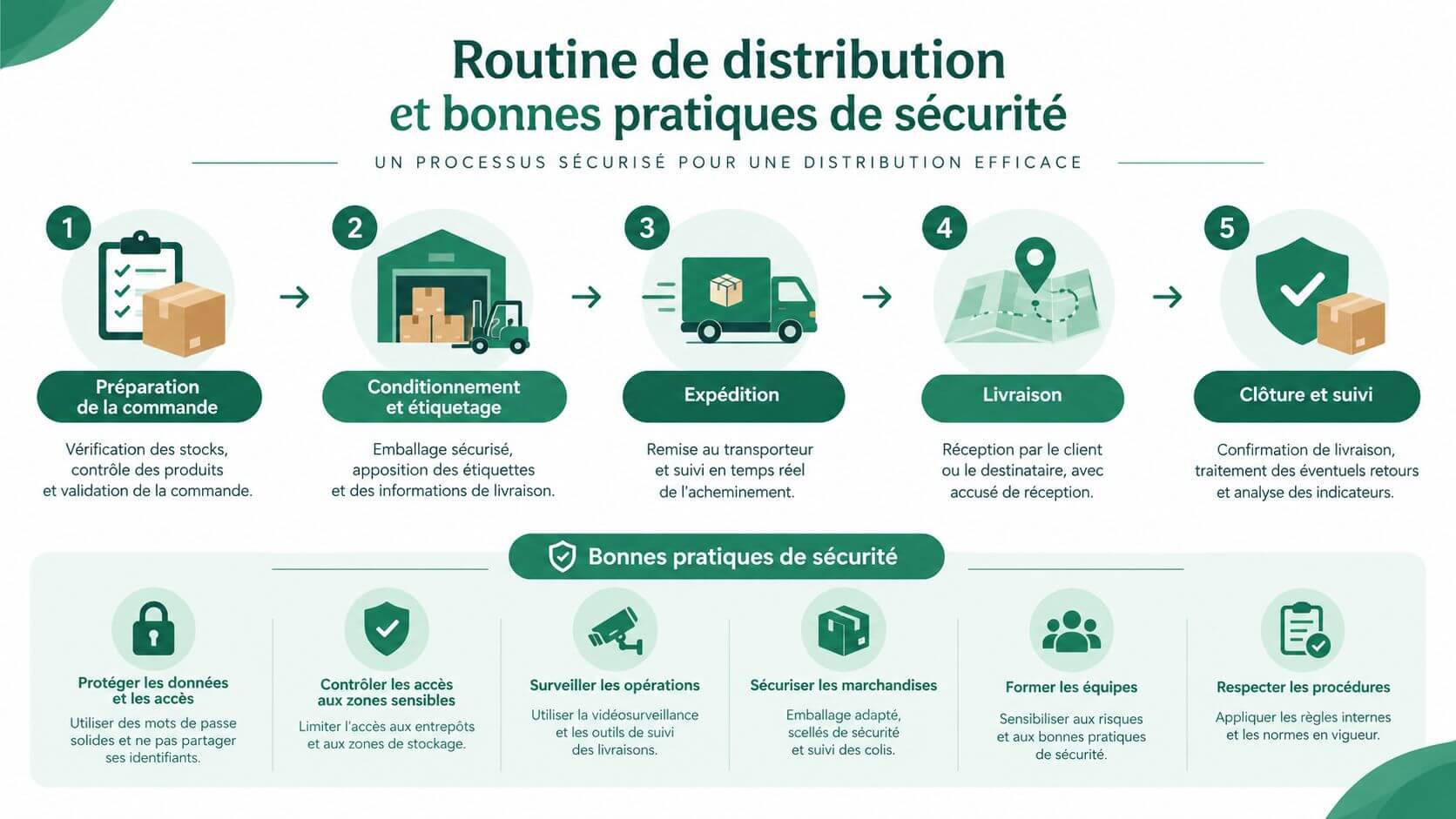
The distribution must not depend on the memory of the person present. It must follow the same order each time, even on days when the caregiver is in a hurry. A stable routine reduces forgotten gestures and makes the deviations visible.
The six times of the catch
- Wash your hands and prepare a clean surface.
- Read the current order or the validated processing sheet.
- Check the five vouchers, the right patient, the right medication, the right dose, the right route and the right time.
- Take out only the relevant socket from the intended compartment, without leaving the other boxes open.
- Administer treatment with the intended liquid or device, checking that the person has taken it well.
- Record or immediately confirm the socket, before moving on to another task.
Control of the five vouchers is presented in French resources as a tool to prevent drug-related adverse events. A French audit dedicated to Public Assistance, presented in the report on the safety of the drug circuit to AP-HP, also recommends linking the trolley to a computer connected to the information system and to a traceability reader in the patient's bed in the organisations concerned.
Locking is part of the distribution
Do not open the trolley until you prepare or give the treatments. Once the socket is finished, close the drawers, check the lock and store the key at its intended location. Do not place it on the top of the trolley, even for a few minutes.
I also recommend that you always follow the same order in the house. Start with the person, check the catch, validate it, and then go to the next room. For a product at risk, plan a second person check when the organization allows, and enter any output or anomaly in the transmission.
The therapeutic monitoring of medicinal products must remain immediate. A later written note is often incomplete, especially when several visits follow one another.
Connecting the trolley to Tribulys for traceability
The drug cart keeps the treatments in the right place. Tribulys serves as a memory of the sockets and as a link between the people, with confirmations, reminders and a shared history. The application does not replace the prescription, the pharmacist, or the judgment of the health care professional. It gives a common record of what has been planned and what has been validated.
The initial configuration should be made from an up-to-date take plan. Enter the treatment, schedules, dosages and useful indications, and then associate the people who need to receive the information. If the stock is tracked, update it at the time of renewal, not when the box is already empty.
A confirmation at the exact time
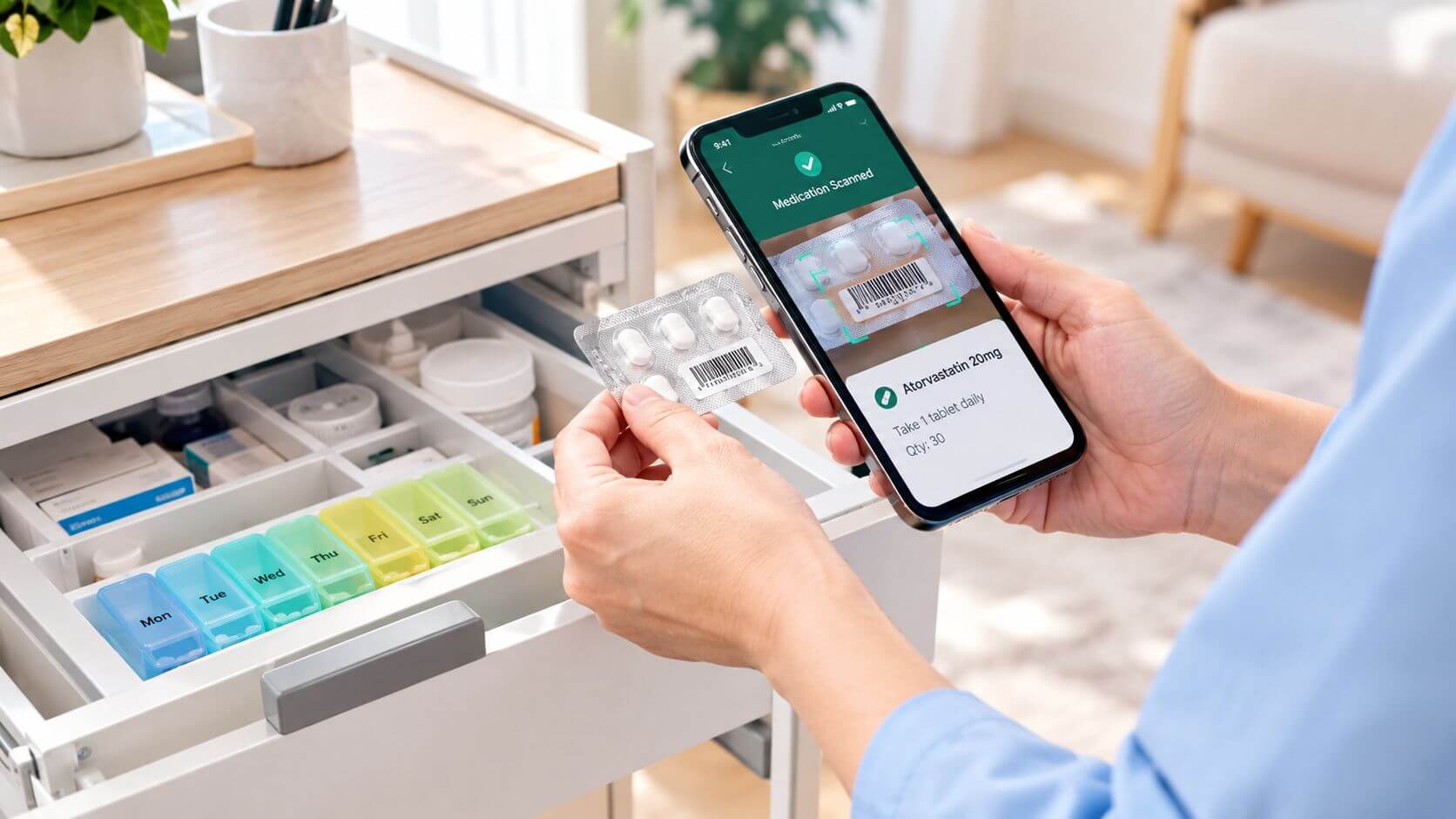
On a daily basis, the provider receives a notification at the scheduled time. He opens the trolley, checks the correct compartment, gives the intake, then confirms the administration in the application. Depending on the organization chosen, he can scan the code of the medicine or validate the intake manually.
This step avoids the notebook placed on the trolley and the messages scattered in several conversations. It also allows to quickly report an adverse effect or difficulty, rather than rely on a subsequent call. solution for family caregivers It also centralizes the liaison care journal, schedule and transmissions, which helps stakeholders to work with the same information.
What history really changes
The question, "Did you give her the night tablet? " becomes verifiable. The family and the authorized caregiver consult the same entrance, with its time and author, instead of reconstructing the day from contradictory memories.
The key point is not to validate a socket in advance. The button must be used after the control and administration. If the socket has not taken place, select the appropriate state and leave a note. An imperfect but honest trace is better than a series of automatic validations that do not reflect reality.
Frequent errors and how to avoid them
The trolley does not secure anything if its use remains approximate. At home, mistakes rarely come from a bad intention. They appear because a person is interrupted, a key is placed in the wrong place or a treatment has changed without the storage being updated.
Storage and access oblivions
An open trolley in the corridor attracts manipulations and makes it impossible to know who has been able to access the products. The correction is mechanical: open, distribute, validate, close. The key must remain on a fixed point, known to authorized stakeholders, but out of reach of the cared person and visitors.
The bulk medication in the top drawer creates another difficulty. Separate the intakes by time and per person, use legible labels and remove old boxes as soon as a professional confirms the discontinuation of the treatment.
Conservation errors
Insulin and other thermosensitive products should not be abandoned in the trolley if their package leaflet or prescription requires specific storage. Place them in an identified refrigerated area, with an appropriate transport method, and note their location in the transmission.
The narcotics must remain isolated in a closed compartment. Their management requires accurate counting and transmission, especially when a relay is carried out between relatives and professionals.
The given but unrecorded catch
The duplicate often appears when the administration has taken place, but no one has registered it. Validate the dose immediately in Tribulys or on the selected transmission medium, then clearly indicate any refusal, vomiting, delay or anomaly.
Finally, do not neglect cleaning. Disinfect surfaces according to the products compatible with the material, remove unnecessary packaging and regularly inspect dates. French instructions state that the absence of effective closure and the non-compliance with hygiene or traceability expose the circuit to a loss of control and a risk of cross-contamination.
Setup checklist and first reflexes
The first installation must be done with the prescription in front of the eyes, not between two races. Take the time to adjust the storage before placing the treatments. A properly installed medicine cart must be understandable by a person who arrives for the first time.
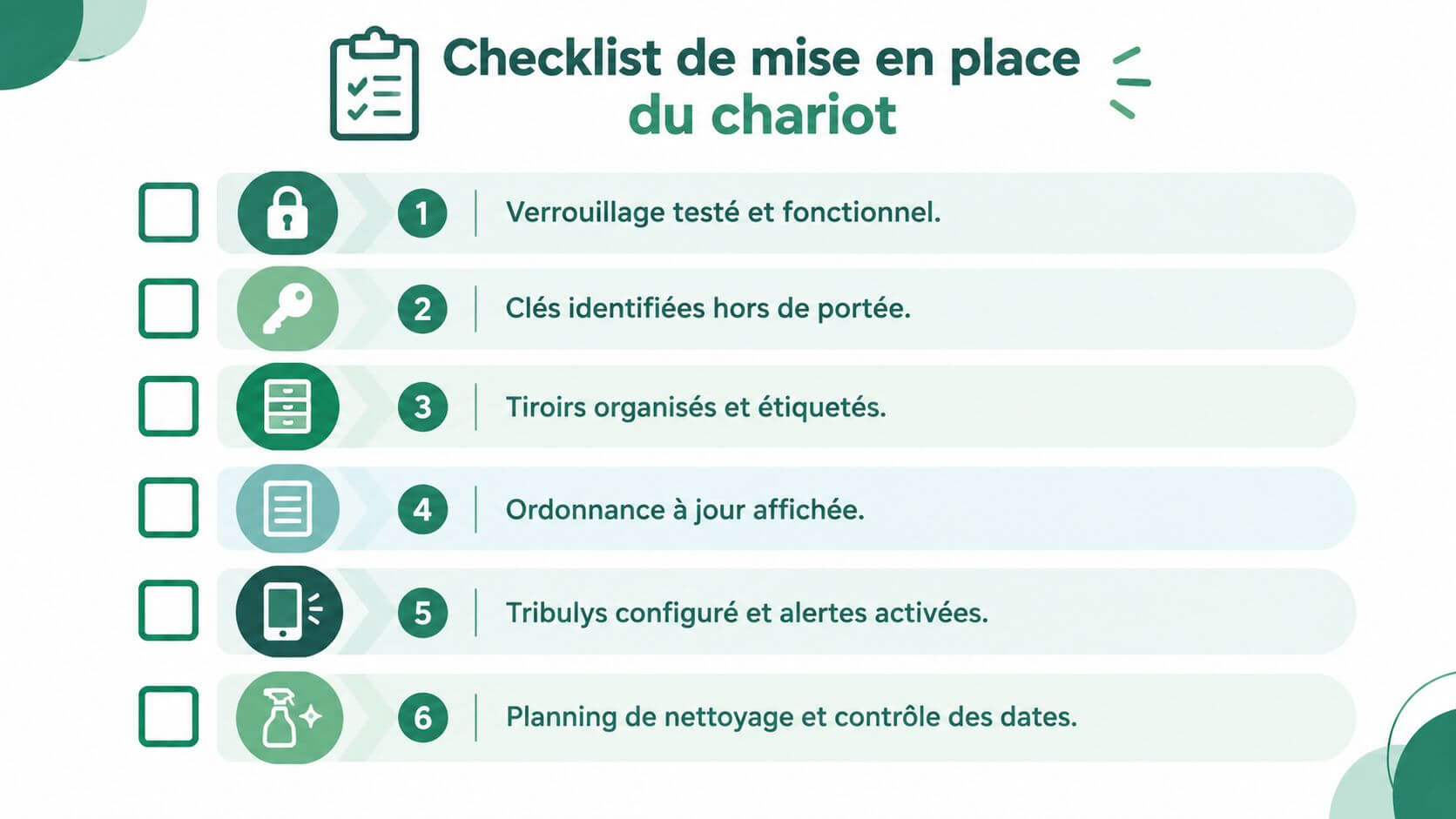
Initial verification
- Locking: Test the lock and check that each drawer really closes.
- Keys: Identify the keys and keep them out of reach, in a known location for authorized persons.
- Drawers: Organize the compartments and put a legible label on each area.
- Order: Remove the outdated requirements and keep only the validated version.
- Application: Configure Tribulys, add schedules and activate necessary alerts.
- Cleaning: Set a clean-up routine and regularly check the dates and condition of the containers.
Place the cart in a living room, but not in a passageway. Access must remain clear for a chair or walker. The parent must be able to participate in the routine if his condition permits, without having access to treatments that require supervision.
Controls that avoid abandonment
On the first day, check that each speaker knows how to open the right drawer and record a catch. On the third day, ask what slowed the distribution. On the seventh day, reorganize the compartments if a product often returns to the work plan. After a month, check the transmissions, oblivions, changes of order and the general condition of the trolley.
These short checks are better than a large late reorganisation. If a practitioner systematically forgets to validate, simplify his access or clearly designate the person responsible for the confirmation. If the trolley remains open, move it or change the procedure. A useful organization must survive the busy days.
Tribulys helps you connect the cart to a digital routine of reminders, confirmations and transmissions shared between caregivers. Set up catch tracking and alerts so that everyone knows what was given, then discover Tribulys to structure coordination at home.
Put this organisation into practice with Tribulys
Keep your care journal, shared calendar, tasks, medication tracking and emergency information together. Start for free and invite the relatives and professionals involved in your loved one’s care.