
Forget, doubts, stress. If you manage treatment at home, you already know this somewhat exhausting mixture, between the doubt in the middle of the day and the messages sent to several people to check if the take has taken place. application taking medicine can really ease this burden, provided you choose a tool suitable for proper use, personal follow-up, family coordination or link with the pharmacy. The key point is not to have "the" best app in absolute, but the one that secures the catch without complicating the lives of the person being followed or the caregivers.
Contents
- 1. Tribulys
- 2. Medisafe
- 3. MyTherapy
- 4. CareClinic
- 5. Dosecast
- 6. Medica Medication Remember & Tracker
- 7. well&well pharmacists
- 8. Grand Pharmacie de France service Mesoigner
- 9. Medissimo KiMéd + Medipac Pillier
- 10. Follow your Track Your Pills pills
- Comparison of the 10 medication-taking apps
- Choose the app that really meets your need
1. Tribulys
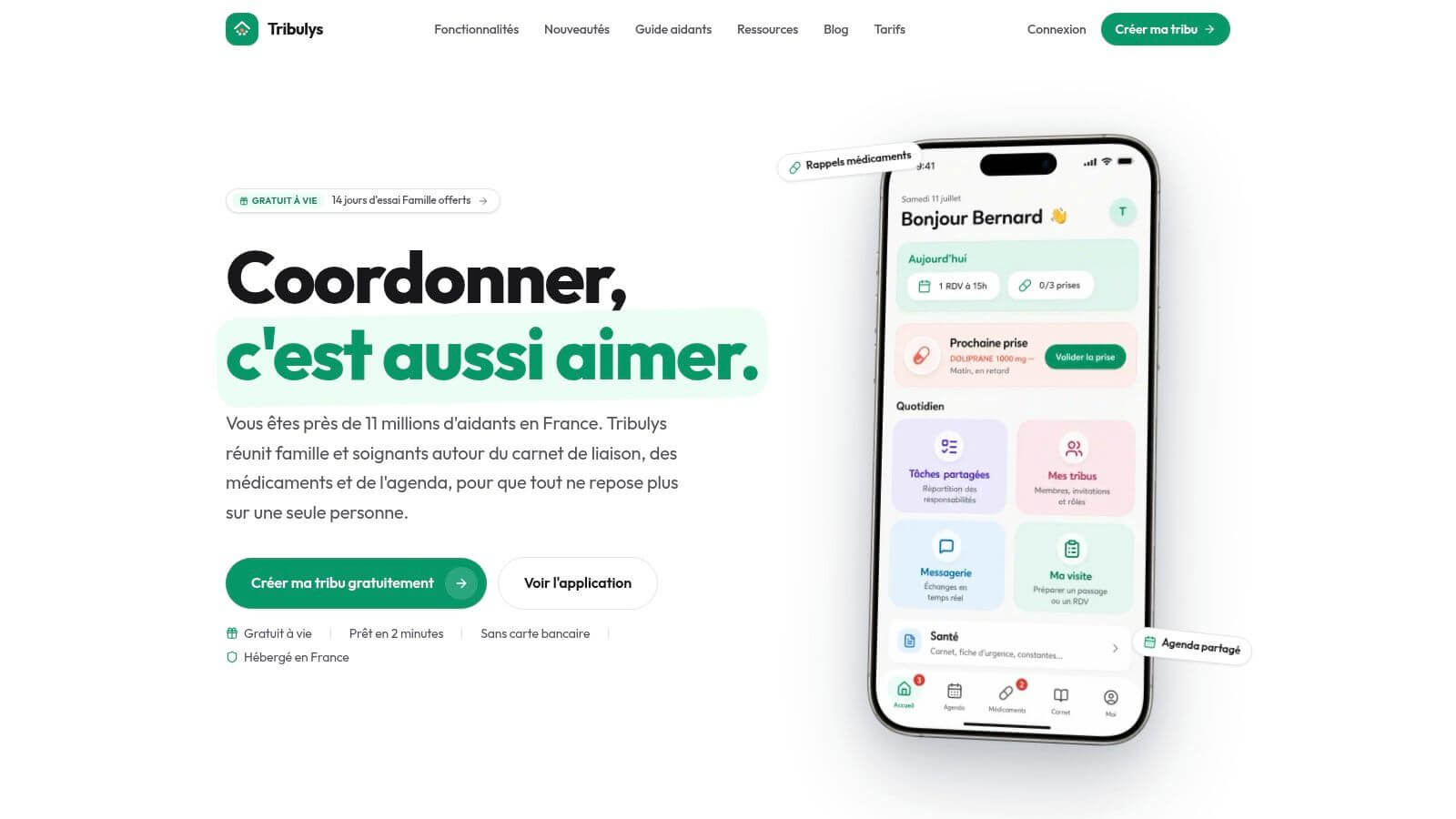
Tribulys does not just try to recall a take, it organizes life around the patient at home. That's precisely what lacks many tracking tools, which remain centered on the phone of one person. Here, the care journal, monitoring of medicinal products andshared calendar living together in the same space, with confirmations of take, oblivion alerts and a history exploitable by the family as by the caregivers. The site also highlights a accommodation in France and the EU, the GDPR compliance and a role-based access control, which really matters when several relatives and professionals consult the same information Tribulys.
A real dashboard for the home
Tribulys' interest appears as soon as a processing process is no longer managed by a single person. The platform allows to coordinate the sockets, appointments, tasks and transmissions, instead of scattering the information between SMS, WhatsApp and paper notebooks. Logic is simple, everyone sees what they need to see, and the confirmations of take reduce the daily doubt.
Practical rule, if coordination becomes collective, the simple reminder is no longer enough. It requires a trace, a role, and a history.
Tribulys is also part of the French context of drug follow-up, where the HAS recalls thatone in two patients waits for a prescription of medication when leaving the doctor's home and that 4 out of 10 French people take medication daily. The same source indicates that in 2002, close to 80% of consultations at least one medicinal product was prescribed, with an average of 2.9 drugs per patient, and an estimated overconsumption 40 % standard units compared to other European countries HAS. In this context, the promise of Tribulys is consistent, trusting the taking and transmission of information, not just sending an alert.
What changes for caregivers and pros
The real strength of Tribulys is the shared traceability. The screen My Visit, the assignable tasks, the searchable out-of-connect emergency record and the catch tracking allow a independent nurse, a home helper or a relative to take back the file without starting from scratch. It's not a simple digital pillar, it's a coordination tool.
The tariff model is also legible, with a formula Free essential for life until 5 members, then an offer Family at 5,99 €/month with unlimited members, free trial of 14 days and advanced functions. This approach is well suited for small teams who want to start quickly, without credit cards, and then go up to range if coordination becomes more complex. On the other hand, the site does not show anyMedical device approval Specific. For some care structures, this can count if they are looking for a more formal regulatory framework for decision support functions.
2. Medisafe
A person who takes multiple treatments, or a caregiver who needs to keep an eye on a drug routine, often looks for the same thing, a simple tool that limits forgetfulness without complicating daily management. Medisafe responds well to this need. customizable reminders, shareable reports and a close alerting function, Medfriend, useful when the person followed often forgets or lives alone. For personal use, the interface remains clear and reassuring, which facilitates adherence over time. The official product sheet also details a drug base and leaflets, convenient to verify information quickly official website of Medisafe.
The real compromise is about functional depth. Some advanced options, including the detection of interactions, are reserved for premium offer, and synchronization involves creating an account. It's a good point for an autonomous person who wants to structure his follow-up, but it's less suitable if you're looking for a very light tool, without any additional step, for an entire home.
To go further on solutions focused on oblivion of catches, see also our guide to applications not to forget its medicines. For a player who hesitates between a reminder-centered app and a more collaborative tool, I also recommend the analysis published by Tribulys on the free alternatives to Medisafe via this comparative application free medicines. The right choice depends less on the name of the app than on the level of coordination expected around the treatment.
3. MyTherapy
MyTherapy is often the best entry point for serious personal follow-up, especially if the person takes several treatments and wants to keep a clear view of his or her routine. withdrawals, health journal, follow up with symptoms and PDF reports to be shared in consultation. Its French website highlights free use and a daily monitoring rich enough to document tension, blood sugar or other health measures MyTherapy.
Its main interest is the consistency between recall and documentation. Many tools are content with a notification. MyTherapy helps to link taking to symptoms and measures, which becomes useful when the doctor wants to understand what is going on between two consultations.
If the priority is individual follow-up, MyTherapy does the job well. If the priority is family or healthcare coordination, it quickly shows its limits, because sharing remains less natural than with a platform designed for several stakeholders.
The positioning is clear, and its ergonomics remains simple enough for recurring uses. On the other hand, if you have to answer the question "who saw the info, and when?", MyTherapy does not bring the same level of traceability as a home coordination tool. For one person alone, that is often enough. For a care tribe, it is sometimes too patient-centred.
4. CareClinic
CareClinic likes families who want to look beyond the simple medicine. The app brings together withdrawals, symptom log, planner, PDF reports and multi-profile monitoringIt is relevant when several people in the home need a health follow-up, or when treatment is part of a chronic disease with several parameters to monitor. CareClinic.
The strong point is the global vision. Treatment, pain, symptoms and certain appointments can be monitored in the same environment, thus avoiding multiple tools. In practice, this approach helps caregivers who want to document the evolution of a situation rather than simply tick a "taken" box.
The counterpart is a denser interface. For someone who just wants a clean and quick reminder, CareClinic may seem too heavy. Advanced analytics functions also go through the premium, so the app takes all its meaning if you really exploit the health journal, not if you are looking for a unique and basta alert.
5. Dosecast

Dosecast is distinguished by its flexibility. When the schedules are not fixed, when several devices have to follow the same schedule, or when a treatment requires complex repetitions, the application offers Advanced programming and one multi-device synchronization via CloudSync. It goes well to somewhat twisted situations, those where a simple daily reminder is no longer enough Dosecast.
The core of the tool is there, in the fineness of the setting. You can manage precise schedules, intervals, postponements and monitoring of the remaining quantities. It is convenient for treatments that require real control, especially when several people monitor the same therapeutic.
On the other hand, Dosecast does not have the most reassuring public side for a helper with little technology. The interface seems less accessible than that of the most mainstream apps, and some advanced features go through a Pro version. If the person managing the processing does not like to finely configure their tools, they risk giving up too soon.
6. Medica Medication Remember & Tracker
Medica goes right to the goal. The Android app is putting on the Reliability of recalls, the intelligent carryovers, night silence and the addition of pictures of medicines to limit confusion. For people who manage polymedication and want a light tool, the approach is pragmatic Medica.
What works well here is simplicity. You quickly understand what to take, when to take it, and how to find a box or file without being burdened with a too large health record. Renewal reminders add a small safety net that is useful in everyday life.
The limit is just as clear. Medica remains mostly Android oriented and does not offer any real advanced coordination brick. It is therefore a good one. application taking medicine for individual or semi-autonomous use, but not the strongest tool as soon as you need to share a history with several professionals.
7. well&well pharmacists
well&well stands out because it directly connects the recall to the local pharmacy. You can schedule taking hours, send your prescription to the pharmacy and exchange it via a secure messaging With the pharmacist. It's useful when the question is not only "did I take my treatment?", but also "how do I get it back, and to whom do I ask a question?" well&well.
The advantage is local integration. The pharmacist becomes more easily a routine contact, which can reassure elderly patients or caregivers who want a simple circuit. In a logic of home maintenance, this direct link is often more useful than a spectacular but isolated application.
The reverse is the coverage, necessarily linked to the well&well network. The recall functions remain useful, but they are not as extensive as in the solutions dedicated to pure follow-up. If you are looking for a very wide coordination between family, nurse and doctor, the tool lacks depth.
8. Grand Pharmacie de France service Mesoigner
The Mesoigner service of the Grande Pharmacie de France keeps the compendial logic at the centre. notifications of take,forwarding of orders and one direct interaction with the compendial team, with the possibility for the pharmacist to analyse adhesion statistics in case of repeated oblivion Mesoigner de la Grande Pharmacie de France.
This approach is interesting because it does not separate the recall from the pharmaceutical board. When forgetfulness repeats itself, the pharmacist has a better context to accompany the patient, rather than responding to the blind. It is a real plus for situations where one wants a simple follow-up, but not disconnected from the field.
The compromise is the framework. The service is linked to the official, so it will be less relevant off the usual customer base. It fits well if you want continuity with your pharmacy, less if you are looking for a neutral tool, multi-actors and expandable to different professionals.
9. Medissimo KiMéd + Medipac Pillier
Medissimo goes further than a simple app, because she combines a Secure stacker prepared by the pharmacy and implementation KiMed to notify the patient, record compliance and trace possible side effects. The link with the official gives a real structure to the drug circuit, which matters a lot when home maintenance becomes fragile Medissimo.
The strong point is obvious, coordination. Pharmacist, nurse, doctor and family can fit into the same path, with a more organized traceability than in most mainstream apps. In cases where the risk of mistakes must be seriously reduced, this architecture is more reliable than an isolated reminder.
The price to pay is dependence on the device. It's not plug-and-play for everyone, and the tool is more suitable for a accompanied route than for spontaneous personal use. If you need a simple smartphone alert, it will be too structured. If you need a secure circuit with pharmacy and caregivers, it makes sense.
For caregivers who are wondering how to choose a stacker in addition to an app, Tribulys has also published a useful marker via this guide on the pill box.
10. Follow your Track Your Pills pills
Follow your pills pleases those who want to keep the data at home. The iOS app works without account, stores information locally and offers advanced recalls, widgets, PDF reports and even a detection of drug interactions Follow your pills.
The real argument is confidentiality. No account creation, no imposed cloud synchronization, and exports that facilitate timely sharing with a healthcare professional. For a user who is very attentive to his or her data, it is a reassuring and consistent approach.
The limit, on the other hand, is clear, the app remains iOS and its interaction base depends on the references used. It is well suited to a personal use where discretion prevails, but less to a broad family coordination. As soon as a relative, an IDEL or a caregiver has to intervene, the absence of a real collaborative layer is felt.
Comparison of the 10 medication-taking apps
| Solution | Key Features | Quality / UX | Price & Value | Target audience | Distinctive assets |
|---|---|---|---|---|---|
| Tribulis | Shared notebook timed; follow-up drugs (confirmations+alerts); schedule; tasks; My visit; emergency card | ★★★★ ★ (single mobile application, real-time notifications) | • Essential €0/month (- 5 members); Family €5.99/month; Trial 14d | Close Caregiver, IDEL, kine, auxiliaries, families | • Hosting FR/EU GDPR; real-time synchronization; off-linking (Family); CB-free booting; access control |
| Medisafe | Custom reminders; adhesion tracking; exportable ratios; Medfriend | ★★★★ (reliable notifications) | Freemium (premium for advanced functions) | Poly-treated patients, close caregivers | Large adoption; early warning (Medfriend); drug base and package leaflets |
| MyTherapy | Reminders; symptom log; constant monitoring (TA, blood glucose); PDF reports | ★★★★ (full daily follow-up) | Free of charge (basic functions) | Chronic patients, users wanting medical reports | EU editor; printable PDF exports; follow-up measures |
| CareClinic | Reminders; symptom logs; planner; multi-profile; exports | ★★★ю (global view, dense interface) | Freemium (premium for advanced analysis) | Family, Chronic Disease Monitoring | Multi-profile consolidated health view, useful for long pathologies |
| Dosecast | Advanced programming; inventory management; CloudSync multi-device | ★★★★★ (very fine settings) | Freemium / Pro (IPA for Pro Features) | Users with complex patterns, caregivers | Advanced time flexibility; multi-device synchronization |
| Medica | Accurate reminders; intelligent reports; drug photos; night silence | ★★★ (light and fast) | Free (mainly Android) | Android users, polymedication | Photo library; light interface for daily use |
| well&well (pharmacies) | Reminders; delivery of prescriptions; secure courier officin | ★★★ (incorporation officiel) | Free / connected to the well&well network | 👥 Patients registered with well&well pharmacies | Local pharmacy integration; direct channel with pharmacist |
| Grand Pharmacy of France (Mesoigner) | Notifications of intake; delivery of prescription; adherence analysis by pharmacist | ★★★ (official accompaniment) | Service officiel (variable) | - Patients of the same kind | Personalized coaching and adherence analysis by the pharmacist |
| Medissimo (KiMed + Medipac) | Notifications via KiMéd; Medipac pile traceability; feedback/effects | ★★★★ (coordination city-domicile) | Implementation via partner pharmacies (variable costs) | Home-held patients, caregiver/caregiver coordination | ✨ Pharmacy-prepared pill organiser, traceability and care team alerts |
| Follow your pills (Track Your Pills) | Advanced reminders; interaction detection; export CSV/JSON/PDF; iOS widgets | ★★★★★ (privacy-first, local) | One-time purchase / no account or cloud | 👥 iOS users seeking privacy | Local data; complete export; detection of interactions |
Choose the app that really meets your need
There is not a single best drug application, there are tools suitable for different situations. If you want to avoid personal forgetfulness, MyTherapy, Medisafe or Follow your pills can do the work with good ease of use. If you need to manage multiple treatments, moving schedules or finer reminders, Dosecast and Medica If the main problem is the coordination between relatives, nurses, kines and doctors, Tribulys takes advantage because it not only alerts, it structures the information.
The issue of data security also deserves real sorting. Some applications favour the Local or without account, others bet on the cloud, sharing or integration into a pharmacy. For home maintenance, this is not a technical detail. This is often what determines whether the tool lasts, or whether it ends up abandoned after a few days because it complicates coordination rather than lighten it.
The right reflex is to choose first the scenario of use. Individual follow-up, family coordination, or connection with the pharmacy. Only then, look at ergonomics, confidentiality, the quality of reminders and the ability to transmit usable information at the right time. It is this hierarchy that avoids bad surprises, especially when taking medication already places enough mental burden on caregivers.
If you are coordinating home intakes and want a tool that links the drugs, the link book and the shared calendar, go see Tribulys. The platform is designed for close caregivers and professionals who need clear, shared and secure follow-up on a daily basis. If your priority is to make information reliable without multiplying messages and calls, it is a good starting point.
Put this organisation into practice with Tribulys
Keep your care journal, shared calendar, tasks, medication tracking and emergency information together. Start for free and invite the relatives and professionals involved in your loved one’s care.