
You put the armband on a parent's arm, the screen lights up, then the first question comes right away, is this number good, or have I missed something? It's a very common scene at home, especially when tension becomes a regular subject of surveillance after an appointment, unusual fatigue or treatment to follow closely.
Measuring tension is not just a matter of reading two numbers. The gesture seems simple, but its value depends on the preparation, the position, the timing and the way in which the results are recorded. That's why reliable follow-up reassures both the helping loved ones and the doctor, especially when measurements vary from day to day.
Contents
- Contents
- Why a home measure is a pillar of medical follow-up
- Prepare the measure to ensure reliable results
- The measurement procedure explained step by step
- Understanding numbers and interpreting results
- Common errors that may distort measurement
- Follow the constants and alert the doctor with Tribulys
Contents
- Why a home measure is a pillar of medical follow-up
- Prepare the measure to ensure reliable results
- The measurement procedure explained step by step
- Understanding numbers and interpreting results
- Common errors that may distort measurement
- Follow the constants and alert the doctor with Tribulys
Why a home measure is a pillar of medical follow-up
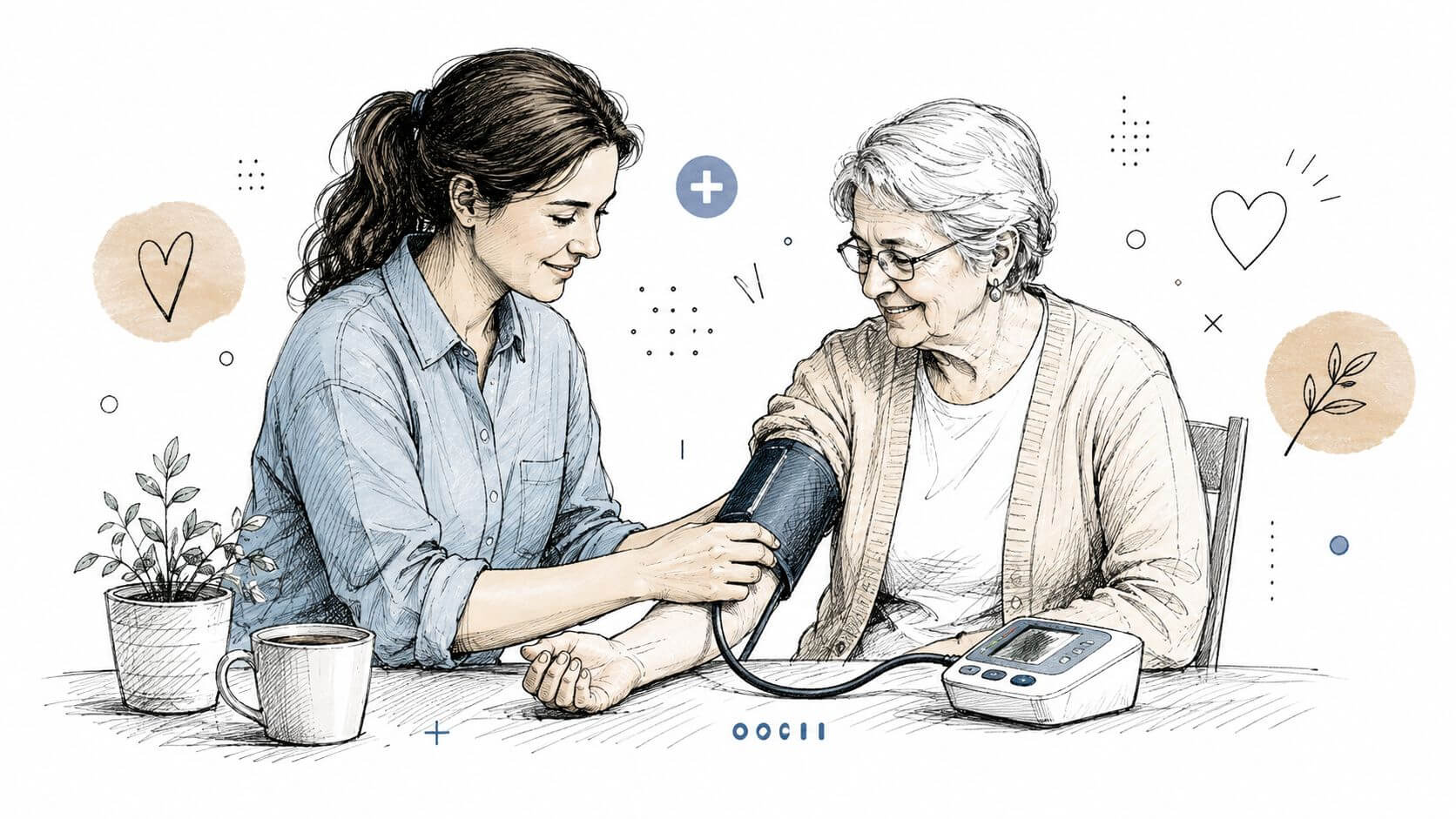
When a girl, spouse or home helper takes on the tension of a relative, he does not only fill a formality. He observes an evolution in conditions close to daily life, which helps the doctor to distinguish an isolated value from a real trend. This difference changes clinical reading, especially when the numbers vary from one take to another.
This logic is part of the history of tension measurement, sincehaemodynamometer described in 1828 by Jean Léonard Marie Poiseuille, then the armband of Scipione Riva-Rocci in 1896, until the auscultatory method of Korotkoff in 1905, still at the heart of modern practice (history of tensiometer and early inventions).
A measure only makes sense in time
The turnaround was not only technical. Old work has shown that people with high blood pressure, even without symptoms, are at a greater risk, which has made blood pressure a problem. major prognostic indicator. The practical point, for both the caregiver and the caregiver, remains the same. The figure only helps if it is reliable, dated and comparable.
A useful voltage measurement is a measure that can be read, compared and transmitted unambiguously.
In home care, this logic takes on even more weight, because many people can intervene around the same patient. The treating physician, the independent nurse, a caring relative and sometimes a physiotherapist do not always observe the same time of day or the same conditions. A clear trace avoids confusion between a really high tension and a context-related variation. shared medical record This is facilitated by well-organised monitoring, especially if the records are added in a readable and consistent manner (shared medical record, guide).
With Tribulys, this coordination logic becomes easier to keep on a daily basis. The measures can be kept, consulted and shared with the right interlocutors without losing the thread of the follow-up.
Prepare the measure to ensure reliable results
Most errors are played before even pressing the button. A person can be seated correctly, but if the measure follows an effort, a coffee or a stressful conversation, the figure no longer reflects the desired state of rest. As a self-measure, the reference in France is based on the rule of 3, with morning and evening readings during 3 to 7 days, and 2 consecutive measures at each session, spaced 1-2 minutes.
The moment chosen weighs as much as the device
In the morning, the measure is made before breakfast and before medicinal products. In the evening, she makes herself before bedtime. This organization limits the risk of confounding the effect of meals, activity or treatments with the tension value itself, as recommended Sickness insurance, taking tension at home.
You must also leave it. 5 minutes restin position Sittingwith the back and arm supported, the decrossed legs and feet flat. It's not just comfort, it's what reduces the biases associated with posture and muscle tone. If the person has just walked fast, climb stairs or speak long, it is better to wait a little and resume measurement in stable conditions.
The armband and equipment must be adapted
The armband must be at the good size. Too small, it can distort reading. Too big, it loses precision. For domestic follow-up, the most useful is a tensiometer. validated and easy to put correctly, preferably on the arm if the objective is a regular and comparable follow-up.
The armband is placed on naked skin, never on a garment, and he must marry the arm without overcompressing. The arm must remain motionless at the height of the heart during the whole take. This stability makes it possible to compare the results over time, without confounding a position error with a true clinical variation.
Practical rule. If the preparation changes from day to day, the figures become much less useful than the average obtained under constant conditions.
The measurement procedure explained step by step
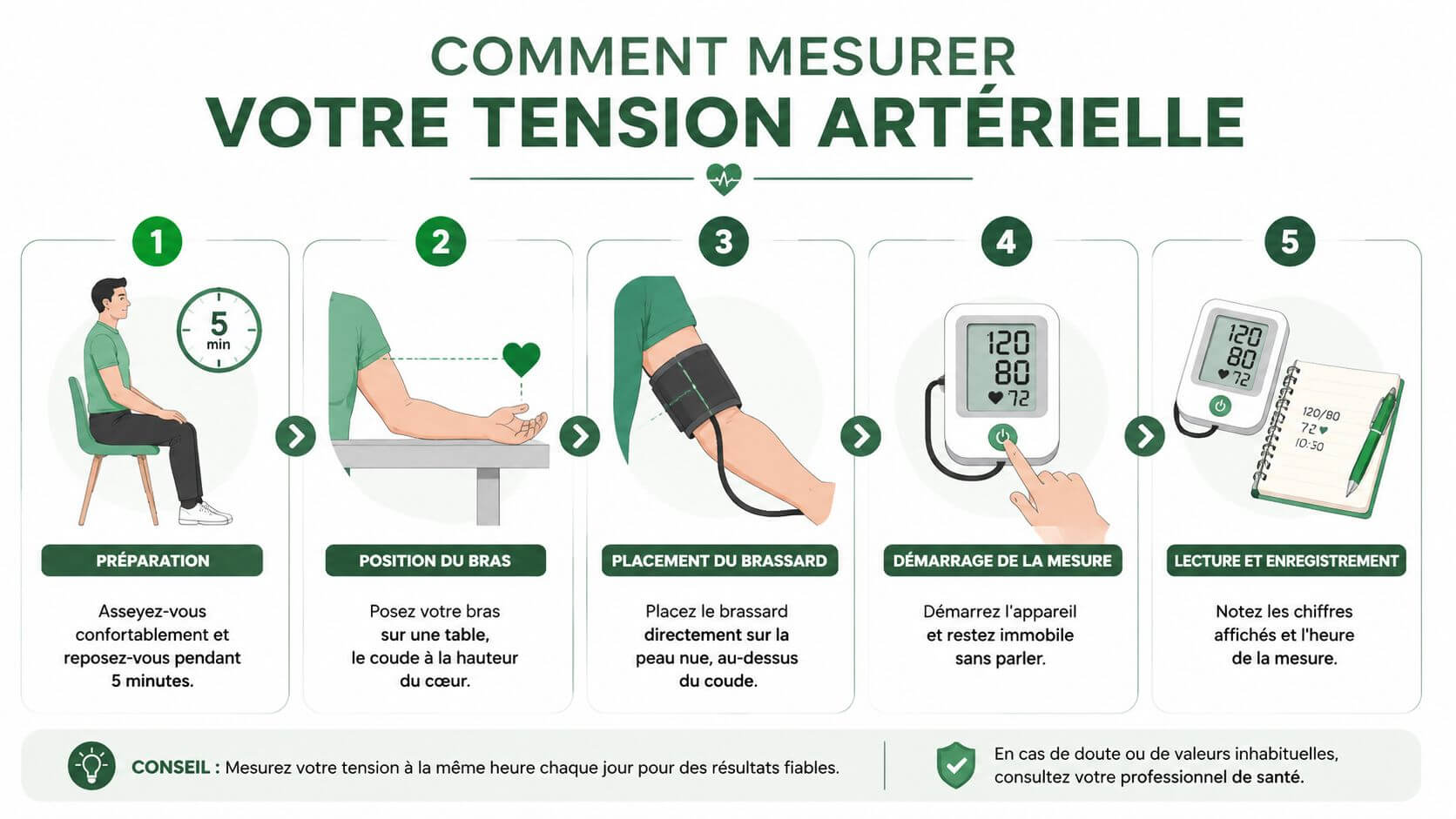
A useful measure is not limited to pressing a button. It depends on a series of simple gestures, executed in the same order, with the same position and calm. This is what makes it possible to obtain a figure that can be compared from one day to the next, without confounding a normal variation with a catch error.
Body posture changes reading
The person must be Sittingwith the back supported, the feet laid on the ground and decrossed legs. The arm rests on a table or support, so that the armband reaches the heart. If the arm hangs in the vacuum, the muscles contract more and the measurement becomes less reliable.
The brassard stands 2 to 3 cm above the elbow fold, directly on the naked skin, with the hose oriented towards the forearm. It must be checked that it does not turn and that it does not tighten a cross. A bad orientation does not always prevent the apparatus from inflating, but it can make the result more difficult to interpret.
Repeating gives us an exploitable average
For home follow-up, one does not just have a single value. The reference method is based on catches morning and evening for 3 to 7 days, 2 consecutive measures at each session, separated from 1-2 minutes. This repetition is used to smooth the deviations of the moment, not to look for a more flattering number.
The doctor needs a coherent set of measures, not an isolated result influenced by stress, fatigue or misexecuted gesture. In practice, this changes the reading much, because one person can show clear variations from one take to another without necessarily reflecting a clinical evolution. This is also what makes the reading more useful when it is shared with the health care team and recorded in a follow-up tool like Tribulys, instead of remaining scattered between paper, messages and approximate memories.
The best measure is therefore the one that can be placed in a series that is dated, repeated and taken under similar conditions. This helps the health care professional to distinguish a true evolution from a simple fluctuation.
Understanding numbers and interpreting results
When the device displays two values, the first corresponds to the systolic pressure, the second to the diastolic pressure. The systolic reflects the moment when the heart contractes, the diastolic phase of relaxation between two beats. For a helper, the goal is not to interpret everything alone, but to know when a value should be reverified, noted with its context, or transmitted to the doctor.
| Systolic voltage (mmHg) | Diastolic tension (mmHg) | Category |
|---|---|---|
| < 120 | < 80 | Normal |
| 120 - 129 | < 80 | High |
| 130 - 139 | 80 - 89 | Hypertension stage 1 |
| ≥ 140 | ≥ 90 | Hypertension stage 2 |
An isolated value doesn't say everything
A one-time measure may give a misleading impression. Stress, pain, lack of sleep, apprehension or simply the time of day often alter reading. It is for this reason that, in practice, more attention is being given to trend over several days a figure taken alone. HTA Foundation in France This is because tension is more pronounced over time than on an isolated survey.
I-I-Iwhite blouse effect This difference is well illustrated. A higher value in the firm does not automatically mean that the usual tension at home is the same. On the other hand, some people have reassuring numbers in consultation, and then higher values in them. A structured survey at home helps to make the difference between a reaction to the context and a really repeated tension.
What needs to be noted for the measure to be useful
The number alone is not enough to speak. The time, the position, the arm used, the possible repetition and the particular circumstances give meaning to reading. Without these elements, one risks overinterpreting a somewhat high value, or on the contrary, trivializing a signal that deserves to be reviewed.
Clear tracking also gains to be centralized. The simplest way is to record measurements in a shared space, for example with a digital transmission notebook, so that the caregiver and the health care team have the same history in the right place.
If the figures vary, the right question is not only "is it worrying?", but also "under what conditions was this taken?"
A well-informed series allows the health care professional to distinguish a stable tension, a context-related increase, or a discordance that deserves to be verified. This is what avoids making a decision on an overly fragile basis.
Common errors that may distort measurement
Most of the errors come from the gesture, not from the device. A measurement taken in the noise, with a cramped arm, a brassard badly placed or without rest time quickly loses its clinical value. Talking while taking can raise blood pressure and give a higher number than in reality, as recalled How to measure your blood pressure.
Mistakes that are most common
- Talk during inflation. Silence avoids an artificial increase in reading. If the person responds, the measure loses its comparability and it is better to take it back in peace.
- Leave your arm unsupported. An arm in the vacuum forces the muscles to work. The support must maintain it effortlessly, otherwise the displayed value can be distorted.
- Put the armband on a garment. The armband must be placed on naked skinOn a tissue, the pressure exerted is no longer reliably transmitted.
- Forget the height of the heart. An arm too low or too high changes the reading. Adjust the table, armrest or seat position before starting the measurement.
- Measure just after an activity or stress. The body has not returned to rest. The measurement does not reflect the usual state and may make it appear to be a more unstable tension than it is.
When the armband is not properly positioned or the arm is not supported at the right height, the gap may be sufficient to direct the follow-up in the wrong direction. Risk is not only a misleading figure, it is also a decision taken on a fragile basis.
A written routine is better than a fuzzy habit
Families who follow several measures gain to keep the same method at each take. transmission logbook or a structured digital space reduces oblivion, partial notes and readings out of their context (transmission logbook). When several caregivers take turns, this rigor quickly becomes indispensable, for an incomplete survey is as badly read as an incorrect measurement.
The right reflex is to correct the detected error immediately, then to repeat the measurement after a few minutes of rest. This simple gesture avoids giving weight to a figure damaged by precipitation or by an overly agitated context.
Follow the constants and alert the doctor with Tribulys
Measuring tension is useful only if the information reaches the right person at the right time. This is where coordination becomes decisive, especially when several caregivers take turns, the passages multiply and the notes disperse between paper, messages and calls. 1 in 3 adultsand home follow-up recommendations are still poorly adapted to complex situations where several caregivers intervene around the same patient (French Federation of Diabetes).
When to notify the doctor without delay
Some values should be reported quickly, especially if they are repeated or associated with symptoms. In practice, a very unusual number, a series that goes up sharply, or a value that does not correspond to the patient's usual profile justifies contact with the attending physician. If the patient has additional malaise, chest pain, shortness of breath or neurological disorder, follow the emergency course appropriate to the situation.
The important point is not to turn each gap into an alarm. It is to identify the persistent changes, those that are found on several measures taken correctly. This is exactly the type of information that a shared follow-up makes more readable.
Why shared tracking changes the situation
A single notebook allows you to enter the value, time, context and name of the person who measured. When the history is organized, the doctor reads the patient's path much faster. This avoids misunderstandings related to scattered messages and lost documents.
A tool such as Tribulys is used to centralize constants, transmit them between caregivers and caregivers, and keep a clear record of the measurements over time. Secure messaging and structured tracking also facilitate exchanges when there is a need to clarify a value, a schedule or an anomaly (Secure health messaging).
The right reflex, after every important step, is to record it immediately and keep it accessible to the whole tribe. This is what turns an isolated figure into exploitable medical information.
If you're coordinating the power supply at home, centralize your readings, comments and exchanges in a single clear space. Tribulys to follow the constants, share useful information with caregivers and keep a reliable history to show the doctor.
Put this organisation into practice with Tribulys
Keep your care journal, shared calendar, tasks, medication tracking and emergency information together. Start for free and invite the relatives and professionals involved in your loved one’s care.