
The State Diploma of Caregiver, the DEAS, is now preparing in 1,540 hours on 44 weeks since the reform of 2021. It is this diploma that opens the door to the profession of aide-soignant in France, with structured training in equal parts between theory and practice.
You may be comparing schools, checking registration deadlines or looking for a path compatible with your current life. In this case, the real subject isn't just how long it lasts, it's also what route I'll be able to enter without fooling myself, and then hold on to the duration.
Contents
- Understanding Caregiver Training
- The State Diploma and its New Reference
- Different Ways of Access to Training
- Costs, Financing and Registration
- Content Pedagogical and Acquisive Skills
- Tips for Choosing and Preparing Well
- Resources and Next Steps
Understanding Caregiver Training
A candidate I often see comes up with the same idea at the beginning, she wants to help, she already knows a little about the care, but she does not yet know what the actual carer training really covers. She quickly discovers that the profession is not limited to giving a hand, because it is based on gestures, observations, transmissions and a regular presence with the accompanied person.

The DEAS The official framework has been re-engineered by the decree of the 10 June 2021, with a passage of 1,435 hours and 41 weeks to 1,540 hours and 44 weeks, and a reclassification to Level 4. This development marks a clear professionalisation, as training now combines 770 hours of theoretical teaching and 770 hours of practice, either 22 weeks in institute and 22 weeks in a professional setting (Ministry of Health).
What it changes for a candidate
Before choosing a centre, you have to look at the logic of the course, not only its title. The repository organizes the rise in competence around 5 blocks, with formal validation by criteria, thus reducing exit gaps between institutes (Legislation).
A good reflex is to connect your project to a real field. Someone who targets the hospital, home or EHPAD will not learn in the same daily setting, even if the degree concerned remains the same.
The right choice is not the nearest center, it is the one whose rhythm, the internships and the accompaniment correspond to your situation.
The Tribulys site on the Home maintenance gives a good point of entry to understand how the transmissions and the concrete organisation of the follow-up change according to the place of exercise, and why these topics are already central even before entry into training (Tributelys.fr).
The State Diploma and its New Reference
The DEAS is not a simple school title, it is a strictly supervised professional certification. The new reference framework is based on a more legible logic for applicants, with total training of 1,540 hours, spread over 44 weeks, and a validation thought around skill blocks rather than a fuzzy accumulation of courses (Legislation).
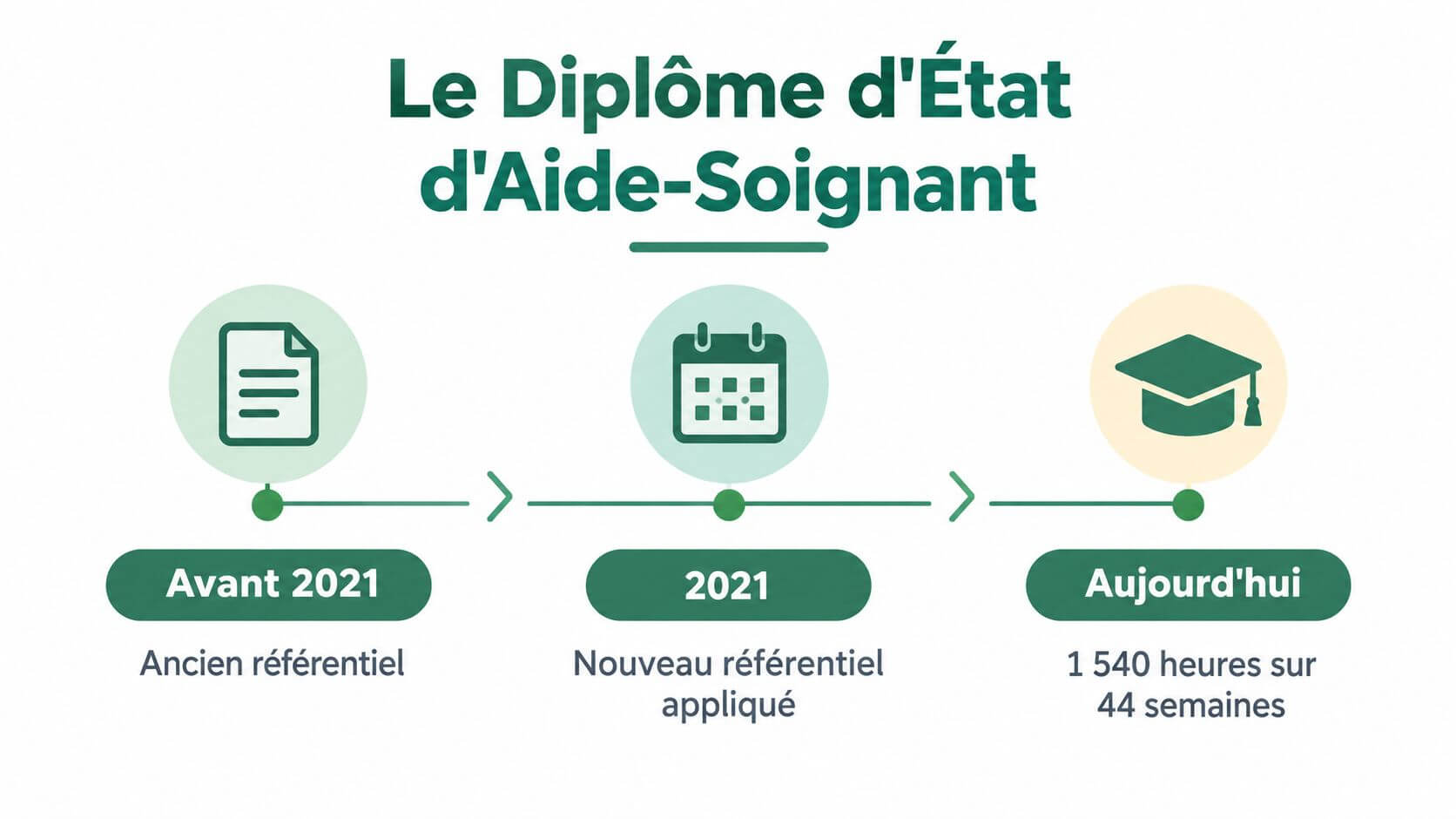
Before and after 2021
The old model was shorter, more fragmented, and the reform clearly toughened the structure. The Ministry confirms that the curriculum is now being built to better link learning, clinical setting and risk management, with an explicit place in the simulation in health and block evaluation (ANFH).
The important point, for a future candidate, is that this reform does not only change the volume of hours. It changes the way of learning, because we now expect a sharper progression between observation, understanding, and then safe execution of everyday gestures.
The level expected today
The transition to Level 4 It is not symbolic. It places training in a more professionalised logic, with clearer expectations on the transmission of information, rigor in observations and the ability to work as a multi-professional team (Ministry of Health).
The most important thing in training is not to make a lot of it at once, it is to do it right, to say clearly what we have seen and to know who to transmit.
In practice, this repository reassures some candidates and destabilizes others. It reassures, because it frames progress. It destabilizes, because it requires a true learning discipline, not just motivation.
Different Ways of Access to Training
Not all candidates enter through the same door, and that is what avoids a lot of unnecessary confusion. The right path depends above all on your situation at the time you are applying, not on a single model supposed to suit everyone.
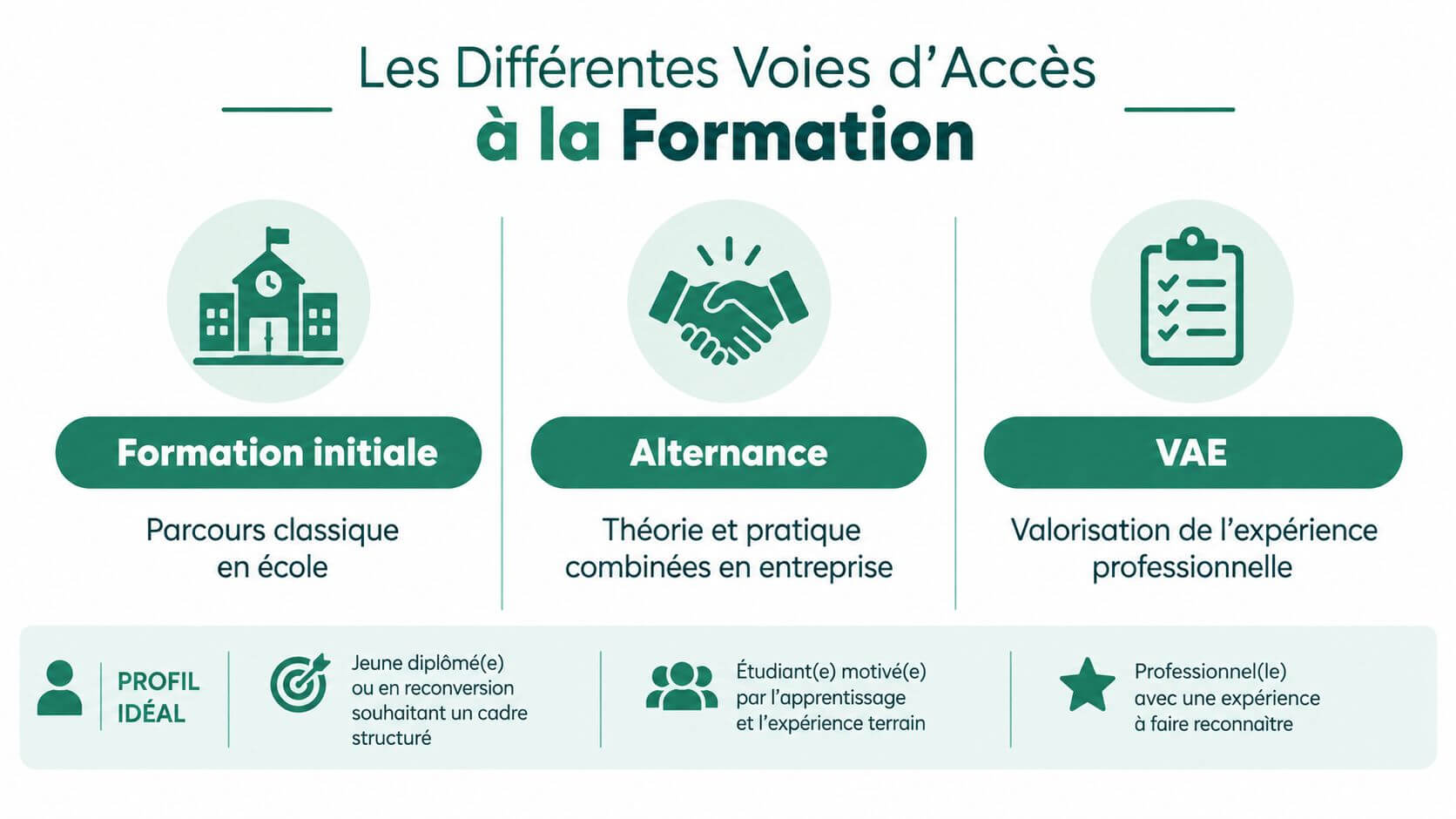
Three profiles, three logics
The initial training is often suitable for those who leave school or want to enter the profession with a classic setting.alternation Talks more to people who need to stay connected with a professional activity, because it combines theory and practice in a more integrated organization in the world of work.
The VAE It is intended for those who already have experience in an environment close to care and who want to make this experience recognized. It does not replace the learning effort, but it values a practice already installed, provided that it is sufficiently documented and consistent with the repository.
How to choose without dispersing
The right criterion is not "which path is the fastest", but "which path is the most tenable for me". A person undergoing retraining does not have the same constraints as a student, and an employee cannot always follow the same pace as a full-time candidate.
| Profile | Often the most suitable route | Attention |
|---|---|---|
| Departure without long experience | Initial training | Support the rhythm of a structured journey |
| Employment status | Alternative | Articulating working time and learning time |
| Field experience | VAE | Preparing a Strong and Coherent File |
This type of reading avoids many mistakes. We still see candidates embarking on a path simply because it looks simpler, whereas the right question is rather that of the timetable, the energy available and the level of autonomy already acquired.
Costs, Financing and Registration
The true cost of a health-care assistance training is rarely understood in a single figure. Teaching fees vary by institute, and registration schedules also change a lot from one institution to another, requiring early verification of dates, documents requested and admission procedures.
In some cases, fees can become a real brake. By 2025/2026, field sources report educational costs of up to 7 800 €, which completely changes the arbitration of a candidate for conversion or already in office (IFSI.fr).
Finance without waiting for the last moment
The decisive point is to link the project to the right financing. Depending on your situation, you can look at thelearning, the VAE, CPF or employment-related care, but the exact eligibility must always be verified with the host organisation and the funder.
The deadlines count as much as the budget. Many candidates take it too late, while a complete file, a request for care and confirmation of entry take time, especially when several interlocutors have to validate the same path.
Preparing his file with method
- Check IFAS regulations to find out the expected documents, filing dates and any fees.
- Anticipate funding before final registration, especially if you intend to mobilise a job-related device.
- Gather your credentials in a legible manner, with consistent information from one document to another.
- Keep a margin of time for administrative exchanges, as responses rarely happen on the same day.
Digital tools are also starting to count in the preparation process. Some candidates are getting used to co-ordination materials close to those they will find in the field, especially for transmissions, shared tasks and monitoring of information that is useful on a daily basis.
Content Pedagogical and Acquisive Skills
The heart of training is the way in which one learns to observe, transmit and act reliably. The trade repositories published by France compétences de la transmission of comments an area of activity in its own right, with the obligation to transcribe the data collected and to transmit information relevant to the maintenance of continuity of care and activities (Uniformation).
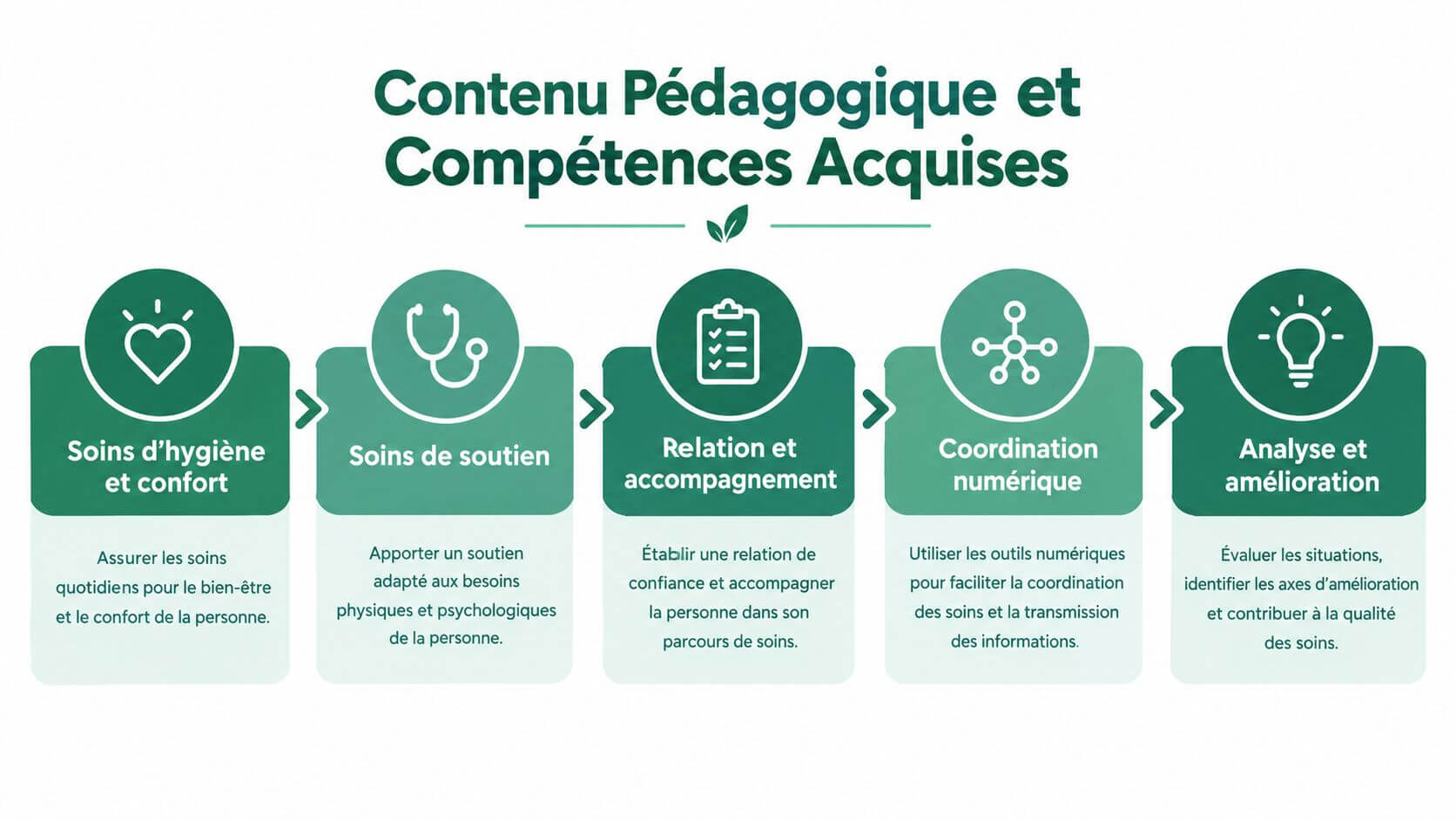
The gestures are not enough
Future caregivers obviously learn hygiene care, comfort, support for daily activities, and clinical condition monitoring. But the difference between a good beginner and a fragile candidate often lies in the quality of his or her transmissions, his or her ability to name what he or she has seen and how he or she fits into a team.
The ANFH document recalls that the carer has a fundamental role in the transmissions, that he must report all his observations and that his responsibility is involved in the relevant transmission of information, in particular via the Targeted transmissions (ANFH).
The role of digital in learning
It is here that modern tools take on educational interest. A digital link book, a shared calendar or a division of tasks allow to work, in simulated situations, the quality of an observation, the accuracy of a message and the continuity of a support.
Tribulys can be used in this type of workshop as a coordination support, with a time-coded link book, shared calendar, tasks and emergency card. A trainer can thus make a group work on the writing of dated information, the distribution of passages and the response to an unforeseen event, without leaving the concrete framework of the home.
When a transmission is imprecise, it is not only a wrong word. It is sometimes a delayed action, a doubled care or a forgotten deposit.
The care journal for home care services is also defined as an exchange tool. day by day between stakeholders, assisted person and family, with dated information, an identified author, and contact details useful in case of emergency (Helpers.fr) This is exactly the type of support that helps a candidate move from theory to clean, readable and coordinated transmissions, as is also found in the home care coordination explained on Tribulys.
Tips for Choosing and Preparing Well
A good IFAS is not just about reputation or proximity. It is necessary to compare the pace of the internships, the way the follow-up is organised, and the clarity of the information given before the start of the training, because one poorly informed candidate is fatigued faster than another.
Preparation for admission is mainly due to the consistency of the project. The jury wants to hear a future caregiver who knows what he is looking for, why he is moving towards this profession, and how he is dealing with schedules, standing stations, teams and transmissions.
Preparing with the right benchmarks
An interview succeeds better when the candidate speaks of concrete situations. An experience in contact with dependent people, even short, gives relief to the speech, because it allows to evoke precise observations rather than abstract motivation.
There is also a need to work on the differences between roles. Confounding caregiving and nursing remains a common mistake, and it is very quick to see when the candidacy lacks precision about the actions, limits and place on the team.
The best preparation is to be able to explain what you saw, what you understood, and then what you would do differently the next time.
What it's best to check before registering
- Date of entry, because it varies according to the institutes.
- The format of admissions, folder alone, maintenance, or complementary steps.
- Funding opportunitiesespecially if you're already in employment.
- The adequacy of the internship project with your future field of exercise.
Mental preparation also counts. Training requires endurance, so it is better to enter with a simple organization, realistic revision habits and a clear vision of the pace to be kept, rather than with a list of objectives that are too ambitious.
Resources and Next Steps
A solid file starts with reliable markers. To check the framework of the DEAS, first consult the official texts on Legislation, then compare the sites of the IFAS in your territory, as they are the ones that specify the schedules, the terms of access and any fees.
For a candidate, this step is similar to the preparation of an internship before entering the institute. You gather what counts, you remove the superfluous, and then you advance with a readable file. If your course is based on experience already acquired, gather the relevant proofs from the start. If you are aiming for a classic path, check your availability before sending your application, in order to avoid a gap between your return to school and your personal constraints.
The method remains simple, check, compare, apply. A good file shows above all a clear, realistic and coherent project with the profession.
Tribulys helps structure useful transmissions, planning and information around the home, which joins the expected skills in caregiving training. To see how a digital link book and a shared calendar can support daily coordination, visit Tribulys and observe its use in field situations.
Put this organisation into practice with Tribulys
Keep your care journal, shared calendar, tasks, medication tracking and emergency information together. Start for free and invite the relatives and professionals involved in your loved one’s care.