
You are probably at a very concrete crossroads, with a dossier to be mounted, a conversion to the head, and a real question in the background, is the aide-career training Is it worth it for you now, or is it another idea we're pushing back to later? The useful answer is not theoretical, it holds in one thing, this course is short, professionalizing, very framed, and it leads to a recognized State diploma in a sector which remains massive, with 30,300 students or students preparing a degree in nursing in 2023 according to the DREES, and 93,300 registered in the first year of training for non-medical health professions in 2024, i.e. +2 % as compared to 2023 (DREES).
The profession is not ideal. It is physical, demanding, relational, and it asks to act quickly without mistake. But it opens a clear entrance to care, with an alternation of terrain, institute and internship that forces to learn for real, not only to recite courses.
Contents
- Start your training as a caregiver
- Conditions of access and eligible profiles in 2026
- Content, duration and organisation of the DEAS
- Funding aide-career training according to its status
- Selection, Examinations and Registration Schedule 2026
- VAE, conversion and place of the ground
- Checklist and tips for successful training
Start your training as a caregiver
When arriving in IFAS, three doubts often arise: your legitimacy, the physical reality of the trade and the pace of the internships. Add a question rarely addressed at the beginning: will you be able to meet the concrete needs of a person at home, while coordinating your observations with caregivers and other caregivers? The trade is not limited to the actions that are being learned. He asks to observe, transmit and hold your place in a team.
What the degree really changes
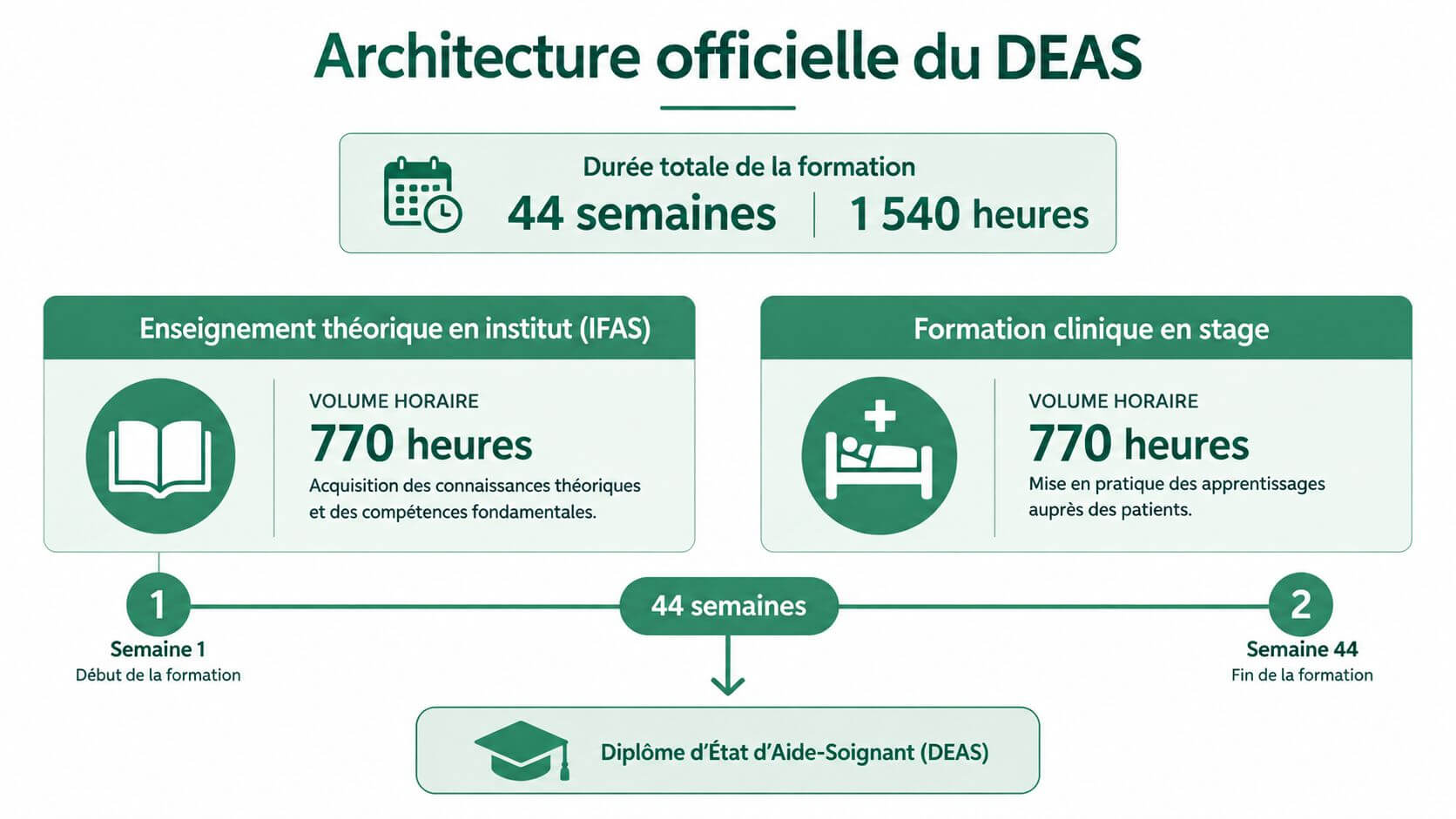
The DEAS It not only serves to validate a project. It gives you a professional framework to intervene with dependent people, understand your responsibilities and adjust your actions to each situation. The current system is based on a training reingenerated by the decree of 10 June 2021, with 1,540 hours on 44 weeks, allocated to 50/50 between institute and internship, then validated by 5 skill blocks (Ministry of Health).
The framework is therefore short, but dense. The courses give the benchmarks, the simulation allows to repeat, and the courses confront these acquired to the constraints of the service or the home. You will have to learn to prioritize, to report an evolution and to transmit exploitable information. The theoretical preparation is not enough if it does not help you to manage fatigue, intimacy, unforeseen and relationship with the loved ones.
Simple rule, Choose this training if you already accept the rhythm of care, internship learning and the discipline of a collective trade.
Your status will also weigh on the journey. The time available, the income maintained and the expenses to be expected are not the same for an employee, a job seeker or a person undergoing retraining. Check this point before you commit, as a solid professional project can become fragile on an poorly prepared financial organization.
The six steps that follow help you to deal with these decisions in the right order, without reducing the job to a promise of employment. aide-career training It remains accessible, but requires endurance, constant adaptation and a realistic view of the terrain, including when care is built with caregivers at home.
Conditions of access and eligible profiles in 2026
Access to DEAS The national framework recalls the absence of a condition of diploma, which attracts a wide variety of profiles, from secondary school students in guidance to employees in retraining, to job seekers and professionals already employed in care (Ministry of Health).
The three entrance routes
We have to distinguish three paths, otherwise we mix everything and build a bad file.
- Initial route, for high school students who enter training as the first professional project.
- Learning, for young people in alternation and certain profiles beyond the classical framework depending on the situation.
- Continuing training, for employees, jobseekers and persons undergoing conversion.
The principle is simple, the way of entry must stick to your status, not to your desire for the moment. An apprenticeship file is not constructed as a dossier of conversion. An employee is not organized as a free candidate. This is where many are mistaken.
Parts to prepare without dragging
The file is almost always based on common bases, but it must be squared.
- ID, for administrative identity and registration.
- CV, to show your journey without drowning the jury.
- Letter of motivation, to connect your story to the profession.
- Funding rationale, if your status so requests.
- Certificates of traineeship or experience, when you have already touched the care or accompaniment.
Candidates who have already worked as ASH, help at home or in an environment close to care are often invited to a positioning interview. It makes sense, the jury wants to know what you can do, what you think you know, and what needs to be upgraded.
| Entry route | Eligible audience | Main parts of the folder |
|---|---|---|
| Initial route | Lyceans, students | ID, CV, cover letter |
| Learning | Young people in alternation, certain profiles changing according to the situation | Identification document, CV, cover letter, contract or project justification |
| Continuing training | Employees, jobseekers, retraining | Identification document, CV, cover letter, proof of funding, certification of experience |
Content, duration and organisation of the DEAS
The DEAS is not played in a block of theory before the real field. It relies on an alternation thought to make you move from observation to gesture, then from gesture to transmission. For the student, it means a simple thing, the formation must stick to the real care, not to an abstract version of the profession.
The formal structure of training
The above-mentioned national framework 1,540 hours on 44 weeks. This base is divided into 770 hours in institute and 770 hours in clinical placementThe logic is clear, every knowledge has to be verified on the ground, otherwise it remains theoretical.
The 5 skill blocks structure the diploma. They must be read as a set of professional gestures, not as isolated subjects.
- Support and care of the person, in the acts of daily and social life.
- Clinical status assessment and the implementation of appropriate care.
- Information and support people and their entourage.
- Maintenance of immediate environment and materials related to care activities.
- Multi-professional team work and processing of information.
What really works in the institute
The institute is used to lay the foundations often lacking at the beginning, hygiene, emergency actions, patient rights, clinical tracking, communication, and situationalization. The ministry recommends a simple progression, starting from the block objectives, chaining with simulation and directed work, and then validating the internships with explicit criteria.
The trap is classic, believing that presence is enough. What matters is the proof of competence. You have to show that you are watching just, that you are alerting at the right time and that you are transmitting without losing the information.
The right question isn't "did I do my internship?", but "what better do I do when I get out of the internship?"
The internships that must be taken seriously
The land must confront you with several realities: Ehpad, hospital, home or home care service according to local standards. The home is often underestimated. Yet, this is where the gap between theory and real life appears most clearly.
On the ground, the care is not limited to gestures. You have to understand the caregivers, deal with short visits, follow the organization of the home and maintain the coordination around the person cared for. This is also where the profession takes its true dimension, working with the team, but also with the relatives, without blurring the roles.
Funding aide-career training according to its status
Funding is often dealt with on a daily basis, while it decides on the remainder, the timing and sometimes even the entry into training. aide-career training and find themselves in totally different situations depending on their status. The amounts change according to the IFAS, the method of care and the file of the candidate. IFITS This is a good illustration of these differences, but the target establishment grid remains the only reference to be checked.
The real cost depends first on your status
Apprenticeship remains the easiest way to read. The employer and the OPCO take care of the training, with a paid alternation. On the other hand, insufficient personal funding or a CPF can leave a burdensome remainder. The right logic is clear, it is necessary to secure the financial assembly before locking up the school.
For example, an institute displays in 2026 6 374 € for an unfunded student, 8 654 € with employer or financer, and rates close to 9 240 € on certain routes. These amounts come from a single institution and show above all the extent of possible variances. Always check the pricing of the target IFAS before signing.
Direct advice, file your funding file before blocking your entry. A solid file without funding often ends with an avoidable delay.
The devices to consider according to your profile
The right device depends on your situation.
- CPF, if your meter covers a useful part of the cost and the remaining charge remains acceptable.
- Learning, if you can enter an alternate logic with remuneration.
- AIF or POE, if you are a job seeker and your advisor validates the entry.
- Region, if your territory funds training in some settings.
- Skills Development Plan, if you are employed and the employer accepts the investment.
- Personal funding, if no other support comes to fruition.
The deposit order counts as much as the system. Start with employer support or alternation, then look at the CPF, then the employment or regional assistance, and finish with self-financing if nothing goes wrong. It's less attractive than a fast-delivered file, but that's what avoids calendar errors.
The real subject is not only the price displayed. It's also what you have to pay, what you get during the training, and the flexibility you keep if your project moves.
| Status | Recommended device | Cost to the applicant | Compensation |
|---|---|---|---|
| Apprenticeship | Learning | Very limited to zero depending on the case of care | Yes |
| Employee | Competency Development Plan, CPF as appropriate | Variable depending on folder | Yes if salary retention, otherwise agreed |
| Job seeker | AIF, POE, regional aid by territory | Variable, sometimes zero, sometimes partial | Depending on the device |
| Individual conversion | CPF, then abundances possible | Variable, often partial | Non-systematic |
| Personal funding | Self-financing | Highest for the candidate | No |
Selection, Examinations and Registration Schedule 2026
The selection has changed its nature. It is less academic than before, but more demanding on the consistency of the course. The jury is not looking for a perfect profile, it is looking for a credible candidate, stable, and already aligned with the profession.
What jurors really look at
The file remains the first door. CV, motivation letter, experience and logic of the project have to tell the same story. If your file says "I want to help," but your journey does not show human contact, involvement, or understanding of the care setting, you're going wrong.
The mouth often slices. It's not about reciteing a speech. It is necessary to know how to speak of a situation of lived help, to explain what has been observed, what has been understood, and what the profession imposes in terms of discretion, transmission and posture. We need to talk about the aide-career tradeNot a nurse's fantasy.
The schedule to be closely monitored
The registration periods vary according to the IFAS, but logic 2026 usually follows deposits between January and June, interviews between March and July, and then a re-entry most often at the beginning of September (Memo Cards CaregiverSome establishments close fast, so waiting for the last moment is a bad strategy.
Already qualified profiles can benefit from developments, in particular the holders of CAP ASSP, of bac pro ASSP or FROM AES. The idea is not to pretend to discover the system at zero when you already have a relevant base. Jurors see him immediately.
Errors that cause points to lose
- Generic folderwhich could be sent to any channel.
- Job project blurred, without any concrete connection to the care.
- Self-Centred Speech, instead of a speech centered on the person accompanied.
- Poor understanding of the profession, especially when you confuse caregiver and nurse.
- Sub-preparation of the oral, while this is often where everything is played.
VAE, conversion and place of the ground
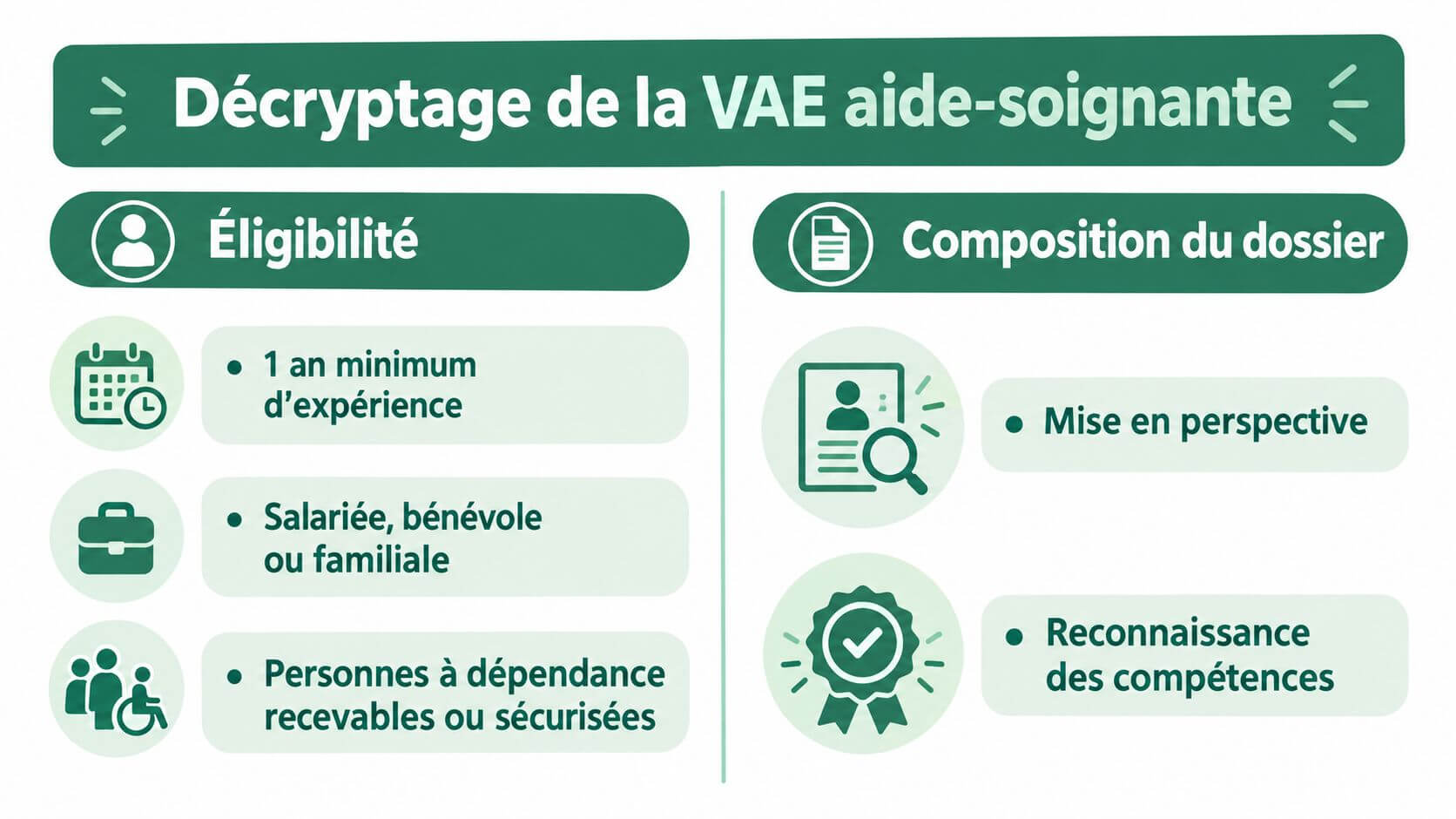
The Caregiver EAW It is interesting, but it is not a magic shortcut. It is mainly used to recognize what people already know how to do on the ground, provided they document it properly. For profiles in conversion, it is more logical than to start a training course again as if the experience did not exist.
Why VAE deserves to be taken seriously
Candidates who have worked in Ehpad, in the hospital, in home service or with dependent relatives often already have gestures, reflexes and an understanding of the daily lives of fragile people. The VAE makes it possible to transform this experience into official recognition, provided that they maintain a solid record, with the CERFA, Admissibility booklet and a jury interview of about one hour, according to the usual circuits of the device.
The strong point of the EAW is that it avoids repeating content already mastered. The weak point is that it requires a real ability to formalize what we do, not just to do it. Many candidates know how to help, few still know how to explain their practice with precision.
What the field reveals and that training needs to better integrate
The standardized framework does not exhaust reality. Home maintenance, coordination with family caregivers, digital transmissions and business tools require additional reflexes. Training focused solely on the institution leaves a blind spot, because the home requires dealing with relatives, irregular rhythms and scattered information.
In this context, coordination tools such as Tribulys can serve as organizational support around transmissions, tasks and home-based follow-up, especially when several caregivers and professionals work around the same person. It's not the heart of the degree, but it's become a real field subject.
When the VAE is the right choice
It is relevant if you already have a real experience of care or accompaniment, and if you are ready to prove your skills with method. It is less so if you are only looking to avoid training. To complete an EAP, you must focus on areas where the terrain is more technical, coordination, transmissions, relationship to the entourage, and digital monitoring tools.
Checklist and tips for successful training
The biggest job starts before entering the IFAS. A good candidate does not wait for the meeting to organize, he anticipates the dates, the funding, the oral preparation and the constraints of the internship. This is the difference between a file that passes and a file that floats.
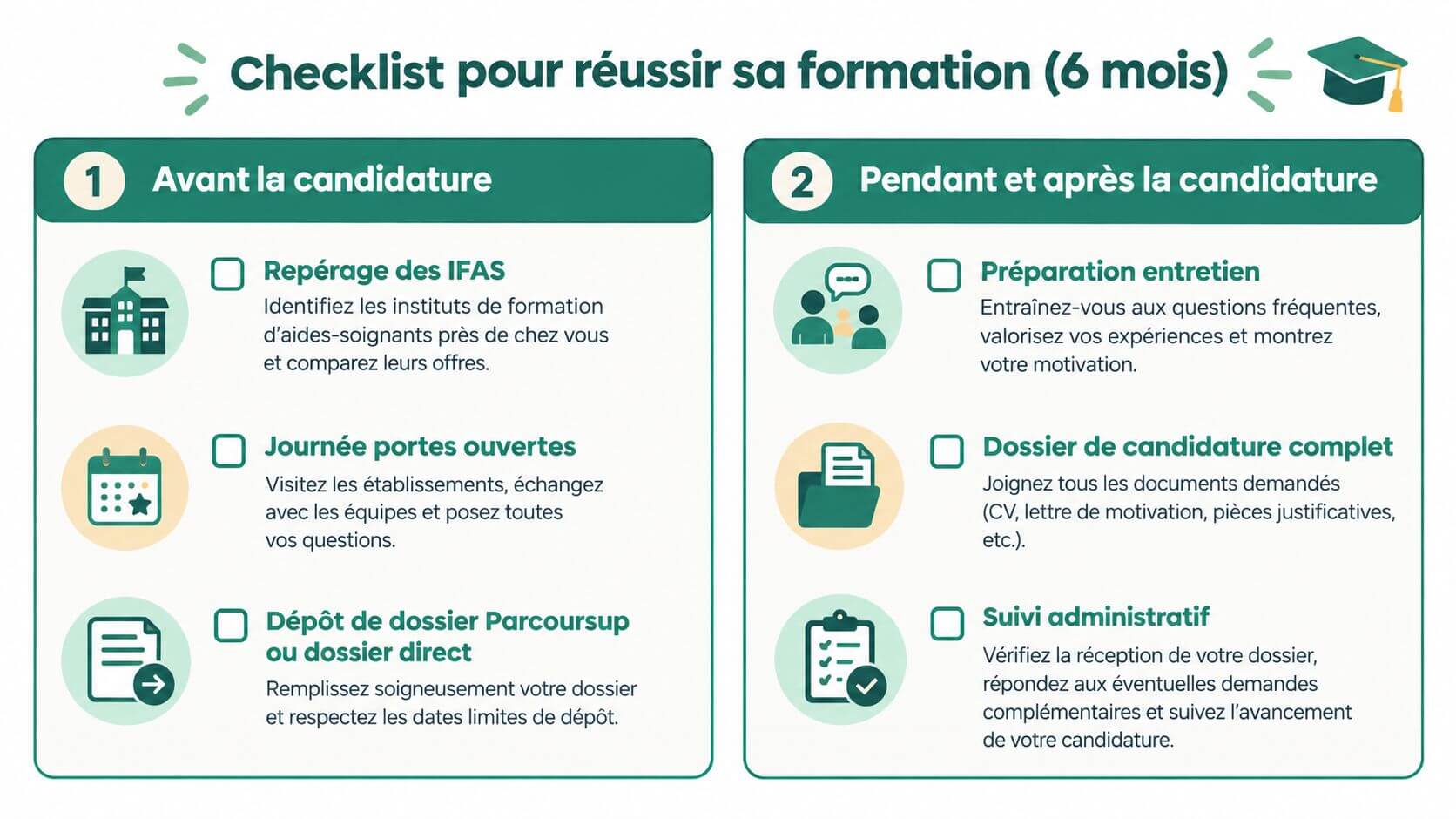
Six-month checklist
- Identify IFAS, compare modalities, internships and schedules.
- Take part in an open day, to see the expected level and ask the real questions.
- File folder, online or online depending on the institution.
- Preparing for maintenance, with concrete examples of aid situations.
- Close funding, before the final agreement.
- Finalize registration, and then arrange medical and material examination.
Adapting your preparation to your profile
A high school student must show that he or she knows the reality of the care, not just the image he or she has of it. A job seeker must lock up funding and availability. An employee has better use his or her career as proof of professional maturity. A candidate for retraining must explain what he or she transfers from his or her former life to the trade.
To be avoided absolutely, a generic file, a letter of motivation copied, and an underestimation of internships at home. These are the three dumbest and most frequent mistakes.
The resources to consult without losing you are the site of the ARS of your region, the Portal of the Routeup if your way goes through it, and the network of targeted IFAS. To go further on the preparation of the file, see also useful benchmarks for the aid-career application.
The selection is done before entry. Success is played over time, in your ability to keep pace, learn from the ground and transmit just.
Tribulys centralizes the transmissions, planning, documents and reminders around a person assisted at home, which exactly matches the coordination difficulties that many caregivers encounter in internship or exercise. If you are planning a career in care or are looking to better organize home follow-up, go see Tribulys and look at how the tool can structure exchanges between friends and professionals.
Put this organisation into practice with Tribulys
Keep your care journal, shared calendar, tasks, medication tracking and emergency information together. Start for free and invite the relatives and professionals involved in your loved one’s care.