
At 7:30 a.m., your mother waits for the nurse. At 8:15 a.m., the home care worker arrives, but no one knows if the morning medication has already been taken. Your brother thinks the medical appointment is tomorrow, while the attending doctor has not received the last observations. The information exists, but it is scattered between calls, text messages, paper books and family memories.
It is in this situation that the expression EHPAD at home Makes sense. The subject is not just to finance a few hours of help or to avoid an entry into the institution. A reliable system must be organized, capable of functioning despite absences, changes in schedules and multiplicity of stakeholders.
Contents
- Understanding the concept of home EHPAD
- Accompaniment models and medico-social architecture
- Financing and eligibility conditions
- Human benefits and operational limitations
- Practical path to structure the home
- Coordination of care in the digital age
- Anticipating the future and supporting caregivers
Understanding the concept of home EHPAD
Marie wants her father to stay at home. He knows every room, his neighbours visit him and his attending doctor has been following his evolution for a long time. Yet, after a fall and worsening of his cognitive disorders, the needs far exceed the help of the household. We must coordinate nursing care, meals, toilets, appointments, treatments and information transmitted to the family.
One EHPAD at home, also called EHPAD outside the wallsdoes not legally transform housing into an institution. The term refers to a coordinated organization that seeks to provide the home with continuity of follow-up, monitoring and the flow of information close to those proposed in a medical-social structure. It is therefore not an isolated service, but an assembly of professionals and devices around a life project.
Practical rule: If no one knows who is involved, what has been done and what needs to be done next, the family has not yet built an EHPAD at home. It simply adds benefits.
The concept is part of a long-standing evolution of home care. historical reminder of home hospitalization shows that the Laroque report of 1962 marked a turning point, before the recognition of the HAD by the hospital law of 30 December 1970 and its consecration as an alternative in its own right in 1991. A decree of 2007 then expanded the HAD to include persons welcomed in EHPAD and EHPA, then the decrees of September 2012 extended its scope to social and medical-social establishments with accommodation.
Initiatives specifically thought of as EHPAD at home remain recent. The oldest identified date of 2015, and more than half have been born from 2017, according to the same historical source. This model responds to a clear demand, maintaining home markers while strengthening the organization around a person who has become very dependent.
The limit is equally clear. The home does not spontaneously offer the continuous presence of a team. Therefore, it is necessary to build this continuity, define responsibilities and provide a solution when one of the links is missing.
Accompaniment models and medico-social architecture
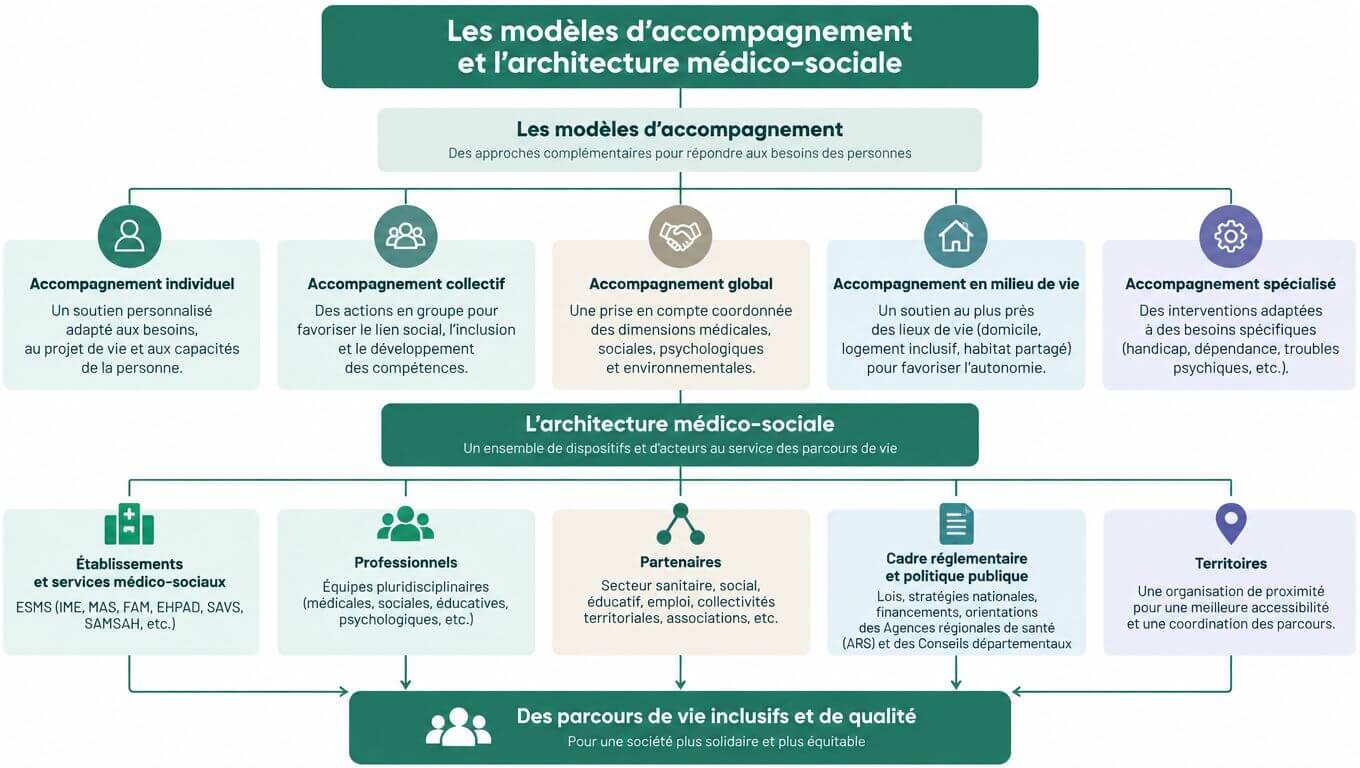
Home maintenance is based on several actors, each with a different role. The difficulty comes less from the existence of the services than from their articulation. A nurse can provide the prescribed care, a home care worker help with the toilet or meals, a doctor adjust the treatment, and a relative monitor the general condition. Without coordination, these interventions remain parallel.
Who acts for what need
The Home autonomy services The reform described by the Ministry of Solidarity on Home Self-Government Services The aim is precisely to facilitate the bridges between help and care. It is essential to prevent a person from receiving a toilet aid without the useful observations being passed on to the caregivers.
The SSIAD is mainly involved in nursing and hygiene care for people in need of regular support. Independent nurses and nursing centres can carry out prescribed procedures and participate in clinical follow-up.HAD, it responds to complex care situations requiring a strengthened medical and care organization at home. It therefore does not automatically replace daily life support services.
The treating physician It maintains a central role. It evaluates the evolution of the state of health, coordinates medical decisions and can direct to the appropriate devices. Living aids, for their part, often observe the first changes in habits, diet, mobility or behaviour. Their transmission should not remain informal.
The pivotal role of TRCs
The Regional Resource Centres, or CRT, provide a particularly close response to the logic of an EHPAD outside the walls. They organize coordination between the caregiver and health professionals, including home care and help services, the attending physician and specialists. TRC system submitted by the department is also based on agreements between EHPAD and home services.
In concrete terms, a TRC can help to reduce ruptures during hospital discharge, worsening of health status, or change of management. It does not remove local constraints, but it provides a point of support to identify stakeholders, clarify responsibilities and adjust the course.
The family must ask three things from the first contact with a service: which coordinates, How information circulates and what happens in case of absence or emergency. If the response remains vague, the device may rest entirely on the primary caregiver.
Financing and eligibility conditions
Funding is important, but it must not be the only starting point. A family can get financial assistance and stay in difficulty if the hours are poorly distributed, if the stakeholders are not passing on anything, or if the actual needs are not properly assessed.
I-I-IAPA, or Personalized autonomy allowance, is the main lever for financing some of the assistance needed for an elderly person who is losing autonomy. The request is made to the departmental council, which evaluates the situation and establishes a plan of assistance. The level of dependence, appreciated in particular through the GIR classification, influences the assessment of needs and the mobilizable aids.
The steps to follow
Start by formalizing the needs, without minimizing them. Note the necessary aids in the morning, evening and night, the prescribed care, appointments, travel difficulties and times when the caregiver is not available. A file based on a real week is more useful than a general description of the daily life.
Then submit the application to the departmental council and request a home assessment. Prepare contact information for the attending physician, useful prescriptions and a list of stakeholders already present. This preparation allows the assessor to understand the difference between the theoretical assistance and the organization actually needed.
In 2026, the APA-funded national home helper floor rate is fixed at 25 €. This amount serves as a benchmark for the financing of the intervention, but it does not guarantee that all project expenditure will be covered. The aid plan, the rest of the costs and any unfunded hours must be checked.
| Device | Main objective | Indicative amount or ceiling |
|---|---|---|
| APA | Financing part of the aid linked to the loss of autonomy | National floor tariff of 25 € in 2026 for APA-funded home help |
| Respite aid | Allowing a caregiver to blow or be replaced | Until €583.52 per year in accordance with applicable conditions |
| AJPA | Compensating certain periods spent with a close friend | Ceiling 66 days and 66,64 € per day, depending on the devices |
Respite aid does not replace a permanent organisation. They are used to prevent the primary caregiver from carrying absences, weekends and recovery periods alone. They should be included in a schedule, rather than only when exhaustion is already in place.
Finally, clearly separate three budgets: hours of help, care and accommodation. This distinction facilitates applications and quickly reveals areas not covered. A decision to keep at home is only solid when the family knows both the funding obtained, the remaining expenses and the plan for worsening.
Human benefits and operational limitations
Staying at home preserves landmarks, familiar objects and some of the decision-making power. For a disoriented person, finding the same environment every day can make routines easier. The family can also preserve an emotional relationship that is not limited to checking a toilet, a meal or a medication.
But the home is not automatically simpler. Each passage becomes an element of a chain. A delayed intervention can shift a meal, a toilet or a treatment. A statement transmitted to a single relative can disappear when he or she works, sleeps or is not reachable.
The last kilometer is the real point of tension
The home care sector lacks room for improvement. 69,560 projects for the recruitment of home helpers and life helpers are planned in 2026, with 62.3% of recruitment difficulties, according to data published by the Ministry of Solidarity on Home Help Trades. For a family, this translates into difficult replacements, modified schedules and sometimes fragile continuity.
The main risk is therefore not only medical. It is organizational. Who warns the family when a passage is cancelled? Who checks that the person ate? Who reports unusual confusion? Who confirms that a statement was understood by the next intervenor?
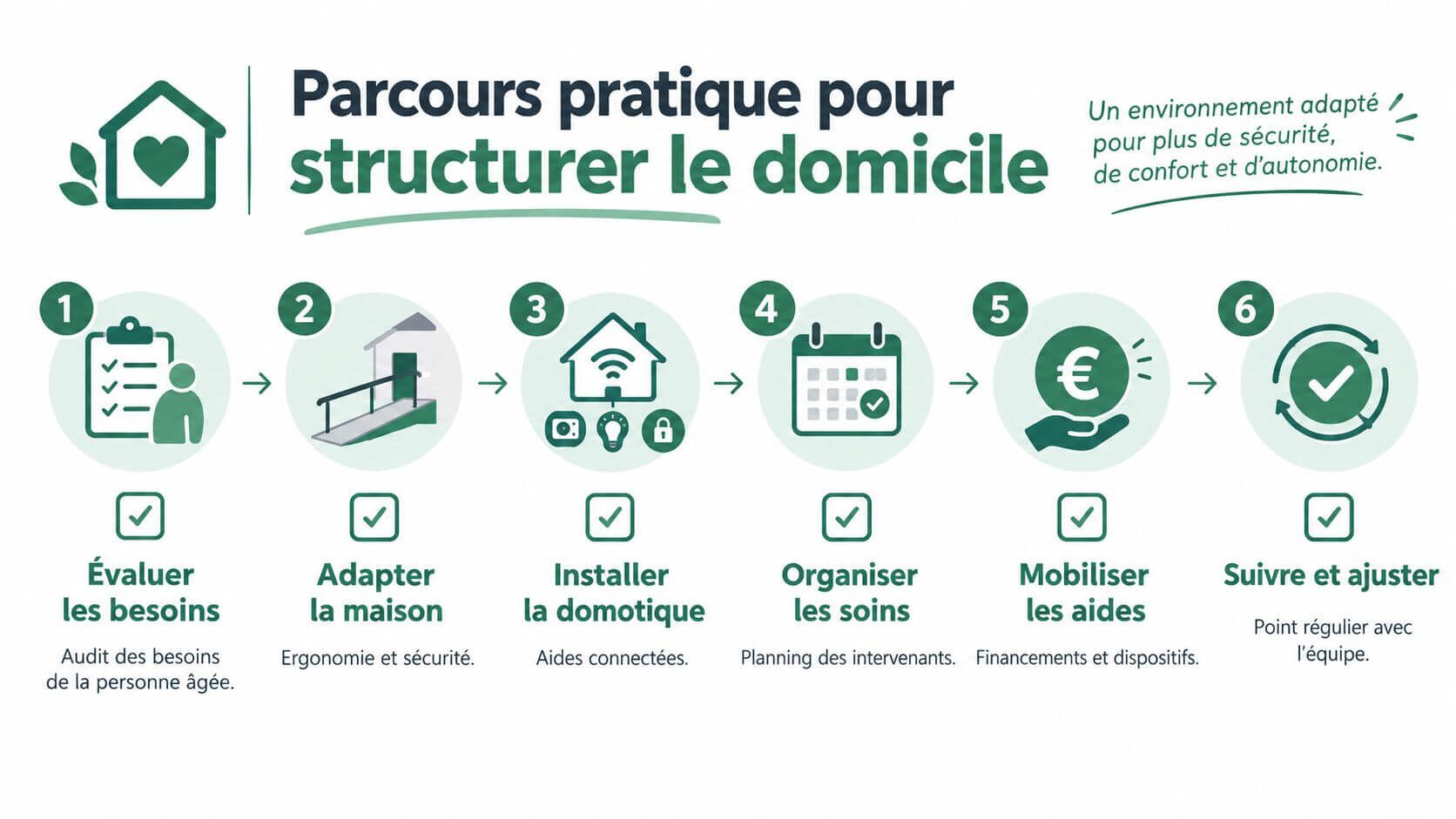
Compare the following two organizations:
- Fragile organization: The next of kin divide calls, the stakeholders use a notebook rarely consulted and the changes are sent in several conversations.
- Organization: Each passage follows a common instructions, tasks are assigned, important events are timed and the team knows where to find the up-to-date information.
The second organization does not solve the shortage of professionals. However, it limits the errors caused by this shortage. Your priority must be continuity of information, even when the continuity of people is not perfect.
Practical path to structure the home
A suitable home is not limited to installing a support bar. Space, care, responsibility and transmission must be organized simultaneously. The Bank of the Territories estimates that 708 million annual hours by professionals to the dependent elderly, with a half distribution between home and EHPAD, according to the analysis taken by the CNSA Home and EHPAD Presentation. The volume of intervention makes a common method indispensable.
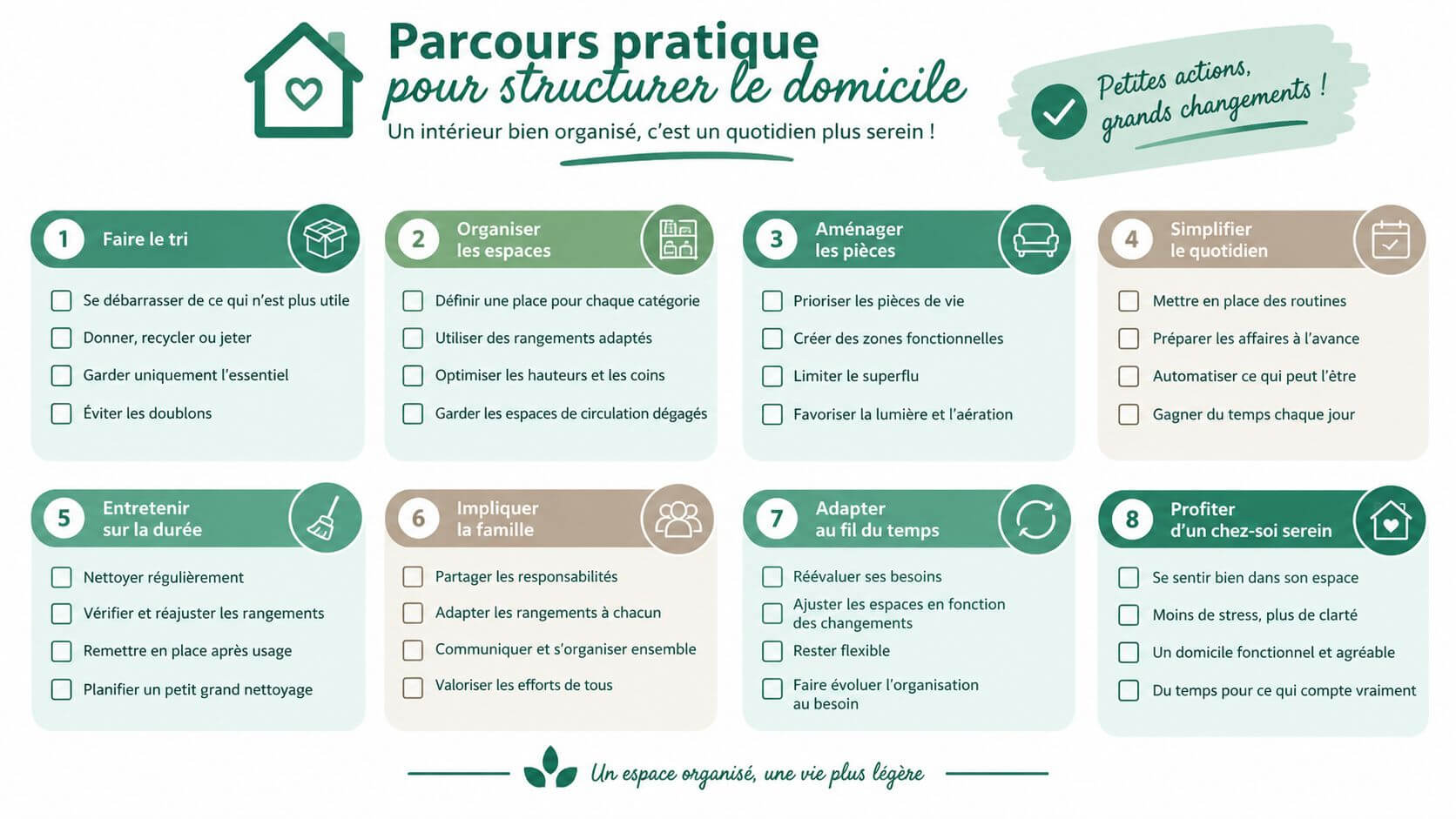
Start with a daily audit
For several days, observe the times that are problematic. Note the difficulties in getting up, washing, dressing, eating, taking medication and moving around. Add less visible situations, such as night calls, missed appointments or conflicts between family orders.
Then adjust the accommodation according to the identified risks. The bathroom often deserves special attention, as it concentrates transfers, humidity and travel in a restricted space. To think about a suitable layout, consult this bathroom project with Home, by checking that aesthetic choices serve the safety, accessibility and habits of the person.
Home automation can complete the layout without replacing it. Automatic lighting, remote assistance or a detection device can reduce certain risks, but no tool must give the illusion that a human presence is useless. The family must always know who receives an alert and how soon this person acts.
Write rules of operation
Build a team around explicit roles. The attending physician controls medical decisions, nurses ensure prescribed actions, home care workers accompany everyday actions and relatives organize family aspects. These boundaries must be written, because misunderstandings arise especially when each thinks that the other takes care of them.
The schedule must display passages, appointments, priority tasks and replacements. It must also provide for unusual situations, such as a person who refuses to eat, a fall without apparent injury or an absence from home.
To deepen the concrete organization, consult this guide on the Home maintenance. The aim is not to fill in tables for themselves, but to give each participant identical and usable information.
A useful transmission answers four questions: What happened?, What has been done?, What remains to be done and which must be notified. Avoid vague formulations such as "medium state" or "to be monitored". Prefer a precise, contextualized and dated observation.
A care room project or dedicated space must remain compatible with the privacy of the person. The home must retain its character as a place of life, even when professionals often intervene.
To view a complete organization of passages and responsibilities, here is a complementary video resource:
Coordination of care in the digital age
The paper book is useful, but it quickly reaches its limits when several people intervene. A text message can remain unanswered, important information can be lost in a family conversation and a phone call does not always leave a trace usable. The problem is not the lack of good will. It is the absence of a common history.
A numerical coordination solution must meet specific uses. It shall be used to consult the planning, confirm a task, transmit an observation, find a prescription and identify the author of an information. It must also remain accessible to people who are uncomfortable with digital tools.
What to Centralize
A shared space can bring together the elements that most often cause errors:
- Drugs: taken confirmed, recall, possible forgetfulness and searchable history.
- The meetings: date, schedule, designated accompany and special instructions.
- Comments: changes in appetite, pain, fall, fatigue or change in behaviour.
- The documents: Orders, minutes, contact information and emergency records.
- Responsibilities: assigned tasks, planned passages and actions still open.
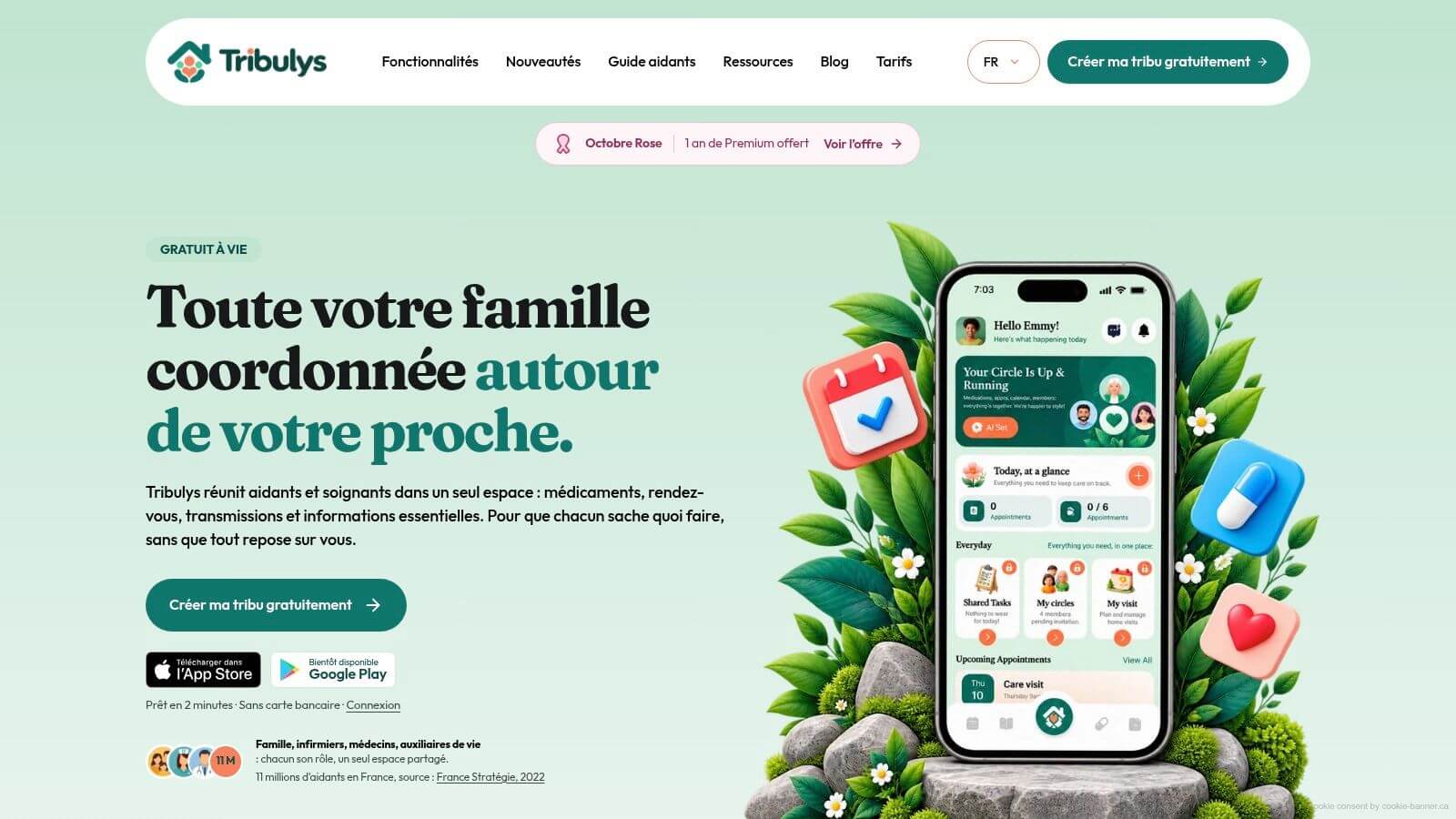
Tribulys centralizes information, transmissions and planning in a web and mobile application for family caregivers and professionals around a loved one kept at home. The platform includes a timed link book, a shared calendar, a follow-up of medicines, tasks, an emergency sheet and a safe deposit box. It is hosted in France with HDS certification, and access is limited to authorized members with traceability by author and time stamping.
Traceability is not used to monitor professionals. It allows you to reconstitute the course of a day, identify missing information and prepare for a more accurate exchange with the doctor. Remote relatives can also follow syntheses and alerts without multiplying calls.
To learn more about the methods of sharing between relatives and stakeholders, consult this content on the coordination of home care. The tool does not replace clinical judgment or human relationship. It provides a common basis for everyone to work with the same version of the facts.
Anticipating the future and supporting caregivers
An EHPAD at home is not a final decision. Health status can change, night needs increase and relatives lose the ability to perform certain tasks. The family must schedule re-evaluation points, even when daily life seems to be stabilized.
Observe the signals that require rapid discussion: repeated falls, regular refusal to eat or wash, more frequent confusion, hospitalizations, very disturbed nights, lack of reliable replacement or exhaustion of the primary caregiver. None of these signs automatically mean that the home is impossible. They indicate that the current organization may not be enough anymore.
Decision responsible: To keep someone at home is not to be able to support everything in the family. It is to ensure a safe, re-evaluateable and sustainable environment for the person receiving care as well as for those who accompany him.
Delegating technical coordination allows relatives to remain children, spouses or siblings. They can devote their time to speaking, going out, listening and sharing moments that are not only devoted to care. This separation between emotional and operational management protects the relationship.
If home care reaches its limits, start the steps before the crisis. Ask the treating physician for further advice, contact the local services and compare the accommodation or relay solutions available. Prepare an alternative is not forsaken. It is to avoid an important decision being made in the emergency after hospitalization or exhaustion of a loved one.
Tribulys brings together planning, transmissions, medicines, tasks and documents in a shared space to structure the daily life of a loved one kept at home. To reduce forgetfulness and better distribute responsibilities between family and professionals, discover Tribulys and start organizing your coordination.
Put this organisation into practice with Tribulys
Keep your care journal, shared calendar, tasks, medication tracking and emergency information together. Start for free and invite the relatives and professionals involved in your loved one’s care.