
Marie caught a big cold, she thought it was all over after a few days, then the cough came back, dry, embarrassing, with whistles when she was climbing the stairs. Her son hesitated between a relapse, an asthma that turns out, or a VOCID that hangs around. This situation is classic among caregivers, and it deserves a simple reading, because a respiratory noise that worries is not necessarily an emergency, but it is never a detail to ignore either.
The Asthmatiform bronchitis and VOCID-19 Both give cough, sometimes shortness of breath, sometimes chest oppression, and the doubt is common. The right reflex is to understand what distinguishes one from another. postviral bronchospasm, asthma and one SARS-CoV-2 infection, then to know what to watch at home, what to pass on to the doctor, and when to call without delay.
Contents
- When a cough that whistles worries after a virus
- Understanding Ashmatiform bronchitis and its vocabulary
- Distinguish bronchitis asthmatiform, asthma and VOCID-19
- Useful check-up at home and in the doctor
- Therapeutic options and relief actions
- Warning signs and times to consult
- Coordinate family and caregivers around the loved one
- Limitations, medical follow-up and frequent questions
When a cough that whistles worries after a virus
When a loved one starts coughing after a cold or a VOCID, the first question is not "is it serious?", it's "is it moving in the right direction?". A cough that whistles to exercise, and sometimes to rest, makes you think of a bronchi that has become irritated and reactive, a bit like a pipe that contracts as soon as it is stimulated. This painting can be impressive in the ear, but it is often reversible.
The key point for a caregiver is to avoid confusing three different stories. Asthmatiform bronchitis often follows a viral episode, a asthma is a chronic disease that comes back, and a VOCID-19 The French surveillance also recalls that respiratory signals often coexist, with periods when VOCID and bronchial damage circulate in parallel, which explains why a wheezing cough after virus deserves to be taken seriously without being dramatized (Public health France).
Practical benchmark: If the cough comes back after an improvement, it is necessary to think in terms of evolution, not only in terms of the new symptom.
The purpose of this guide is simple. Identify the correct vocabulary, make the difference between similar tables, know what to rate at home, recognize alert thresholds, and transmit useful information to the caregiver without turning every family observation into a diagnosis.
Understanding Ashmatiform bronchitis and its vocabulary
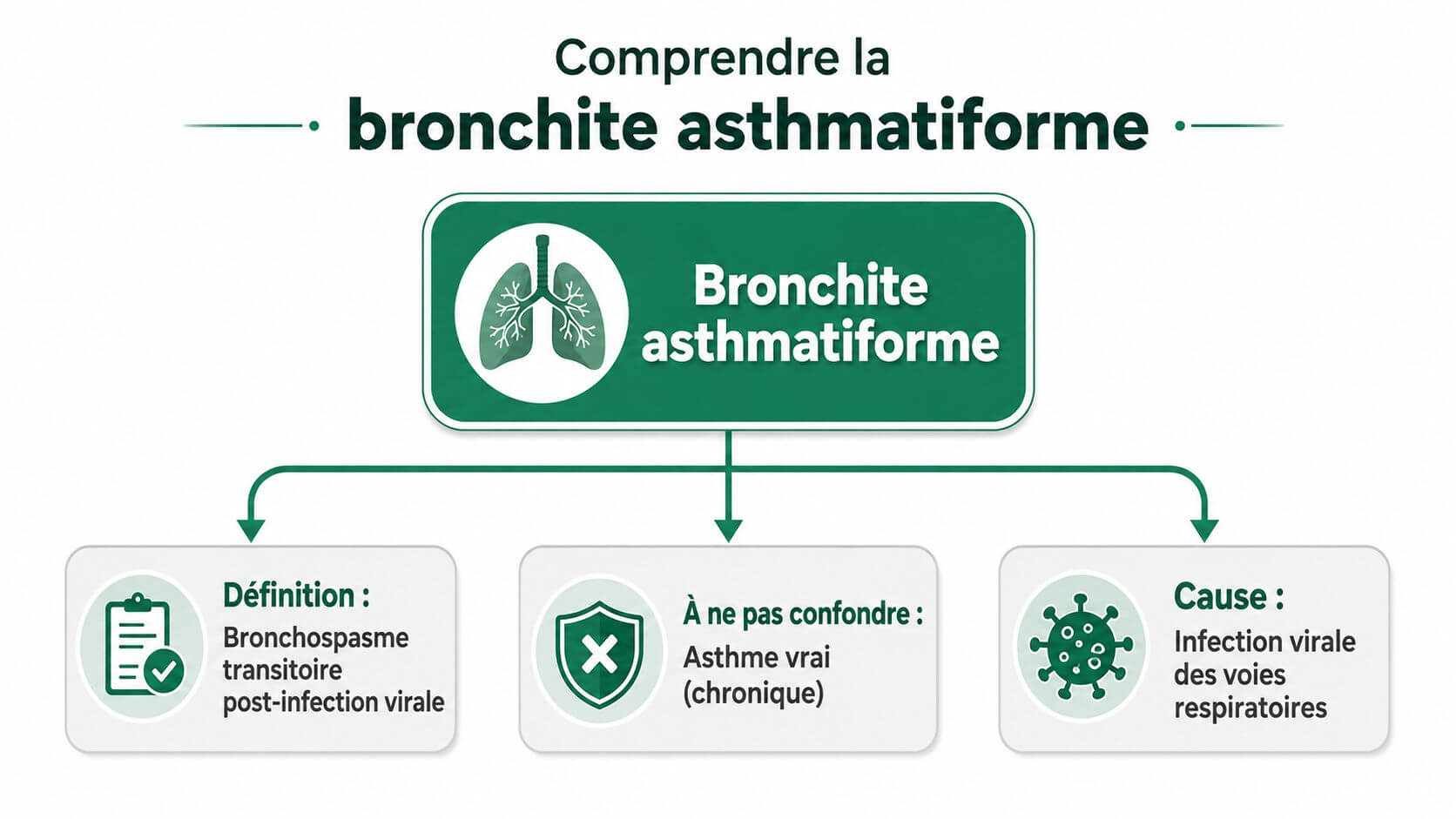
The Asthmatiform bronchitis is not a true asthma. In practice, this term is often used to describe a bronchial inflammation with whistles, occurring after a viral infection, transient bronchospasmThe Société de pneumonologie de langue française does not recommend this word, because it can delay the search for authentic asthma and lead to unnecessary antibiotics, whereas we should rather talk about postviral bronchospasm or d-postviral bronchial hyperreactivity (MedecinDirect).
What's going on in the bronchi
The mechanism is quite simple. After a respiratory virus, the bronchial mucosa ignites, inflates, produces more mucus, and the bronchial muscle contracts in a reflex way. cough, the expiratory whistles and the sensation ofthoracic oppression. It's noisy, sometimes tiring, but it's not a chronic disease by nature.
The term is questionable because it mixes clinical appearance and background disease. In an adult without known asthma, the post-viral episode is often transient. In a person who repeats episodes, however, one has to ask whether there is a underlying asthma rather than a simple bronchitis, especially if bronchodilators clearly relieve.
Why this vocabulary helps caregivers
Saying “asthma-like bronchitis” may be reassuring at first, but the term can also mislead. “Asthma-like” does not mean “asthma” or “a lifelong condition”. The more precise terminology, postviral bronchospasm, helps to understand that the objective is to calm a transient inflammatory reaction, then to check that everything is in order.
To be noted: If the episode repeats, we don't stop at the word bronchitis, we're looking for a root cause.
Distinguish bronchitis asthmatiform, asthma and VOCID-19
The three paintings can be similar on the ground. Cough, shortness of breath, wheezing and chest oppression overlap, and that is precisely why clinical examination and context are essential. antigenic or PCR test helps to slice, including in pharmacy for the antigenic test, because the symptoms alone are not always enough (Qare).
| Criterion | Bronchite asthmatiform | Asthma exacerbation | VOCID-19 |
|---|---|---|---|
| Background | After respiratory virus, often with persistent cough and whistles | Known asthmatic terrain, or high suspicion of asthma | Acute infectious picture, sometimes within a family viral circulation |
| Chronology | Often following a cold, flu or other virus | Can be triggered by virus, stress, irritant | Sudden or progressive onset, with respiratory and general symptoms |
| Swirls | Common, especially at expiration | Common, sometimes more marked | Possible, but not specific |
| bronchodilator response | Often good if bronchospasm is real | Often clear if asthma is involved | Variable, not enough to exclude infection |
| Indication of the VOCID test | Useful if doubt persists | Useful if compatible symptoms | Essential in case of suspicion |
The context helps a lot. Brutal fever or VOCID-compatible symptoms are oriented towards SARS-CoV-2 infection, while allergic terrain, history of asthma, and net improvement under bronchodilator are oriented towards asthma. If the whistles follow a cold in a non-asthmatic person, with no clear signs of infection, asthmatiform bronchitis or post-viral bronchospasm become more plausible.
Tobacco blurs everything. It maintains bronchial irritation and complicates the reading of symptoms, so a helper who seeks to understand the whistles of a loved one will gain to consult also a useful landmark on the subject as the Link between cigarette and asthma, especially when the cough repeats.
Useful check-up at home and in the doctor
At home, the goal is not to make a diagnosis. The objective is to spot the evolution, to note what changes, and then to transmit simple data. An isolated measure says little, but a two or three day evolution helps the doctor to decide a lot.
What a caregiver can notice without heavy equipment
- Temperature: take the value with a frontal or tympanic thermometer.
- Breathing at rest: Count the chest movements for one minute.
- Poultry: raise heart rate if a wrist saturometer or reliable device is available.
- Appearances audible: Note if they agree without stethoscope.
- Night cough: specify if she wakes up the next of kin or prevents him from sleeping.
- Colouring: monitor lips and extremities.
- Duration of symptoms: Register since when it all started, especially if a VOCID is suspected.
In the physician, the assessment goes further. He searches for a history of asthma, auscultus, can ask for a VOCID test if necessary, and measures oxygen saturation. A chest x-ray can be useful if an overinfection should be ruled out. The right reflex, before the appointment, is to gather three very concrete elements, the starting date, the evolution day by day, and the treatments already tried.
| Measurement | At home, by the caregiver | To the doctor |
|---|---|---|
| Temperature | Raised with a thermometer | Interpreted with other signs |
| Breathing | Counted on one minute at rest | Examination and clinical examination |
| Saturation | If oxymeter available | Confirmed and contextualized |
| Symptoms | Cough, whistling, sleep, coloring | Clinical Analysis and Severity Research |
| Treatments already tested | Record what was taken and at what time | Adjust or confirm support |
The most useful is precision. A timed figure is better than a vague impression, and a written evolution is better than an uncertain memory. To prepare this type of exchange, a simple memo like that proposed in this guide on the preparation of a medical appointment can serve as an example of a family framework.
Therapeutic options and relief actions
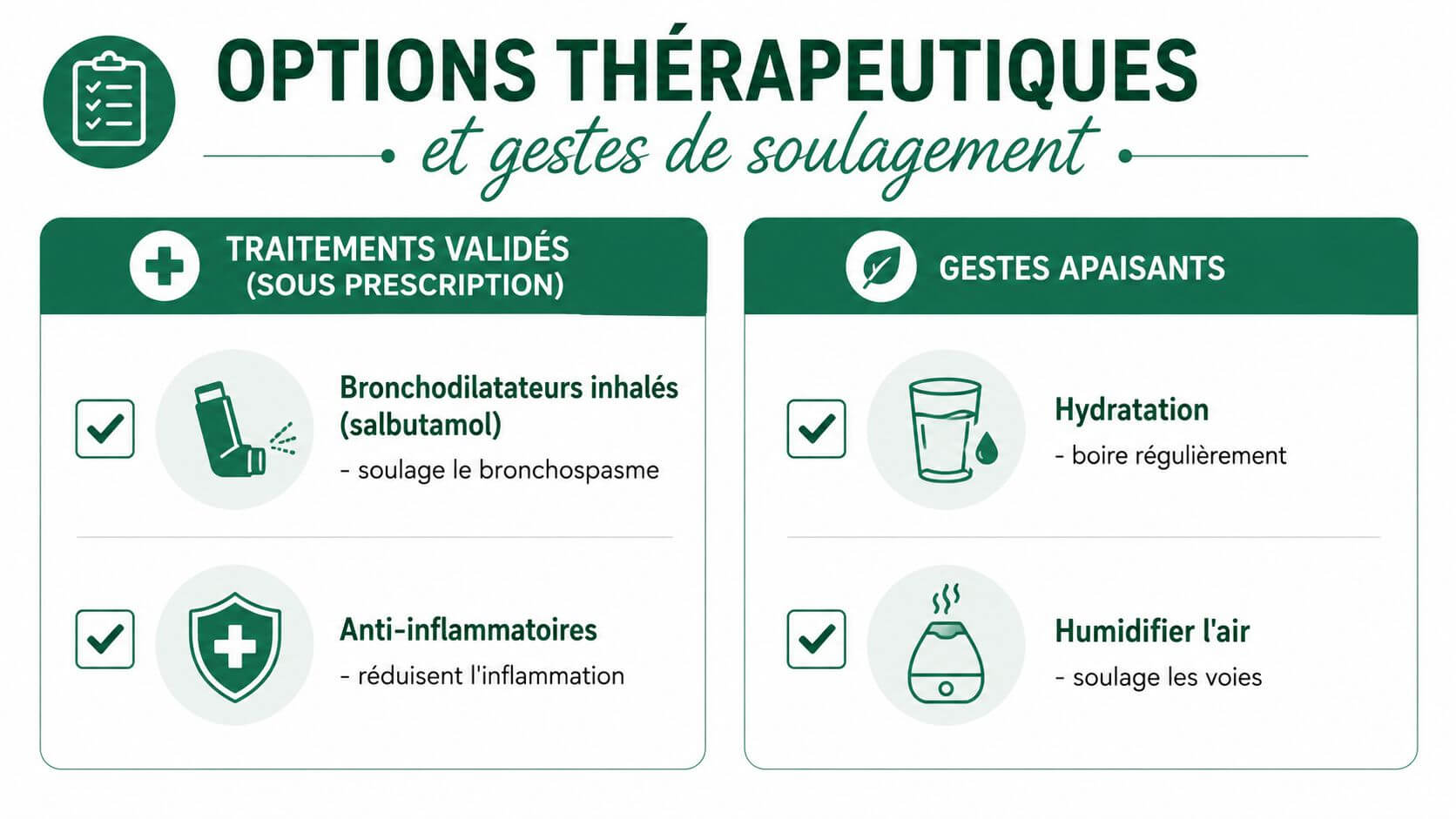
When cough whistles after a virus, the first question is simple, should the bronchial opening, calm the inflammation, or treat another cause. The doctor chooses according to respiratory discomfort and clinical examination. Inhaled bronchodilators of short duration of action, such as the salbutamol or terbutaline, can be proposed when whistles are present. They release the bronchi, as you loosen too tight a hose, and an inhalation chamber often helps to send the medication better. To facilitate the management of drugs, consult our guide on how to management of medicines with Tribulys.
Treatments that may be prescribed
- Inhaled Bronchodilators: they relieve the bronchospasm when it exists.
- Oral or inhaled corticosteroids: they are reserved for severe or prolonged forms, on prescription.
- Antibiotics: They're not automatic. They only discuss if a bacterial overinfection is suspected by the doctor.
Daily gestures also have their place. Drinking regularly, humidifying the ambient air, sleeping in a semi-seated position and avoiding irritants can limit discomfort. Stopping tobacco counts a lot, as a bronchial already inflamed tolerates smoke, indoor perfumes or irritant aerosols.
Simple gestures that really help
- Regular hydration: distribute the drinks during the day.
- Slow breathing: It can calm the impression of oppression.
- Nasal lavage: useful if the nose is congested and the breathing becomes more painful.
- Relative rest: It is better to avoid intense efforts for a few weeks.
- Less dry air: an overly dry environment irritates the airways more.
The watchword remains sobriety. We relieve, we observe, we re-evaluate, without multiplying the drugs without clear indication. bronchospasm post-viral treatment does not need a high-risk treatment as a matter of principle. It needs treatment adapted to what really bothers, wheezing, coughing or shortness of breath.
Warning signs and times to consult
Some thresholds must remain in mind, because they change the behaviour to be held. In a caregiver, the simplest grid is the one that combines saturation, breathing, heart rate, fever and patient behaviour. The following measures serve as practical benchmarks, not an automatic verdict.
The thresholds to be stored
- Oxygen saturation at 94% or less at rest, or decrease by more than 3 points in relation to habit.
- Respiratory frequency beyond 25 cycles per minute at rest.
- Heart rate above 110 beats per minute at rest.
- Fever that persists beyond 4 days or that comes back after an improvement.
- Lips or bluish ends.
- Difficulty speaking in full sentences.
- Cough that prevents sleeping more than two consecutive nights.
- Aggravation after initial improvement.
When the shortness of breath becomes marked, when saturation descends under 92 %, when there is confusion, sweating or respiratory distress, you should call the 15If the signs remain moderate but persistent, the attending physician should be contacted in 24 hours. Thoracic pain, bloody spitting or malaise require an emergency assessment.
The level of caution is lower in elderly, diabetic, immunocompromised or already asthmatic people. In them, we don't leave a respiratory discomfort that settles in. The right reflex is to react early rather than waiting for a stable picture to deteriorate.
Coordinate family and caregivers around the loved one
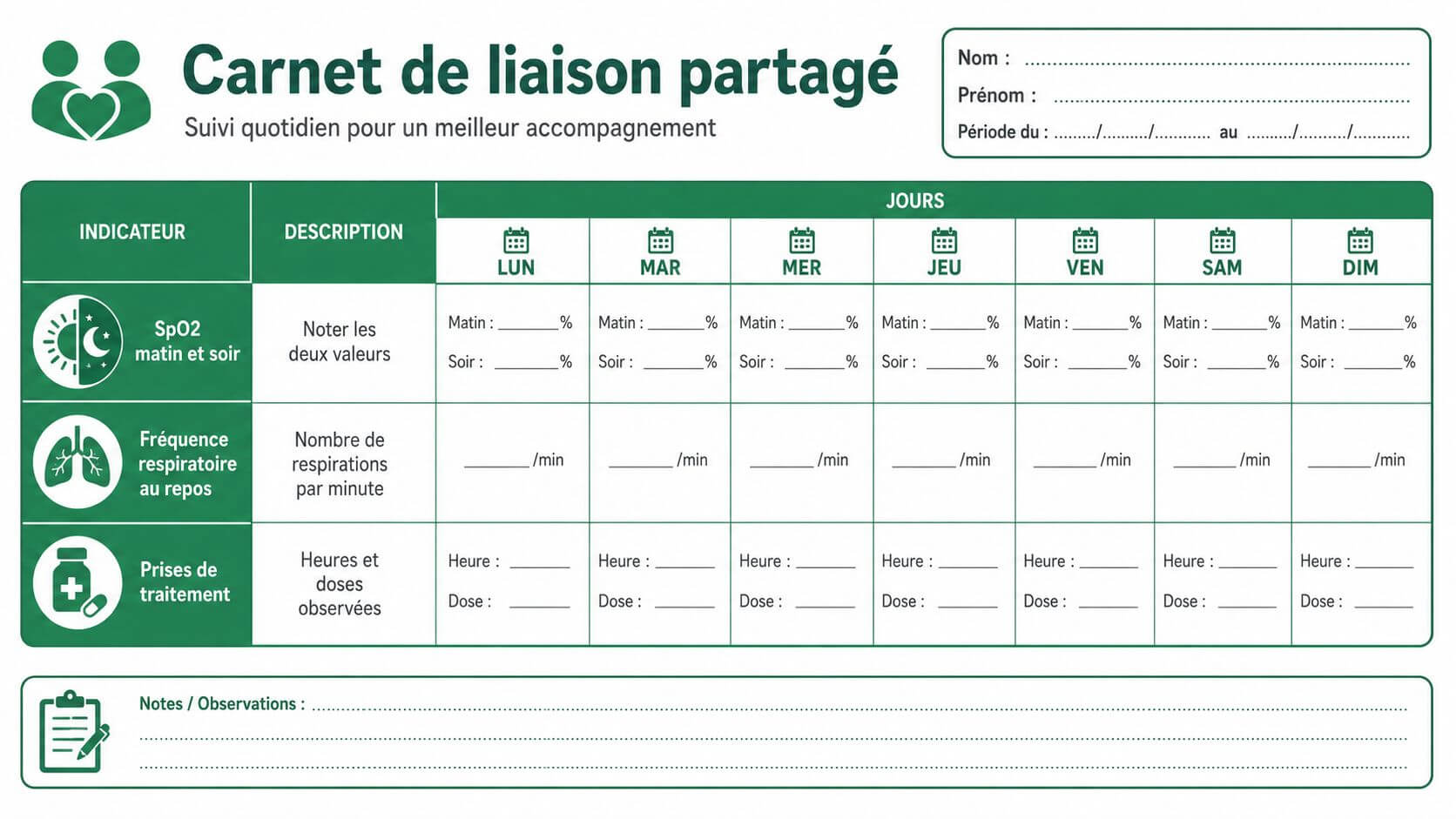
A caregiver who notes the values in the morning and evening avoids much blur. In a shared notebook, she can record saturation, respiratory frequency at rest, treatment times with the hour, then an unusual event like a night hound or paler lips. It is not medical follow-up in place of the doctor, it is clear coordination between several people around the same close.
What really helps in transmissions
- Horodater each measure: This shows the real evolution.
- Transmit numbers: the doctor better interprets a precise data that an impression of it went wrong.
- List the treatments already given: This avoids duplication and forgetfulness.
- Record history and allergies: especially if a change in treatment is discussed.
- Provide a daily point: A close referent can centralize the information.
A simple example helps to understand. In the morning, the family notes a dry cough, then in the evening a clearer respiratory discomfort and some whistling. The important value is not the anecdote taken in isolation, it is the succession of two close alerts that draw an evolution, therefore a need for re-evaluation.
It is also necessary to distinguish the logistics from the medical. Knowing who passes, who calls, who brings the drugs, is useful. Decide whether a wheezing breath corresponds to an asthma or to a post-viral bronchospasm is not done at home, this remains the responsibility of the caregiver. To structure the relays after a hospitalisation or a return home, a simple framework such as this reminder on the return from hospital home can serve as an organizational model.
Limitations, medical follow-up and frequent questions
Self-monitoring has its limits. A finger oxymeter can be misleading if the fingers are cold, varnished, badly infused, or if the device is of poor quality, and saturation is not enough to summarize all the respiratory severity. Even when the situation improves, a medical follow-up remains useful for re-evaluating respiratory function, adjusting treatment if necessary, and not overlooking a Long VOCID or an asthma that reveals itself.
| Question | Summary response | When to Reconsult |
|---|---|---|
| Is asthmatiform bronchitis contagious? | It is not the bronchial episode that is transmitted, it is the underlying virus. | If the surrounding area also develops fever, cough or respiratory discomfort |
| How long does it last? | Often a few weeks after infection, with progressive improvement. | If cough or wheezing settles, or if condition deteriorates |
| Can we prevent recidivism? | Yes, with hand hygiene, smoking cessation and up-to-date vaccination. | If episodes return to each viral infection |
| When to go back to the ER? | If saturation drops, the lips bluish or shortness of breath becomes major. | Without waiting in case of distress |
| What can I tell the doctor? | Bring the logbook of constants and list of treatments. | With each worsening, or if doubt persists |
The first question that a caregiver often asks concerns contagiosity. The simple answer is that the virus is, not the bronchial reaction itself. Another common question is about duration, and we must be careful without dramamatizing, because evolution depends on the terrain and the starting infection.
The best thing is to arrive at the meeting with concrete elements, not with assumptions. A logbook of constants, the timing of the take, the list of allergies and history, saves time and improves the quality of the exchange. When the family shares clear information, the doctor can decide faster and more precisely.
If you coordinate the care of a loved one who coughs, whistles or breaths after a virus, Tribulys can help you centralize constants, treatments and transmissions in a single shared notebook. You keep a clear view for family and caregivers, without confusing daily coordination with medical follow-up.
Put this organisation into practice with Tribulys
Keep your care journal, shared calendar, tasks, medication tracking and emergency information together. Start for free and invite the relatives and professionals involved in your loved one’s care.