
8.3 million people help a loved one in everyday life, 4.3 million of them from the elderly. An auxiliary application of useful life therefore needs to secure a unique, time-honoured and traceable history of observations, medicines and incidents, not only display a schedule.
In the same day, a relative can receive a text message from a child, a call from a home care worker, a note left on the table and information given orally to the nurse. Everyone wants to do well, but no one knows what information is the latest, who saw it and what action has been taken. The problem is not the lack of involvement. It is dispersion.
Contents
- Why home coordination goes beyond simple planning
- What a life auxiliary application really is
- Features that transform daily life at home
- How to choose an auxiliary application of life without being wrong
- Concrete scenarios where application makes a difference
- Proceed to action with a realistic implementation checklist
Why home coordination goes beyond simple planning
At 9 a.m., the home care worker noticed that the elderly person was eating less and seemed more tired. At noon, she warned a relative by message. In the afternoon, the nurse passed, but did not see the SMS. In the evening, another family member asked in a discussion group if anyone had checked the situation. Meanwhile, everyone interpreted the silence in their own way.
This scene is nothing unusual. Home maintenance involves people who do not have the same hours, the same responsibilities, or the same access to information. public portal on home help services recalls that the organization may be under the responsibility of the provider, the direct employment or the agent. This difference in framework changes the division of responsibilities, but the person receiving care remains at the centre of the same daily life.
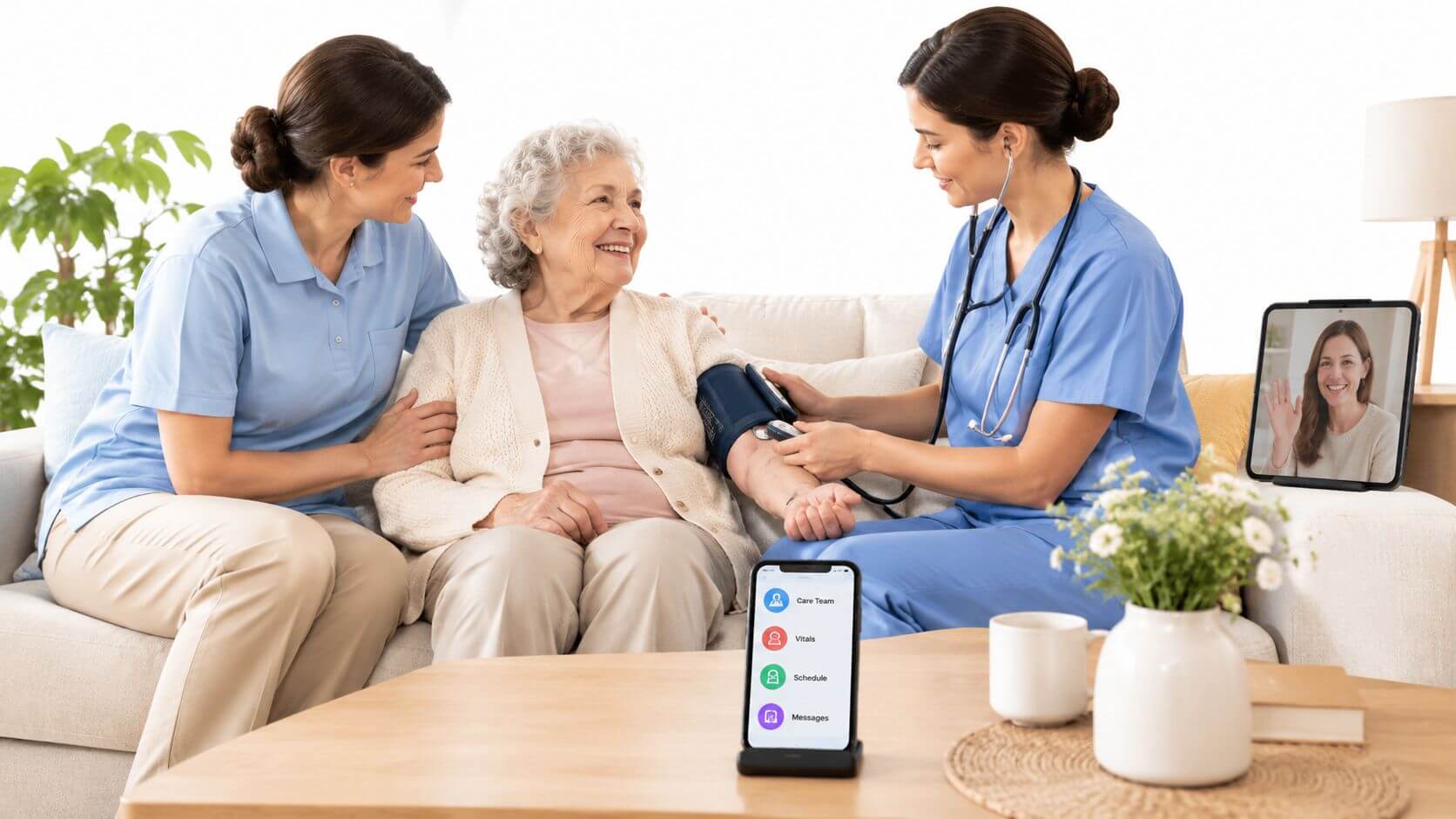
The schedule doesn't tell us what happened.
A schedule indicates that a visit was planned. It does not necessarily specify whether the person ate well, whether a dose has been confirmed, whether pain has occurred or whether a statement has changed. Structured transmission, associated with an author, an hour, a context and, if necessary, an expected action.
The DREES data illustrate the weight of the home. In 2023, the average number of home helpers was 823 600against 662 300 reception aid, while 472 100 home helpers were granted to persons with disabilities by departments in the 2025 edition of DREES. These figures do not indicate which application to choose, but they show why home follow-up cannot be based on isolated exchanges.
Practical rule: important information must be readable by the right person, at the right time, without forcing the team to reconstitute the story in several conversations.
An auxiliary application of life must therefore reduce the silences between two passages. It must allow to see what has been observed, what has been done, what remains to be done and which must be warned. coordination of home care begins with this discipline, not with the accumulation of notifications.
What a life auxiliary application really is
An home care worker application is not a simple stakeholder directory, nor is it an improved score tool. It becomes useful when it connects everyday gestures, instructions, observations and decisions made around the same person.
The need is particularly complex because responsibilities vary according to the intervention framework. In the case of the service provider, the person receiving care is a client of the service, who employs the service provider. In direct employment or acting as an agent, the relationship and obligations are not distributed in the same way. The tool must take these roles into account instead of giving everyone the same access.
A common space, with different rights
The family does not need to see all the professional information. The home care worker must be able to transmit a field observation without changing a prescription. The nurse may need to consult constants, while a remote relative will seek above all a clear synthesis and tasks that require her intervention.
A serious solution distinguishes sharing of the visibility. It keeps the author and the time of a transmission, combines comments with the right event and avoids that sensitive information mixes with personal messages. The link book, the emergency log, the schedule and the processing follow-up must form a coherent set, not a collection of independent tabs.
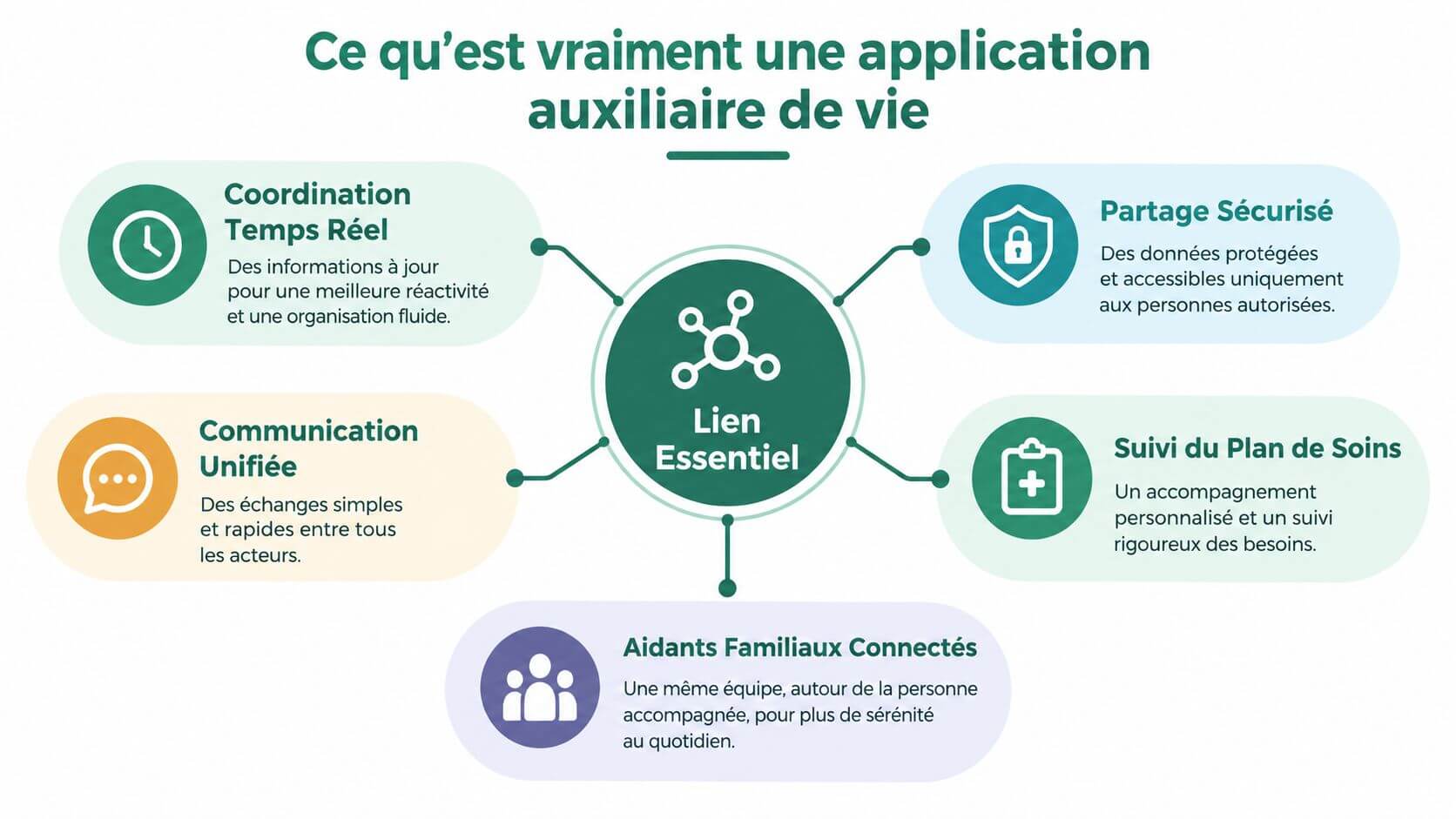
Value comes from continuity
Homework is heterogeneous. They may include household assistance, shopping, meals, hygiene, accompaniment, observation of the general condition or transmission to a health professional. TheIGAS describes this diversity of support provided by relatives, with interventions that are not limited to care.
The right criterion is therefore not the number of functions displayed on a commercial page. This is the ability of the application to answer four simple questions:
- Who observed or carried out the action?
- When was the information entered?
- Who should read it or act?
- What trace remains available after the visit?
A notification alone is not enough. It can be ignored, lost or misunderstood. A contextualised, timed and task-related transmission creates a continuity that can be exploited by authorized persons.
Features that transform daily life at home
Useful features are those that close a specific break in the follow-up. Before choosing an application, you must start from a concrete incident, such as a forgotten set-up, an impossible take to confirm or an observation that never reaches the doctor.
The care journal as Collective Memory
The digital link book shall enable a short observation to be entered, dated and associated with the data subject. An auxiliary may report unusual fatigue, difficulty during the meal or a change in mobility. A relative can respond in the same context, without moving the information into a parallel conversation.
One electronic link book It works better when it offers categories, alerts and legible history. The objective is not to write endless reports. It is to keep the facts that allow the next speaker to understand the situation.
Medicines require proof of use
A reminder indicates that a take is expected. It does not prove that it took place. A French study cited for polymedic seniors in digital autonomy reports a gap between 100 % of declared compliance and 32% actual compliance in the results presented by Medissimo. This contrast shows why an application must go beyond an audible alarm.
The relevant follow-up involves:
- Confirmation of take, with a searchable trace.
- Forget alertaddressed to the appropriate role.
- Background, useful for preparing an exchange with the pharmacist or doctor.
- Clear sign, in order not to turn an alert into an improvised medical decision.
The application does not replace the health care professional. It makes the information observable and facilitates transmission.
The agenda must show the action expected
A shared calendar becomes really useful when it indicates who is involved, why, when, and what instructions accompany the appointment. A medical check-up, an auxiliary pass and a race are not interchangeable. The calendar view must remain linked to the tasks and remarks that give meaning to the event.
The constants, the documents and the emergency form complete this base. Tension, weight or temperature curves can make a more legible evolution, provided that the measurements are correctly captured and interpreted by the competent persons.
Finally, contextual messaging and periodic syntheses avoid soliciting the whole family at every detail. A remote helper can receive an organized view of important events, rather than a succession of messages whose priority he or she must guess.
How to choose an auxiliary application of life without being wrong
The choice must not start with the list of functions. It must start with the risk that the family is trying to reduce. If the problem is the lack of visibility on the passages, the calendar counts. If the errors concern processing, the confirmation of the sockets and the history become priority. If the participants work in poorly covered areas, the offline mode is not negotiable.
The criteria that separate the useful tool from the additional channel
| Criterion | Why He Counts | What He Protects |
|---|---|---|
| Traceability | Each observation must be associated with one author and one hour | Continuity between the passages |
| Access by role | Not all members need the same information | Confidentiality and clarity |
| Off-line operation | The terrain does not always guarantee a stable connection | Post-visit data transmission |
| Simplicity of use | A complex interface will be bypassed in fatigue | Daily adoption |
| Treatment monitoring | An alert must be able to become a searchable confirmation | Forgets and double-takes |
| Export of documents | Useful orders and information must remain retrievable | Preparation of appointments |
| Data governance | Health information requires an explicit framework | Trust of families and professionals |
Check actual usage before signing
Ask to see the path of a full visit. Can the speaker open a checklist, record an observation, report an alert and finish the transmission without going through several menus? What happens if the phone no longer has a network? Is the data then synchronized, with the actual time of entry and the identity of the author?
Examine also the difference between a link platform, a telepointing tool and a coordination space. The first helps to find a speaker. The second documents his presence. The third organizes the information around the person receiving care. These functions may coexist, but they do not respond to the same problem.
An application that sends more notifications without clarifying who should act does not reduce the mental load. It moves it.
Security must be concrete. Look for accommodation adapted to health data, an understandable access policy, invitation management and a possibility to remove a stakeholder who is no longer concerned. The experiment must be as suitable for a relative who has been consulting since his or her work as for an assistant who seizes a transmission between two visits.
Concrete scenarios where application makes a difference
The value of a tool appears in times when no one can afford to reconstitute the information. The subject is not to automate the relationship. It is to ensure that each person has a reliable context before acting.
A son living in another region should not have to call several relatives to find out how the week went. With an organized synthesis, he can distinguish the visits made, the important observations, the tasks on hold and the alerts that require his intervention. He remains involved without turning the family into a telephone hotline.
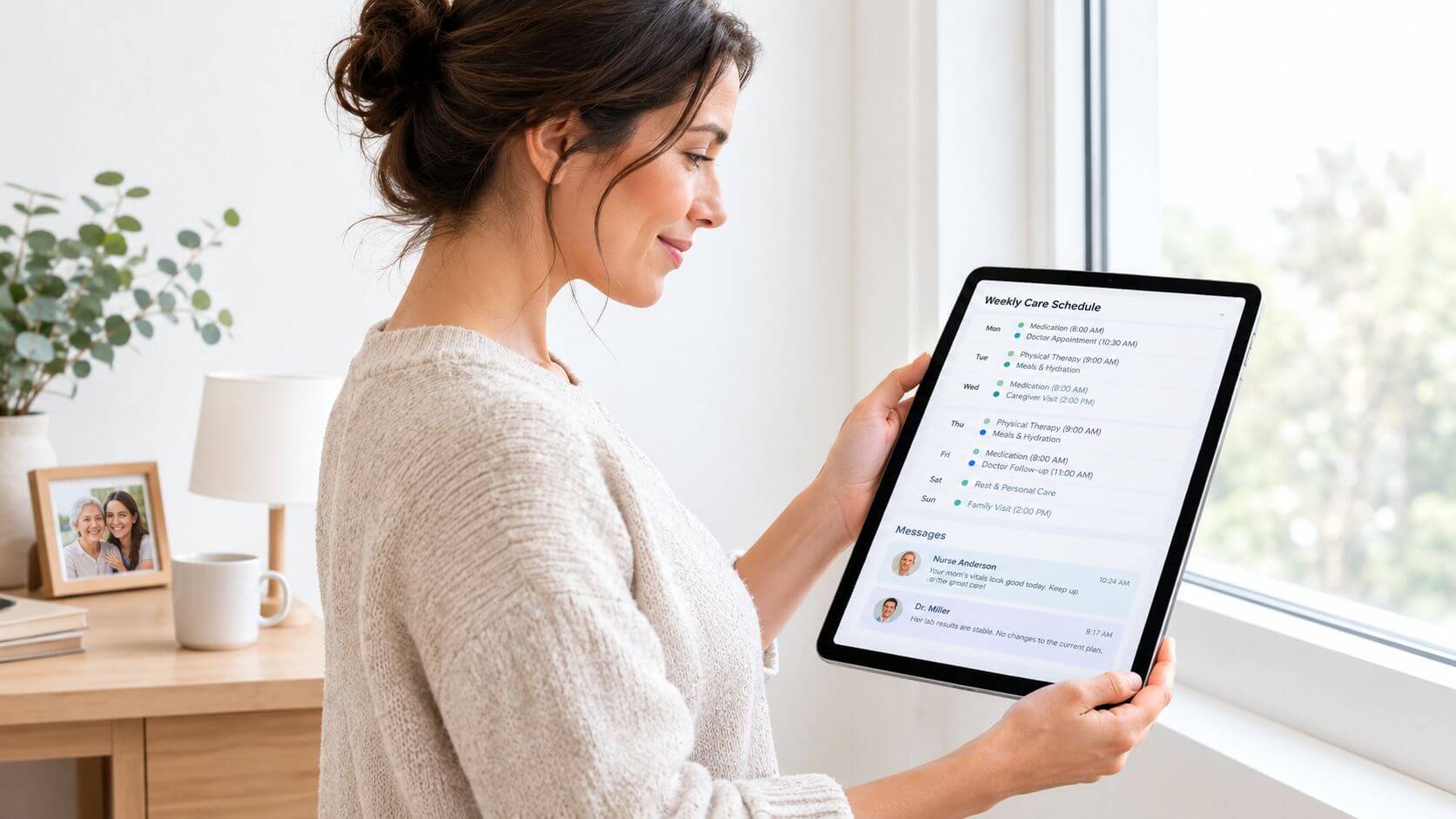
Before and after a visit
A independent nurse arrives with information that is already structured. She can consult the latest permitted observations, check the recorded measurements and identify a development reported by the home care worker. She does not have to treat each text message as a separate piece or ask the family to repeat the entire story.
In the field, a life aid can use a guided checklist to keep in mind a planned task. If the connection is missing, it captures the necessary elements and then synchronizes the transmission when the network returns. This continuity prevents the note from remaining in a paper book or in the memory of the speaker.
When a treatment or a constant raises a question
An unconfirmed dose triggers an alert according to the rules defined by the family and professionals. The application does not decide to administer an additional dose. It makes the doubt visible, keeps the history and allows to contact the right person.
In the same way, an unusual measure is only of value if it is contextualized. Date, author, measurement conditions and evolution count more than an isolated figure. A physician can then have a statement prepared for the consultation, without confusing a follow-up tool with a diagnostic device.
Discipline remains essential
No software compensates for a blurred rule. The family must define what should be transmitted immediately, which may appear in a synthesis and which responds to alerts. Stakeholders should know what observations are relevant to their role and when they should contact a professional.
The application reduces the loss of information only if the actors use it as a reference channel. If some continue to send important instructions by SMS, the old problem comes back in another form.
Proceed to action with a realistic implementation checklist
Start with a specific situation. Choose a visible difficulty, such as unconfirmed sockets, schedule changes or lack of transmission after a visit. An application deployed to solve a concrete problem will be better understood than a tool presented as a solution to all coordination.
Implementation in practice
Name roles. Identify the person who administers the space, the authorized relatives, home care workers, nurses and other professionals involved. Specify what each person can view, modify and receive.
Define priority transmissions. Decide what observations should be entered at each crossing, what alerts require an early response, and what information can be expected for a synthesis.
Test a complete course. Make a fictitious visit, with checklist, observation, task, comment and alert. Also check the operation without connection and subsequent synchronization.
Install the tool on the devices actually used. A perfect procedure on an unused computer is no use. The application must be accessible from the daily phone or tablet.
Form by simple gestures. Show how to consult the day, transmit an observation, confirm a catch and find a document. Avoid training on functions that no one needs immediately.
Review access regularly. Remove people who no longer intervene, adjust the rights and control the recipients of alerts. Confidentiality is part of the coordination, it does not come after.
The aim is not to replace the necessary calls or professional judgment. It is to reserve direct exchanges for the decisions that deserve it, while keeping a reliable record of daily life. An auxiliary application of life must make the home more readable, not add a group of notifications.
Tribulys offers a private space where family caregivers and licensed professionals can gather liaison books, agendas, tasks, medicines, constants, documents and emergency cards around a loved one at home. To check if this organization fits your situation, visit Tribulys and test coordination based on timed transmissions, controlled accesses and shared history.
Put this organisation into practice with Tribulys
Keep your care journal, shared calendar, tasks, medication tracking and emergency information together. Start for free and invite the relatives and professionals involved in your loved one’s care.