
About 440 000 persons per year could be palliative care in France, but only 190 000 would benefit from it at present. At home, the primary mission of the caregiver is to observe, ensure comfort and transmit precisely to the professional nurse and physician in order to avoid unwanted worsening or transfer to the hospital.
It's 9 p.m. You're arriving at Mrs. Dubois' house for the evening pass. She refuses her pain treatment, her son seems exhausted and you notice a new redness in the sacrum. There's nothing to allow you to change a treatment or make a diagnosis, but your eyes can change the rest of the evening.
In palliative care, the caregiver is often the professional who knows best the daily variations of the patient. You know how he breathed the day before, what position he stood for, whether he ate a few spoons or usually asked to drink. This continuity gives meaning to every observation.
Contents
- Your role at the heart of the care relationship
- The legislative and historical framework for palliative care
- Your priority clinical and relational missions
- Navigate between ethics, family and professional boundaries
- Coordination as a clinical requirement for home care
- Practical guide to symptom-based decision-making
- Summary of good practices for effective caregiving
Your role at the heart of the care relationship
Mrs. Dubois doesn't necessarily ask you to talk. She simply shakes your hand, turns her face away when her son evokes the medicine and whispers that she wants to stay in bed. During the toilet, you see that she grimace when she turns on the left side. Her breathing is shorter than at the last passage and the redness of the sacrum persists despite the change of position.
You do not conclude that this is an escarre, you do not decide to increase the painkiller and you do not force the treatment to be taken. You collect the facts, you perform the comfort care that falls within your function, and then you quickly pass on to the nurse. This chain, observation, comfort, transmission, protects the person without getting you out of your role.
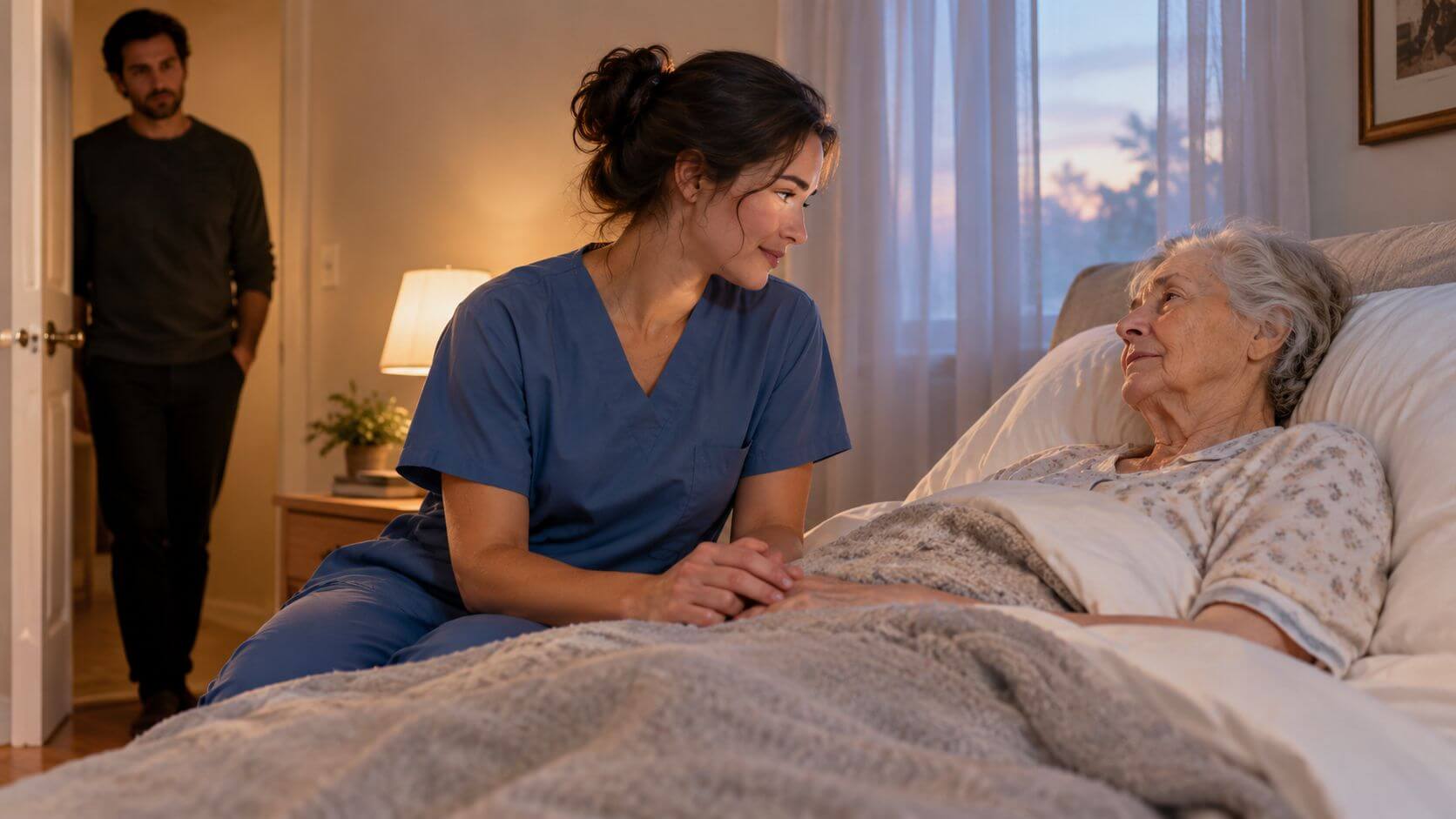
The daily look that detects change
Your value is not limited to the visible gesture, such as the toilet or the installation. It is also found in the small gaps that you are able to spot:
- A different breath, faster, irregular or accompanied by a movement of concern.
- An unusual expression, a frown of eyebrows, a withdrawal of the hand or a tension of the body during treatment.
- A change in behaviour, like a new agitation, unusual sleepiness or sudden refusal to communicate.
- A change in inputseliminations, sleep, skin or mouth condition.
A useful transmission does not only say "Ms. Dubois is less well". It specifies what has changed, when, in what situation and with what reaction the patient has. This clarification allows the nurse or physician to make a fact-based clinical decision.
The relationship counts as much as surveillance. A simple speech, a respected silence and a calm attitude can reduce the anxiety of the patient as that of his or her loved one. To work your listening, reformulation and presence in difficult exchanges, you can consult this resource of Oral practice with SpeakMeeters.
Field rule: You don't need to solve everything to be useful. You need to spot, relieve in your area of expertise and circulate information at the right time.
The legislative and historical framework for palliative care
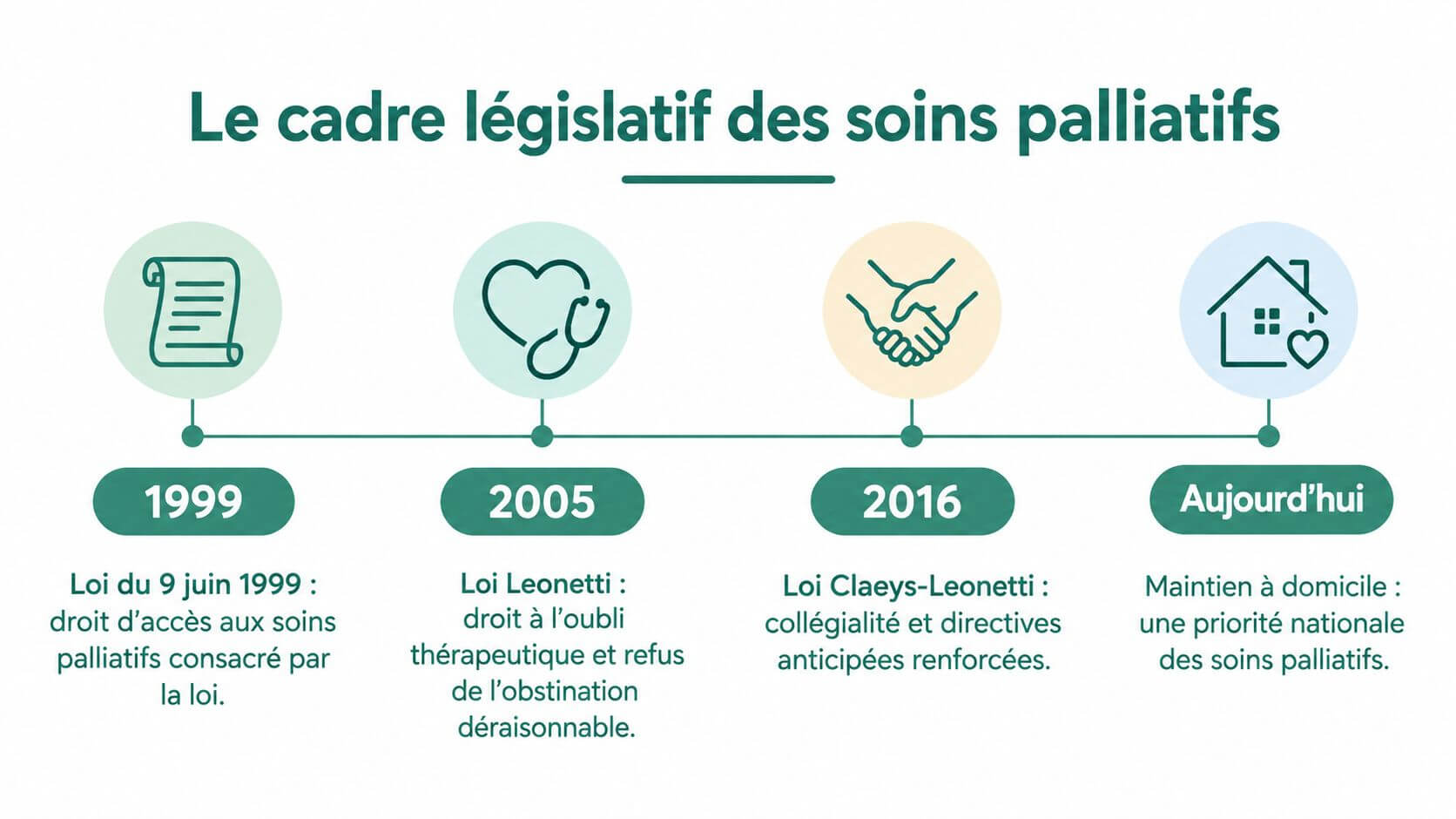
The current position of caregiving is part of a gradual evolution. 9 June 1999 has enshrined the right of access to palliative care and defined it as active and continuous care designed to relieve pain, alleviate psychological suffering, preserve dignity and support the environment. This definition reminds us that accompaniment is not simply a treatment of a symptom.
The first national plan, covering the period 1999-2001, was supported by EUR 58 million and funded the creation of palliative care units as well as mobile teams. Proximity has become an organized component of the journey, with professionals able to identify changes and share them between the different locations of care. The National Assembly file on the development of palliative care traces these first milestones.
A larger organization
In 1998, France had 54 palliative care units totalling 576 beds. In 2019, it had 164 units representing 1,880 beds, of 5,618 beds identified in palliative care in 901 institutions, either A total of 7,498 beds, and of 428 mobile teams. Over this period, the number of units was multiplied by three and the number of mobile teams by five, according to Parliamentary data on the provision of palliative care.
These numbers do not change your toilet gesture, but they change the context in which you do it. A patient can move from home to a facility, be accompanied by a mobile team, and then return home with new instructions. The more stakeholders involved in the journey, the more important the quality of your transmission becomes.
So you are a link to an interdisciplinary system. Your observation helps the nurse to appreciate the evolution, allows the doctor to have concrete information and supports the continuity of the life project. The institutional framework does not ask you to decide in place of the other professionals. It gives you a recognized place to contribute to the decision.
Your priority clinical and relational missions
Your perimeter is in three verbs: comfort, observe, transmit. You intervene under the responsibility of the nurse and you do not substitute for her for acts falling within her own role or a prescription. This limit is not a restriction of your usefulness. She secures the patient and clarifies the person who must decide.
Start with comfort
The toilet must remain a care, not an imposed test. You observe fatigue, adjust the rhythm, protect privacy and interrupt if the patient expresses a refusal or suffering. Oral care, skin protection, installation and repositioning take an important place, especially when the person stays in bed for a long time.
The High Health Authority recommends that the skin and mouth should be preserved, that unnecessary examinations should be limited and that the diet and hydration should be adapted to suit the situation. HSA card on end-stage care.
Observe without interpreting
In each passage, highlight concrete elements:
- Consciousness and behaviour, with the level of awakening, drowsiness, agitation or withdrawal.
- Breathing, its apparent rhythm, the existence of shortness of breath or discomfort during care.
- Signs of discomfort, such as grimaces, complaints, treachery or anxiety expressed.
- Inputs and disposals, without turning a loss of appetite into judgment on the patient.
- Skin and mouth, describing the location concerned, the aspect observed and the evolution.
- The tolerated position, possible movements and requests made by the person.
Record the time, your name or professional ID, the observed facts and who was notified. “Severe pain” is less useful than “grimacing and withdrawing the arm when being turned at 18:40; lying on the right side better tolerated; nurse called”.
Supporting Without Promise
The patient can ask if the pain will disappear or if his or her loved one will be able to stay at home. You can accept the question, recognize the concern and transmit the request. You do not promise the medical evolution or the permanent availability of a practitioner.
Your professional border is in this sentence: " I can hear you. I'll pass on what you're telling me to the nurse so the right person can answer you. "
Navigate between ethics, family and professional boundaries
The family can be loving, exhausted and sometimes contradictory in the same minute. Mrs. Dubois' son asks you to have her eat, then asks you not to tell her that the situation is getting worse. A girl telephones to get information, while the patient asked you not to detail anything in front of her.
You don't have to choose between professional coldness and total availability. You can stay present while clearly separating the patient's speech, the observed fact, the loved one's request and the action decided by the team.

Answer without crossing the limit
To a person who says "force him to eat," you can answer that you are going to propose, listen to his refusal and pass on the situation. To someone who asks "give him this medication", you remind that the administration and adjustment of the treatment is the responsibility of the authorized professional and the intended framework.
Confidentiality also requires discernment. End-of-life preferences do not circulate automatically among all relatives. According to the Observatoire de la fin de vie 2025, 46% of French people wish to formalize their wishes in writing and 43% orally, which means that these preferences can be divided between the patient's speech, the record and the exchanges with professionals, as presented by the Ipsos study on end-of-life wills.
To avoid misunderstandings, your transmission can distinguish four elements:
| Element | Example of formulation |
|---|---|
| Observed fact | "The patient pushes the spoon and closes the mouth." |
| Patient's Word | "He says he's not hungry and asks to sleep." |
| Family application | "The son asks that the feeding be continued." |
| Action taken | "Proposal agreed, comfort assured, nurse informed." |
Do not describe the relative as "difficult" and do not describe the patient as "opponent". These words close the discussion. Instead, describe what happened, what was asked and what you passed on. Persistent disagreement, pressure on the patient or sensitive information should be relayed to the nurse or physician.
Coordination as a clinical requirement for home care
A home does not become a place of care simply because several people are involved. The project is based on a community team, with the treating physician, nurse, physiotherapist, home care workers and, where necessary, a team specialized in palliative care or pain management.
The Department states that approximately 440 000 persons per year could be palliative care in France, while 190 000 There is also an increase in the number of hospital admissions at home. 22 % the number of patients treated in palliative care since 2022, according to the information of the Ministry on the methods of palliative care.
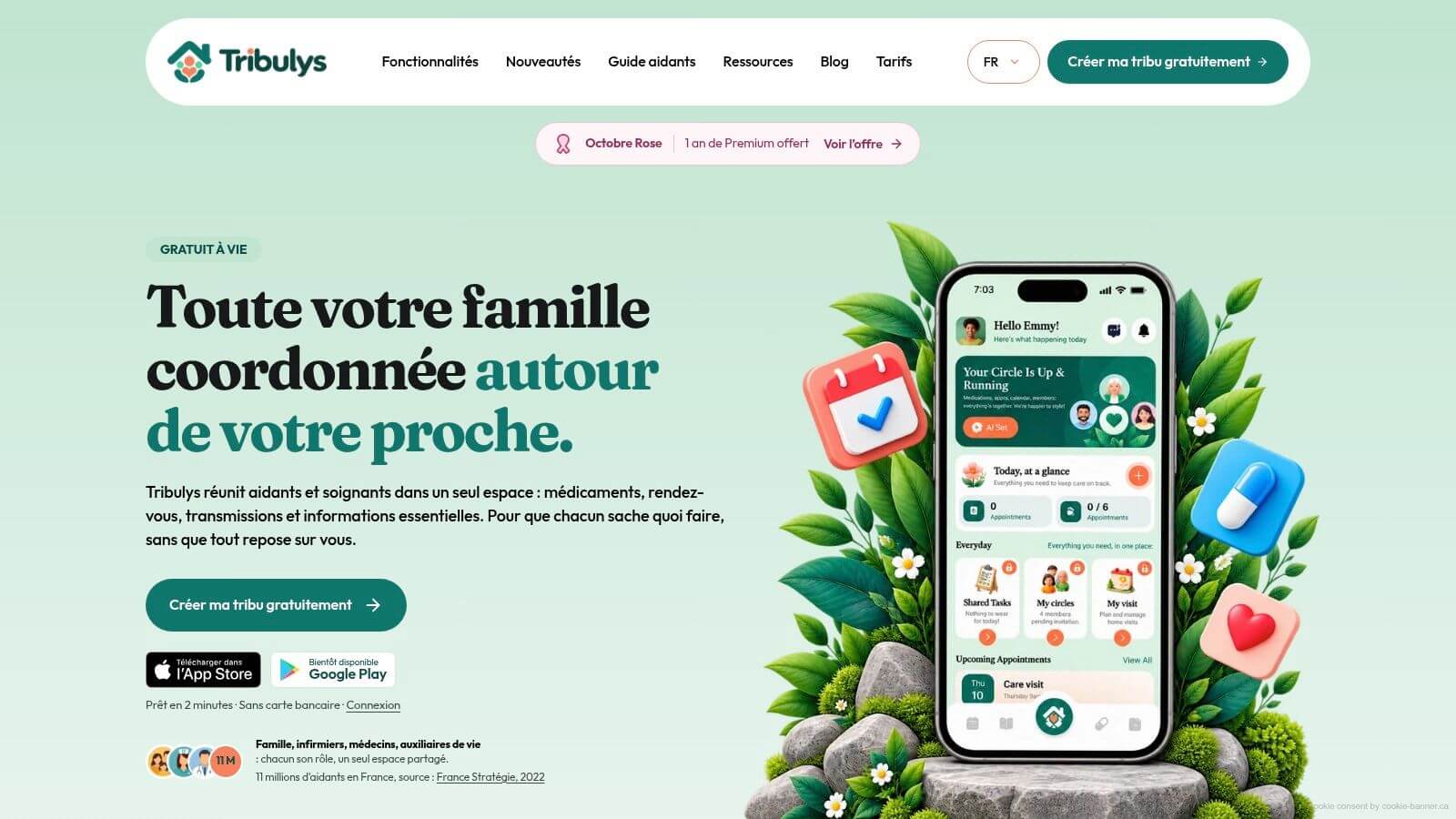
Transforming the visit into usable information
Upon arrival, check the recent instructions and events since the last visit. Upon departure, pass on the time, care, symptoms observed, progress against the previous visit, patient's wishes or refusal, the presence of the caregiver and the professional alerted.
A paper link book, secure messaging or digital tool may be suitable if the team actually uses them and if access is limited to authorized persons. The essential thing is to have a unique history, assigned and timed. A note left in a personal SMS can be lost, misunderstood or inaccessible to the speaker who arrives afterwards.
Tribulys' Guide to Palliative Care at Home presents this coordination logic. The application includes a liaison care journal, a visit checklist, a shared calendar and an emergency log, with information accessible according to the rights defined by the tribe.
The technology never replaces the call to the nurse when a symptom changes rapidly. It is used to keep track, contextualize the alert and make visible information that could have remained in the memory of a single stakeholder.
Here is an example of organized transmission:
- Before treatment, check changes and instructions.
- During treatment, note reactions and signs of discomfort.
- After treatmentreport what has changed and who has been warned.
- In case of unusual silence, looking for information rather than assuming that everything is fine.
Good coordination does not make all information available to everyone. the right information, with the right level of access, at the right time. This requirement protects professional secrecy while avoiding disruptions between home, nurse, HAD, physician, mobile team and family.
Practical guide to symptom-based decision-making
The question is not "Am I able to deal with this situation alone? " The right question is "what can I observe, what can I do without a prescription and who should I alert now? " Home maintenance depends on a fast and organized response, not on the ability of the caregiver to take care of everything.
The French are 75% say they prefer to end their life at homebut only 56% believe that specific support would be available, according to published data on access to palliative care at home. This difference between desire and confidence in accompaniment makes your transmission particularly important.
Read the situation without deciding in place of the team
| Situation observed | What You Do | Contact Relays |
|---|---|---|
| Unusual pain or reaction during treatment | You stop or adapt the comfort gesture, describe the sign and time | Nurse quickly |
| More difficult breathing or new dyspnoea | You install the person in the tolerated position, stay close to him and transmit | Nurse, then doctor or specialized team as directed |
| Unusual agitation or drowsiness | You secure the environment, look for recent facts and note the patient's words | Nurse and doctor |
| Refusal to eat or drink | You respect the refusal, propose without forcing and observe the mouth and the general state | Nurse |
| Fall, acute distress or urgent aid request | You do not leave the person alone, secure without needlessly mobilizing it and follow the local protocol | Emergency if the situation so requires |
The table does not replace the instructions of the service or the home. If the person has an apparent vital distress, if he or she no longer responds or if you cannot ensure his or her safety, the emergency call is required according to the procedures in force. In other situations, the nurse, the attending physician, the HAD or the mobile team can arrange an appropriate response and avoid an unwanted transfer.
Your transmission must remain descriptive: "noise breathing since the change of position", "patient awakening but responding less", "repeated refusal of two drinking proposals". Avoid "he agonizes" or "he makes a decompensation" if you are not entitled to make this interpretation.
To structure this information, a shared transmission book can help the team compare passages and find the evolution of a symptom.
Summary of good practices for effective caregiving
The next morning, the nurse took up Ms. Dubois's case. She found the observations of the day before, the time the treatment was refused, the reaction to the reversal, the skin condition and the son's request. She could call the doctor with specific information, re-evaluate the situation with the team and explain to the family what was her role.
Nothing spectacular happened during your visit. You did not prescribe, make a diagnosis or promise that home care would be possible under any circumstances. However, your rigor allowed the team to decide before the situation became unmanageable.
Reflexes to keep
Observe without interpreting. Describe what you see, hear and see during the treatment. A grimace, a refusal, a modified breath or a poorly tolerated position are valuable information when it is located in time.
Transmit without delay. Important information should not wait until the next meeting or stay in a forgotten notebook. Use the planned circuit and confirm that the nurse or professional concerned has received the alert.
Respect the limits. You can offer a facility, perform comfort care, listen and alert. You do not change a prescription, don't give a drug at the request of a loved one, and don't force a person to eat or talk.
Protecting the patient's word. Ask what he wishes to share, welcome his refusals and do not pass on more information than necessary to an unauthorized relative. If in doubt, ask the nurse.
Take care of the relationship. A concerned family needs concrete benchmarks. Tell what you have observed, what you can do and who you are going to warn. This clarity avoids the impossible promises to keep.
To be noted: the caregiver is not alone in the medical decision. It makes the decision possible by providing a reliable, contextualized observation to the right person.
Before leaving home, reread your note as if you were the professional who comes after you. Will she understand what has changed, what the patient asked for, what you have done and who has been alerted? If the answer is yes, you have turned an ordinary passage into true continuity of care.
For a palliative care caregiver, effectiveness is not measured by the number of acts performed. It can be seen in the ability to preserve comfort, dignity, speech and the life project, while allowing the team to act when symptoms change.
Tribulys centralizes timed transmissions, visit checklists, calendar, emergency card and useful information between relatives and authorized professionals. Tribulys to structure your passages at home and make each observation accessible to the right person.
Put this organisation into practice with Tribulys
Keep your care journal, shared calendar, tasks, medication tracking and emergency information together. Start for free and invite the relatives and professionals involved in your loved one’s care.