
In 2021, France accounted for 423 500 care workers in operation, and the profession remains indispensable despite difficult recruitments and sometimes fragile organizations. Being a caregiver is to accompany, observe and transmit accurately, both in institutions and at home.
At the end of the job, a situation often returns. An elderly person has eaten less, moved with difficulty and seems more confused than in the previous passage. The information seems simple, but it must reach the right professional, at the right time, with enough context to be useful. A remark left in a notebook, a forgotten SMS or an incomplete oral transmission can change the continuity of the accompaniment.
The job of caregiver is therefore not limited to comfort care. It is also based on a daily clinical observation, close collaboration with the nurse and reliable traceability of the acts and changes observed.
Contents
- In everyday life, what does a caregiver really do?
- Missions, competencies and intervention framework
- Training, diplomas and career paths
- Salary, recruitment and field realities
- Working effectively at home and coordinating care
- Hospital, EHPAD, home or acting, compare exercise patterns
- Effective integration of a multidisciplinary team and secure passageways
In everyday life, what does a caregiver really do?
At the end of a home visit, the caretaker checks the important elements for the last time. The toilet is done, the person took his meal, the transfer to the chair took place with the precautions prescribed. But a detail attracts his attention, unusual fatigue and less participation in ordinary gestures. She notes it, specifies the moment, context and action performed, and then transmits the observation to the stakeholder concerned.
This scene summarizes a day of work. The caretaker accompanies the person in the essential acts of daily life, such as the toilet, dressing, installation, travel and meals. It also brings a relational presence, particularly important among people isolated, disoriented or dependent.

Observe during each passage
Caregivers can measure certain parameters according to the organization of the service and the instructions received. Above all, they observe the evolutions: change of mobility, decrease of diet, change of behavior, unusual temperature or deterioration of the skin condition.
A useful transmission distinguishes the facts from interpretations. "The person refused breakfast and drank little" is exploitable. "The person is going badly" is much less so. You have to add the time, the circumstances, what was done and the person alerted.
Practical rule: a transmission must allow an absent professional to understand what happened without having to reconstitute the scene by several calls.
The day rarely ends with the last gesture. It ends with checking the tasks performed, alerts sent and information that must remain visible to the next team. This continuity transforms each passage into a link of collective support.
Missions, competencies and intervention framework
Caregiver intervenes within a framework of collaboration with the nurse. The national repository describes a professional who accompanies the person in the essential acts, observes his or her clinical condition, measures certain parameters and reports any unusual developments, as recalled by the official certification framework for health-care workers.
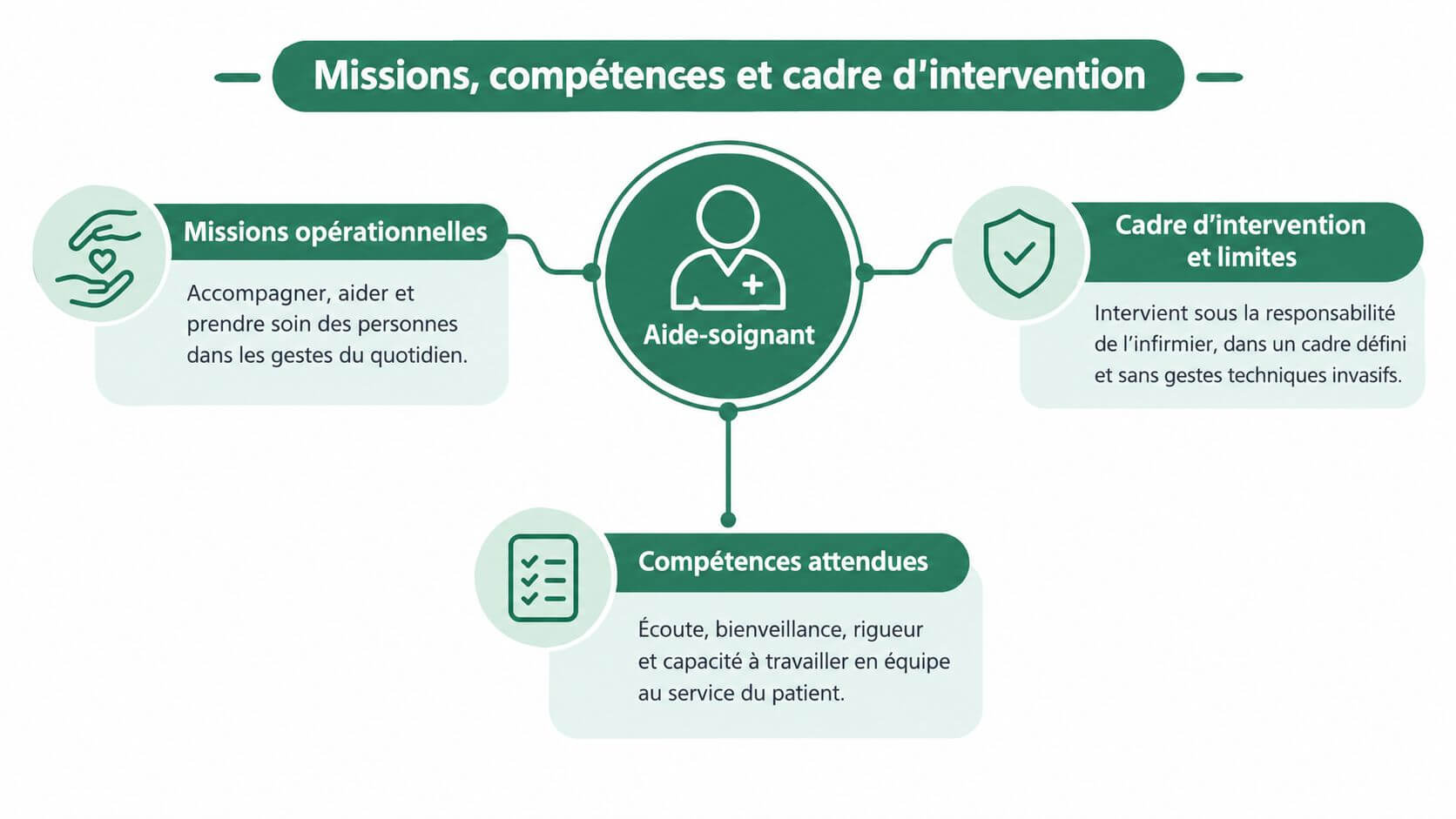
What comes under the daily role
The role is organized around three concrete responsibilities:
- Accompany, by promoting remaining autonomy rather than systematically acting in place of the person.
- Observeby identifying physical, psychic and behavioural changes in their context.
- Transmitby communicating facts dated, understandable and directed to the competent professional.
A good observation does not consist of making a diagnosis. It describes what is visible, measurable or reported, and then reports what is coming out of the habit. The nurse can then assess the situation and decide what to do.
The scope of the intervention also imposes clear limits. The caregiver does not prescribe, does not modify treatment alone and does not replace the nursing or medical assessment. When a situation exceeds the instructions received, the right reflex is to suspend the personal initiative, alert and trace.
The transmission must follow a simple logic: observation, moment, context, action carried out, recipient of the alert. This method avoids vague formulations and reduces the risk of clinical change being lost between two stakeholders.
A checklist may help to keep in mind nothing, but it does not replace the professional judgement or protocols of the institution. It serves as a support to make repetitive steps, especially during home visits or team changes.
To visualize the principles of collaboration and the limits of the role, this video presentation on the job of caregiver complete the written repository.
Training, diplomas and career paths
The profession was built gradually after the Second World War. The title of care giver has been created in 1949, then the certificate of fitness for the caregiving function provided a national framework in 1956. Since 31 August 2007, graduates are covered by the State degree of caregiving, according to the historical benchmarks presented in this publication on the training of healthcare workers.
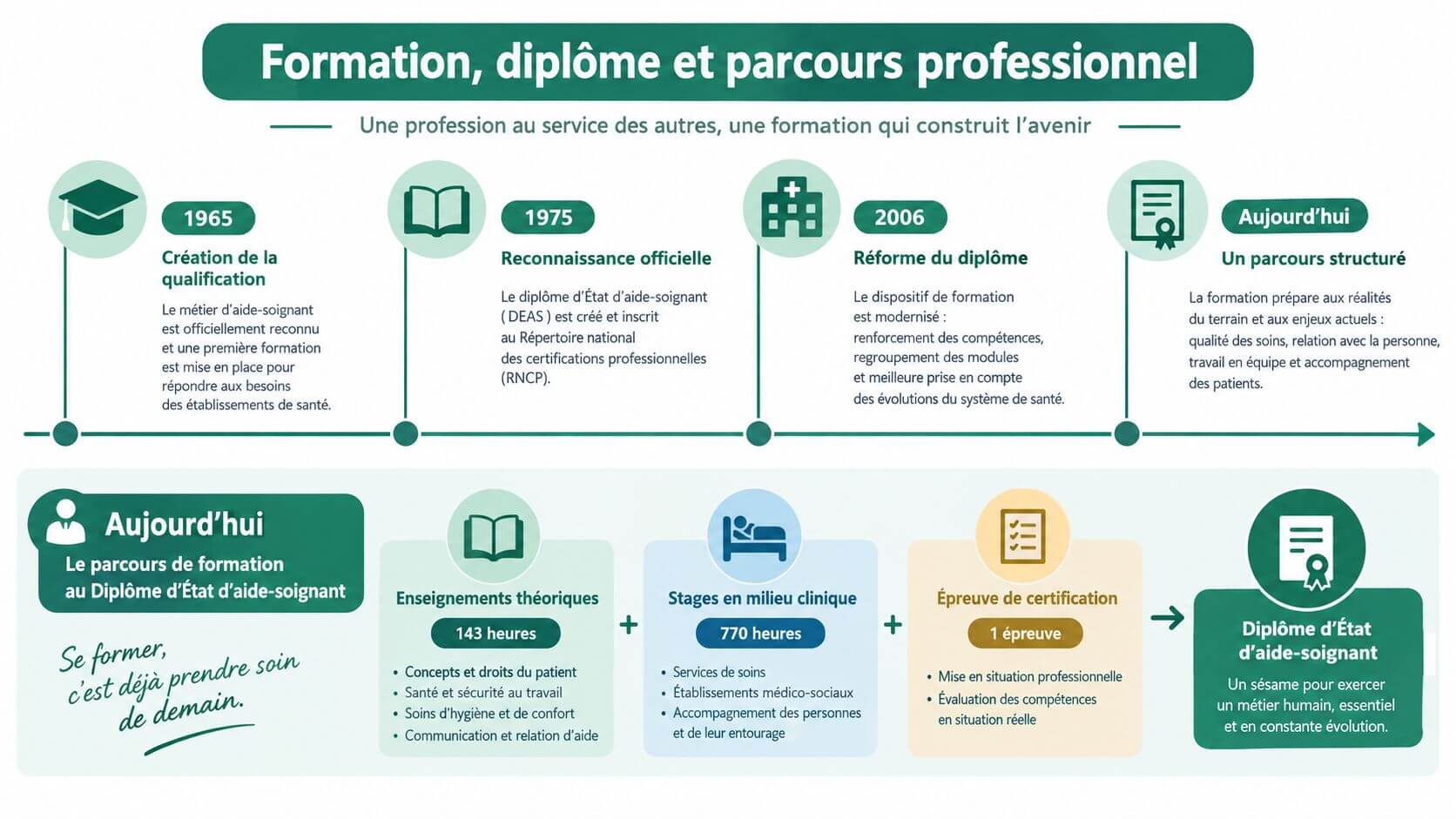
A short, but demanding journey
The current training programme covers: about 12 months. It combines theoretical lessons and practical internships, because mastery of the profession is not only acquired in a classroom. The internships confront the student with real rhythms, situations of dependency, transmissions and teamwork.
In 2018, 22,800 students have obtained the diploma of caregiving, according to the same source. This benchmark shows the importance of workforce renewal, but a diploma is not enough to guarantee immediate adaptation to all environments.
A beginner must learn to organize his or her priorities, to ask for help at the right time and to distinguish urgent information from an observation to be integrated into the current transmission. The transition from hospital service to an EHPAD or home also requires an adaptation to the protocols, equipment and level of autonomy of individuals.
Before registering, it is useful to compare the expectations of schools, the selection procedures, the courses offered and the work environments accessible after graduation. Guide on Caregiver Training can serve as a starting point for organizing this research.
Salary, recruitment and field realities
The trade offers employment opportunities, but this does not mean that all jobs are sustainable. 2025, approximately 56,040 projects for the recruitment of health-care workers were recorded in France, while recruitment difficulties reached 65,6 % for the category of caregivers, nurses and midwives, according to the survey Labour requirements of France Labour.
The paradox arises when this volume is brought closer to the fall in 28% of intentions to recruit caregivers between the years of crisis and 2024-2025, reported by the national barometer of the OPCO Santé in the same source. Employers can recruit less while encountering persistent difficulties, because applicants do not go to the same territories, schedules or working conditions.
The position counts as much as the trade
A hospital position can offer a very structured organization and a strong presence of teams, but the pace, schedule and burden of care can be intense. In EHPAD, the daily relationship with residents is central, with a continuity that requires patience, stability and ability to spot sometimes discrete evolutions.
The home brings more variety and a relationship often more personalized. In return, the caregiver has to deal with different housing, travel, unequal equipment and less immediate coordination. The temporary arrangement allows to vary the establishments, but requires to adapt quickly to new instructions and unknown collectives.
The salary should not be examined alone. It is also necessary to look at schedules, travel times, weekends, the predictability of schedules, the equipment available and the quality of transmissions. An organization that reduces unnecessary calls and clarifies responsibilities can alleviate the day, without pretending to solve recruitment difficulties.
Working effectively at home and coordinating care
A home visit can take place in a narrow space, with equipment different from that provided by the service. Intervenors sometimes follow each other without crossing each other, which increases the risk of lost information.INRS analysis of health and human assistance occupations describes infectious, chemical, physical and psychosocial risks, as well as exposure to handling, movement and binding postures.
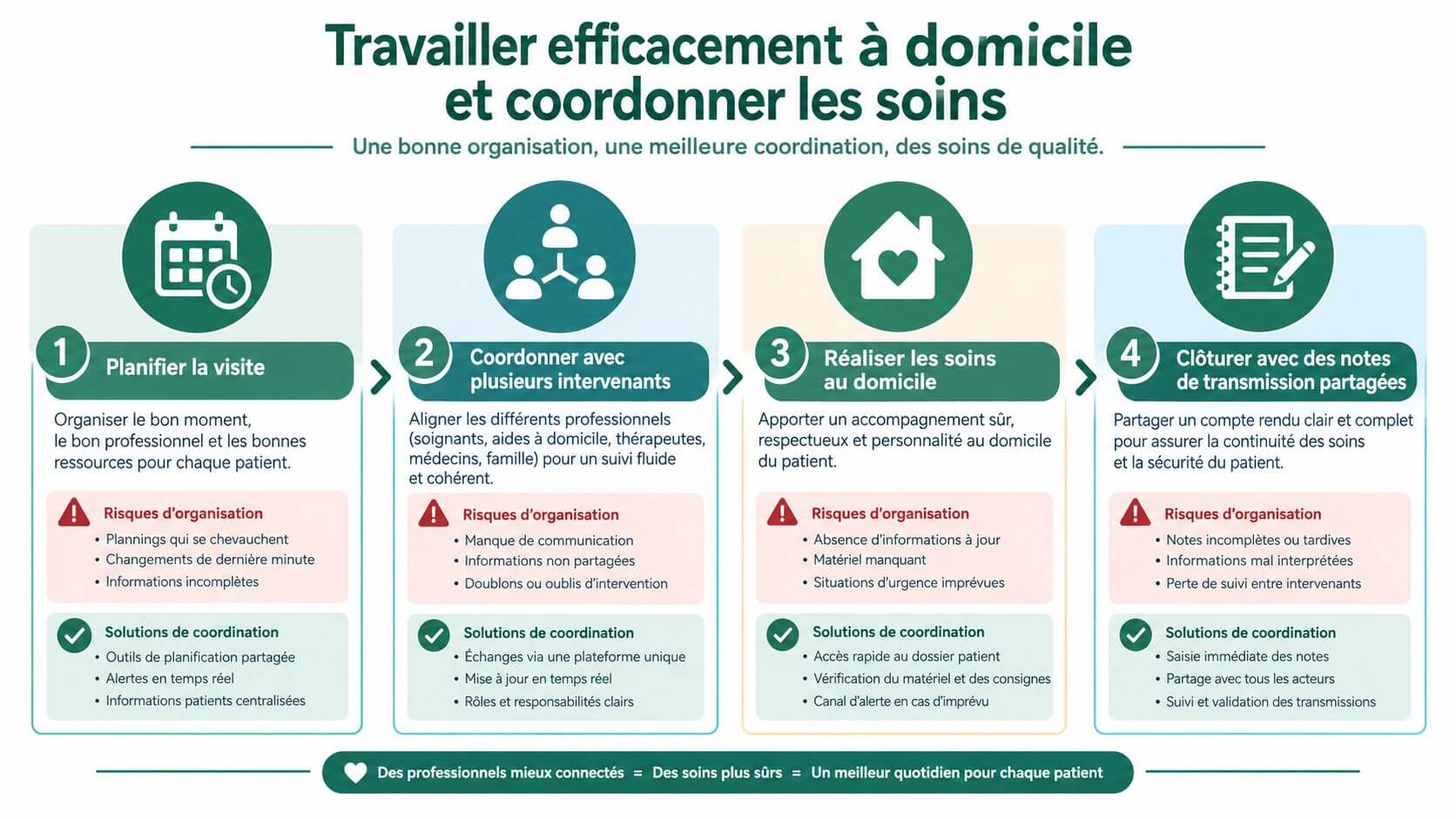
Before the visit
Prepare the information that will really guide the passage: mobilization instructions, precautions, recent changes, appointments, emergency contacts and tasks already done. A common sheet avoids searching several conversations or asking the family to check an intervention. To deepen the organization of the passages and the coordination with the relatives, consult our Home Caregiver Guide.
The shared calendar indicates the expected professionals and scheduled schedules. It makes visible a replacement, absence or modification of schedule, so that the team can react without multiplying calls.
During the passage
A guided checklist structures the steps without reducing the relationship to a series of boxes. Note the useful observations, the difficulties encountered, the assistance provided and the alerted person. An exploitable transmission describes the facts, their evolution and the action undertaken.
Medicines require a strict framework. The caregiver does not change a prescription, does not decide on an adaptation and does not replace the nurse. Takings, refusals or swallowing difficulties are drawn according to the applicable protocol, with an alert sent to the correct contact.
After the visit
The care journal must keep a legible history, identified by an author and one hour. A call is still required in the event of an emergency. Important information must also be entered in the space provided, so that other stakeholders can find it.
Tribulys includes a time-bound logbook, a checklist "My visit", a shared calendar, tasks, documents and the follow-up of useful information at home. The offline operation responds to situations where the network is unstable. The application does not replace the employer's procedures or clinical judgment. It provides a common space for organising passages and finding transmissions.
Hospital, EHPAD, home or acting, compare exercise patterns
The choice of place of exercise strongly influences the way of working. Basic skills remain the same, but autonomy, rhythm, relationship with loved ones and the flow of information change.
| Method of exercise | Strengths | Points of vigilance |
|---|---|---|
| Hospital | Present team, structured protocols, diversity of situations | Sustained rhythm, variable hours, strong coordination between units |
| EHPAD | Continued relationship, in-depth knowledge of residents, accompanying work | Relationship load, heavy dependence, need to identify slow changes |
| Home | Autonomy in the organization, personalized relationship, real life environment | Travel, isolation, housing and variable equipment |
| Interim | Discovery of different services and operations | Quick adaptation, incomplete markers, sometimes difficult to recover transmissions |
In the hospital, the caregiver can quickly solicit a colleague or nurse, but must be integrated into a highly organized care chain. In EHPAD, knowledge of the resident's habits becomes a valuable observational tool. A slight change in appetite or behaviour can make sense because the team knows the usual functioning of the person.
The home requires special attention on the organization. The caretaker acts in a private space, with greater practical autonomy, but he must know when to interrupt a task and alert. The interim, however, is suitable for professionals who agree to change frequently, provided that they check the protocols before intervening.
The best environment therefore depends less on a general reputation than on the match between the pace proposed, the preferences of the professional and the real quality of the collective.
Effective integration of a multidisciplinary team and secure passageways
Coordination is not just about the hospital. 2025, 64,900 posts were advertised in the care and health professions, and DREES 782,500 non-medical nursing positions, either 68% of all waged non-medical personnel, according to the file Take care published by the Ministry of Solidarity.
In the home, the caregiver can meet a Independent nurse, a attending physician, a home care worker, a physiotherapist and relatives. Each has a part of the information. Security depends on the ability to gather these elements without crossing the role limits.
A transmission that circulates
For each unusual observation, it is necessary to identify:
- The factwithout an improvised diagnosis.
- The moment, with the context of the passage.
- The consequence, such as refusal, difficulty or modification of accompaniment.
- Action, in particular the alert sent or the instructions applied.
- The recipient, so that no one assumes that another professional will take care of it.
Calls and SMS can trigger a quick reaction, but they quickly create scattered information. A structured note accessible to authorized people allows to retrieve the history, check the tasks performed and avoid duplicates.
To be noted: Tracing is not about protecting yourself behind the administration. It's about giving the team the necessary elements to decide and act.
The caregiver must also be able to say what he or she cannot do. He or she observes, accompanies and transmits. He or she does not prescribe, change treatment alone and does not turn a concern into a diagnosis. This position is not a weakness, it protects the person accompanied and clarifies the responsibility of each practitioner.
Before leaving home or service, a final check is useful: is the important observation written, is the alert gone, is the task assigned, and is the next deadline visible? These simple actions make the continuity of care more reliable.
Tribulys centralizes timed transmissions, passages, tasks, documents and follow-up information in a space shared between professionals and authorized relatives. To structure home visits and limit the loss of information between calls, SMS and scattered notebooks, discover Tribulys and invite those involved to join the coordination.
Put this organisation into practice with Tribulys
Keep your care journal, shared calendar, tasks, medication tracking and emergency information together. Start for free and invite the relatives and professionals involved in your loved one’s care.