
A home carer performs hygiene and comfort care under the prescription and responsibility of a nurse, while the nurse can prescribe and perform independently the medical acts that fall within his or her role. This distinction allows us to understand immediately who intervenes, why, and within what limits.
You may be facing a familiar situation. Your parent still lives at home, but the toilet becomes difficult, the meals are irregular and no one really knows if the morning treatment has been taken. The nurse passes at one time, the assistant of life to another, a relative calls at night, and the information is scattered between text messages, paper notebook and corridor conversations.
At home, the problem is not just finding a competent person. Each stakeholder must also know what happened before their arrival and clearly communicate what they observed. In France, the home care and assistance sector brings together more than 10 000 structures according to the Ministry of Solidarity, with many professionals but relays that sometimes remain fragile. A well-realized passage can lose much of its value if the essential information does not reach the next professional.
Contents
- Who is the Home Caregiver and what are its essential roles
- Key Differences Between Caregiver, Auxiliary of Life and Independent Nurse
- Legal framework and home care funding
- How to find and evaluate a home carer
- Maintenance and handover checklist with the caretaker
- Practical examples of a typical day and gestures of a caregiver
- Daily coordination of care with Tribulys and caregivers
Who is the Home Caregiver and what are its essential roles
The first border is simple. Caregiver does not replace nurse, and he does not work as an independent medical professional. He intervenes in an organized framework, usually within a care service, to accompany the person in hygiene care, comfort, mobility and observation of his condition, under the responsibility of a nurse.
At home, his eyes are often very concrete. He sees if a person gets up more difficult, eats less, if a redness appears on the skin or if it seems more confused than the previous day. These observations do not automatically give rise to a diagnosis, but they must be transmitted so that the nurse or doctor can decide on the follow-up.

The gestures of everyday life
A visit can include raising, installing in the chair, toilet, dressing, preventing the risks of immobility and helping with meals. The carer also ensures the comfort of the immediate environment, respect for privacy and the way in which the person participates in gestures.
Supervision is part of the work, but it must remain within the framework provided by the service and the care project. The professional may identify certain constants or report a functional change, according to the applicable protocols. He does not prescribe, modify a treatment and does not decide on a medical act alone.
Practical rule: a precise observation is better than a vague impression. "She ate less and sewed after breakfast" helps the team more than "she's not well".
Clinical and relational presence
The profession requires technical skills, but also constant attention to the patient's words. An elderly person can refuse a toilet because he or she is painful, tired or embarrassed. An experienced caregiver does not force the rhythm. He or she explains, proposes one step at a time and identifies what needs to be reassembled.
The need is considerable. In December 2022 1 336 500 persons were benefiting from the APA, which 794 000 at home and 542 500 in institutions, according to key figures of the CNSA. Home maintenance is therefore based on a daily organization where comfort gestures, observation and transmission must work together.
Key Differences Between Caregiver, Auxiliary of Life and Independent Nurse
At 8 a.m., Mrs. Martin's daughter asked for an injection. At 10 a.m., the home care worker found her mother drowsy. At noon, the caregiver noticed that she had almost nothing to eat. If everyone kept the information for him, the difficulty came not only from the choice of profession; it came from the coordination between the workers and the family.
I-I-ICaregiver perform hygiene and comfort care, under the responsibility of a nurse.Life aid accompanies everyday activities, such as meals, routine maintenance or travel, without performing any medical care.Independent Nurse evaluates the situation within its jurisdiction and performs nursing, including technical procedures and clinical surveillance.
| Profile | Training | Acts carried out | Legal framework |
|---|---|---|---|
| Caregiver | State diploma of nursing aid | Toilet, comfort, mobility aid, observations and transmissions according to the care project | Coordinated intervention and nursing responsibility |
| Aides of life | Training of the person assistance sector by route | Meals, daily gestures, accompaniment, routine maintenance | Personal service or direct employment, without medical procedures |
| Independent Nurse | State nursing diploma and regulated practice | Nursing care, dressings, injections, administration and monitoring of treatments as prescribed | Self-employed nursing practice in its field of competence |
Three situations to choose the right contact person
For the toilet of a very dependent person, the caregiver intervenes as part of a care service. To prepare a meal, recall a routine or accompany an exit, the home care worker usually meets the need. For an injection, a complex dressing or a course of treatment, you must contact the nurse.
This distinction becomes more delicate in the presence of addiction, cognitive disorders and multiple treatments. The INRS describes a profile where more than two-thirds are 80 years of age or older, two-thirds need help with toiletries and dressing, and one-quarter are confined to bed or chair. In this context, an observation transmitted to the right professional may prevent an error of care.
The right family reflex
Write down who observed what, when and what response was given. A shared notebook may suffice, provided the information is readable and consulted. A structured digital handover tool, such as Tribulys, also helps to prevent a change in appetite, a fall or an unusual difficulty between two visits.
Do not ask a professional to "do as usual" if the act exceeds his/her role. Note the question and then address it to the co-ordinator nurse, physician or department concerned. Home care facilities distinguish among them the SSIADs, home self-care services, Independent nurses and HAD depending on the person's situation and the nature of the care.
Legal framework and home care funding
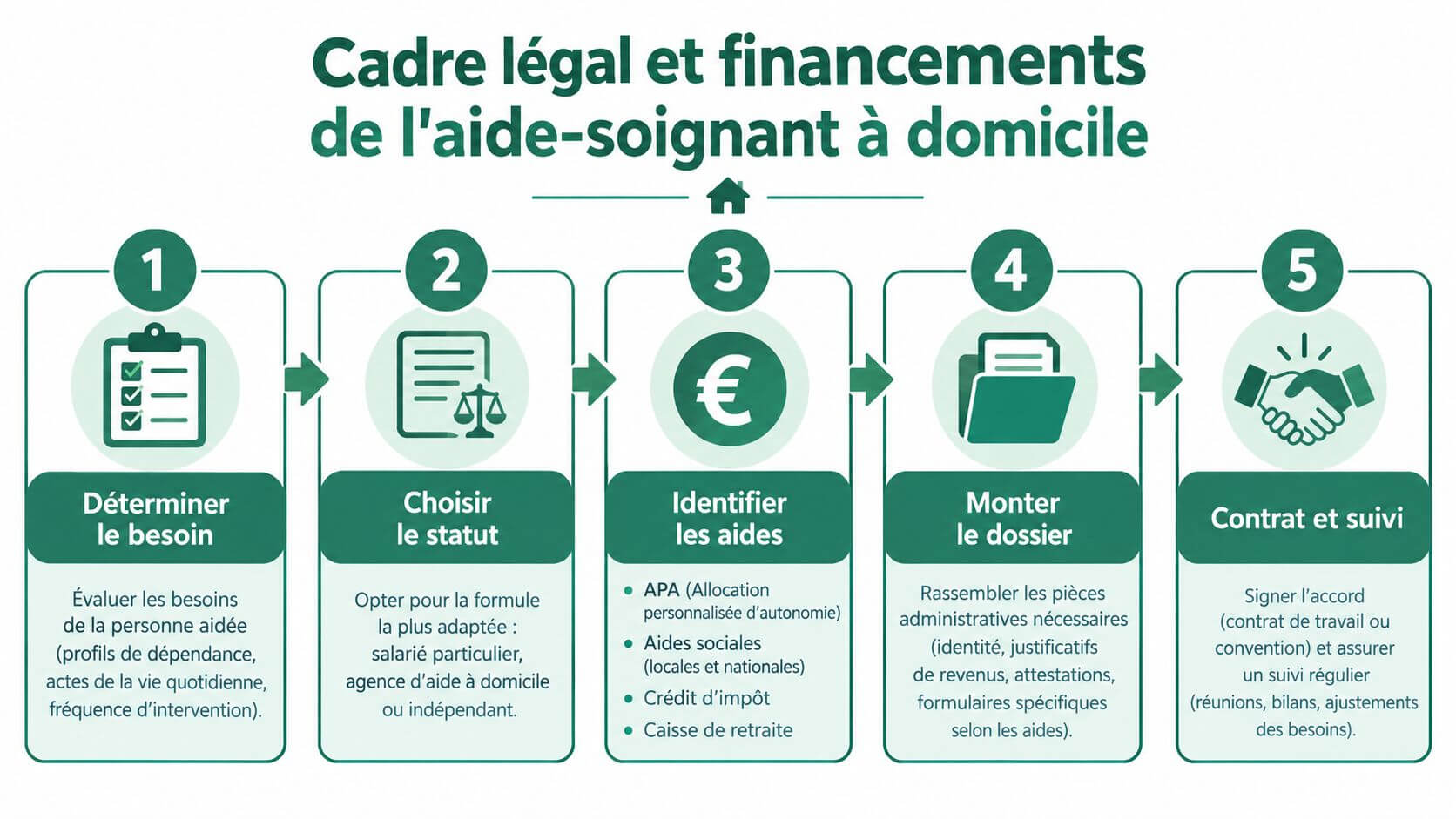
A loved one can receive a toilet aid in the morning, then see the nurse pass for a dressing. These interventions are neither the same professional nor the same funding. The prescription, the evaluation of autonomy and the status of the structure determine the approach to be followed.
The SSIAD act for prescribed and coordinated care. The home support and support services rather organize the actions of daily life. The reform brings them closer to home self-government services. Since 30 June 2023, SSIADs must also propose an aid activity and have a time limit of up to the end of the period of 2025 to move towards this framework. Official Presentation of Home Care specify the forms of care and their general conditions.
Aids to be examined
I-I-IAPA at home is allocated according to the IRM and is the subject of an aid plan notified by the department. It can finance part of the interventions related to the loss of autonomy. PCH certain situations of disability. Depending on the case, departmental assistance, pension funds or other arrangements may supplement the funding, depending on the age, resources, autonomy and benefit requested.
Therefore, the amount is not deducted from the "home help" only. Prescribed care, an unsanitary toilet, a night presence or a disability-related intervention follow different rules. Ask for written confirmation before planning the passages.
The useful administrative path
- Have the need assessed. Ask the attending physician or the appropriate department to describe the care, frequency of passage and expected assistance.
- Get the prescription when it is required. This will allow the care department to review the application in the appropriate setting.
- Contact the departmental council or the caisse concerned. Prepare elements on autonomy, resources and administrative status.
- Ask for a quote or confirmation of support. Make a distinction between care, daily help and what remains to be paid.
- Keep the documents. Prescription, assistance plan, contact information and transmissions must remain accessible to authorized persons.
In the field, funding does not solve the problem of information lost between two stakeholders. A more difficult toilet, a pain reported or an unusual refusal must reach the right professional. A structured transfer, on a shared medium or with Tribulys, keeps these observations in the same place and reduces the risk of a decision being made on incomplete information. digital guide on home-based self-care reform presents HAD as an ongoing, coordinated and complex home medical and paramedical care activity.
How to find and evaluate a home carer
A first passage may seem successful, and then reveal a problem a few days later: the caregiver noticed unusual fatigue, the family noted it in a message, but the nurse was never informed of it. Therefore, the research must assess the intended actions and the quality of transmission between the people around your loved one.
Start with a concrete description of the situation. Do we need to help raise, create a toilet, observe the general state, intervene at a fixed time or take over with a nurse? A specific request allows the service to propose a realistic organization and to identify the limits of its intervention.
There are a number of starting points for SIDS, home-based services, referrals from the treating physician, and local directories. public directory of home help services can also help identify structures available in your territory.
A six-check selection
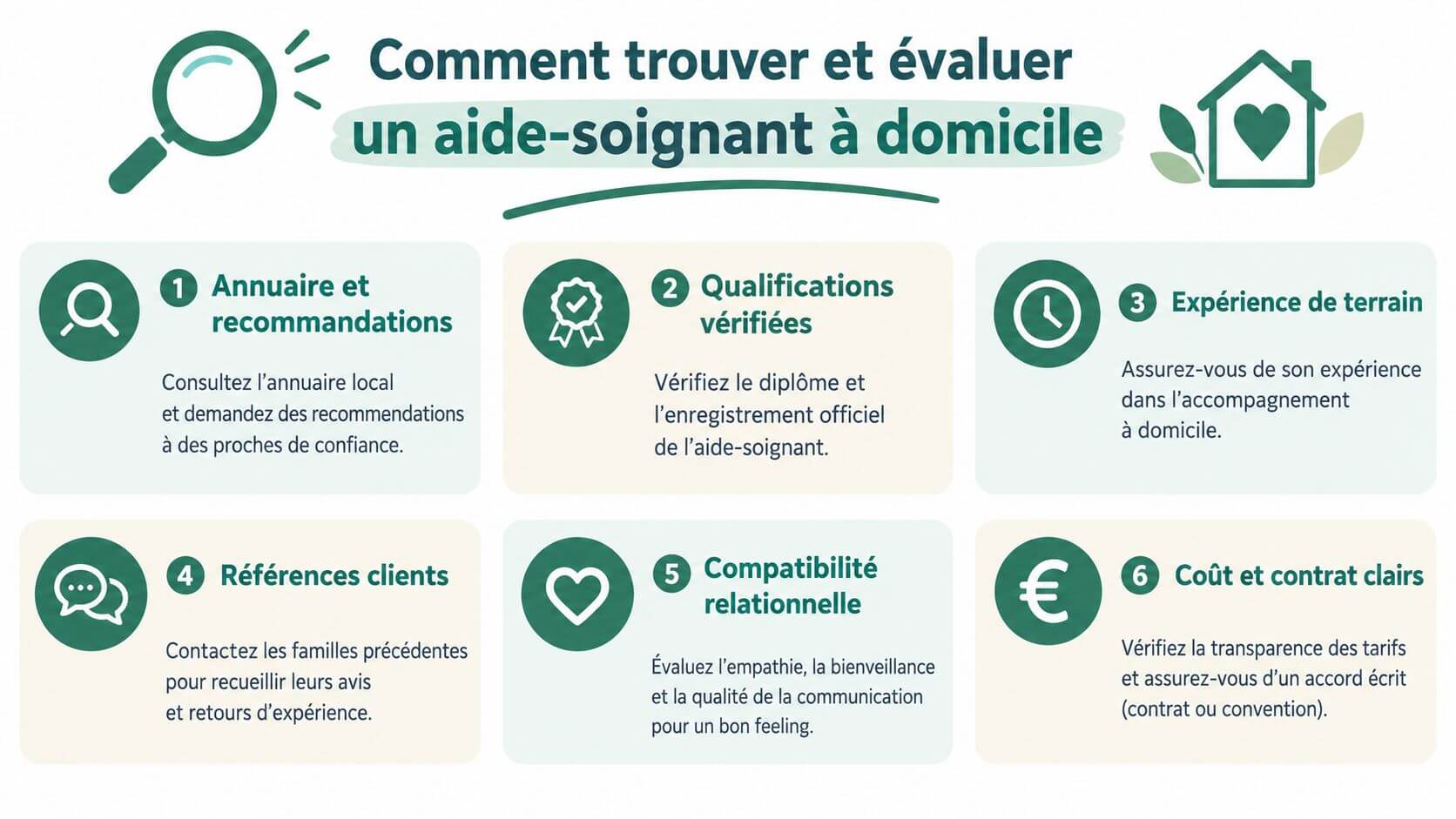
Yearbook and recommendations. Call several structures. Check that they are actually involved in your area and that they can offer the necessary schedules, rather than covering only one neighbouring municipality.
Qualifications verified. Ask for the name of the professional, his/her qualification, the intervention framework and the person who supervises him/her. A clear structure also specifies the role of the referent nurse.
Field experience. Describe the team's experience with cognitive disorders, transfers, bedridden people, and denial of care. Concrete responses are better than a general presentation.
During the first visit, devote ten minutes to a simple observation. Ask how a replacement, a leave or a change of schedule would be arranged, then see if the professional speaks directly to your loved one and follows his/her pace. References and continuity allows to evaluate also the Relationship compatibility.
Clear cost and contract. Before the first visit, specify the services, frequency, schedule, absences and billing.
Finally, ask how a change in health status is transmitted, how observations are read, and when an alert is processed. A written and structured transmission, accessible to authorized persons, prevents information from remaining on a personal phone or being lost between two stakeholders. Also ask who to contact at the weekend or in case of absence.
Maintenance and handover checklist with the caretaker
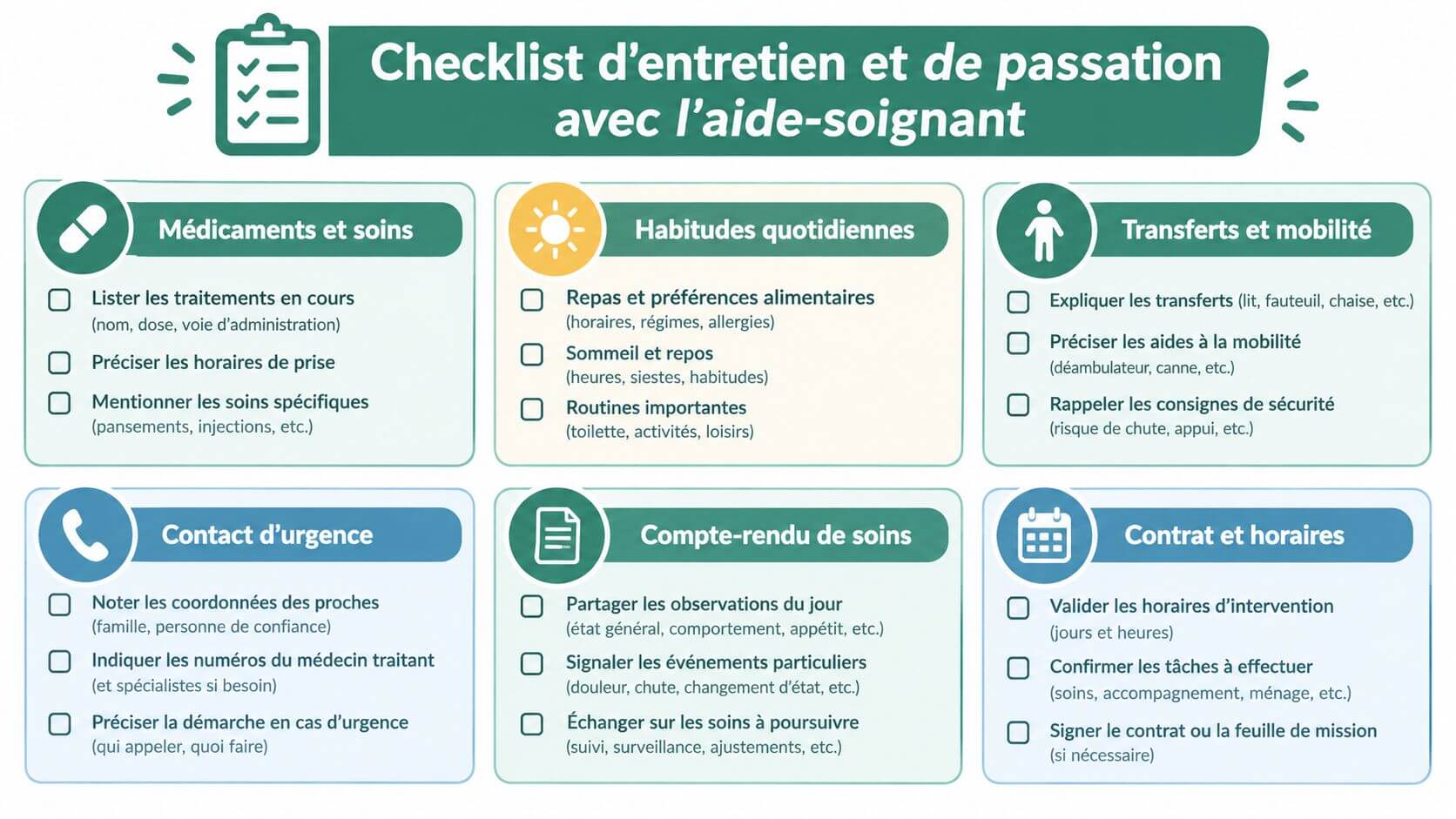
The first passage must be used for something other than getting to know one another. It must allow to build a common base, understandable by the family, the caretaker and other professionals. Prepare the documents, then let your loved one explain his habits with his own words.
The first morning scenario
On arrival, present the current treatment, known allergies, important history, eating habits and toilet preferences. Show technical aids, explain transfers and report the risk of falling, cognitive disorders or times when the person is tired.
The caregiver must know who to call in the event of a change. Enter the contact details of the contact person, physician, nurse and department. Also specify what is an immediate emergency and what should be forwarded to the team for decision.
The procurement scenario
After the visit, a useful transmission answers a few simple questions:
- What was planned. What help or care should be provided?
- Which has been noted. How did the person mobilize, feed or behave?
- Which has changed. Pain, fatigue, redness, avoided fall, refusal or confusion?
- What has been done. Installation, meal assistance, call of the competent professional.
- What's left to follow. Point to be checked at the next passage and person to be notified.
A transmission must not become an endless narrative. It must allow the next speaker to understand the situation without reminding you to reconstitute the day. To structure this medium, you can consult this model of care journal for Home Help.
To be noted: an oral instruction given in the entrance may disappear. A written, dated and assigned observation may be reread at the time it becomes necessary.
If treatment has not been taken, never ask the caregiver to compensate by a personal decision. HAD France on medicines indicate that the next dose should not be doubled and contact the coordinator nurse promptly in case of non-take or overdose.
Practical examples of a typical day and gestures of a caregiver
At 7:30 a.m., Mrs. Martin's daughter reported a bad night, while the nurse left a different set of instructions the day before. Before any action, the caregiver checks the priorities, recent changes and available information. This preparation avoids following a routine that has become inappropriate. It also serves to quickly identify what needs to be confirmed with the team.
The morning passage
When he arrived, he observed the apparent breathing, mobility, mood and general condition. He asked how it happened at night, then accompanied him by respecting the remaining abilities. A person who can still participate must remain an actress of the gesture, even if it takes a few more minutes. This time also shows if a usual movement becomes difficult.
The toilet combines modesty, order and vigilance. The professional checks areas exposed to redness, carefully drys the folds, helps with dressing and installs the person in a safe position. He then prepares breakfast according to the known instructions. A difficulty in swallowing, reduced appetite or unusual fatigue must be distinguished from a simple dietary preference.
The treatment aid does not give the carer the power to change a prescription. In case of uncertain information, he suspends the initiative and contacts the nurse or family in accordance with the protocol provided for. An unusual refusal, confusion or change must be transmitted with specific facts. Without this trace, each stakeholder risks rebuilding the situation from a different fragment.
Afternoon passage
In the afternoon, the visit may be shorter, but it remains attentive. The caretaker observes fatigue, walking, hydration and constants when a follow-up is planned. A different tension or unusual temperature is not enough to conclude. These elements take their meaning with the general condition and previous observations, then are transmitted to the team.
The loss of autonomy sometimes takes place in small touches. A relative who no longer gets up alone, eats less or falls asleep during an activity deserves an early warning, even without visible emergency. The caregiver informs the coordinator nurse and the family according to the rules of the team, without making a diagnosis himself.
Caregivers provide a large part of the SSIAD visits and represent 80% of ASIAD caregivers. They also realize more than 80% of patient visits. Their daily transmission thus constitutes a safety mark, especially when several professionals and relatives take turns at home.
Daily coordination of care with Tribulys and caregivers
At 10 a.m., the caretaker observed that the person ate less. In the evening, his daughter noticed unusual fatigue. The nurse, however, arrived without knowing these two facts. However, each one ensured his visit. The risk came from the hole between the passages, when an observation remained in a notebook, a call or the memory of a relative.
A structured transmission plays the role of a relay that does not lose the thread. With Tribulys, a web and mobile application for the coordination of family caregivers and healthcare professionals, authorized persons can consult a shared calendar, a link book and information followed over time. The platform indicates HDS-certified accommodation in France, GDPR compliance, real-time access limited to authorised persons and traceability by author and time stamping, as presented on the site of Tribulys.
The three morning gestures
See the shared calendar. The carer checks visits, appointments and schedule changes. He knows which professional should intervene and avoids passing on outdated or contradictory instructions.
Read the latest transmissions. The link book contains the facts that have occurred since the previous passage. A avoided fall, a little eaten meal or a denial of care can change the way in which to relate and the points to observe.
Check for planned tasks. The caretaker identifies useful information, monitoring points and assigned responsibilities. It starts with legible priorities, instead of reconstructing the situation from several conversations.
Avoided treatment error
In a fictitious example, the person no longer knows if he or she took his or her morning treatment. A transmission indicates that his or her daughter was present at the time of taking it. Therefore, the caregiver does not immediately propose a new dose. He or she contacts the girl and nurse to verify the fact before any decision is made.
This check can avoid a double take of anticoagulant, a common error when the morning take is not drawn in a time-stamped and assigned way. It does not replace the opinion of the competent professional. In case of oblivion or overdose, the next take should not be increased and the coordinator nurse should be contacted quickly.
When the network does not follow
In a poorly covered area, a nurse can inform the offline "My Visit" function during the pass, then synchronize her observations when the connection returns, if this feature is available in her environment. The immediate seizure reduces the risk of forgetting a detail between two homes.
The time book also links the observations of relatives. In another fictional example, the caregiver notes that a relative has been eating less for two days. Her daughter adds in the evening what she observed, then the nurse consults the set before her next visit. Continuity is then based on the same follow-up, while maintaining the telephone call when a situation requires a quick response.
To review this organization, consult this Guide on Home Care Coordination.
Tribulys centralizes the schedule, transmissions, tasks and monitoring of treatments in a shared space between loved ones and authorized professionals. To organize a more reliable relay around your loved one, discover Tribulys and start by providing the information needed for the next visit.
Put this organisation into practice with Tribulys
Keep your care journal, shared calendar, tasks, medication tracking and emergency information together. Start for free and invite the relatives and professionals involved in your loved one’s care.