
You are planning a conversion, you are already working with fragile people or you are looking for training that quickly leads to a useful job. aide-career training often combine access to diploma, funding, internships and regulatory developments. The French course has changed dramatically since 2021, and professionals who graduated before this reform are now affected by updating mechanisms.
Choosing an IFAS is not just about comparing a time or date of re-entry. You have to understand what the degree actually prepares, what pace corresponds to your situation, how to build a convincing file and what coordination skills will be expected in the field.
Contents
- The new face of the caring profession
- Access conditions and selection process
- Training module and key modules
- Learning rhythms and remote options
- Actual costs and financing strategies
- Professional Opportunities and Care Coordination
- Prepare your candidacy and pass your entry
The new face of the caring profession
At home, an elderly person seems to be more tired than the previous day. It works less well, eats little and responds briefly. The caregiver does not make a diagnosis, but he observes these changes, describes them and transmits them to the competent professional. Its role resembles that of a reliable relay in a team: he collects clues in everyday life to enable an appropriate decision.
The image of a professional limited to toilets, meals and comfort no longer covers the reality of the profession. These cares remain at the heart of the accompaniment, but they are integrated into a care where observation, prevention, communication and transmission occupy a structural place.
Observe, transmit and alert
A useful transmission does not consist of saying that "the patient is not well". It specifies the change observed, the time when it appeared, the circumstances and its evolution. This method allows the nurse and other stakeholders to assess the situation without excessive interpretation.
In the field, the repository asks in particular to know:
- Identify an anomaly, comparing the observed condition with the person's habits and known instructions.
- Alert the right professional, as soon as a change may require an evaluation.
- Collaborate with the Nurse, respecting the role and limitations of each.
- Transmit structured information, in the oral as in the monitoring tools.
- Contributing to interprofessional clinical reasoning, with reliable observations from daily life.
The formation must thus relate three moments: the gesture made, the observation collected and the collective decision that may result from it. Imprecise information can delay intervention or create misunderstanding between stakeholders. The sharing must remain clear, dated and reserved for authorized persons, in particular within the framework of the coordination of home care.
Professional benchmark: a good transmission selects the relevant facts, accurately formulates them and respects the alert circuit.
An enhanced training framework
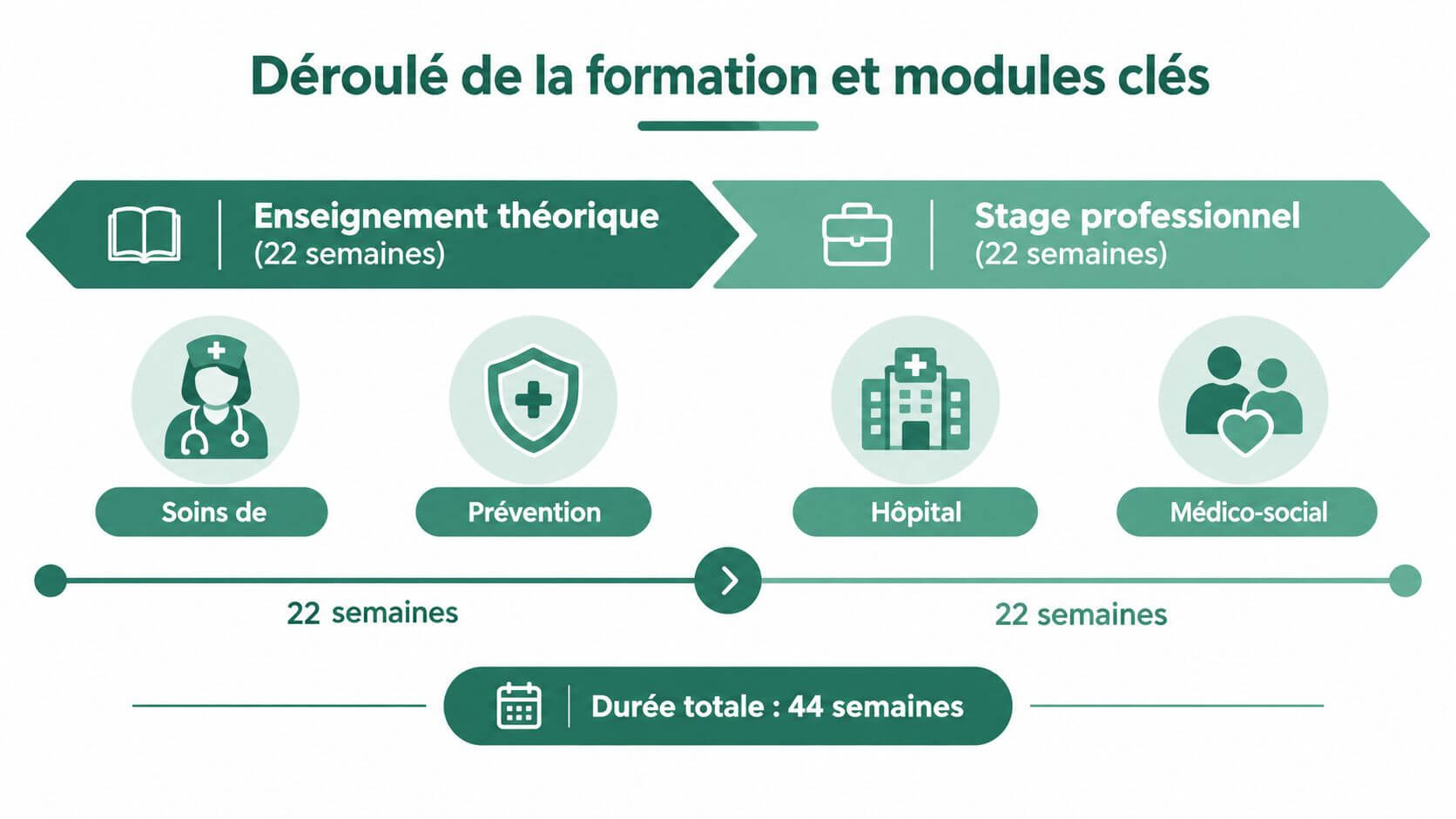
The reform resulting from the decree of 10 June 2021, published in the Official Journal on 12 June 2021 and applied from September 2021, placed the State diploma of carer-aid in the level 4 of the national professional qualifications framework, against level 3 previously. The curriculum includes 44 weeks, distributed between 22 weeks of theoretical and practical teaching and 22 weeks of work placement, according to Ministry of Health.
The regulatory developments associated with 2025 also reinforce the interest of updating skills and continuing training. Distance paths can facilitate this upgrade, provided that the practical time and internships required are foreseen. They do not replace the learning of contact, observation and teamwork.
This common framework helps candidates understand the expectations of the IFAS and gives employers shared benchmarks. The profession remains relational, but it also requires method, discernment and coordination, both in institutions and in the home.
Access conditions and selection process
Access to an IFAS is open without preconditions for a prior degree, but this does not mean that admission is automatic. The applicant must present a dossier, then convince during a selection interview. Administrative conditions may vary depending on the institute and the territory, especially for certain age or document requirements.
Start by checking IFAS rules
Before writing your application, consult the relevant institute's notice. Check the filing period, list of documents requested, selection procedures and any medical conditions. guide de France Travail dedicated to the profession of caregiver Recalls that access is based on selection and that training prepares for concrete responsibilities for monitoring, collaboration and alerting.
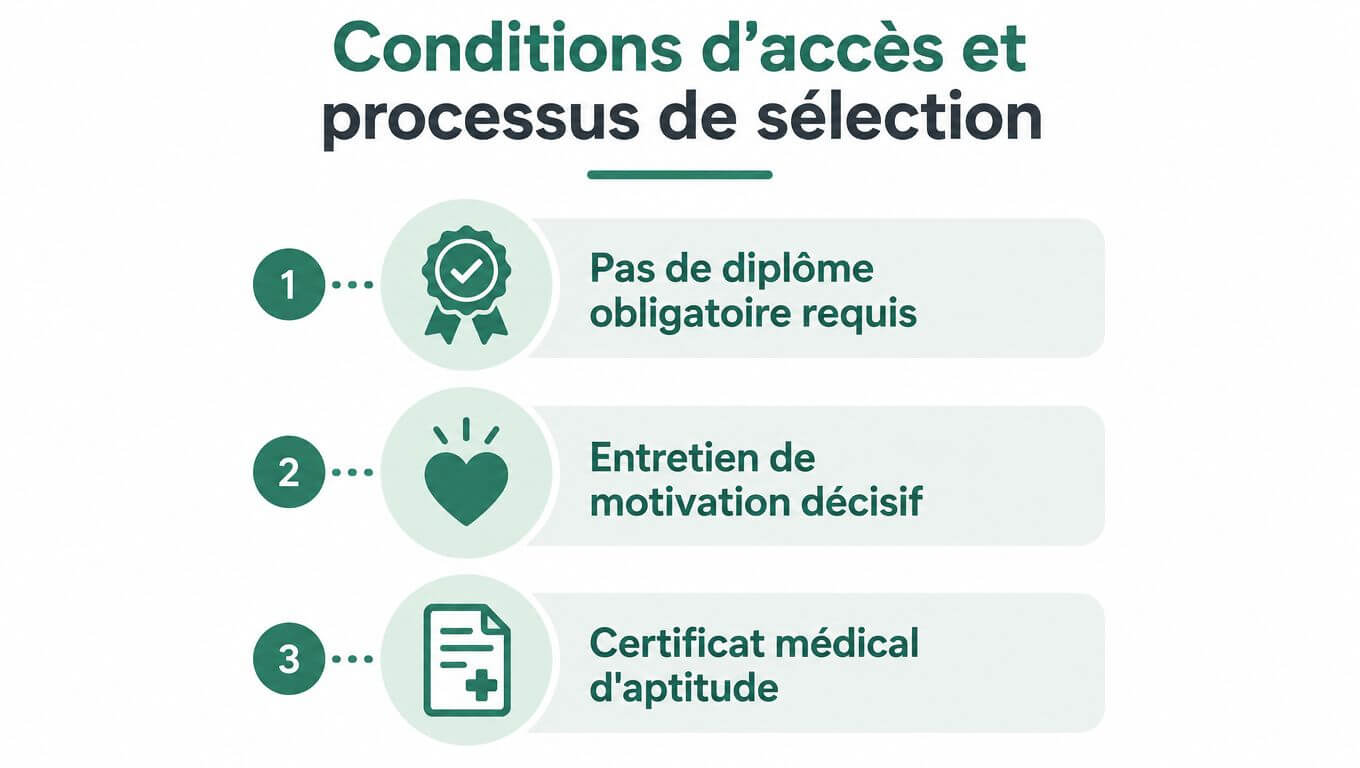
A solid case must answer a simple question: Why is this profession now, and why are you ready for its constraints? An experience in personal assistance, animation, catering, trade or social support can be relevant if you explain what you have learned. Listening, punctuality, managing a tense situation and following instructions are transferable skills.
Build a case that talks to the jury
Avoid general formulas like "I like to help others". Instead, describe a situation where you have had to stay alert, reassure someone, or act with discretion. The jury seeks to assess your understanding of the profession, your maturity and your ability to support the realities of care.
In particular, prepare:
- Your journey, including experiments that are not directly related to health.
- Your motivation, linked to the real missions of the trade and not to an idealized image.
- Your knowledge of constraints, such as variable schedules, teamwork and contact with dependency.
- Your availability, for courses, internships and administrative procedures.
- Your project after training, even if it remains likely to evolve.
The interview is not a medical interview. It is used to verify that you know where you are setting foot. Explain what you understood about the role of the caregiver, what you still need to learn and how you react to a difficulty.
Also ask IFAS how to obtain the required medical certificate and what documents must be provided prior to entry into training. An application may be relevant on the merits, but may be delayed by a missing document or submitted out of time.
Training module and key modules
By entering IFAS, you alternate knowledge learning and testing with patients. The renovated setting organizes the training on 44 weeks, 22 weeks of theoretical and practical teaching and 22 weeks of work placement, as indicated in Ministry of Health on Caregiver Training.
Linking courses to care situations
The modules give a reading grid to understand what is happening with a person. Anatomy and physiology help to interpret a change in the general condition. Hygiene and infection prevention explain the expected rigor for gestures, equipment and circuits.
Professional communication prepares you to exchange with an anxious, confused, painful or uncooperative person. The teachings on accompaniment teach you to preserve your dignity during the toilet, travel or meals. Safety leads to the identification of the risks of falling, undernutrition, dehydration and isolation.
Since the renovation started in 2021, and then the regulatory adjustments of 2025, the diploma is part of the level 4 of the NCP. This development reinforces the place of observation, transmission and coordination with the team. The carer is therefore not limited to carrying out gestures. It collects reliable elements, signals an evolution and contributes to the continuity of care.
In internship, each apprenticeship is observed in a real situation. The student must carry out the care, understand his/her context, prioritize and transmit useful facts. This coordination resembles a relay passage: imprecise information can complicate the work of the professional who takes over.
Internships as a field of evaluation
Internships may include hospitals, the medical-social sector or the support of elderly people. Acute service requires rapid observation and reactive transmission. In geriatrics, rather, gradual changes in habits, autonomy or behaviour need to be identified.
Progress is based on concrete reflexes:
- Preparing for treatment, checking instructions and equipment.
- Explain each step, to preserve trust and consent.
- Observe while accompanyingbeyond the succession of gestures.
- Securing the environment, for the person as for the professional.
- Transmit after intervention, with precise facts, dated in the course of the treatment and useful to the team.
I-I-IAFGSU level 2 prepares to recognize an emergency, protect, alert and participate in the first steps within the framework provided for by the training. The conditions of this certificate are presented by the Ministry responsible for Health in its information on the AFGSU. It supplements the daily skills without authorizing the aide-custodian to decide on a medical conduct alone.
Finally, success is based on three habits: learning classes, asking for internship returns and linking theory, gestures and transmissions. It is this analytical capacity that transforms a stored record into a safe practice.
Learning rhythms and remote options
The DEAS can be prepared in several ways. Initial training is often suitable for people entering or changing occupations. Continuing training is more responsive to employees whose project is linked to employment. Apprenticeship combines training and professional activity under a contract, while the VAE allows recognition of experience already acquired.
The right choice depends less on the prestige of a path than on your concrete situation. A person without experience of care will need a pedagogical accompaniment and structured internships. A professional already accustomed to accompaniment will be able to look for an organization that values his or her achievements, without assuming that experience dispenses with any refresher.
Distance learning changes organization
The framework presented by the Ministry provides for: 1,540 hours for the carer training and authorizes up to 70% of theoretical distance learning, in accordance with the procedures adopted by the organization, as indicated by the published in the Official Journal on the updating of powers.
This possibility is particularly useful for adults who work, care for a child or live away from an institute. It does not remove the requirements. There is a need to have a workspace, plan the sequences, participate in the exchanges and know how to ask for help. Practical work and internships always require a presence adapted to the IFAS calendar.
Before registering, ask specific questions:
- Are distance courses synchronous, with mandatory attendance, or accessible on a delayed basis?
- How does the institute organize practical work?
- What accompaniment does the student encounter a difficulty?
- How are internships sought and distributed?
- What digital tools must be mastered?
Post-reform update
Professionals who qualified before the 2021 curriculum reform are not in the same position as a new applicant. The order of 26 February 2025 established a skills updating training for the care workers involved in the old curriculum. This evolution responds to a concrete need: the practices expected, the level of qualification and the responsibilities for coordination have changed.
An employer may also have an interest in organizing this refresher to harmonize the practices of a team. The professional must then verify the device applicable to his diploma, his status and his institution. The pathways of initial, in-service, VAE and apprenticeship training do not meet the same needs, even if they lead to the same diploma or recognition of skills.
Actual costs and financing strategies
The price displayed by an IFAS does not, on its own, allow you to predict your remaining amount to be paid. The amount depends on your status, the funding organization and the support obtained.IFITS for aide-career training illustrate this difference, with €6,374 for an unfunded student and €8,654 where care is the responsibility of an employer or body.
| Student profile | Estimated costs | Main source of funding |
|---|---|---|
| Unfunded student | 6 374 € | Personal savings or assistance requested individually |
| Employee with care employer or organization | 8 654 € | Employer, financial institution or transitional arrangement |
These amounts are examples of posted rates, not a national price. Two Institutes may apply a different grid, and the same applicant may receive a different financial response depending on their status at the time of entry.
Identify the right contact person
Start by determining your administrative situation. A job seeker must interview France Travail and the regional council, as regional aid may depend on the occupation, territory and status. An employee must speak to his employer and the human resources department before resigning or reducing his activity.
The Vocational training, the financing by the employer, Transition Pro andANFH may correspond to different profiles. An officer of the hospital public service must check the conditions of care with the ANFH. A person undergoing conversion must obtain a written reply on the costs covered, the possible remuneration and the remaining expenses.
Establish a full budget
Do not limit your calculation to teaching expenses. Add travel to the institute and internship sites, meals, requested materials and a possible income reduction. Ask IFAS for a detailed estimate and check what is included.
Administrative Board: do not make a deposit and do not leave your job until you have clarified in writing the admission, cost, financer and payment schedule.
Keep contact names, call dates and documents received. A structured re-launch facilitates the processing of the file and prevents you from repeating the same procedures with several services.
Professional Opportunities and Care Coordination
The training leads to jobs in health facilities, medical and social facilities and some home-based intervention facilities. National data show the importance of the sector: 31,300 students were enrolled in aide-career training 2022, and this training, along with that of nurse, was among the two dominant sectors of health training, representing both of them. 74% of enrolment in the 16 disciplines observed. DREES also indicates that 27 additional training courses were created in 2022.

The published insertion indicators for promotions 2022-2023 and 2023-2024 show that 8 out of 10 leavers were employed six months after graduation, while 84% continued their studiesaccording to the same publication of the DREES on training for health professions. These data should be read carefully, as employment and further study may involve different situations depending on the path observed.
Coordination becomes a daily competence
In an institution, coordination involves transmissions, meetings and care records. At home, it can involve more stakeholders and relatives. The caregiver must know who is responsible for what, where to find an updated instruction and how to report a change in the person's condition.
A digital tool can support this organization if it does not replace professional judgment. Tribulys includes a timed liaison log, a shared calendar, a follow-up of medicines, constants, tasks and documents in a space accessible to authorised members. The platform also offers an offline visit checklist, which can help structure an intervention when the connection is unstable.
The value of such a tool lies in the continuity of the information. A dated transmission makes it possible to distinguish a recent observation from an old one. A shared calendar reduces the uncertainties about passages. An alert or contextual comment can draw attention to a point to be checked, without multiplying the calls and scattered messages.
The professional rules remain a priority. The carer does not make a diagnosis from an application and does not modify a treatment on his own initiative. He uses the information available to observe, transmit and alert within the framework defined by the team.
As a result, digital skills are not a supplement for technophilic professionals. Knowing how to inform a transmission, find a record and protect confidentiality is part of a coordinated practice. Home Caregiver show the importance of this discipline on a daily basis.
Prepare your candidacy and pass your entry
A successful application is prepared before the opening of the registrations. Start by selecting the IFAS compatible with your transportation, availability and funding constraints. Then check the dates and documents requested on the official pages of each institute.
A five-step approach
- Clarify your project. Write down the concrete reasons that direct you to the profession, the audiences you want to work with, and the constraints you accept.
- Gather the coins. Prepare your proofs of identity, journey, experience and medical documents requested by the Institute.
- Write a personal motivation. Describe a real experience, what you learned from it, and how it connects with caring missions.
- Prepare the interview. Train yourself to explain the role of the caregiver, his/her collaboration with the nurse, the importance of transmissions and the possible difficulties of the profession.
- Secure funding. Ask for the rates, ask for the relevant agencies and keep the written answers before confirming your entry.
The jury may ask you how you would react to an anxious person, a change in status or a disagreement in the team. Answer with method. First, protect the person, describe what you are observing, tell whom you are transmitting the information and recognize the limitations of your role.
Your presentation must be honest. You don't need to pretend to know everything. Explain what you've already learned, what you need to develop and how you plan to progress during courses and internships.
If your project is part of a conversion, you can also consult resources for Browse jobs for career switchers in order to compare trades, prepare your transition and better situate aide-career training in your career path.
After sending, note the date of filing and restart the institute according to its instructions. In case of refusal, ask if a return is possible, correct the weaknesses of the file and prepare a new application without downgrading your first step.
Tribulys helps families and professionals centralize transmissions, schedules, documents, constants and treatment tracking around a person kept at home. Visit Tribulys to find out how to structure daily coordination and facilitate the flow of information between authorised members.
Put this organisation into practice with Tribulys
Keep your care journal, shared calendar, tasks, medication tracking and emergency information together. Start for free and invite the relatives and professionals involved in your loved one’s care.