
In France, there is no automatic salary for a family caregiver. Remuneration or compensation goes through distinct mechanisms, with very different amounts and conditions.
You often find yourself in the same position. You help a parent, you may reduce your work hours, and the question becomes urgent: can you finally be paid for this, and in what form exactly? The confusion mainly arises from the word salary, which mixes declared employment, compensation, paid leave, and aid intended for the person being assisted.
In France, 9.3 million people aged at least 5 declared in 2021 that they regularly assist a relative in a situation of disability or loss of autonomy, and only 1.3 million adults declared a direct financial aid, which shows that the majority of caregivers do not receive any direct remuneration (DREES and Insee). The right reflex is therefore to distinguish from the start five possible pathways: PCH compensation, PCH direct employment, employment via APA or CESU, AJPA, and caregiver leave. Once this sorting is established, the topic becomes much clearer.
Table of Contents
- Family caregiver salary - the essential starting point
- The three formal pathways of remuneration through direct employment
- PCH compensation versus PCH direct employment - do not confuse
- AJPA and caregiver leave - compensating for loss of income
- Why formalizing your support with Tribulys changes everything
- Decision-making table and action plan in 5 steps
Family caregiver salary - the essential starting point
The first mistake is to search for a single amount, as if there were a universal scale. In reality, the term family caregiver salary covers very different situations, and the right system depends mainly on two questions: does the aid relate to disability or loss of autonomy, and do you want a real job or a compensation for your commitment.
The right reflex to find your way
If the person being assisted is recognized as disabled and human aid is funded, the PCH comes into play. If the main issue is the decrease or cessation of your professional activity, then AJPA and caregiver leave are the right references. If the person being assisted can employ you directly, we shift to a declared employment logic, with a salary and contributions.
Simple rule, a caregiver can receive financial help, but they are not paid in the same way depending on whether we are talking about compensation, employment, or compensation for a leave.
The heart of the matter is therefore the legal framework. An amount paid under the PCH does not have the same nature as a pay slip, and a daily allowance does not replace a full salary. This distinction changes everything regarding retirement, CSG, social rights, and the procedures to follow.
The five pathways to keep in mind
- PCH compensation, to be compensated when helping a person with a disability.
- PCH direct employment, when the person being assisted becomes the employer of a family member.
- Employment via APA or CESU, for declared aid to a dependent elderly person.
- AJPA, to compensate for a decrease in activity related to caregiver leave.
- Caregiver leave, which protects employment but does not, by itself, create a remuneration.
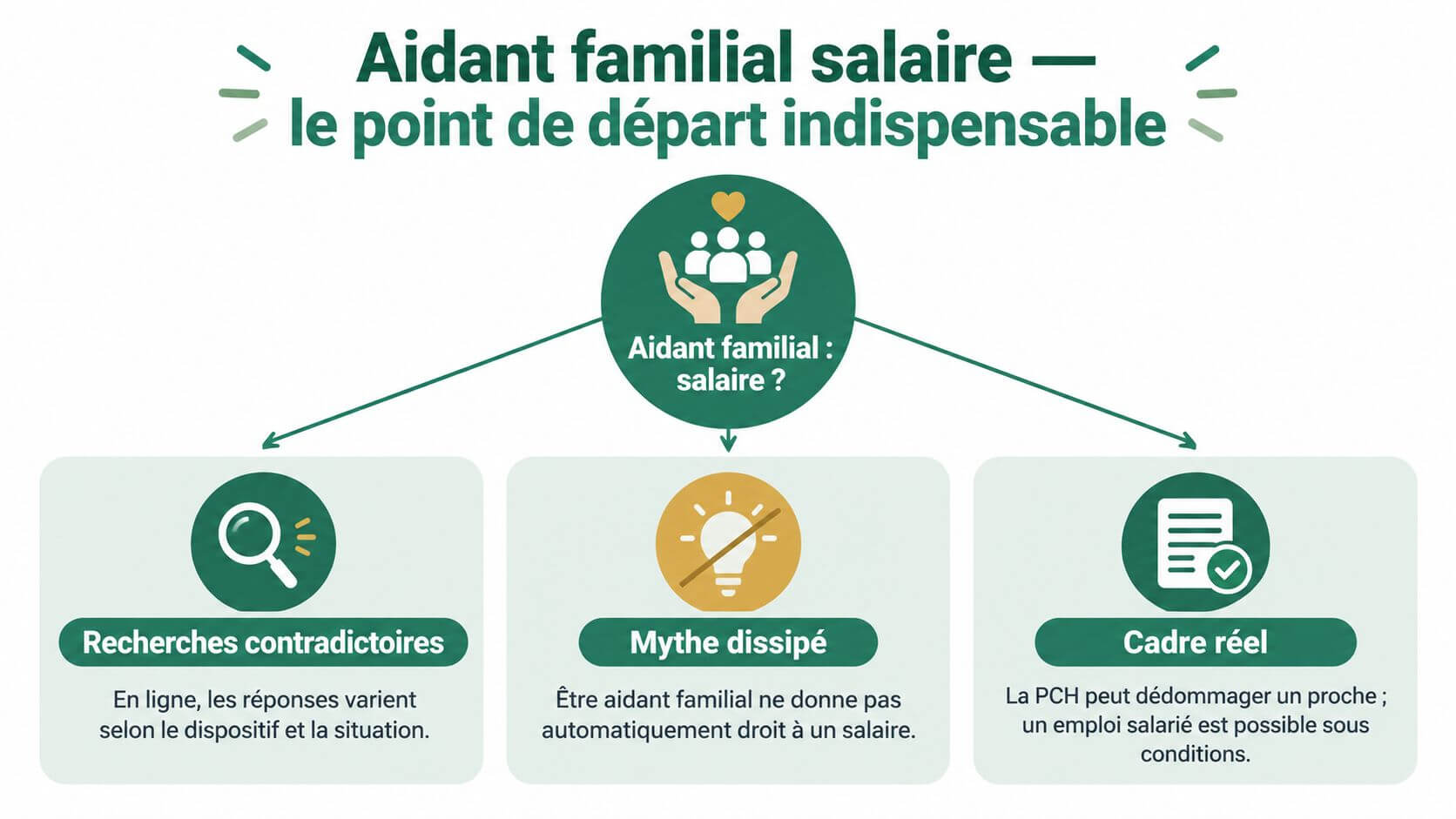
This mind map prevents you from confusing arrangements that follow opposing logics. The real issue is not just knowing if you can be paid, but knowing through which channel, for what amount, and with what social consequences.
The three formal pathways of remuneration through direct employment
The same caregiver can receive an amount that resembles a salary, without the framework being identical. It all depends on the channel used. Between direct employment, APA, and PCH, it is necessary to check who employs, who pays, and under which social rule the remuneration circulates.
Direct employment, APA, and PCH: three different logics
Direct employment rests on a real employment relationship, with a contract, a pay slip, contributions, and social rights. This is the most readable form, because the remuneration follows the classic rules of declared employment.
With APA, the person being assisted can hire a relative if the aid plan allows it. The salary then exists, but it falls within the framework of funding granted under the APA, with limits set by the departmental council.
The PCH adds a particular case. It can finance the direct employment of a family member when there is a real relationship of subordination, which distinguishes it from just compensation. For the reporting rules of home employment, Urssaf's practical benchmarks help to understand the logic of salary and associated contributions.
The starting point remains the same, whether the amount paid is a salary, public funding of employment, or merely a compensation.
Comparison of the three direct employment routes for a family caregiver
| Route | Beneficiary | Hourly rate | Monthly ceiling | Employer's burden |
|---|---|---|---|---|
| Direct employment | Helped person who employs his or her helper | According to the contract of employment | Depending on the means of the person receiving care | Declaration of employment, social contributions |
| APA with declared employment | Elderly dependent | According to the validated aid plan | Ceiling fixed by the departmental council | Reporting via the APA system |
| PCH with direct employment | Persons with disabilities | Compensation paid by the disabled person | According to the assigned PCH | USSRAF contributions, employment declared |
This table shows the real difference. In all three cases, one can lead to remuneration, but the legal support is not the same. Direct employment creates a salary in the full sense. APA and PCH can finance this salary, without confusing it with a simple payment of assistance.
PCH compensation versus PCH direct employment - do not confuse
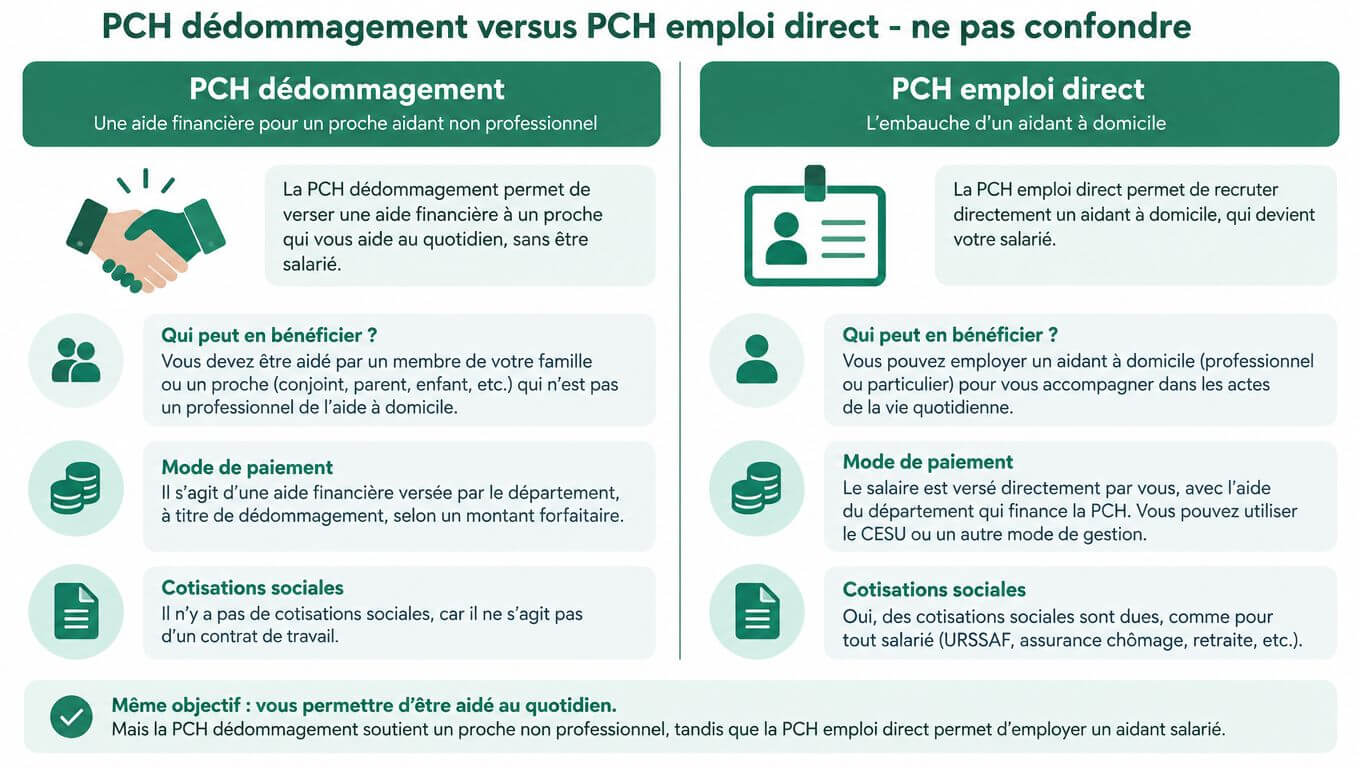
The same aid can take two very different frameworks. PCH compensation compensates for the help provided by a close relative without a link of subordination. PCH direct employment based on a real employment relationship, with the social consequences that go with it.
The point that changes everything about the CSG
The most common trap is to treat compensation as a simplified payroll. Legislation points out, on the contrary, that this compensation is taken into account in the CSG base. The actual net calculation may therefore surprise if this deduction is not anticipated.
The difference is very clear. direct employmentThere is a contract, a salary, contributions and full social protection. PCH compensationThere is no employment contract or payroll, and the amount received does not give rise to the same pension or unemployment rights.
To understand the declarative logic and its practical effects on your files, see also this point on the PCH declaration to the CAF.
When the increased rate becomes relevant
The scale provides for a rate of 75% of net hourly SMIC where the caregiver has to stop or reduce his or her professional activity in whole or in part. This rate does not apply automatically, it depends on the assessment of the file and the allocation rules, as discussed earlier in the regulatory framework.
To be retained, compensation is more simply set up, but it remains framed, capped and socially less protective than a wage.
First identify the legal framework of your aid, then calculate the net amount. The CSG applies from the first euro of the compensation.
AJPA and near-care leave - offsetting loss of income
You interrupt your work to help a loved one, but you do not charge this assistance as a benefit.AJPA is used to offset part of the loss of income related to Caregiver leave. In 2025, it rose to 65,80 € per day, with a ceiling of 22 days per month, either 1 447,60 € monthly before levies, and 66 days per loved one assisted (CNSA).
How the calculation works in practice
The mechanism follows the days actually unworked. A full day of leave shall be entitled to one day of AJPA, subject to conditions. Half a day's leave is entitled to partial compensation, while the rest of the day is normally paid by the employer. In other words, the AJPA reimburses an absence, not the overall value of the aid provided.
The scheme is intended for a number of employees, public servants, self-employed, spouses, paid trainees and unemployed persons who are in receipt of compensation, but with a view to reducing or terminating their activity (For the elderly) Since 1 January 2025, it can be mobilised to four relatives during the course of the career, either A total of 264 days. For practical approaches and cases, this resource helps to clarify the conditions for access todaily allowance of the caregiver.
AJPA and Caregiver Leave, two different answers
The Caregiver leave secure your position during absence.AJPA pay a daily allowance for days actually not worked. The two schemes therefore meet distinct needs, one to protect the employment link and the other to mitigate the decline in income.
The leave protects your place, the AJPA amortizes the loss, but neither of them replaces a full salary.
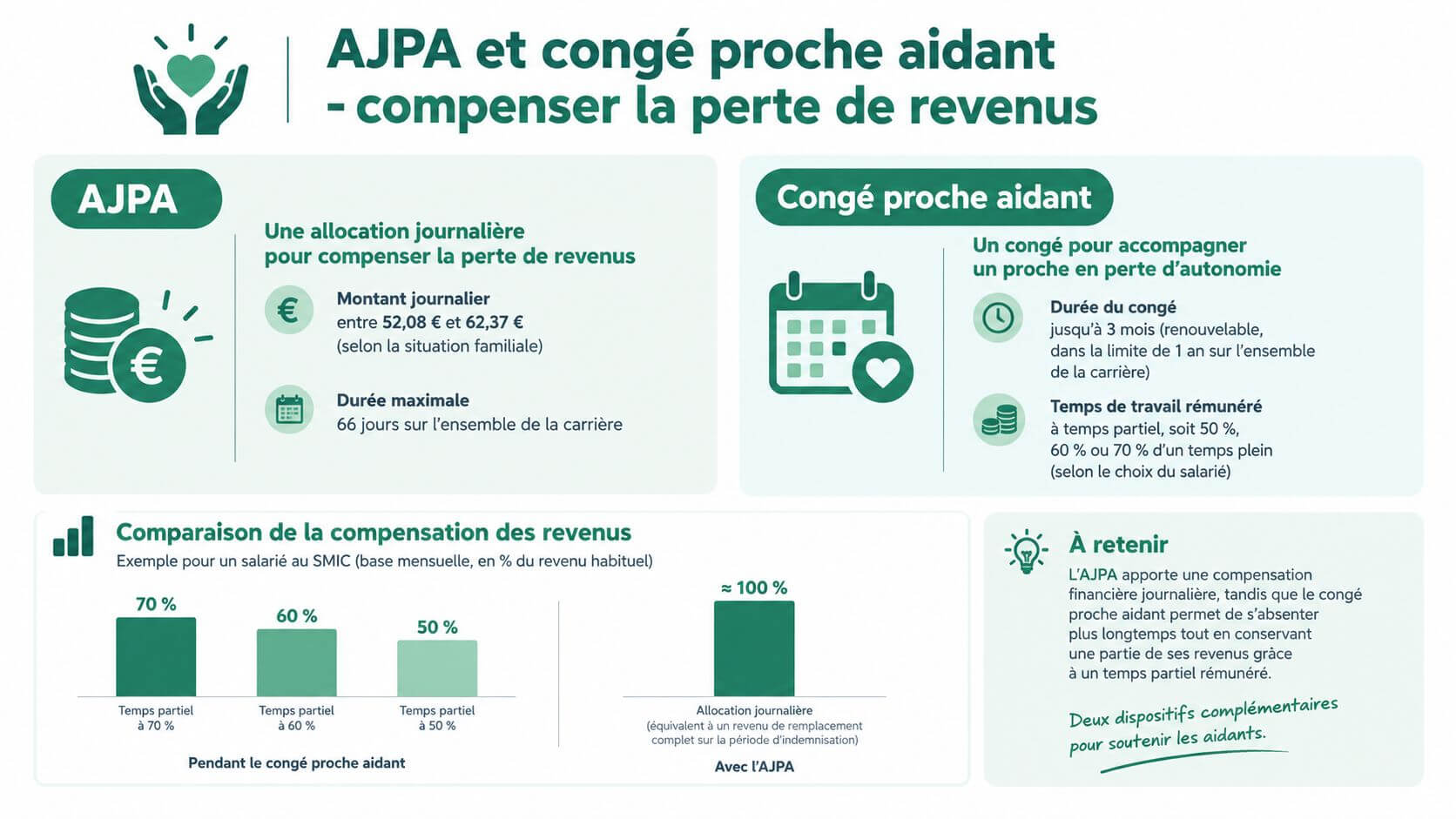
The correct reading is simple.AJPA offsets the loss of income associated with the leave, while the Caregiver leave allows you to reduce or discontinue your activity without losing your job. This security helps to pass a course, but it does not alone build a full replacement income.
Why formalizing your accompaniment with Tribulys changes everything
When looking for compensation or compensation, the real difficulty is not only administrative, it is documentary. You must be able to show who did what, when, and in what context, especially when several relatives take turns or when interventions are frequent.
Useful evidence, not just memories
A paper notebook or messages scattered in several conversations are often not enough to accurately reconstruct the history of an aid. Timely tracking of tasks, transmissions and passages makes the exchanges much more readable for the family, and easier to use when a folder needs to be justified.
This is where a solution like Tribulys It can serve, because it centralizes useful information around the loved one, with a time-bound link book, a shared calendar, a follow-up of drugs and a safe deposit box. For a remote helper or a sibling who shares roles, this centralization reduces grey areas and forgets.
What really matters in a file
- The tasks carried out, to document the actual aid.
- Schedules and passages, to show continuity.
- Drugs and alerts, to keep a reliable trace.
- Administrative documents, to avoid losing useful parts.
Tribulys does not replace the decision of the CDMH or the USSRAF formalities, but the platform makes the organisation clearer when it has to explain the reality of the aid. In a compensation file, this traceability can make the difference between a blurred narrative and a defensible follow-up.
Decision table and action plan in 5 steps
The right device depends first of all on your profile. An elderly dependent parent, an adult with a disability, a caregiver who reduces his or her working time, or two siblings who take turns do not fall under the same mechanism. So you have to start from the real need, not from the word salary.
Which path to choose according to your situation
| Profile | The most coherent route | Main contact |
|---|---|---|
| Major child assisting an adult with a disability | PCH, compensation or direct employment | CDMH |
| Elderly parent with regular help | APA and Declared Employment | Departmental Council |
| Helper who reduces his activity | AJPA and Caregiver Leave | Employer, CAF or MSA |
| Fratry sharing tasks | Written formalization and division of roles | Family, CDMH or department |
| Remote helper | Documentary monitoring and coordination | Family and professionals |
The exact amounts vary according to the device, but the central idea remains the same, you have to choose only one main logic Before you ask for anything. Most errors come from a mixture of compensation, direct employment and leave compensation.
Five steps to move forward without fooling you
- Identify your framework, disability, age-related autonomy, or decline in professional activity.
- Gather the useful pieces, certificates, previous decisions, evidence of attendance and medical documents.
- Trace care and passages, ideally in a shared tool with time stamping.
- Apply to the right place, CDMH, departmental council, CAF, MSA or employer.
- Return to the file regularly, because a situation of aid is changing rapidly.
The wrong file is not only a delay, it is often a waste of time and money for the whole family.
By the end of 2020, approximately 400 000 persons were covered by the PCH or the third-party compensation allowance, for a gross annual expenditure of EUR 2.6 billion, and the beneficiaries of the PCH had increased by 4,2 % Between the end of 2019 and the end of 2020 (DREES%20and%20l%E2%80%99allocation%20compensator%20per%20tierce%20person%20(ACTP).pdf)). These figures recall one simple thing, the devices exist, but you have to ask them with method.
Tribulys helps families structure the daily follow-up of a relative at home, with clear traces of passages, tasks and transmissions. If you are looking to make your accompaniment more readable for a file, family coordination or an exchange with a professional, visit Tribulys to see how the organization can become simpler and more defensible.
Put this organisation into practice with Tribulys
Keep your care journal, shared calendar, tasks, medication tracking and emergency information together. Start for free and invite the relatives and professionals involved in your loved one’s care.