
The duration of palliative home care can range from a few days to several months, or even several years when the accompaniment starts early. Home Hospitalization (HAD), the average observed duration is about 23 to 30 days.
When a family taps Palliative Home Care How Long, she rarely seeks a simple definition. She wants to know if she should organize herself for a few days, a few weeks, or a longer accompaniment. She also wants to understand what this changes in everyday life, for the sick relative as for those around her.
Often, the question comes in a very concrete moment. The doctor has pronounced the words "palliative care". A parent returns from the hospital. The room needs to be reorganized. The calls start between brothers, sisters, spouse, nurse, treating doctor. And behind all this, the same worry comes back. How long will it last, and how will it last if it lasts?
As a care coordinator, I can tell you one simple thing. The difficulty comes not only from the medical uncertainty. It also comes from the practical coordination that the numbers alone do not tell. Knowing that an average exists helps a little. Knowing who to call tomorrow morning, what to prepare at home, how to avoid treatment omissions and how to distribute relays helps much more.
You do not need to be a caregiver to properly accompany a loved one at home. Above all, you need reliable benchmarks, a realistic organization and simple tools not to carry all the mental load alone.
Contents
- Introduction: Navigating into the Uncertainty of Palliative Care
- Understanding the actual duration of home palliative care
- Factors influencing the duration of the accompaniment
- Organize home care and available support
- Facilitate coordination of day-to-day care with the right tools
- Conclusion: Anticipate to accompany with more serenity
Introduction: Navigating into the Uncertainty of Palliative Care
The most destabilizing, at first, is that no one can give you a reliable ending date. The family sometimes hears an estimate, then the situation changes within a few days. Conversely, a close relative who was thought to be very fragile can remain stable longer than expected at home.
This uncertainty is normal in palliative care. It does not mean that the teams do not know what to do. It means that the accompaniment adjusts to the person's real evolution, comfort, symptoms, fatigue, wishes and possibilities of the home.
Palliative care is not a countdown. It is accompaniment care that adapts to a living, changing, very humane situation.
So the right question isn't just "how long?". It's also "how are we going to organize this time, whether it's short or longer?" A family that thinks only in time risks being taken out of court. A family that also thinks about relays, transmissions and supports generally holds better.
It is also necessary to remove a common misunderstanding. Entering palliative care at home does not necessarily mean that the end of life is imminent in the coming hours or days. Some people need very brief support. Others stay at home for a much longer period, especially when care is put in place early and symptoms are regularly reassessed.
When I meet a family, I often propose three simple landmarks:
- A medical landmark. Observe the evolution of illness and comfort.
- A practical benchmark. Check whether the home can keep up with the real pace of needs.
- A human landmark. Preserving the strengths of the patient and those of the loved ones.
These three benchmarks avoid focusing solely on the calendar. They help make better decisions at the right time.
Understanding the actual duration of home palliative care
A son calls in the evening after a first team visit. He almost always asks the same question, with slightly different words: "How long are we talking about, really? A few days? A few weeks? The difficulty is that at home, the duration does not read as an appointment fixed on an agenda. It is more like an organization that adjusts itself according to the condition of the loved one, the symptoms, the fatigue of the environment and the ability of the home to follow.
What averages make it possible to understand, and what they cannot say
The encrypted benchmarks provide a useful starting point. For hospice palliative care in Homelessness, a national synthesis evokes an average duration of 23 days and also quotes another study around 30 days, according to this benchmark on palliative home care in France.
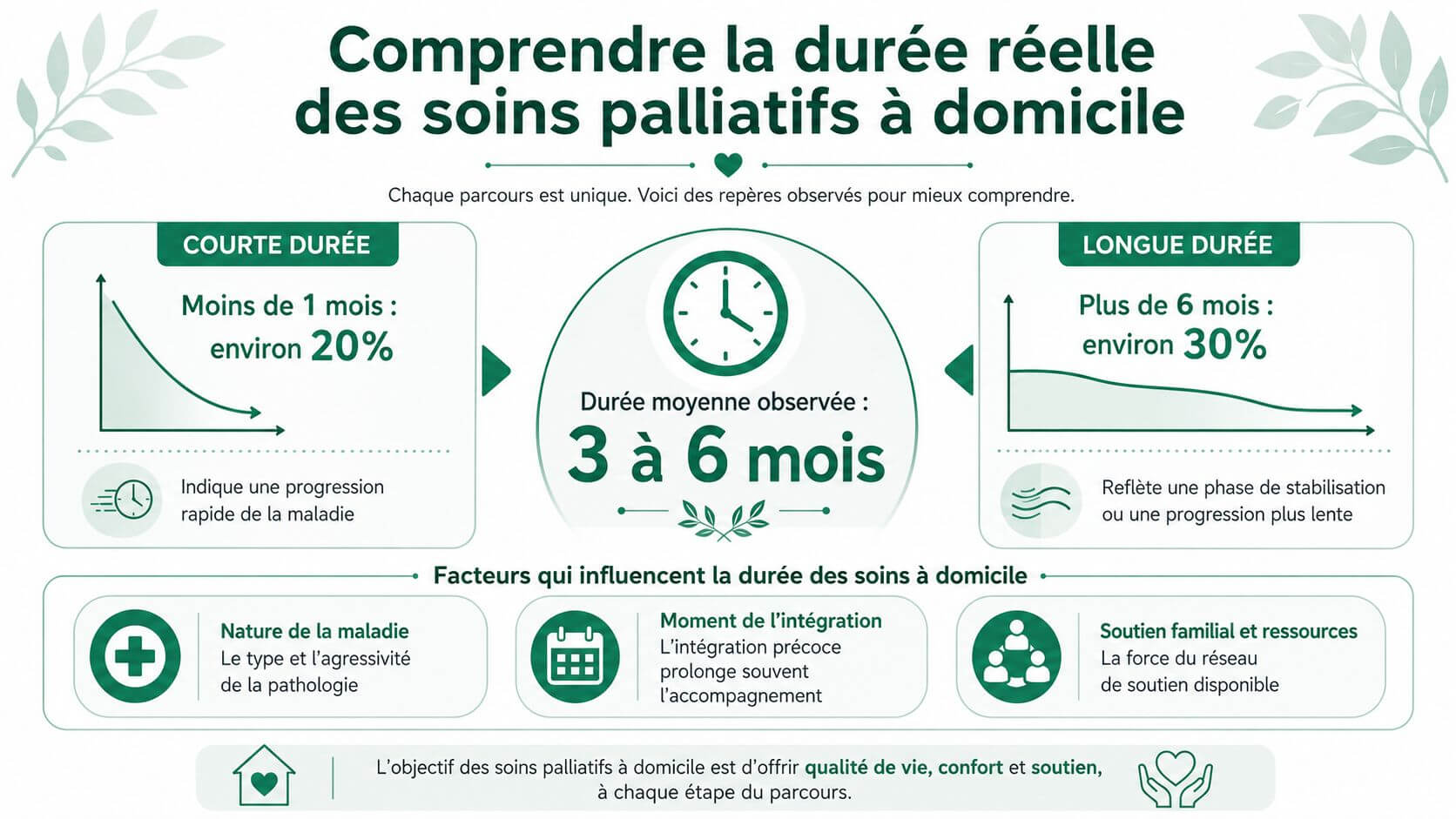
In the same resource, the average length of stay in hospital for patients receiving palliative care is 13.3 days. Comparison helps to understand a simple thing. The home often allows for a longer accompaniment than hospitalization, but in a very different context.
| Support context | Average duration observed |
|---|---|
| HAD Palliative Care | 23 days |
| HAD palliative care according to another study | about 30 days |
| Hospital, mode of palliative care | 13.3 days |
These numbers give a horizon, they don't give your calendar.
Why two families living in the same situation do not have the same duration at all
An average group of very different routes. In reality, there are very short accompaniments on the one hand, because the condition is deteriorating rapidly or the symptoms become difficult to stabilize at home. There are also accompaniments that take several weeks, sometimes more, because the care is started earlier and the organization lasts longer.
This is often where families get lost. They hear a number of days and try to turn it into a reliable forecast. Palliative home care, however, works more like a live schedule. Every concrete change can change the length of time at home: need for a medical bed, onset of pain at night, difficulty swallowing, exhaustion of the primary caregiver, adaptation of treatment, more frequent passage of caregivers.
In other words, duration depends as much on the patient's condition as on the strength of coordination.
At home, the question of time is also a matter of organization.
In the hospital, a lot of things are grouped together in the same place. At home, the information must be circulated among several providers. Treating physician, nurses, pharmacy, equipment provider, mobile team, HAD, relatives. If these relays communicate well, home maintenance can be prolonged in good conditions. If the transmissions become blurred, the situation can become very heavy very quickly, even without a sharp worsening of the disease.
That's why a family better look at duration as a series of practical steps:
- Is the loved one comfortable today?
- Do nights remain manageable?
- Who do we call if a symptom changes tonight?
- Are the ordinances, materials and passages up to date?
- Is only one person carrying all the load without a real relay?
These questions seem very concrete. They are. They are the ones that make it possible to stay at home longer in good conditions, or on the contrary, that indicate that the organization needs to be readjusted.
Simple benchmark: the actual duration of palliative care at home is the time during which the patient's comfort and balance of the environment can be maintained with appropriate supports.
The choice of home matters, but it is not enough alone
The possibility of staying at home exists within the legal framework recalled by the Claeys-Leonetti law, mentioned in the resource already mentioned. In practice, this choice becomes real only if the accompaniment follows. To stay at home is one thing. To be able to stay there with properly relieved symptoms, reachable relays and a family that does not exhaust is another.
This nuance often reassures the loved ones. It removes a false pressure. If the duration is shorter than expected, it does not necessarily mean that everything has failed. This can simply mean that the situation has changed faster than expected, or that the necessary level of care exceeds what the home allows at that time.
For a situation related to cancer, you can also read this insight into palliative care of home cancer, which clearly shows how some routes alternate stable periods and phases of worsening.
Most importantly, remember this idea. The correct reading of the duration is not "how many days are left?", but "what do we need for the next few days, whatever they may be, to be tenable, coordinated and as soothed as possible?"
Factors influencing the duration of the accompaniment
The disease does not change at the same rate depending on the situation
Two patients may have the same apparent age, live in the same type of accommodation, be surrounded with the same love, and yet not have the same path at all. The nature of the disease profoundly changes the duration of the accompaniment.
Some pathologies evolve with rapid degradation. Others progress in steps. In one case, the team will mainly manage a short and intense phase. In the other, it will adjust for a long time comfort, nutrition, nursing care, pain, fatigue and communication disorders.

Another element weighs heavily. The general condition of the patient at the time the accompaniment starts. A person already very weak, very symptomatic, with few reserves, does not have the same trajectory as a person still mobile, capable of exchanging, feeding a little and participating in decisions.
The moment when the accompaniment begins changes a lot
Many families still associate palliative care with the last few days. It's understandable, but it's reducing. When the accompaniment is proposed earlier, it can last longer and especially be better organized.
In concrete terms, early implementation often allows for:
- Better control of symptoms. Pain, shortness of breath or anxiety are identified earlier.
- Preparing the home. Medical bed, technical aids and passages are anticipated.
- Clarify patient's wishes. Decisions taken in an emergency are avoided.
- Relieving loved ones. The family understands the available relays better.
On the other hand, when everything starts very late, coordination is done in haste. We call several professionals at the same time, the information circulates poorly, and everyone feels like they are extinguishing fires.
The more the accompaniment begins in a climate of anticipation, the more gently it can be adjusted.
The patient's wishes and family balance also count
Duration depends not only on biology. It also depends on a project of life, even very fragile. Some patients want to stay home as long as possible. Others feel safer with a one-time return to hospital or other solution.
It is also necessary to look at the family reality without guilt. A home can fit for a time, then become too heavy to manage. It is not a failure. It is a re-evaluation. Home maintenance is important when it respects both the dignity of the patient and the human limitations of those who help him.
Three questions often help to clarify this:
- Is the patient comfortable at home?
- Do symptoms remain manageable at home?
- Do relatives still have enough relays to hold without exhausting themselves?
When one of these answers becomes frankly negative, we have to reopen the discussion with the team. The right decision is not the one we had originally imagined. It is the one that best protects the person and his entourage at the moment.
Organize home care and available support
The most difficult thing in the first few days is not always to understand the disease. It's to know who to call, for what, and at what time. A family often thinks that it has to hold everything. In practice, home maintenance holds better when roles are set up early, as in a small team where everyone knows their perimeter.
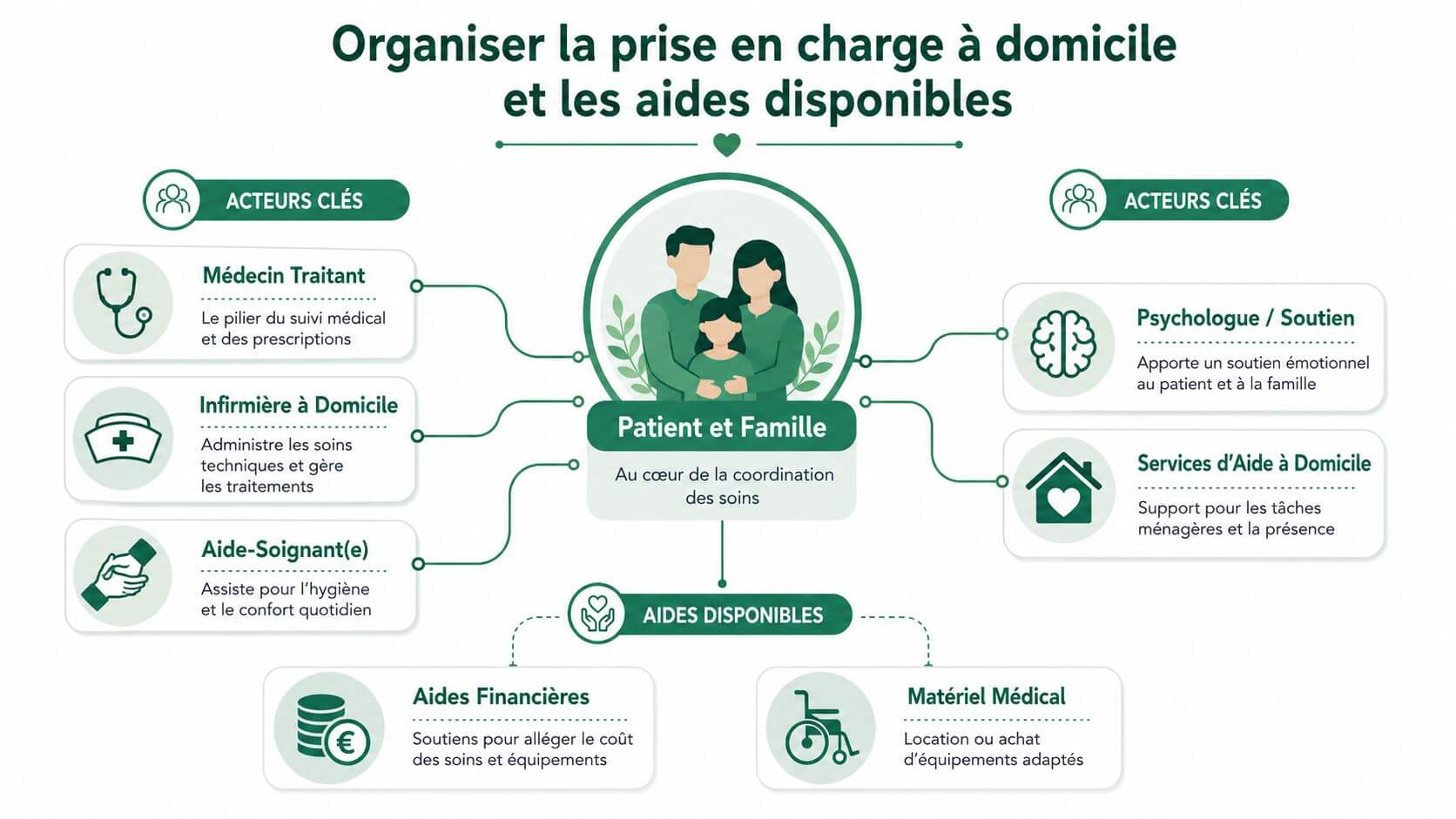
Who does what around the patient
The treating physician often keeps the overall view. It adjusts the requirements, helps to clarify priorities and decides, with other stakeholders, what remains possible at home.
I-I-Inurse or professional nurse See what the family doesn't always see right away. A pain that changes rhythm, unusual shortness of breath, difficulty taking treatments, fatigue that changes. Its role is not limited to technical gestures. It also serves as an alert relay.
The HAD teams It is useful when the organization becomes more complex. It structures the passages, coordinates several professionals, facilitates the installation of equipment and secures heavier care at home.
Around this core, other supports are very important:
- Aides of life or help at home. For meals, presence, certain gestures of the daily.
- Caregiver according to local organization. For hygiene, change, comfort.
- Physiotherapist. For mobilizations, prevention of scarring, sometimes respiratory comfort.
- Psychologist or listening support. For the patient, but also for the loved ones who cash a lot without always showing it.
- Pharmaceuticals. To check prescriptions, explain the forms of taking and avoid confusion between treatments.
A confusion often comes back. The family sometimes believes that "someone coordinates everything" from end to end. Sometimes yes, sometimes no. Coordination is often shared. If no one clearly has this role, simple details are lost. A hardware order leaves too late. There's no prescription for the weekend. A change in treatment is not passed on to everyone.
Concrete aid to be mobilised without delay
In the financial sphere, a lot of families can be relieved of the need to care for palliative care at home, which can be covered by the sickness insurance scheme, particularly in the context of a long-term illness, as pointed out in the report. the IGAS report on palliative care.
The same report shows a very strong burden for family caregivers at home. Some analyses of this burden lead to very high hourly volumes throughout the accompaniment. The useful message for a family is simple: relays must be planned early, before exhaustion, and not after.
Here are the supports to be checked quickly, with a very concrete logic:
| Need | To whom to contact |
|---|---|
| Requirements, medical reassessment | Treating physician |
| Technical care and supervision | Nurse Liberal or HAD |
| Daily help at home | Home Help Service |
| Medical equipment | Pharmacy, provider, coordinating team |
| Helpers' questions | Practical information for family caregivers |
Asking for help does not heighten the situation. It makes it safer. A loved one who is exhausted forgets more easily a catch, an appointment, or a sign that was to be reported.
A simple roadmap for the first days
I often recommend preparing the home as well as preparing a well-organised shift. Not to medicalize the whole house. To avoid unnecessary friction when fatigue rises.
Start with five points:
- Appointing a Family Coordinator. A person centralizes the main information and knows who to call in case of doubt.
- Gathering contacts in the same place. Treating physician, nurse, pharmacy, HAD, equipment provider, trusted person.
- Secure treatment. Available prescriptions, clearly marked schedules, readable instructions for each drug.
- Preparing the living space. Accessible bed or chair, sufficient light, charged telephone, equipment within reach.
- Provide Human Relays. Who spends the morning, the evening, the night if necessary, and the weekend.
If only one point is missing, the day quickly becomes heavier. If the five are ready, the family keeps more energy for the most part: to be present, to observe, and to ask for help without waiting for the situation to develop.
Here is a useful video resource to better visualize the possible organization around the home:
A well-prepared home does not remove uncertainty. It reduces avoidable emergencies and protects everyone better.
Facilitate coordination of day-to-day care with the right tools
Where families are most often lost
It is not always the care itself that is a problem. This is what happens between two passages. The nurse observed a stronger pain, but the information remains in a text message. The son believes the medication was given. The sister thinks the appointment is tomorrow. The paper book is on the table of the living room, inaccessible to the close relative who lives at a distance.
These frictions seem small. In reality, they tire everyone. They multiply calls, checks, doubts, and sometimes mistakes.
The most common situations are similar to this:
- Dispersed information. A little in the messages, a little in a notebook, a little in everyone's memory.
- Unseen agendaSeveral speakers, moving schedules, duplications or omissions.
- Follow-up of fragile treatments. We no longer know for sure what was taken.
- Mental load concentrated on one person. Often the spouse or child.
What a good tool should enable everyday life
A good coordination tool does not replace caregivers. It secures the collective work around them. It must be simple, searchable remotely and useful even when the day is busy.
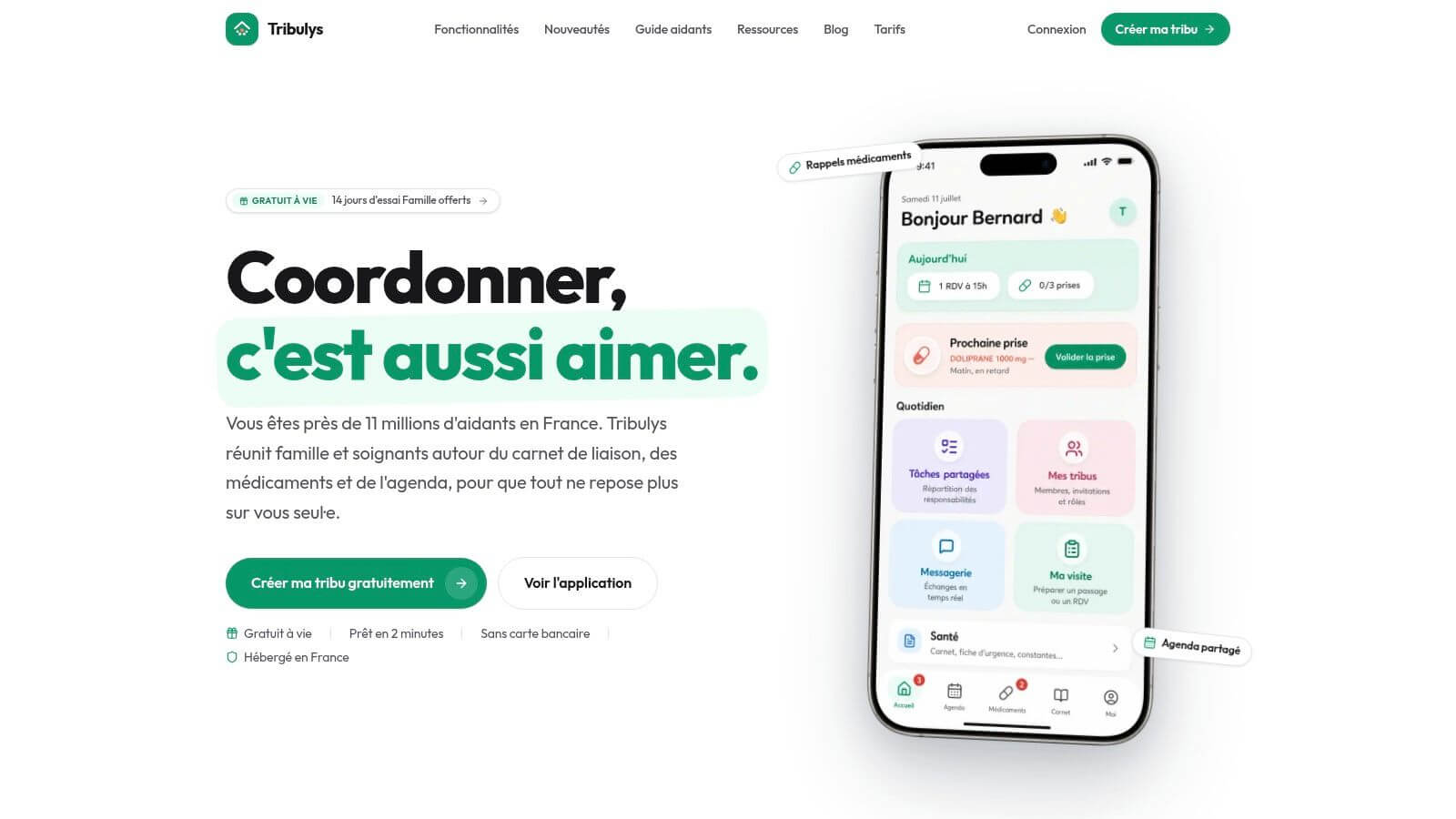
In practice, four functions actually change everyday life:
A shared link book
Each speaker notes what he has observed, done or reported. Everyone reads the same information, in the same place.Clear follow-up of medicines
The catch is confirmed. In case of forgetfulness, an alert prevents us from discovering the problem too late.A common agenda
The passages of professionals, appointments and family tasks are visible to anyone who needs to see them.A courier dedicated to the care context
It avoids discussions lost in several threads of personal messages.
For families looking for a solution of this kind, digital link book to coordinate caregivers can really ease the flow of information.
When everyone sees the same information, tensions decrease quickly. Coordination becomes calmer, and the patient also feels it.
Very concrete examples of peaceful coordination
Let's take an ordinary day. In the morning, the nurse notes that the pain seems more likely to change position. The son, who lives in another city, reads the information without waiting for the evening. He knows that he must ask the doctor if an adjustment of the treatment is necessary.
Another example. A home care worker spends the afternoon. She sees that appetite is decreasing and that an appointment is scheduled the next day. It indicates this in the shared space. The sister, who was due to come later, made her visit to be present at the right time.
Last case, very common. The family wonders if an evening medication has been given. Without traceability, everyone doubt. With a timed confirmation, the question is solved in seconds, without unnecessary stress.
This kind of tool doesn't make the trouble go away. On the other hand, it removes part of the organisational noise that exhausts the relatives. And in hospice palliative care, this energy saving is very important, because it keeps real time of presence with the sick loved one.
Conclusion: Anticipate to accompany with more serenity
The question Palliative Home Care How Long Call for an honest answer. The duration can be short, prolonged, or very variable depending on the disease, the patient's condition, the time when the accompaniment begins and the concrete possibilities of the home. The averages help to position themselves. They never replace the field assessment.
What makes the difference, on the other hand, is much more predictable. Families do better when they understand that the accompaniment is not just an estimate of duration. It is based on a living organization, able to adjust, to transmit the right information and to preserve the strengths of each.
Three supports remain critical:
- Understanding the real trajectory without turning an average into a verdict.
- Structure relays around the doctor, nurses and home helpers.
- Fluidize communication to limit the oblivion, tension and decisions taken in haste.
If you are in this period, you do not have to carry everything alone. Asking for help, clarifying roles, noting important information and regularly reassessing the balance of the situation are protective gestures, not signs of weakness.
To accompany a loved one at home requires courage. But with good benchmarks, clear coordination and adapted tools, this period can become more legible, more secure and more humane.
If you are looking for a concrete way to better coordinate caregivers and professionals around home care, Tribulys centralizes the link book, drug tracking, schedule and exchanges in a single space. The goal is simple: make information reliable, reduce the organizational burden and help you spend more time with your loved one than running after the messages.
Put this organisation into practice with Tribulys
Keep your care journal, shared calendar, tasks, medication tracking and emergency information together. Start for free and invite the relatives and professionals involved in your loved one’s care.