
You may already be in this scenario. An elderly parent lives at home, a child passes in the morning, another responds to emergencies, a caregiver notes their visits, and each keeps some of the information in his or her corner. At the end, no one has the overall view, reminders repeat, and an important detail too often ends up in a lost message or on a piece of paper.
One newspaper for grandparent is used precisely to get out of this fog. Not like a Christmas souvenir album, but like a coordination tool For everyday life, treatment, visits and alerts to be transmitted. When well designed, it reassures the elderly, lightens family exchanges and avoids double communications that weary everyone.
Contents
- Why your loved one needs a shared diary
- Which format to choose between paper and digital
- Structure newspaper content for effective follow-up
- Making the newspaper accessible to the entire family tribe
- Ensuring simple and sustainable adoption on a daily basis
- To conclude, the journal as a link and security tool
Why your loved one needs a shared diary
I have seen families holding three systems in parallel. A notebook placed in the kitchen, a group of messages, then a forgotten painting on a relative's computer. In the morning, one of the girls believes that the catch was made, in the evening another calls to check, and during this time no one really knows if the pile was followed properly.
This dispersal is not marginal. 7.1 million the number of close caregivers, and 30 % This is why remote coordination quickly becomes a point of friction. When several carers take turns, the need is not to add a channel yet, but to reduce the noise around a car. shared journal.
One space, several useful looks
The good journal does not add any complexity. It gathers the information that each person already has, then flattens it in a common format. The family sees the same notes, the caregiver finds the same instructions, and the person receiving care no longer has to repeat the same ten times.
Practical rule, If information is to be re-edited on the phone, written in a message, and then re-validated elsewhere, it almost always deserves to be in the newspaper.
The interest becomes evident as soon as an unexpected happens. An inappropriate appointment, unusual fatigue, prolonged silence, delayed delivery of medicines, all this is better handled when the follow-up is centralized. The journal for the great parent is therefore not a frozen memory, it is a point of convergence between emotional link and continuity of daily life.
What the newspaper really replaces
It replaces duplicates, assumptions and gaps in transmission. It does not replace human exchange, it makes it more useful. Family discussion becomes shorter, more factual, and often more calm.
When this framework exists, each member of the family knows where to look before calling. This is where the newspaper begins to play its real role, that of concrete support for the caregivers distributed geographically and for the professionals who intervene at home.
Which format to choose between paper and digital
The first reflex is often to want to choose a camp. In practice, the right format depends mainly on the person who has to live with the tool on a daily basis. If the grandparent is not comfortable with the digital, a paper medium reassures immediately, while a digital medium becomes more interesting as soon as several players need to be coordinated remotely.
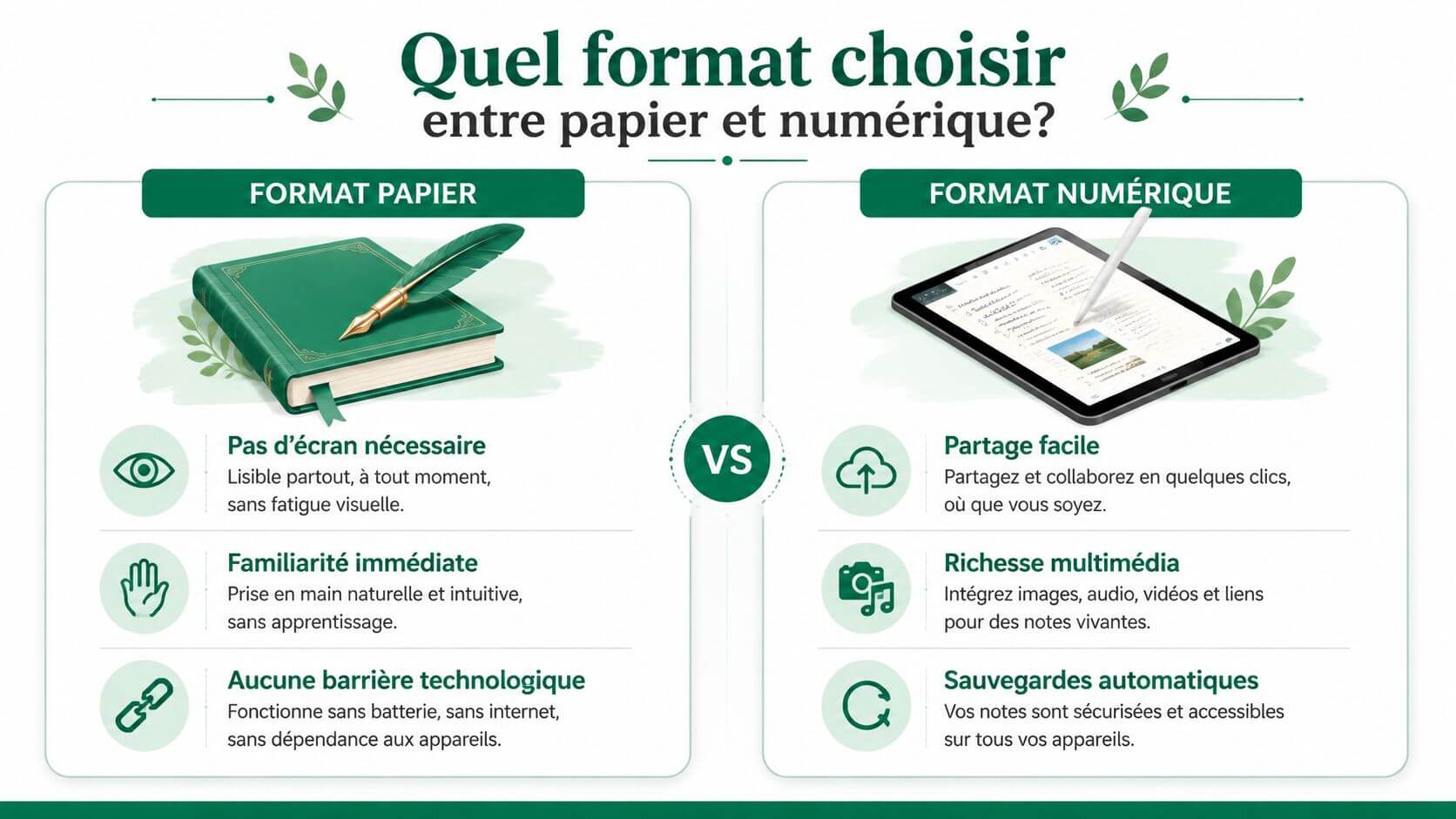
The data for the Digital barometer 2025 recall that people of 70 years and over and access, which makes a solely mobile approach insufficient for a part of the senior public (Digital barometer 2025). On the other hand, digital provides real flexibility for dispersed families, as everyone consults the same version at the same time.
Paper to reassure, digital to coordinate
The paper remains relevant when you need an immediate grip. A rigid binder, a tab book, one page per theme, and the grandparent can already track his information without screen or password. This format works well to start, especially when the main issue is to create a habit without rushing the person.
Digital, however, changes it as soon as you have to share. Remote relatives can read transmissions, reminders can be centralized, and errors associated with multiple versions decrease. It is also easier if the family wants to keep a searchable history without photographing pages or copying notes.
The Good Compromise in Real Life
The most sensible compromise is often paper for the senior, digital for the tribe. The support visible in the home reassures the person receiving care, while the shared version avoids that the information remains locked in the living room. This logic also joins the uses of a care journal at home, which serves as a basis for exchange between several actors, as I explain in more detail in this guide on the home care journal.
In this diagram, paper plays the role of entry point. Digital becomes the collective dashboard. This is usually where families finally breathe.
What to remember before deciding
- If the person receiving care must see him every day, the format must remain legible and reassuring.
- If several carers take turns, shared access quickly becomes indispensable.
- If professionals need to intervene, a central history avoids repetition.
- If use should last, the solution chosen must be simple to open, fill and reread.
The right format isn't the one that impresses the most. It's the one that everyone really uses.
Structure newspaper content for effective follow-up
A useful journal is not a block of disorderly notes. In home help, the care journal The purpose of this information is to circulate information on a day-to-day basis between the stakeholders, the person receiving care and the family. official recommendations of the SAP care journal are clear on this point, and good use is based on a stable structure, identical to each passage (the official recommendations of the SAP care journal).
The most effective is to think in simple blocks. Date, time, person who writes, what has been done, what has been observed, what must be passed on. This framework avoids drowning useful information in long sentences or in messages that are too free. For those who want a wider method of coordination, the complete guide on the transmission book helps structure exchanges without losing the wire.
Headings that avoid transmission holes
Drug follow-up deserves special attention. The French sources of home help converge towards an operational objective of 100% compliance, with close monitoring of the intakes and the support of pharmacists (Medissimo, home helpers). In practice, it is not only a question of recall, it is a question of traceability.
Point of vigilance, Never confuse therapeutic decision-making and decision-making. Without explicit medical instructions, the decision remains at the initiative of the recipient, and the document must clearly reflect this limitation.
Fields to be provided from the start
| Heading | Expected content | Update frequency |
|---|---|---|
| Date and time | Precise time of passage or note | Each intervention |
| Speaker | Name or function of person who writes | Each intervention |
| Acts carried out | Meal aid, toilet, nursing pass, call, delivery | Each intervention |
| Medicines | Catch made, forgotten, delayed, stacker ready or not | At each take concerned |
| Comments | Fatigue, pain, behavior, appetite, mood, unusual silence | As soon as a change appears |
| Alerts | Message to family, SSIAD, nurse or physician | Immediately if necessary |
| Returns from the entourage | Records received, confirmation, follow-up | Over trade |
This structure responds to a real field problem. It avoids everyone writing in their own language, then tries to connect the pieces after the blow. It also helps to spot more quickly what changes, what is missing, and what needs to be relayed without delay.
What really works in everyday use
A good journal must be able to find an alert without reading three weeks of notes. That's why a newspaper for grandparent efficient prefers fixed headings to free comments without frame. The clearer the grid, the faster the family can take over.
In families where it works well, a simple rule is set up. We write short, we write just, and we write in the same place. The rest is about comfort, not follow-up.
Making the newspaper accessible to the entire family tribe
A newspaper closed, or consulted by a single person, quickly loses its usefulness. As soon as you need to coordinate an elderly relative at home, you have to think about roles. The girl who lives near the home does not need the same level of information as the following grandson at a distance, and the nurse does not expect the same details as the attending physician.
Provide the right person with access
Sharing everything with everyone complicates reading and blurs responsibilities. Well-defined access only shares what is useful for everyone. The family reads faster, privacy remains better protected, and duplicates decrease.
In practice, the newspaper must distinguish at least three levels. The person assisted, the relatives, and then the health professionals or home helpers. The same space then serves as a daily notebook, transmission and relay, without mixing sensitive information.
The senior must stay comfortable with the tool
For the grandparent, access must remain simple. A clear interface, few buttons, discreet reminders, and the possibility of rereading the history without looking for a long time. As soon as the person feels monitored, it closes to the tool, even if it works well on the technical level.
A solution like Tribulys meets this need because it centralizes a digital link book, drug tracking, schedule and transmissions in the same shared space. To go further on this point, you can consult the resource on the digital link book. Its practical interest is not to add functions, but to limit the dispersion between family and home workers.
What shared access should allow
- See information useful to everyone's role, without exposing the whole file.
- Avoiding double seizures, which quickly create contradictory versions.
- Find History, without asking the grandparent to repeat everything.
- Relay an alert, without multiplying calls, SMS and cross-mail.
The need for asynchronous coordination is real. When caregivers alone accompany their loved ones, the shared journal becomes a support point for those who cannot be present at each stage. It also helps active caregivers, who must respond quickly without having long exchange beaches.
The right indicator is simple. If a family member doesn't know where to write, or if the grandparents don't know where to read, the system is too complex. A useful shared journal gives a common view, while avoiding that the mental load always falls on the same person.
When access is well thought out, coordination becomes almost invisible. This is what counts at home, less noise, more continuity.
Ensuring simple and sustainable adoption on a daily basis
The problem of family tools is almost never the launch. It's the third week. The newspaper is very well thought out, the first notes are clean, then the habit fades because no one has set the pace or the responsibility of everyone.
Start with few rules, but the same for all
Membership is better when the frame is light. A routine after each passage, a daily check of the catch, a person who rereads the alerts in the evening, and the use takes shape. There is no need to impose ten headings from the beginning if three are enough to secure daily life.
The grandparent must also be associated with the setting up. If he can tell what suits him, what irritates him, and what he understands effortlessly, you get a tool that respects his rhythm instead of jostling him. It is often this detail that makes the difference between a used journal and a forgotten journal.
Reflexes that hold in time
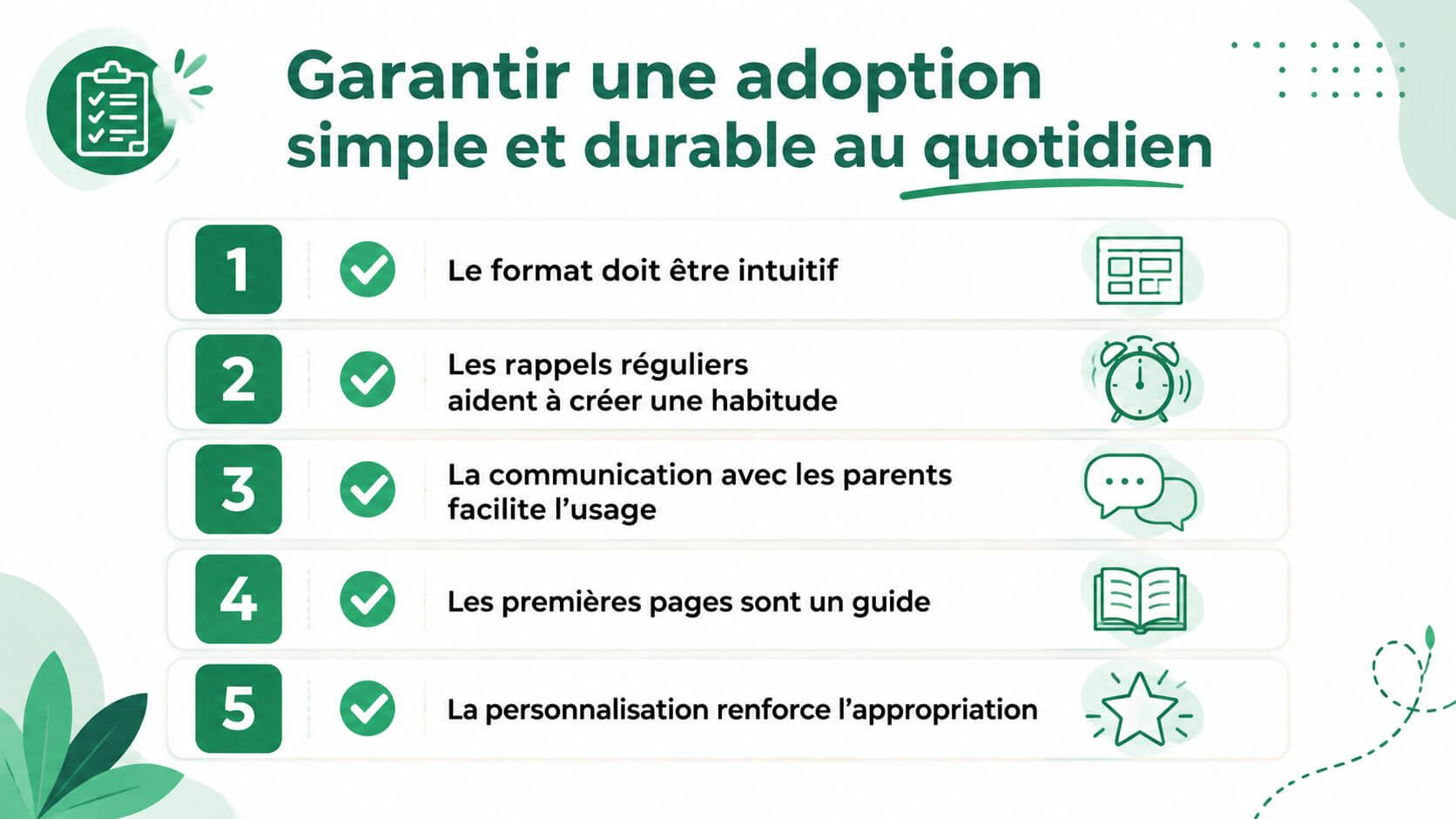
- Make the format intuitive, with quick reading and obvious fields.
- Anchor regular reminders, to create a stable habit without overload.
- Talking to the Helped Person, so that she understands the usefulness of the tool.
- Leave a guide in the first pages, to remind who writes what.
- Adapt content over time, because a good journal evolves with health.
Families that last do not seek perfection. They seek a bearable rhythm. If one section is never used, it must disappear. If another one becomes central, it deserves to rise in visibility.
Sobriety is better than gas plant
Too many notifications get tired quickly. Too long summaries are not read. Congested interfaces make the helpers stop, especially those who are already under pressure or far away geographically.
The rule is simple. The newspaper must remain a support point, not an additional task. As soon as it requires too much effort, it ceases to be a support and becomes another subject to be managed.
To conclude, the journal as a link and security tool
One newspaper for grandparent It works when it really helps to coordinate, not when it accumulates memories without a sequel. The right balance rests on five things, the right format, a clear structure, a role-based access, a simple adoption, and a routine that the family can hold on to. It is this framework that transforms a notebook into a daily security tool.
The 15.1 million Grandparents registered in metropolitan France in 2011, including 14.7 million the need for co-ordination around the home (Insee). In this context, the shared journal is not an emotional gadget. It is a concrete way to better disseminate information among relatives, caregivers and professionals.
The most important thing is consistency. Start small, keep a stable structure, and adjust only what really serves everyday life. When the tool respects the rhythm of the person receiving care, it strengthens both the tranquility of the family and the continuity of care.
Tribulys centralizes the link book, drugs, schedule and transmissions in a shared space thought for home. If you are looking for a clearer organization around an elderly relative, you can see how it works on Tribulys and whether this is consistent with how you coordinate the family and stakeholders.
Put this organisation into practice with Tribulys
Keep your care journal, shared calendar, tasks, medication tracking and emergency information together. Start for free and invite the relatives and professionals involved in your loved one’s care.