
You just received the call that changes everything. The hospital talks about going home, the doctor asks who will follow the treatments, and the family turns to you because you're the closest, the most available, or just the one who already knows how to handle the emergencies. From there, you're become a family helper Without instructions for use, with one priority, prevent everything from resting on your memory and energy.
The right reflex, from the first hours, is to regain control of the organization. Not to do everything alone, just so you don't exhaust yourself from the start. The families that do best are not the ones that improvise the fastest, they are the ones that centralize, share and distribute.
Contents
- Recognise his new reality and pose the first reflexes
- Evaluate the real needs of the loved one to fit the support
- Know your rights and activate caregiving leave
- Organize daily with a shared calendar and reliable reminders
- Identify the roles of each stakeholder and coordinate the tribe
- Forming and preserving his emotional balance as a caregiver
- Set up a shared coordination with Tribulys
Recognise his new reality and pose the first reflexes
The tipping often happens in the noise. A call from the exit service, a misunderstood prescription, a suitcase to be prepared, and then the sentence that remains in the head, "you'll have to keep an eye on it." At that time, you don't need a big speech, you need three very concrete reflexes.
Name the situation without minimizing it
Tell it clearly out loud, to yourself and to others, you enter into a role ofHelping. This simple appointment avoids the blur of "we'll see", which almost always ends up overloading for one person. Accepting a relay, even a small one, is often the best decision of the first day.
Practical rule, if someone proposes to help, take the help right away. A race, a call to the doctor, a niche of presence, it already counts.
List emergencies before thinking about the rest
Don't go in all directions. Start by noting what can't wait, housing security, current treatments, active medical contacts, key people to prevent, and what triggers an alert. This short list avoids confusing the important with the urgent.
The first 48 hours are used to lay the foundations, not to solve everything. If you are looking to settle the logistics, administrative, appointments and emotion of everyone at the same time, you will disperse. Stay sober, note, and then share.
Create a shared coordination space
From the start, open a single medium, notebook, family board, or digital tool like Tribulys, so that the information no longer lives in a single head. The goal is simple, no one must depend on a lost SMS or an approximate memory to know what to do. This sharing changes everything, because it installs a shared truth point.
When the role of family caregiver begins like this, it becomes more breathable. You then move forward with a simple roadmap, first understand the real needs, then frame the rights, organize the daily, distribute the roles, and only then tool you to keep in time.
Evaluate the real needs of the loved one to fit the support
Before you help, you have to look at exactly what you need to help. Many families are wrong about fighting because they come from a general impression, "he tired", "she forgets", "it becomes complicated". That's not enough. You need a written, dated, concrete state of affairs.
Separate medical, daily and emotional
The Medical includes diagnostics, treatments, allergies, the attending physician, recent hospitalizations, and technical gestures, such as dressings or infusions. Daily covers mobility, toilets, meals, shopping, cleaning, travel and procedures.emotional affects mood, isolation, cognitive disorders, need for presence, and the life project.
This separation avoids a classic error, treats everything at the same level. A difficulty to get up does not call the same answer as a treatment oversight, and a loss of morale is not handled as a prescription question. When you mix everything, you lose clarity.
Observe, interview, cross-check
Take a typical day and look at what actually blocks. Ask the loved one what worries him, then ask the same questions to the professionals who are already involved. Crossing the sources is essential, because a loved one does not always tell his fatigue in the same way to his daughter, doctor, or nurse.
A few useful questions suffice to make the essentials emerge. What is difficult in the morning, what medication is problematic, what appointments are unavoidable, what happens at night, and who calls in case of sudden change. Note each answer and date the information to keep up with the evolution.
Good reflex, write down what must remain medical and what can be cared for by the family. This border avoids misunderstandings and false services rendered.
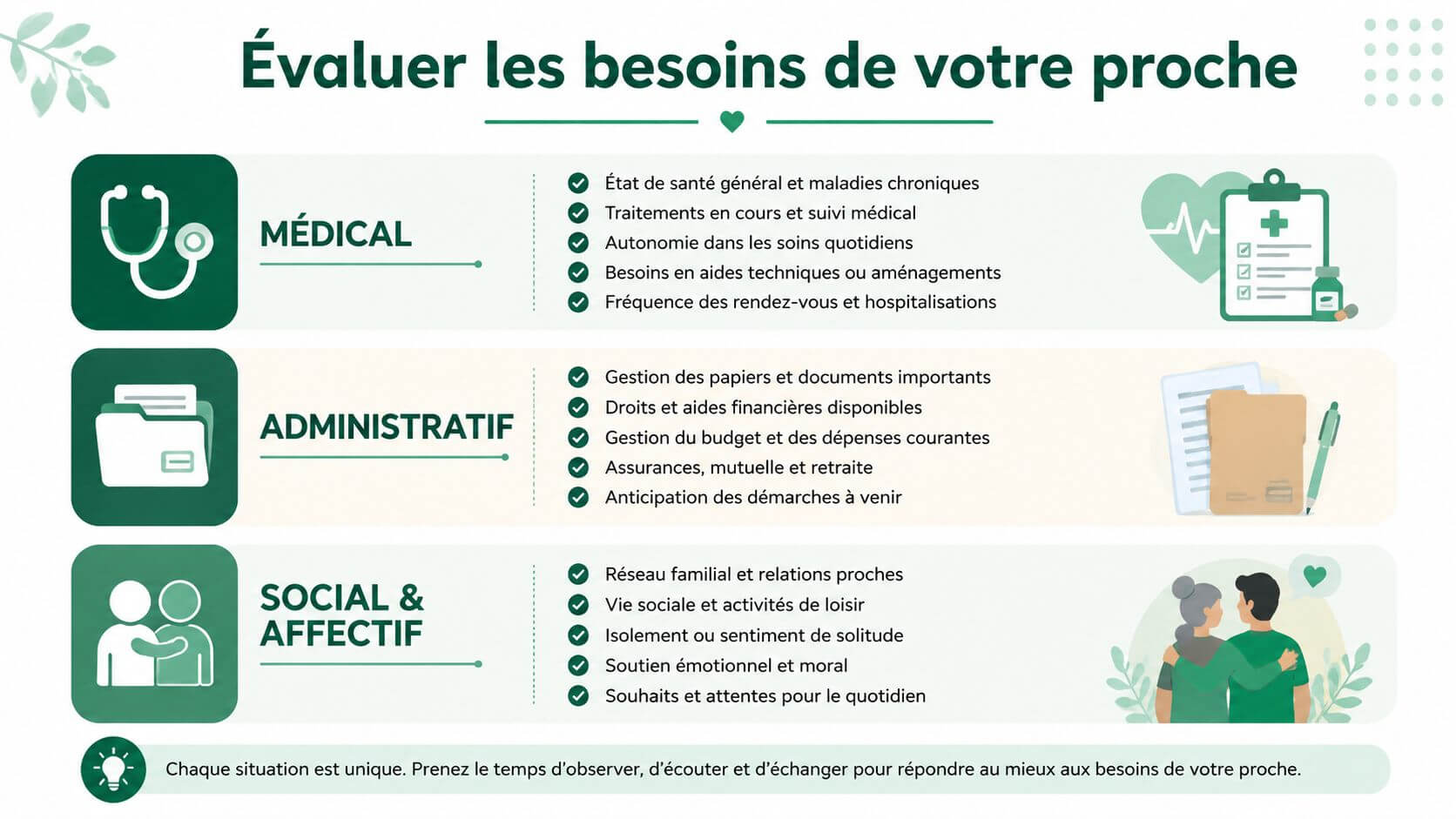
Objectiver to better prioritize
The real goal is not to bring everything to the caregiver. It is to distinguish what is within the caregiver, what can be delegated, and what must remain in the hands of a health care professional. If you take this habit from the beginning, you avoid confusion between emotional support, practical help and medical action.
When this photograph is placed black on white, the coordination becomes much simpler. You know where the points of vigilance are, where the possible relays are, and what needs to be closely monitored without improvisation. It is from there that you can organize something reliable.
Know your rights and activate caregiving leave
The role of family caregiver is not only based on good will. In France, there is a concrete framework, with specific rights, conditions and procedures. Knowing them early avoids wasting time, especially when it is necessary to reconcile professional life and presence with the loved one.
What to check first
The Caregiver leave allows for interruption or reduction of activity to help a relative with a disability or loss of autonomy, under conditions of family connection or close and stable ties, with an assisted person residing in France on a stable and regular basis. at least one month before the start of the leave, by a means dated as a registered letter, a recommended e-mail or a hand-over for signature. The leave is not paid by the employer, but may be entitled to theDaily allowance of the caregiver.
The legal framework also specifies who can be assisted, spouse, partner, partner of PACS, ascendant, descendant, dependent child, collateral up to the fourth degree, as well as some relatives of the spouse, partner or partner, or an elderly or disabled person with whom the caregiver lives or maintains close and stable ties. IRM 1 to 3. These criteria are useful because they avoid remaining in a blurred definition of "I help a loved one".
Money, Timeliness and the File
In 2026, the ceilings indicated are as follows: 66 days per assisted person, within the 264 days in a career, with a maximum 22 days compensated per month and an amount of 66,64 € per day or 33,32 € per half day Public ServiceThe AJPA is paid by the CAF or MSA, according to the plan. Leave remains unpaid by the employer, so you have to anticipate the loss of salary and prepare the proofs in advance.
The logic is simple, you check your caisse, you make up the medical and administrative file, you notify the employer in time, then you prepare the return. It is a coordination mechanism, not a secondary formality. The slightest delay can complicate the family organization.
| Comparing the rights 2026 of the family caregiver | Key conditions | Duration / Amount 2026 | Approach to initiate |
|---|---|---|---|
| Caregiver leave | Family link or close and stable ties, close in the event of disability or loss of autonomy, assisted person residing in France on a stable and regular basis | Until 66 days per assisted person, 264 days in total over a career | Preventing the employer a month before in writing, dated |
| AJPA | Caregiver leave open, loss of partial salary to be compensated | 66,64 € per day, 33,32 € per half daymaximum 22 days compensated per month | File the application with CAF or of the MSA |
| Assisted person's aid | Dependence or disability recognized according to the scheme | Depending on the relative's file, no number to generalize here | Check open aids in the closet's folder |
To go further on the framework of the leave, you can consult Tribulys Guide on Caregiver Leave. Keep a rule in mind, do not launch the application blindly. First check your professional situation, then the next of kin's supporting documents, and then the schedule.
Organize daily with a shared calendar and reliable reminders
A caregiver's daily life is rarely played in big decisions. It is played in the hours that are repeated, the treatments to remember, the appointments to be confirmed, the passages to relay and the little information that change everything. Without a shared calendar, everything is based on calls, SMS and scattered notes.
Building a simple rhythm that holds
A useful schedule does not need to be sophisticated, it must be readable. In the morning, we check the treatments, the appointments of the day, and the general condition. At noon, we notice a quick point, a meal taken or not, a fatigue, a change of mood. In the evening, we validate what was done and we pass on what must be known for the next day.
The idea is not to constantly monitor, but to secure key moments. For each block, add the person responsible if the roles turn between close friends. This avoids blurred phrases of the type "someone will pass", which end up meaning no one.
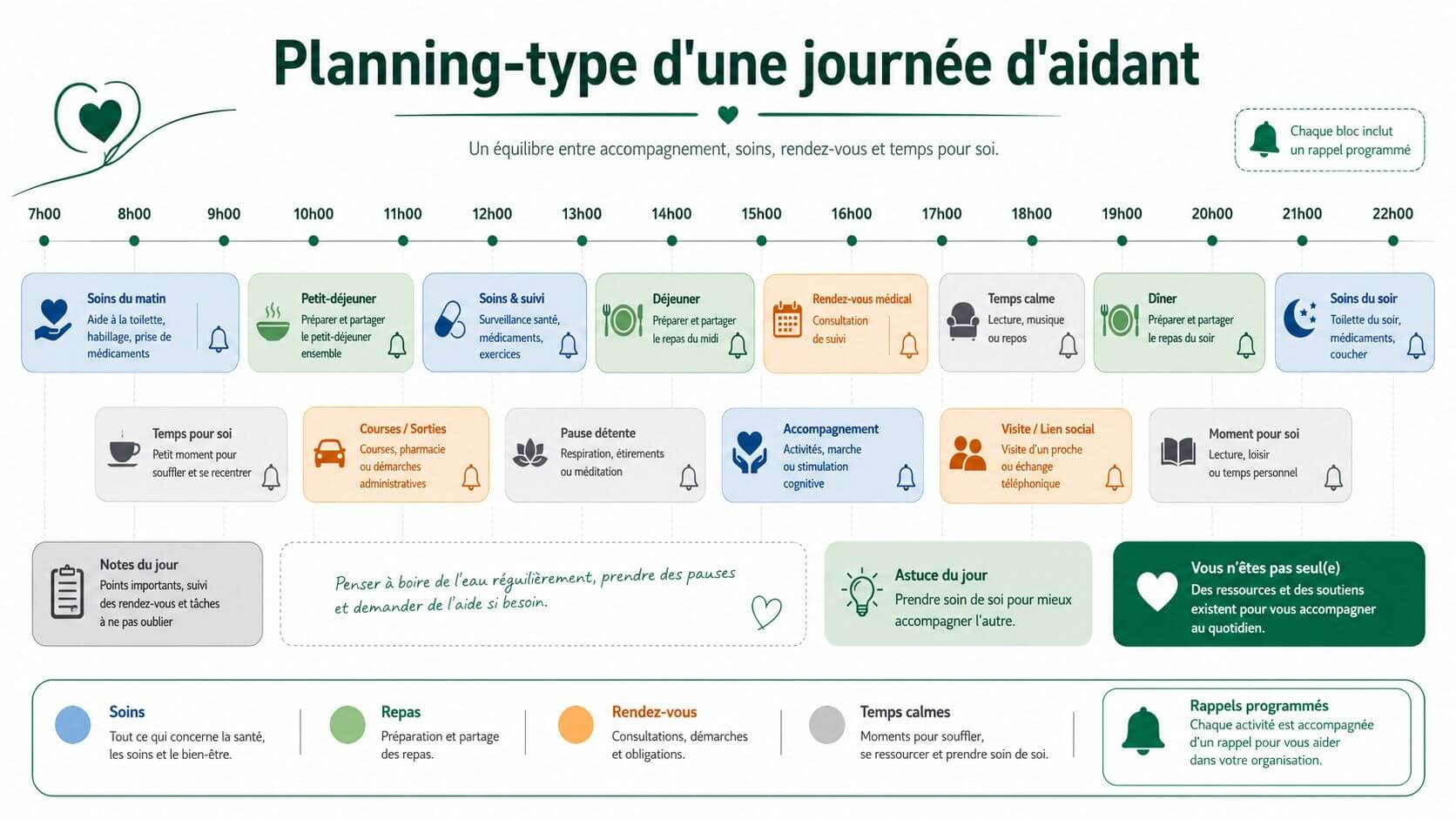
Provide two levels of recall
The first reminder is for the principal, for the appointment, the tour, or the relaying. The second may be useful to the assisted relative, if he is in a position to receive it, for the drugs or the markers of the daily. This double security limits forgetfulness and last minute discussions.
For this to remain clear, attach each reminder to a specific wording, treatment concerned, timing, and possible delivery with or without food. Do not improvise the schedules, always follow the prescription and recommendations of the healthcare professional. The role of the schedule is to follow the prescription, not to replace it.
A good shared calendar is not just for planning, it is for transmitting before moving.
Avoid Sunday night calls
When everyone consults with the same schedule before moving, the family loses much less time to wonder who comes tomorrow. Nurses, relatives and home helpers have the same starting point, so fewer duplicates and fewer oblivion. Timed link book then becomes the natural extension of the agenda.
If you leave a clear support, even simple, you can then make it evolve. If you start from a stack of messages, you spend your time reconstructing what happened. For a family work base, a well-structured shared calendar immediately changes the way to anticipate.
Identify the roles of each stakeholder and coordinate the tribe
When a family runs out, it's not always because there's too little help, it's often because no one knows exactly who does what. The caregiver ends up serving as a one-stop shop, and that's where the tension rises. The right approach is to divide the roles, not stack them.
Who to call as needed
| Who does what around the loved one helped | Main Perimeter | Typical acts | Normal frequency | Expected transmission |
|---|---|---|---|---|
| Treating physician | Global medical piloting | Adjusting follow-up, guiding, coordinating decisions | Depending on health status and appointments | Summary of changes, alerts, general developments |
| Independent Nurse | Technical care and supervision | Bandages, injections, constant follow-up, adherence | As required | Condition of bandage, catches, anomalies, alerts |
| Aides of life | Daily help | Toilet, dressing, meals, comfort, presence | Based on planned organization | What has been done, difficulties encountered, mood |
| Home help | Practical support | Household, shopping, logistics support | Depending on the help schedule | Tasks completed, points to be taken over |
| Physiotherapist | Rehabilitation and mobility | Exercises, mobilisation, functional support | As required | Stress tolerance, progress, pain |
| SSIAD | Coordinated home care | Protocol-based care intervention | According to prescription and organization of the service | Structured transmissions over passages |
| Family | Coordination and presence | Link, follow-up, current decisions, relay | Continuous, subject to availability | Shared information, family decisions, useful remarks |
The principle is simple, everyone has their perimeter, and the caregiver must not absorb everything. For a change of bandage, you contact the nurse. For a toilet or a meal, you look at the home helper, home care worker, family. For an administrative problem, it is often the family that keeps hands.
Name a unique reference
The most important thing is to have a unique reference that connects with professionals. This reference is not the one that does everything, it is the one that centralizes the information and avoids conflicting versions of the file. Without this role, instructions disperse and transmission errors appear quickly.
To split the roles is to protect everyone. The helped relative gains continuity, the caregivers gain clarity, the family gains breath.
To coordinate this tribe properly, this guide for the coordination of carers provides a useful framework. The idea is not to make it complicated, but to make each interlocutor readable. As soon as everyone knows who to talk to and on what, the tension drops.
Forming and preserving his emotional balance as a caregiver
A long-lasting helper is a learner. Not a silent hero, not a rescuer who cashes everything, but someone who knows how to acquire the right gestures and keep a balance base so as not to collapse. Training is not a luxury, it is a condition of safety.
Learning the Right Ways
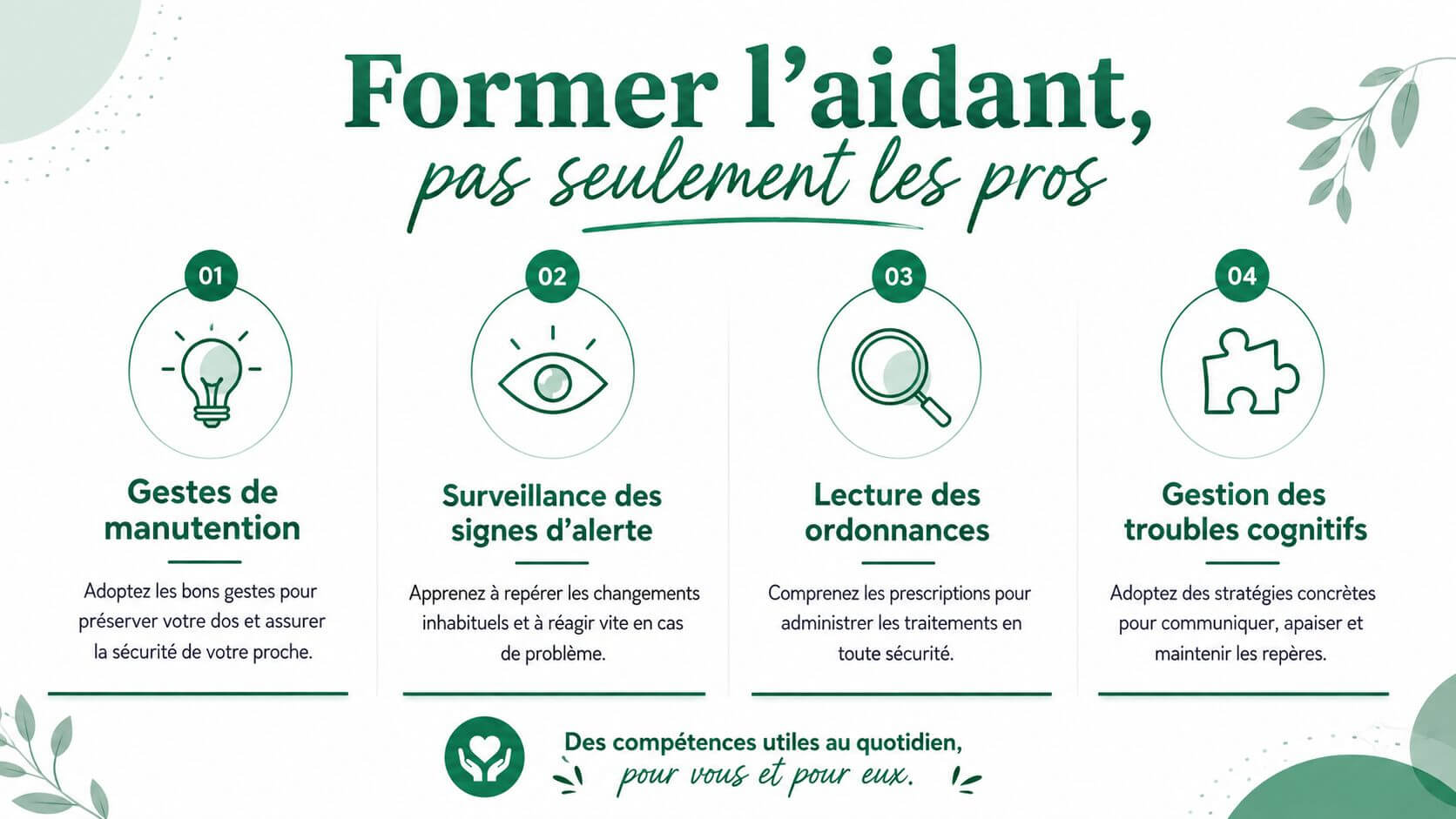
You don't need to become a health professional, but you need to know what you're doing. Handling gestures, warning signs monitoring, reading prescriptions and managing cognitive disorders are basic skills for a family caregiver. The sooner you learn them, the less you improvise in the emergency.
The formats already exist, associative workshops, free online modules, Red Cross trainings, webinars offered by support platforms. Search short, concrete, applicable the next day. If a resource does not help you to act, it fatigues you more than it serves you.
Install three rituals in the first week
The first ritual is a single walking slot, even a short one. The second one is a weekly non-medical exchange with a trusted relative. The third one is a listening number recorded in the phone, for the days when the mental load overflows.
These gestures seem modest, but they change the psychic life of the caregiver. When everything revolves around treatments, appointments and emergencies, one must keep a space that belongs only to you. It is a measure of continuity, not a whim.
Asking for help is not an admission of failure
It's even the opposite. A caregiver who knows how to delegate, ask for a relay and rely on speaking groups holds better in time. The best indicator of success is not perfection, it's your ability to stay strong without falling apart.
Set up a shared coordination with Tribulys
When a family starts to centralize, it immediately gains in clarity. Calls decrease, duplicates too, and everyone knows what was done before moving. That's exactly where a coordination solution takes on meaning, because it replaces fragments with a common view.
Deploy coordination without starting over
The first step is to create the tribe and to invite the relatives and professionals concerned. Then, we structure the shared calendar with the slots of presence, the care and the medical appointments. We then open sheets by theme, drugs, races, hygiene, moral, to group what was previously dispersed in the SMS and the paper notebooks.
The timed transmission log then serves as a common memory. Each intervention leaves a clear trace, which avoids repeating the same thing twice or omitting important information. Roled permissions allow the principal to keep the steering without becoming the only point of contact.
Tribulys centralizes these elements in the same logic of monitoring, with shared calendar, Timed link book, recalls of medicines and emergency reports. It is a concrete way of moving from a dispersed organization to a readable coordination. For a loved one assisted at home, Tribulys serves as a common space between family and professionals.
Moving forward over fourteen days
The first two days are used to declare the tribe and import contacts. From the third to the fifth day, you migrate planning and treatments. From the sixth to the ninth day, you configure the records and notifications. From the tenth to the fourteenth day, you make a first feedback and adjust what blocks.
Measure the setting up with simple criteria, the number of transmissions informed each week, the average response time to alerts, and the rate of attendance at medical appointments. You do not need a complex picture to know if the coordination holds. If the information circulates better and if the family calls less urgently, you are on the right track.
If you want to stop wearing everything alone, go see how Tribulys centralizes the schedule, transmissions, treatment reminders and the emergency card in the same place. It is a concrete way to secure the first days, then keep a clear coordination with your loved ones and the professionals. Tribulys and set up a family organization that finally relies on a real sharing of information.
Put this organisation into practice with Tribulys
Keep your care journal, shared calendar, tasks, medication tracking and emergency information together. Start for free and invite the relatives and professionals involved in your loved one’s care.