
A parent falls on a Sunday night in the bathroom. The phone is in the next room, the time to get up has not come, and no one knows if the alert will go in time. That's exactly where the Senior fall detector stops being a gadget and becomes a coordination brickbetween the fall, the transmission of the alert and the intervention.
The real subject is not only whether the sensor sees the fall. The real subject is who receives the information, in what form, with what speed, and who then acts. In France, this logic takes all its meaning in a context of population ageing where INSEE projects a higher proportion of people aged 65 or over in 2030 only in 2021, with a growing need for home care according to the demographic scoping recalled by the Alzheimer Network.
You will therefore read a practical guide, without decorative discourse, to understand what works, what deceives, and what needs to be demanded of a serious system. Comparisons that stop at the price of the bracelet pass by the essentials. Here, you look at the complete chain, and that is where the real value is played.
Contents
- Contents
- Why a fall detector changes home data
- How a Drop Detector Works
- The different types of detectors and the remote assistance layer
- How to choose a detector adapted to the profile of the senior
- Connecting the detector to the coordination of caregivers and professionals
- GDPR and fall data confidentiality
- Installation, maintenance and daily use scenarios
- Decide and take action without overpaying
Contents
- Why a fall detector changes home data
- How a Drop Detector Works
- The different types of detectors and the remote assistance layer
- How to choose a detector adapted to the profile of the senior
- Connecting the detector to the coordination of caregivers and professionals
- GDPR and fall data confidentiality
- Installation, maintenance and daily use scenarios
- Decide and take action without overpaying
Why a fall detector changes home data
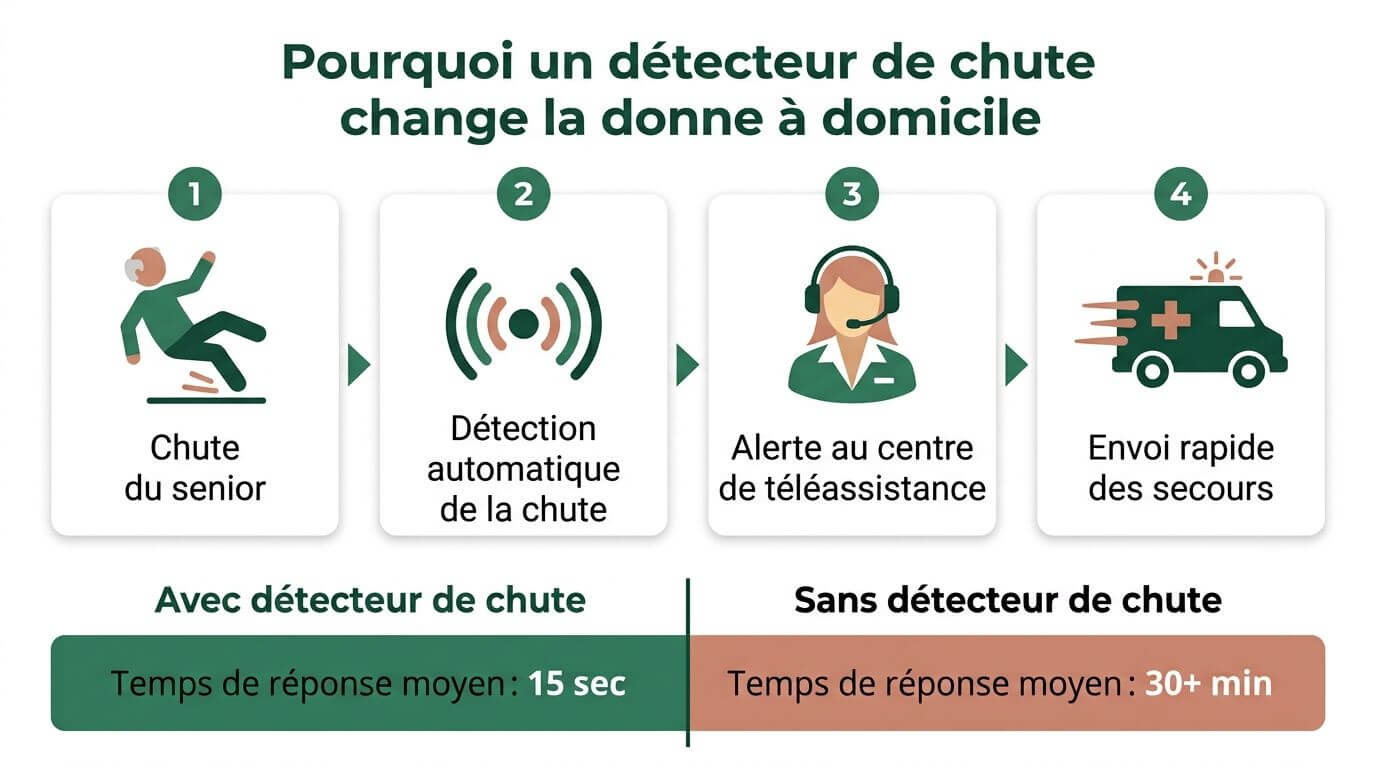
On Sunday evening, the scene is banal. An elderly person slides into the bathroom, finds himself on the ground, and can no longer reach the phone placed at a distance. The danger is not only the fall, it is the time lost before someone was warned.
The right reflex isn't the button, it's the chain
The manual call button reassures as long as it remains accessible. As soon as a person is ringed, immobilized or confused, this model collapses. automatic detection exist precisely to cover this security hole, triggering an alert without voluntary action.
In the literature on technology, it is recalled that these devices are intended to reduce intervention timeto reassure caregivers and to secure elderly people living alone, without replacing the human presence Alzheimer NetworkIt's the right way to think about them. A detector doesn't cure anything, it triggers the right answer faster.
Practical rule. If the device does not quickly transmit to a person capable of acting, it loses most of its value.
This is also why credible systems are not limited to a sensor. They combine a worn detector, a tele-assistance link, then an escalation to the loved ones or the rescue. The sensor is just a start. The care does the rest.
A useful detector is not the one that alerts alone, it is the one that brings the right information to the right place.
How a Drop Detector Works
One Senior Fall Detector is based on a fairly simple mechanics to understand. sensor then the algorithm looks for a sign of a real fall, often followed by a immobility. It is this combination, not a single isolated indicator, that serves as the basis for the decision.
The sensors that do the work
The French offers generally mention a accelerometer and, on recent models, gyroscope. The accelerometer measures the sudden changes in speed, the gyroscope adds the angular dimension, and the software compares the signals to avoid false triggering Cap Retraite. It's the logic of a car airbag, without the unnecessary metaphor, if the signals don't look like a real shock, nothing leaves.
| Sensors and detection logic | ||
|---|---|---|
| Sensor | What it measures | Validation criterion |
| Accelerometer | Rapid change in speed | Net kinematic change |
| Gyroscope | Rotation and orientation | Angle compatible with a drop |
| Software logic | Combination of signals | Impact followed by immobility |
The trigger may be automatic, after a phase of immobility often announced around 15 to 20 seconds in French offers Cap Retraite, or manual via a button. The first covers situations where the person cannot act, the second one remains useful when he is conscious and able to call.
What the technique does not regulate on its own
The weak point is not the presence of a sensor. It is the ability to recognize ambiguous cases, such as a soft fall, a slip with quick recovery or a removal of the bracelet. The experts cited in the public debate recall that, to their knowledge, there is no reliable data in real conditions on the absolute effectiveness of fall detectors. Radio-Canada. It is a healthy reminder, laboratory figures are not enough to sell serenity.
Good buyer sense. Look for a good transmission system before looking for a promise of sensor perfection.
The different types of detectors and the remote assistance layer
In the home, the classic mistake is to buy an object and believe that the problem is solved. Senior fall detector is worth nothing if it is not connected to a clear chain, alert, transmission, intervention. The right purchase is therefore played on two levels, the equipment carried and the service that receives, qualifies and transmits the alert.
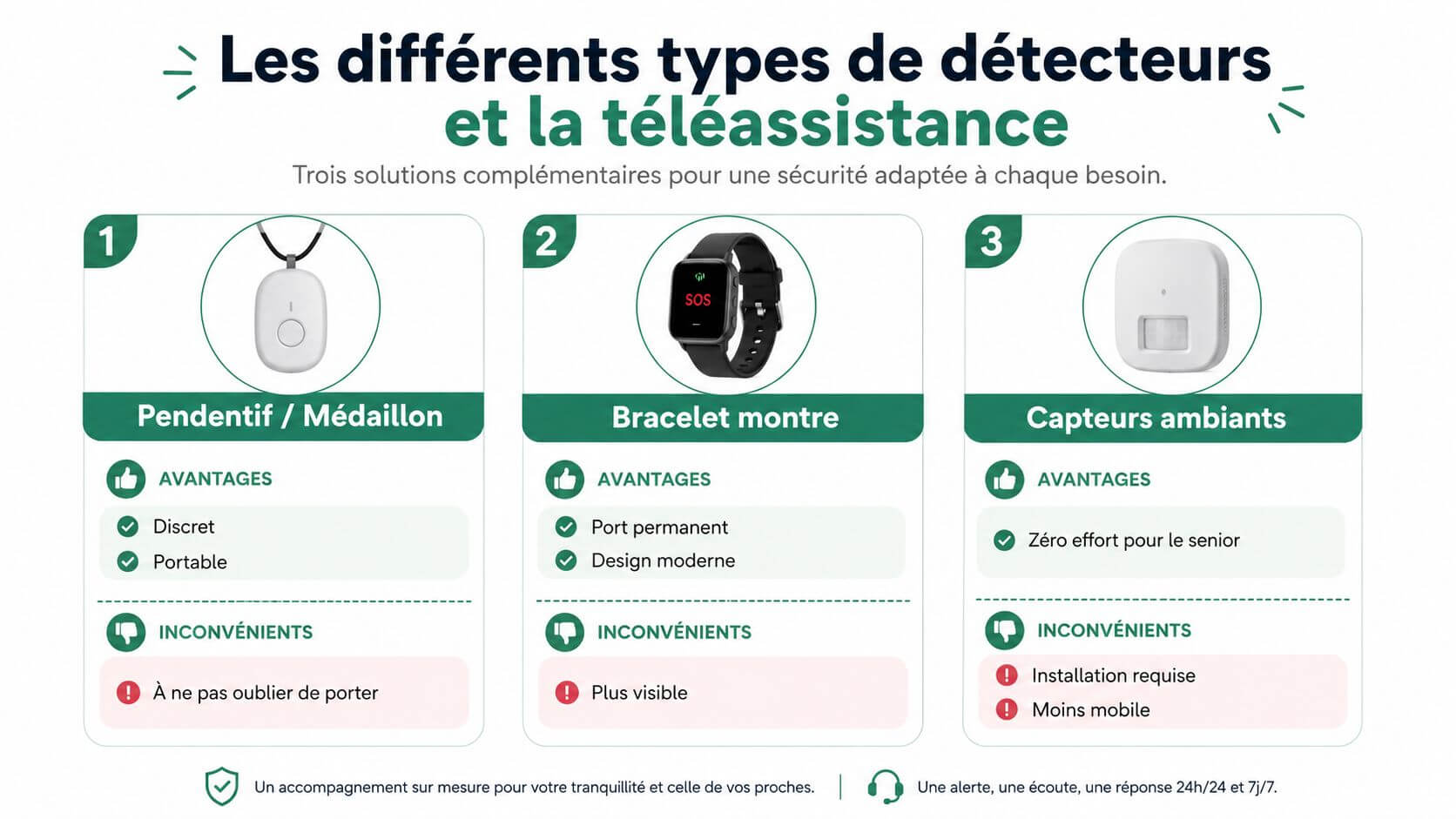
The French market often mixes these roles, whereas they do not do the same service. A pendant, a bracelet or an ambient sensor do not have the same logic of use, and the tele-assistance adds the layer that turns a raw alert into support. The real subject is not the shape of the object, it is the ability to get the information out in the right place and to leave an exploitable trace of what happened.
The serious diagram starts with equipment worn or installed, passes through a communication box, and then leads to an operator center available 24 hours a day and 7 days a week official telehandling portal. It is this continuity that avoids wasting time when the person is confused, immobilized or unable to speak. Without human relays, a sensor remains a sensor.
Pendant, bracelet, ambient sensor
The Pendant or medallion remains simple to understand and easy to wear. Its defect is known, you must have it on yourself at the right time. watch bracelet spends better in everyday life, because it looks like an ordinary object and remains easier to accept for certain profiles. ambient sensors do not ask for anything from the person, but they impose a facility and cover only the areas planned.
The right choice is made on real habits, not on the commercial brochure. A person who removes anything worn as soon as he or she returns home does not need a sophisticated bracelet, he or she needs another protection logic. A person who often travels outside has better keep equipment that he or she really agrees to wear. Consistency of use counts more than the display effect.
Tele-assistance is not an accessory
Remote assistance is not used to decorate a detector. It is used to make the alert useful. In practical terms, it combines a worn device or a fixed sensor with a reception platform, so that a request for help leaves even if the person cannot support or explain his or her situation. emergency call button Moreover, it remains the best point of reference for understanding this assisted rescue logic, as it clearly shows the difference between manual triggering and organised support. guide on the emergency call button.
This montage has real value, because it leaves a trace of the alert and its treatment. Who received the call, when it was transmitted, to which contact it was sent, this is what counts at the moment when the family wants to understand what happened. A simple object that bets does not give this legibility.
The monthly cost of French teleassistance solutions is often presented as a service subscription, with the human supervision that goes with Cap Retraite. It must be read for what it is, a payment for reception, qualification and recovery, not only for a case or bracelet. It is this layer that separates an isolated accessory from a real support device.
- Pendant or medallion, relevant if the person accepts a light and visible object.
- Watch bracelet, relevant if the daily wear is more natural than a pendant.
- Ambient sensor, useful if the port is unreliable or if you want a fixed solution over a specific area.
At the bottom, the best set is the one that triggers correctly, transmits without breaking and then lets you know what has been done. A fall detector has value only in this chain.
How to choose a detector adapted to the profile of the senior
The right choice does not start with the brand. It starts with the actual profile the person, his mobility, tolerance to the port, his movements, and how his fall might occur. An attractive watch on a product sheet becomes useless if it ends up at the bottom of a drawer.
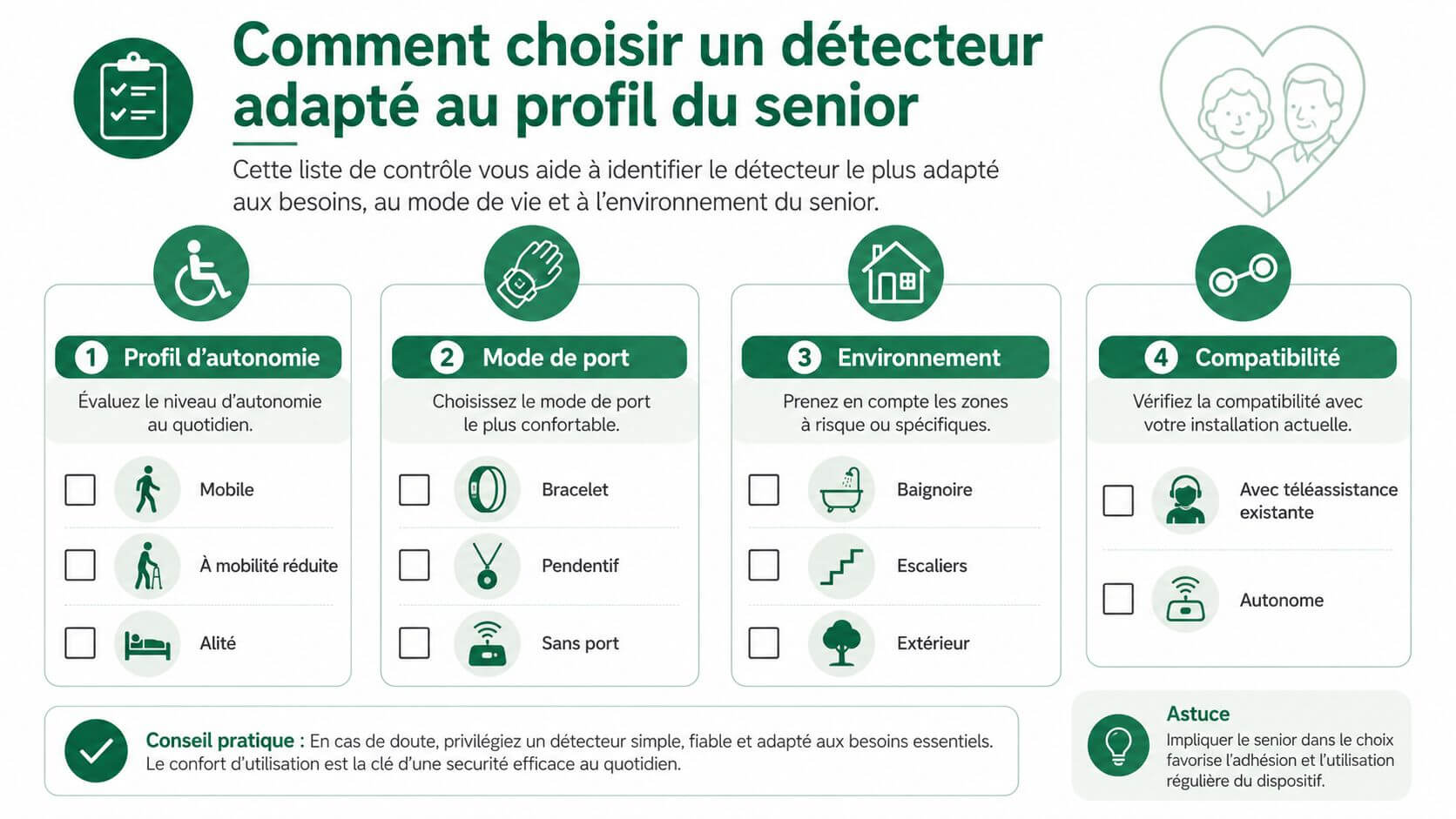
Once this point has been set, you must look at the detector as a brick of a wider chain, alert, transmission, intervention. Without this chain, the object reassures at the moment but leaves the family in the blur at the first incident.
The criteria that really matter
- Autonomy of the person, mobile, with reduced mobility or bed space, because the same device does not cover the same risks.
- Port mode, bracelet, pendant or without wear, as the best detector is the one that remains actually used.
- Living environment, bathroom, stairs, exterior, since a risky area does not always require the same solution.
- Compatibility with existing, especially if tele-assistance is already in place.
- Total cost, initial purchase, options and subscription, not to mention the service behind.
The real subject is not the object alone, it is its place in the organisation of the daily. If the detection does not fit into the relay of the relatives, the tele-assistance and the response of the professionals, the value of the material falls quickly. Commercial guides often highlight very high performance, but they do not say anything about the quality of the treatment behind the alert. In practice, this is where the difference between a useful device and a simple accessory is played.
What I recommend straightaway
If the person lives alone and is fragile, I prefer a offer of remote assistance with automatic detection rather than an isolated sensor. If it often comes out, I look at the strength of the daily port and the clarity of the relay to the loved ones. If it easily removes objects, I switch to a logic without object worn, because insisting on the bracelet often amounts to paying for an unused device.
If the family wants to keep a clear record of the alerts and follow-up given, it is necessary to choose a system that is linked with a shared monitoring tool, such as a solution for the coordination of caregivers such as Tribulys. There, the detector is no longer an isolated gadget, it feeds information that can be used by relatives and stakeholders.
The key point remains simple, the effective port governs reliability. A good model on paper is of no use if the person does not keep it. A medium but actually worn model is better than a very ambitious product, never in service.
Connecting the detector to the coordination of caregivers and professionals
A fall alert without traceability quickly creates noise. Two relatives call, a caregiver has already passed, the nurse does not have the same version, and no one knows what has been transmitted to the rescue. This is where the coordination chain becomes more important than the sensor itself.
Information must travel without getting lost
In a serious coordination, the fall becomes a timed entry, shared, visible by the right interlocutors, and linked to a history of intervention. This is exactly the type of logic that tools like Tribulys seek to bring to home maintenance, with shared notebook, assignable tasks, emergency sheet and structured follow-up guide for the coordination of carers. Interest is not cosmetic, it is operational.
The concrete gain is obvious. We avoid the duplicate calls. We keep track of the alert. We document what was done, by whom, and at what time. For a family that coordinates passages of IDEL, physiotherapist and auxiliaries of life, this shared memory changes the quality of the follow-up.
Key point. The problem is not only "did the bracelet ring?", it's "who was warned, with what information, and how the event was traced?"
Why traceability is as good as alert
Good coordination turns the incident into a useful data. The attending physician no longer receives a blurred story three days later, he gets a properly rated event, with context and follow-up given. Professionals gain readability, and remote caregivers stop running after information fragments.
It is also there that conventional solutions show their limits. They trigger, then let the family recompose the story. The most useful hybrid uses, on the contrary, combine alert, shared journal and clear tasks to prevent the fall from becoming an ill-documented episode. For a coordinated home maintenance, this shift is decisive.
GDPR and fall data confidentiality
Many families ask the wrong question. They ask if the sensor is reliable, while they should also ask what it does with the data it collects. In a technology device, the question is not annex, it is central.
What to Check Before Signing
The GDPR imposes a explicit purpose, minimisation of data, rights of access and deletion, and a clear legal basis, consent or contract as the case may be. For a fall detector, you must also ask where the data are hosted, who accesses it, and how the roles are separated. Drop, geolocation or other sensitive indicators do not treat themselves as mere comfort data.
- Specific purpose, the collection must serve prevention, coordination or alert, not anything else.
- Segmented access, every helper doesn't need to see all the history.
- Accommodation in France or in the EU, especially when it comes to home coordination.
- Rights of the patient, access, rectification and deletion must be simple to exercise.
- Controlled sharing, an emergency record must not become a non-custodial document.
What families often forget
A system can be reassuring and misconfigured at the same time. Confidentiality does not disappear because a device is useful. It manages itself, and it needs to be thought out from the start, especially if several relatives and professionals intervene around the same person.
Home maintenance platforms have an interest in reducing the exposure of information by access by role and nominative invitations. This is an example of a coherent functioning with coordination, because it avoids the wild sharing of consent, rights and practices around the elderly. The right reflex is simple, asking who sees what, where it is hosted, and how to remove access if needed.
Installation, maintenance and daily use scenarios
The technical installation is often fast. Human appropriation, however, takes time. Families always underestimate this gap, then end up with a connected device but a bancal protocol.
Install without complications
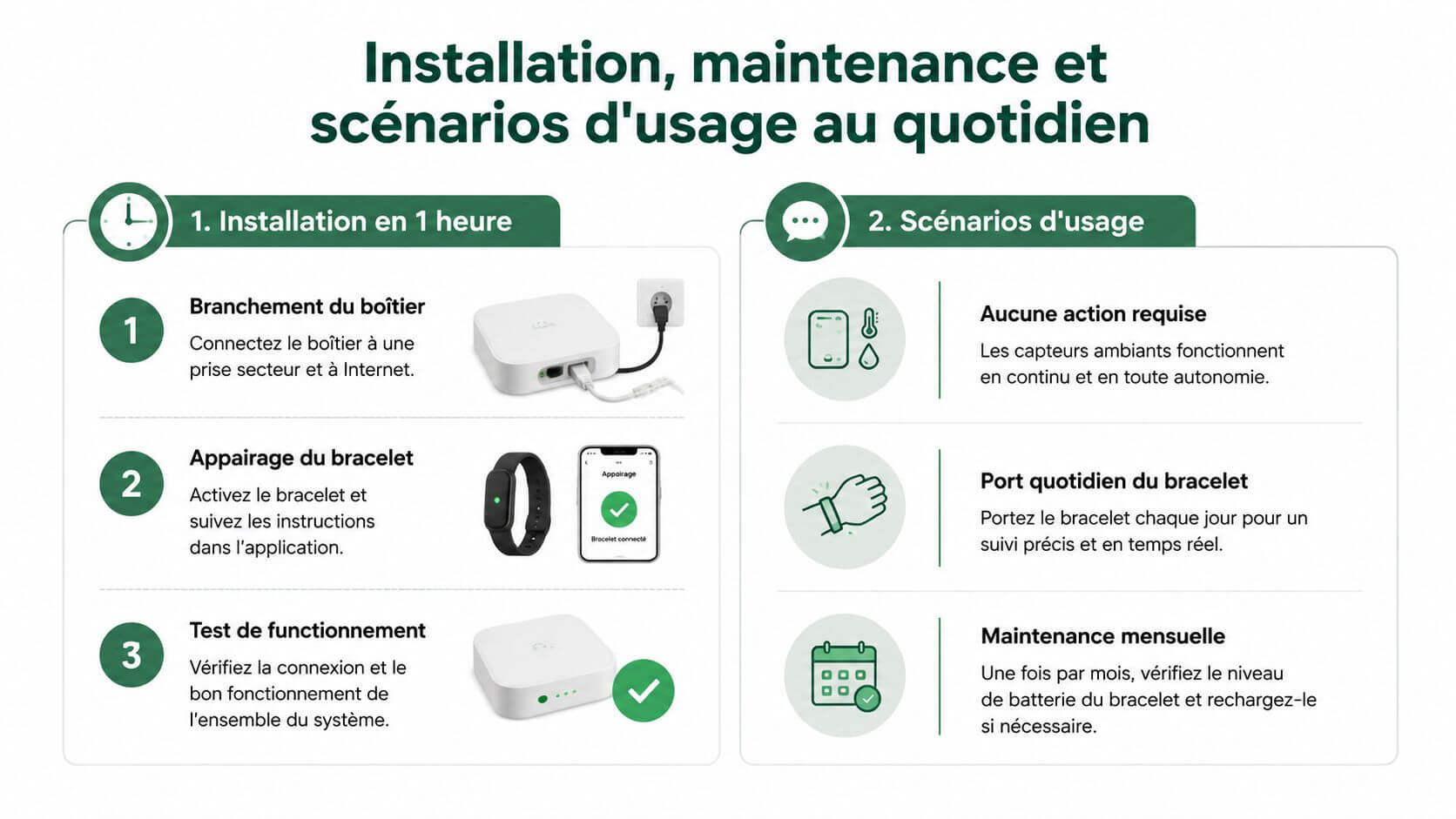
The simple diagram holds in three gestures, plug the case, pair the bracelet or pendant, and then test the alert. For most of the solutions, this remains a short start. The real work starts after, when you have to teach the person to keep the object, and the helpers to react in a coherent way.
The monthly test is non-negotiable. The battery is checked. The alert link is checked. The primary recipient is confirmed. A system never tested quickly becomes an illusion of security.
Use cases that break bad habits
- Night fall, the alert must leave without dependent on voluntary action.
- Soft fall, the sensor may hesitate, so the human protocol must be clear.
- Forget charging, the bracelet disappears from the protective chain as soon as the battery falls.
- Unforeseen visitor, a real incident must be distinguished from an unnecessary trigger in order not to saturate caregivers.
In a serious organization, each incident is recorded in the shared notebook, because an unmarked event ends up being reconstructed from the wrong side. Follow-up discipline is as important as the material. It avoids blind spots, duplicates and false certaintys.
If you want to stabilize a device in 30 days, the logic is simple, initial test, reminder to caregivers, check risk scenarios, and then weekly point on alerts and oblivion. It's not spectacular, but that's what makes the tool really useful every day.
Decide and take action without overpaying
The right decision is made in four questions. Who are you protecting yourself, what is the main risk, how much can you pay each month, and who should be warned when the alert leaves. If you do not have a clear answer to these four points, you are not buying the right system yet.
The simple rule to keep in mind
For a fragile person living alone with helpers at a distance, I recommend offer of remote assistance with automatic detection and structured relays, not an isolated sensor. For a mobile person, often leaving, the stake is the continuity of the port and the transmission. For a person who easily removes objects, the question is no longer what bracelet is involved, but which architecture without obligatory wear.
That's a useful decision. The best sensor is the one that stays worn, alerts quickly, and whose information comes to the right people without confusion.
The shopping checklist I'd have any family sign
- Real port, will the person accept the device every day?
- Transmission, does the alert go to someone who can be reached, not just to an application?
- Traceability, will the incident be kept in an exploitable history?
- Overall cost, subscription, options and service are clear from the start?
- Coordination, who warns family, home help or professionals if needed?
Do not pay for a promise of isolated precision. Pay for a complete circuit, from shock to intervention, with a clean follow-up. This is where the Senior Fall Detector Makes sense.
Tribulys helps families and professionals to turn an alert into useful information, with a shared care journal, clear roles, an accessible offline emergency card and unambiguously assigned tasks. If you already coordinate caregivers or home workers, see Tribulys to structure this chain and prevent the fall from being lost between several conversations.
Put this organisation into practice with Tribulys
Keep your care journal, shared calendar, tasks, medication tracking and emergency information together. Start for free and invite the relatives and professionals involved in your loved one’s care.