
On a Tuesday, in the middle of a meeting, your phone vibrates. It's your father's home care worker. He fell a little in the morning, nothing serious, but the midday dose was staggered and no one was able to notify the nurse. You learn it at 2:00 p.m., while everything happened at 9:00 a.m.
If you recognize yourself, you are not alone. When you help a loved one from a distance, it is not the incident that gnaws the most. It is to discover it too late, by a call or SMS that arrives in bulk, after hours of silence. Between impotence and too much information, the place is narrow.
A good caregiver application can change that. Let's see how, concretely.
The real problem is the dispersion of information.
We often think we lack information. In reality, there are many, but they are scattered: a text message from your sister, a voice message from the nurse, a notebook placed on the kitchen table, a messaging group where the prescription photos mix with family jokes.
As a result, everyone is doing their best and yet:
- two people give the same medicine, or no one gives it;
- a medical appointment is lost in a thread of discussion;
- the history becomes unobtainable at the exact moment you need it.
That's where the mental load settles. We spend more time searching, guessing or catching up than helping. For those who live far away, it's even heavier: the paper book is 300 kilometers away, and you always depend on someone to tell you what it contains.
What a helping close application needs to do for real
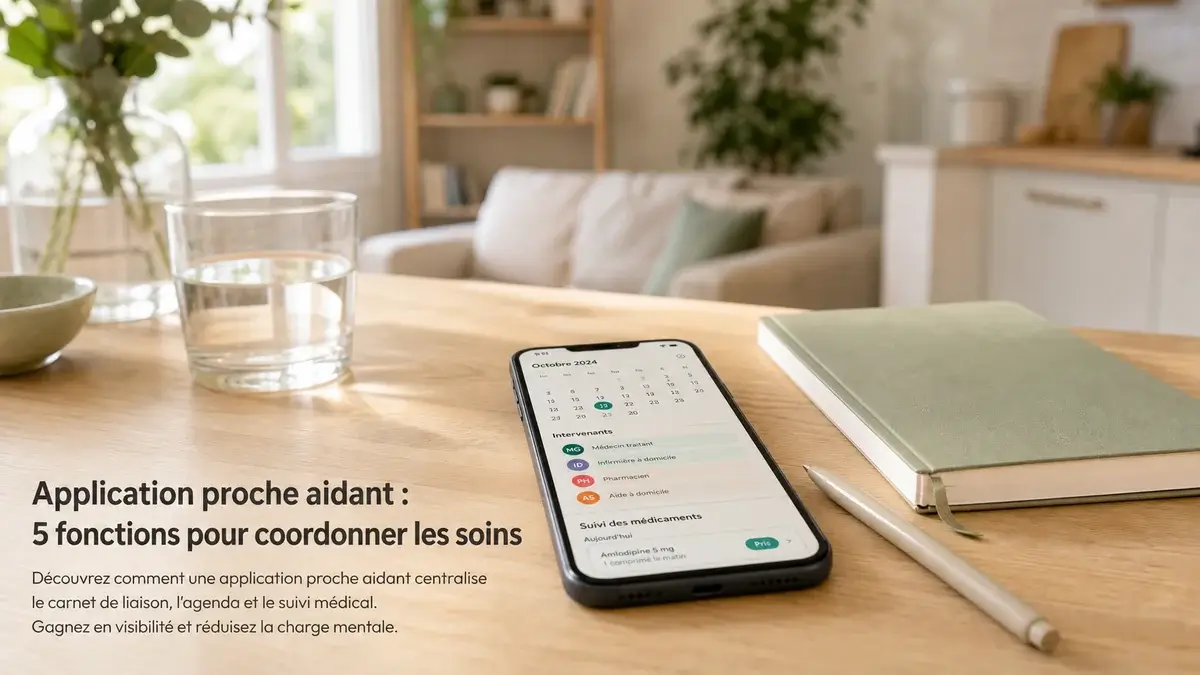
A list of features is not enough. What matters is that family and caregivers find themselves in a single space, simple to read in ten seconds. coordination of home carefive functions make the difference.
A shared and timed link book
Each entry indicates who wrote what, and when. No more "who came by this morning? " You check out the history of caregiver passages from your phone, without calling anyone.
A shared calendar for caregivers
Medical appointments, nurse passages, come from the assistant of life: everything lives in the same place, with reminders sent to the whole team. The idea of a shared calendar is to remove important dates from the thread where they drown.
Drug monitoring and alerts
The follow-up of medicines morning, noon and evening, with an alert in case of missed dose, limits forgetfulness as well as double doses.
The monitoring of constants
The monitoring of constants (tension, weight, temperature) allows us to detect a trend rather than an isolated value.
An emergency card
In the event of a failure, the essential information is accessible only to authorised persons: treatments, allergies, contacts, doctor referent. No one searches in a drawer.
Helping from a distance: your office becomes a coordinating post
Being away does not mean being useless. From your computer or phone, you can:
- add a neurologist appointment to the common agenda;
- assign a task to your sister ("renew the order")
- deposit a record in a safe of medical documents;
- read the summary of a passage and read the transmissions of caregivers.
In Tribulys, for example, the "My Visit" function gives a summary of passage, with checklist and transmission. The auxiliary of life ticks what has been done, you read the result between two appointments. The courier of the tribe keeps the rapid exchanges in the same space, instead of scattering them. And the automatic reading of a prescription avoids copying everything by hand.
The effect is simple: fewer check calls, fewer catch-ups, and visibility that happens in time. You do not replace the presence, but stop flying blindly.
Health data: safety is not negotiated
We're talking about very sensitive information. Before inviting anyone, ask yourself these questions, and ask for clear answers from the publisher:
- Who can see what? Access must be restricted to the members you have authorized.
- Where are the data hosted, and how are they protected?
- Does the operation respect the GDPR, and is the accommodation suitable for health data?
- Can you retrieve your information, for example in PDF export of folder and transmissions?
Don't hesitate to ask for these black-on-white guarantees. A serious tool will not be bothered. Our page on the choice of an app for family caregivers Moreover, details this point of vigilance.
Start in 5 minutes, without complicated configuration
There's no need to fill it all out on the first day. Here's a realistic plan:
- Create the common space and invite your sister, nurse and home care worker.
- Inform the emergency form and specify who is allowed to consult it.
- Launch a simple stream: the calendar and transmissions of passages.
- Then add the most useful follow-up in you, medications or constants.
- Take the visibility test: a week later, find out in 30 seconds what happened yesterday with your loved one.
Tribulys offers mobile apps for iOS and Android, in addition to its web version accessible from a browser. You find the same account and your tribe on compatible devices. To lay the foundations for family, our guide for the coordination of carers help you map the stakeholders before inviting them.
A small tip: if one of the caregivers hesitates, start with a single habit, for example a transmission line after each passage. The rest will follow when he sees that it saves him time.
The question to ask you today
What makes you waste the most time: looking for information, guessing what happened, or catching up on what was forgotten?
Your answer indicates where to start. If it's looking, start with the link book. If it's guessing, by the passages and constants. If it's catching up, by the calendar and alerts.
And if you've ever lived a time when the information came too late, tell it in comment. These stories help other helpers feel less alone, and they help us build Tribulys better.
Put this organisation into practice with Tribulys
Keep your care journal, shared calendar, tasks, medication tracking and emergency information together. Start for free and invite the relatives and professionals involved in your loved one’s care.