
The phone rings while you're trying to work. Your sister asks if someone accompanied your father to his appointment, your brother is looking for the last prescription and no one knows if the evening treatment was taken. In the focus group, the answers mix with the old information, while the caregiver who lives near the home sometimes does not have time to document everything.
This is not due to a lack of goodwill. It comes from an organization that has become too complex to rely on the memory of one person. One application family organization does not replace calls, visits or medical decisions. It gives everyone a common framework to act without having to reconstruct history from SMS and memories.
Contents
- Why family management drifts without a common tool
- What is a family organization application
- The essential features to coordinate care
- Managing ruptures of presence and exhaustion of the caregiver
- How to choose your platform and selection criteria
- Deploy the application and organize the tribe
Why family management drifts without a common tool
A family can operate for a while with a paper calendar, a few calls and a courier group. Then the appointments multiply, the workers change, the treatments evolve and the relatives take turns. On Monday, a girl accompanies the parent to the doctor. On Tuesday, a neighbour passes by to shop. On Wednesday, a brother at a distance asks if the instructions given Monday have been applied.
The information exists, but it is not in the same place. A sister thinks she has warned everyone, a brother believes that another person takes care of the visit and the principal caregiver keeps the important details in her head. This organization holds as long as no one gets ill, goes on leave or forgets a transmission.

In France, 7.1 million people report regularly helping a dependent relative, according to the data of the DREES on loss of autonomy. This assistance increases as responsibilities tend to focus on a smaller number of caregivers. Coordination is therefore not a comfort reserved for very organized families, it is a concrete response to a real daily burden.
Most Frequent Breaks
The same flaws often occur:
- The scattered channels. A schedule can be found in a text message, a prescription in an email box and an important statement in a call that no one has kept track of.
- Implicit responsibilities. Everyone wants to help, but nobody knows exactly who accompanies, who confirms a catch or who calls the professional.
- Incomplete transmissions. The caregiver is familiar with the context, but the distant relative receives only a late summary, sometimes without a date or author.
- Dependence on one person. When the primary caregiver is unavailable, the family discovers that he is the only one who knows about habits, contacts and the latest decisions.
Practical rule: an important task should never depend on information that only a person can find.
A common tool structures this mutual assistance. It allows to associate an action with a person, a deadline and a confirmation. It keeps observations in the same place and gives relatives visibility adapted to their role. Technology becomes useful when it reduces assumptions, not when it adds another notification.
What is a family organization application
A family organization application dedicated to carers looks less like a simple calendar than a single one. shared digital link book. The calendar indicates that an appointment exists. The accompanying notebook, which instructions have been given, which document must be presented and what happened afterwards.
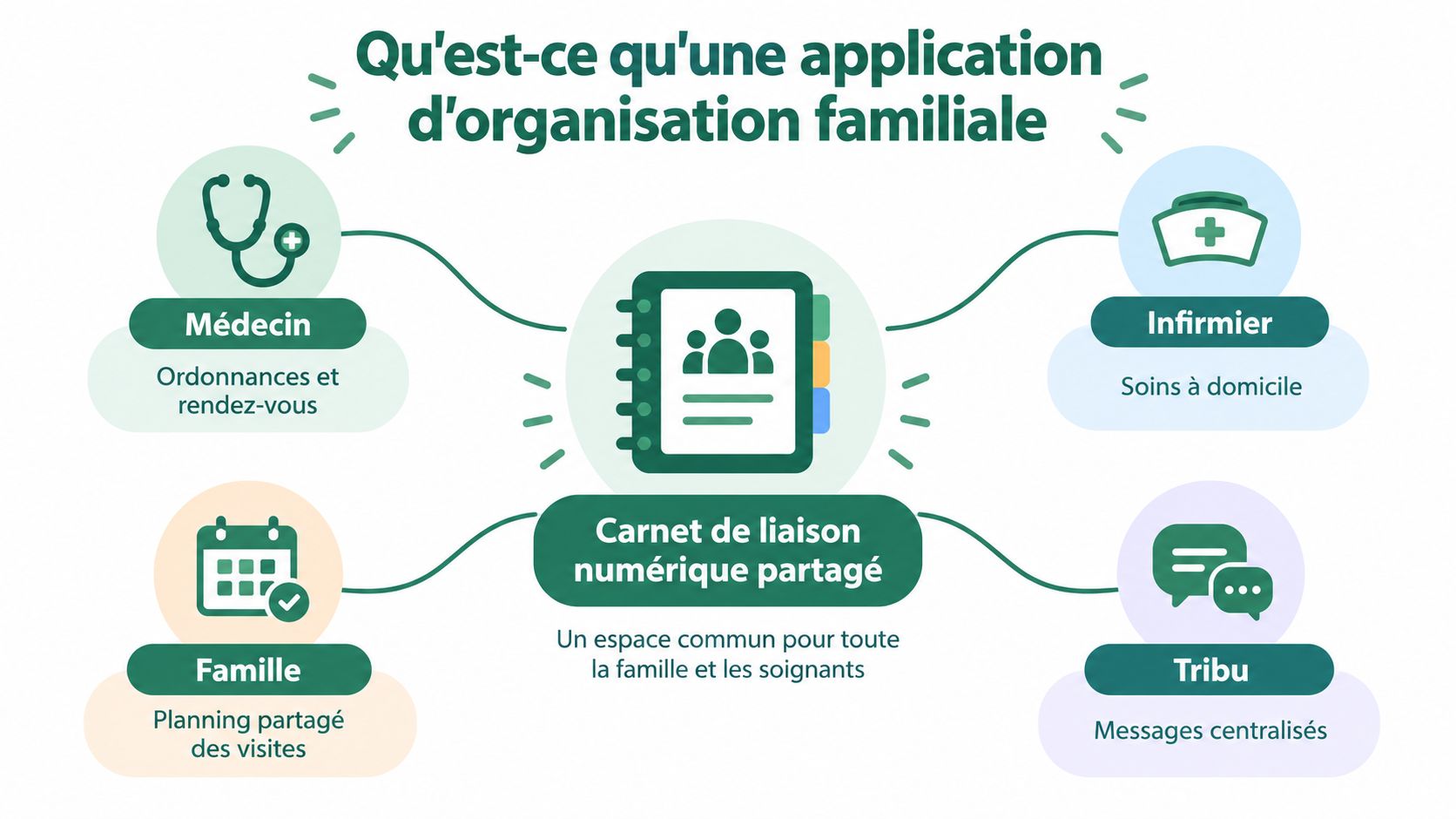
The principle is based on a common source of truth. Instead of asking, "Who knows if the nurse came by? ", an authorized member consults history. Instead of looking for a prescription in an old conversation, he opens the document associated with the helped relative. Every useful information must remain understandable by a person who joins the organization later.
A tribe with different rights
The "tribe" refers to the group of people authorized to participate in the follow-up. It can bring together the children, a neighbour, a home care worker and, where appropriate, professionals involved in the home. Not all need to see or change the same elements.
A relative can manage the schedule, another can receive the summaries, while a speaker only informs a visit or an observation. management of access rights protects confidentiality and prevents everyone from changing sensitive information without distinction.
A structure, not a focus group
A WhatsApp group is convenient to quickly prevent the family, but it mixes urgent exchanges, photos, short answers and durable information. A specialized application separates spaces: planning, tasks, medicines, documents and transmissions.
The essential difference is traceability. A time stamp indicates what has been written and when. A task displays its person in charge and its condition. A confirmation makes it possible to distinguish an action carried out from an action simply mentioned. For a geographically broken family, this organization reduces verification calls and misunderstandings without removing human contact.
The essential features to coordinate care
A strong application recognizes its ability to transform informal exchanges into exploitable information. A shared agenda alone is not enough. We must be able to understand what was planned, what was done, who did it and what follow-up is needed.
The Timed link book is the starting point. Each observation should include an author, a date, a context and, if necessary, an alert. A phrase like "unusual condition this morning " remains too vague. A useful transmission specifies the time, the observed change and the action taken, without turning the tool into a diagnostic space.
Monitoring of medicines requires true traceability
The sound recall does not answer the most important question: has the catch been confirmed, refused or forgotten?ANSM on Drug Errors, the errors concerned in particular a drug error in 36% of cases and poor compliance in 18% of cases.
The module must therefore distinguish the treatment, dose, unit, schedule, person responsible and status of the dose. A timed history must show who has confirmed the action. If a dose remains unconfirmed, the alert can be transmitted to an authorized contact, with the last visible action. This limits the double administrations caused by contradictory information, but never replaces the opinion of a healthcare professional.
Planning, documents and offline mode
The shared calendar must show the appointments, the passages at home and the accompaniments. A task such as "accompaniing mom" becomes really useful when it contains a date, a person in charge, an hour and a short deposit. The documentary safe completes this schedule with important orders, reports and coordinates.
The offline mode deserves a central place. A caregiver may be in a building where the network is not well connected, in a move or in a relative whose connection is unstable. An offline searchable feature allows you to find a checklist or essential information and then synchronize the transmission when the connection returns.
To compare the modules offered by a coordination solution, consult the Tribulys features. The right choice depends less on the number of icons displayed than on the ability of the tool to prevent an unconfirmed action from disappearing in the message stream.
Managing ruptures of presence and exhaustion of the caregiver
One Tuesday morning, the principal caregiver must stay at home because she is ill. She knows the pill, the hours, the nurse's number and the last medical order. Her brother, who lives far away, agrees to take over, but he does not know if the morning treatment has already been given. He calls two people, receives different answers and hesitates to intervene.
The problem is not only the absence of a visit. It's the temporary disappearance of the decision center. A resilient organization must allow another person to quickly understand the situation, act in its role and leave a trace for the future.
In 2021, 2 million people aged 60 or over needed self-help, depending on DREES sheet on loss of autonomy and carers. Home maintenance therefore involves coordination that can work despite absences, changes in pace and fatigue.
Prepare a relay plan
A relay plan is based on a few concrete decisions:
- Appoint an alternate. This person should know where to find treatments, appointments, contacts and latest transmissions.
- Set alert thresholds. An unconfirmed catch, a cancelled visit or an unusual observation must trigger a clearly assigned action.
- Limit rights without blocking action. The alternate must have access to the necessary information, without automatically obtaining all administrative rights.
- Provide for resumption. Upon the return of the primary caregiver, the history must show what was done during the interruption.
An unusual silence alert can also attract attention when no transmission is recorded at the usual pace. It should not be interpreted as proof of problem. Rather, she points out that an authorized person must verify the situation.
The best application is not the one that assumes that the primary caregiver will always be available. It is the one that allows someone else to resume without starting from scratch.
How to choose your platform and selection criteria
The choice of a platform must begin with the risk you are looking to reduce. For a family, it is often the oblivion of an appointment. For a professional, it may be the absence of a reliable transmission. For a distant relative, it is the impossibility of knowing what happened without calling several people.
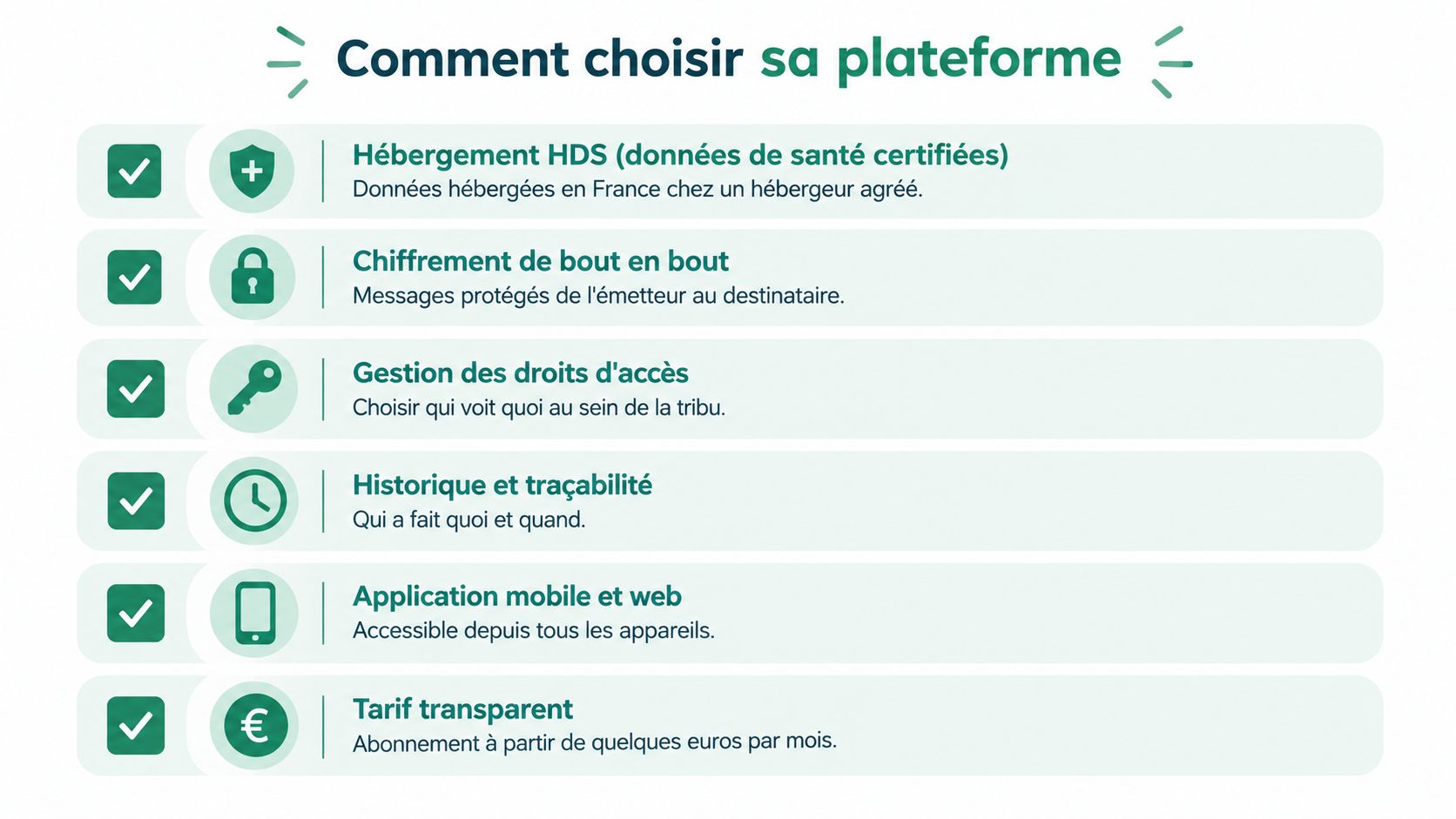
Compare solutions on real uses, not just on their appearance:
| Criterion | What to check | What's Problem |
|---|---|---|
| Data protection | Accommodation adapted to health data, readable privacy policy and GDPR compliance | A promise of security without verifiable detail |
| Shared access | Simple invitations, distinct roles and configurable rights | A single account used by the whole family |
| Traceability | Author, date, history of changes and status of tasks | Unable to assign free notes |
| Contingency | Mobile application, web version and offline operation | Unusable tool as soon as network disappears |
| Adoption | Interface understandable by people uncomfortable with digital | A long or technical registration course |
| Economic model | Explicit price and possible access for close guests | Make each member pay before the test |
Accessibility is not limited to a beautiful interface
In France, 13 million people are far from digital, based on information from the official digital website on the selected dematerialization. An application can therefore centralize information for three relatives and exclude the assisted parent, a neighbour or a stakeholder who does not connect regularly.
Prefer a hybrid organization. It can combine an invitation by e-mail, light mobile access, printable syntheses, a framed delegation and a clear rule in case of non-connection. Digital must maintain the continuity of coordination, not become a new condition of access to aid.
To compare a classic task application with a tool designed to track a relative, also look at the management of shared tasks. The decisive criterion remains simple: a replacement person must be able to understand the essentials quickly, with the appropriate level of confidentiality.
Deploy the application and organize the tribe
The technical installation takes a short time. The change usually requires more method. A family adopts an application when it immediately understands what it is gaining in a concrete situation, for example knowing who accompanies the parent on the next appointment without sending several messages.
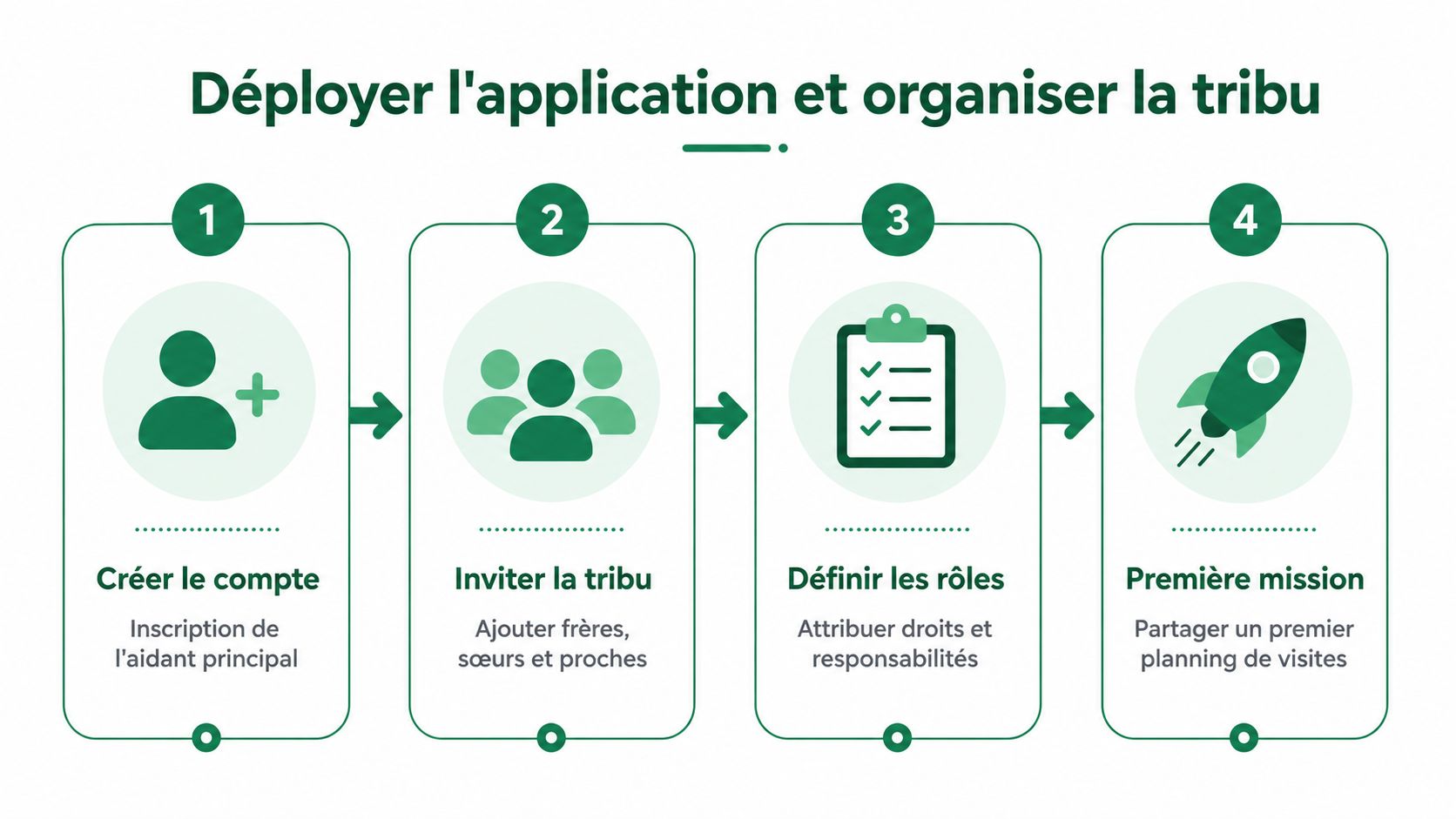
Start with a reduced perimeter:
- Create the primary caregiver account. Only provide information for start-up purposes and check the privacy settings.
- Invite the tribe. Add relatives who actually participate in decisions or visits. Explain each person's role in one sentence.
- Define responsibilities. Attribute planning, races, appointments, transmissions and relays, rather than leaving tasks "to someone".
- Share a first mission. Create a tour schedule for the next few days and ask each person to confirm their commitment.
Adopting the tool without excluding anyone
Do not ask the whole family to complete all the entries on the first day. First, enter the essential contacts, upcoming appointments and the treatment that requires the most follow-up. Then show the result from an immediate need: "Who comes by tomorrow morning? "
For a loved one who is not comfortable with digital technology, plan a short demonstration on his or her own phone. A person can receive a synthesis by email, consult a printed version or transmit information by phone to a member who will seize it. This flexibility is essential when not everyone can log in regularly.
The family rule must remain clear: the application contains sustainable information, while an appeal can be used to deal with an emergency. Important decisions must then be recorded so that other caregivers have the same context.
The video below can be used as a support when presenting the tool to the family.
After a few days, look at what is not used. A feature that forces relatives to enter the same information twice will be abandoned. Conversely, a fast transmission, a readable schedule and a well-attributed alert can become reflexes. The goal is not to digitize each gesture, but to make the family able to continue when the person carrying the bulk of the load has to stop.
In the same space, Tribulys brings together the care journal, the planning, the tasks, the follow-up of the medicines and the useful documents around a relative at home. To organize a tribe with shared roles and a more reliable relay, discover Tribulys and create your family organization.
Put this organisation into practice with Tribulys
Keep your care journal, shared calendar, tasks, medication tracking and emergency information together. Start for free and invite the relatives and professionals involved in your loved one’s care.