
At 7:00 p.m., the girl who lives at a distance discovers a text message indicating unusual fatigue. The home care worker may have noted it in a paper notebook, the nurse left a voice message and the brother thinks the medication has already been taken. No one has the same information at the same time. Daily log application is used precisely to avoid this delay.
Contents
- Why the shared daily newspaper changes the deal
- Key features of a daily newspaper application
- Privacy Criteria and GDPR Compliance
- Concrete examples of impact on coordination and mental load
- Good practices to integrate the newspaper into daily routines
- Manage periods of replacement and respite
- Daily newspaper as a tool for formal coordination
Why the shared daily newspaper changes the deal
On the ground, the difficulties rarely come from a lack of good will. They appear when several people take turns without meeting each other. A relative passes in the morning, a nurse intervenes later, another family member calls in the evening, then the doctor has to reconstitute the previous days from incomplete memories.
The paper notebook remains useful in some situations, but it often sleeps at home. A WhatsApp group facilitates discussion, without providing reliable chronology, clear separation between observation and emergency, or a simple search in history. Messages mix with photos, late responses and personal conversations.
In France, 9.3 million people reported regularly helping a relative with disabilities or loss of autonomy in 2021, according to the data provided by the Statistical documentation on carers. Among them, 8.8 million were adults and 0.5 million were minors aged 5 or older, which shows that coordination can bring together several generations. The same source indicates that 61% of caregivers are employed, with strong constraints of availability and transmission.
A common memory rather than a personal notebook
The shared journal does not replace the judgment of a professional. It gives each person the same basis of facts dated, identified and searchable. A note on a little consumed meal, an alert about a narrowly avoided fall or a task attributed to a relative become elements of continuity, instead of remaining in the memory of the present person.
The care journal is already presented as an exchange tool between the person receiving care, his/her family and home care workers. Useful information may include the attending physician, emergency contacts and the elements that the person agrees to share, as explained by the French framework of the care journal for services.
Practical rule: important information must be readable by the person taking over the relay, even if he or she did not attend the previous passage.
The difference between a personal diary and a co-ordinating journal is therefore due to its use. The first helps to remember. The second allows several caregivers and professionals to act with a common understanding, including when their schedules, workplaces and access levels never coincide.
Key features of a daily newspaper application
A useful application is not limited to a text box. It must transform an observation into information that the right person can use, at the right time, with sufficient context to avoid interpretations.
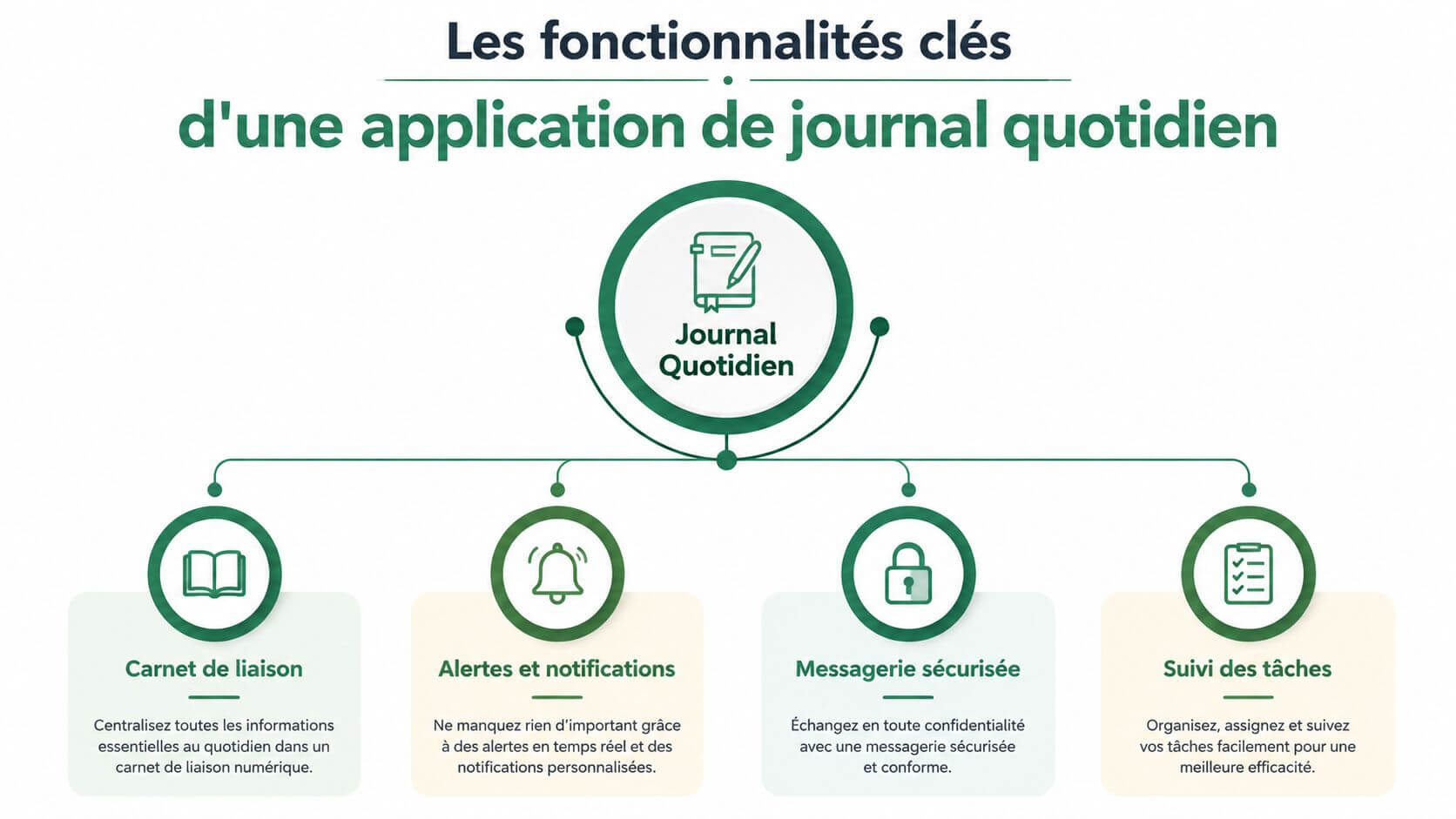
The functions that really structure the relays
- Shared care journal. The timed and signed entries indicate who observed what, when and in what context. A note such as "slept agitated tonight" does not have the same value as a note indicating the time, observation and action performed.
- Separate notes and alerts. A note keeps current information. An alert draws attention to an event that deserves a quick reading or action. On Tribulys, the "note" and "alert" entries are the most used by the tribe, and the alert generates the most readings.
- Drug tracking. An isolated reminder does not prove that a catch has been made. Confirmation of the catches morning, noon and evening, alert in case of oblivion and searchable history give a more precise vision to the relatives and professionals.
- Unified agenda. Medical appointments, nursing passages and family tasks must appear in the same space. Otherwise, each one keeps its own calendar and duplicates reappear.
- Access by roles. A doctor, nurse, assistant and family member may not need to see the same information. Differentiated permissions protect confidentiality while maintaining the necessary continuity.
- Offline operation. A transmission should not disappear because the mobile network is unstable. The offline mode allows you to enter in the logbook or in a visit and then synchronize the data as soon as the connection returns.
What doesn't work so well
An application that accumulates functions without hierarchies can become as confusing as a group of messages. Users need to quickly identify emergencies, pending tasks and latest transmissions. Filters, search, targeted notifications and a readable history count more than a long list of rarely used options.
To compare the compromises between notebooks, agendas, messaging and task tracking, consult this comparison of the coordination tools. The right choice depends mainly on the number of stakeholders, their digital ease, the sensitivity of the data and the need to work without a network.
Privacy Criteria and GDPR Compliance
A daily newspaper often contains health data, lifestyles, contact information and information on interventions. The comfort of use must therefore never make forget the central question, which can consult these data, which changes them and how long they remain accessible.
In particular, the French digital coordination mechanisms recommend the use of My health area and MSHealth to fluidize exchanges in a secure environment. To understand the precautions to be taken with digital tools and artificial intelligence, the resource secure customer data with AI provides a useful vigilance grid, even if the context of use differs.
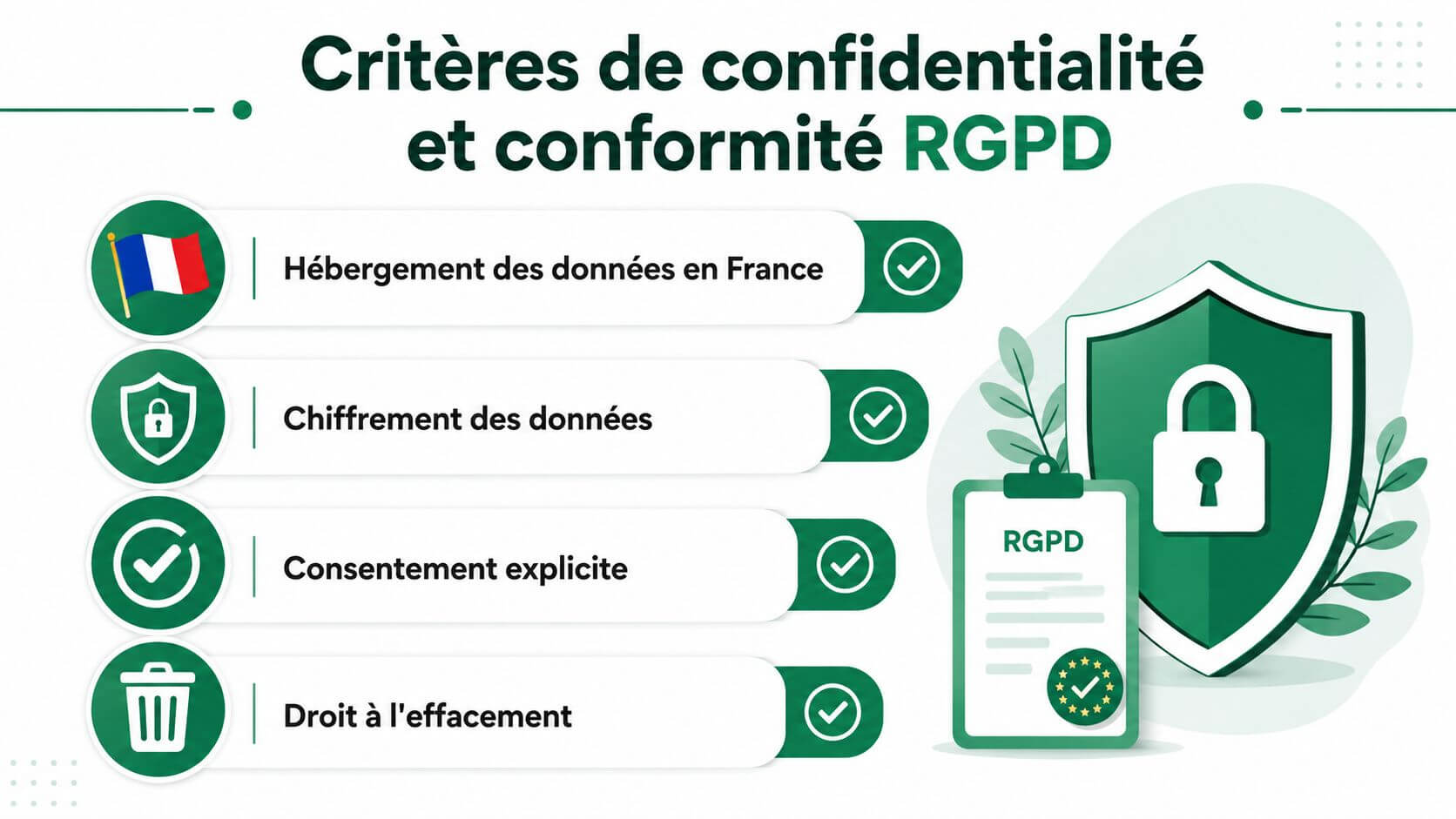
Auditing in Four Questions
- Where are the data hosted? Check the country of accommodation, the applicable legal framework and the identity of subcontractors. A solution intended for the French domicile must clearly explain its organisation.
- How are accesses protected? Search for encryption, appropriate authentication and session management. Serious security must cover data during transmission and storage.
- Is consent explicit? the person receiving care must understand what information is being collected, for what purposes and with which users. Consent must not be drowned in a general formulation.
- Are rights really applicable? The user must be able to request access, rectification or erasure of his data, according to the applicable rules. The contact details of the controller and the procedure must be easy to find.
Permissions are better than limitless sharing
A single access for the whole family seems simple, but it exposes more information than necessary. A role-based access limits the visibility of information useful to each function, while keeping track of actions and changes.
The Secure health messaging It also deserves a separate assessment. A private courier integrated in the follow-up may avoid dispersing exchanges into personal channels, but it does not replace professional procedures or devices for health transmissions.
Concrete examples of impact on coordination and mental load
One night, a caregiver finds that her mother has less appetite and seems more tired. She's putting an alert in the paper. The next day, another family member reads it, adds an observation about sleep, then the nurse finds these elements before she passes. At the medical appointment, the family no longer relies solely on a general impression. It may present a series of observations dated, with the actions carried out and the changes noted.
This example does not mean that the application poses a diagnosis. It improves the quality of the transmission. The doctor has a more precise context, while relatives can answer more clearly questions about the appearance, repetition or evolution of a symptom.
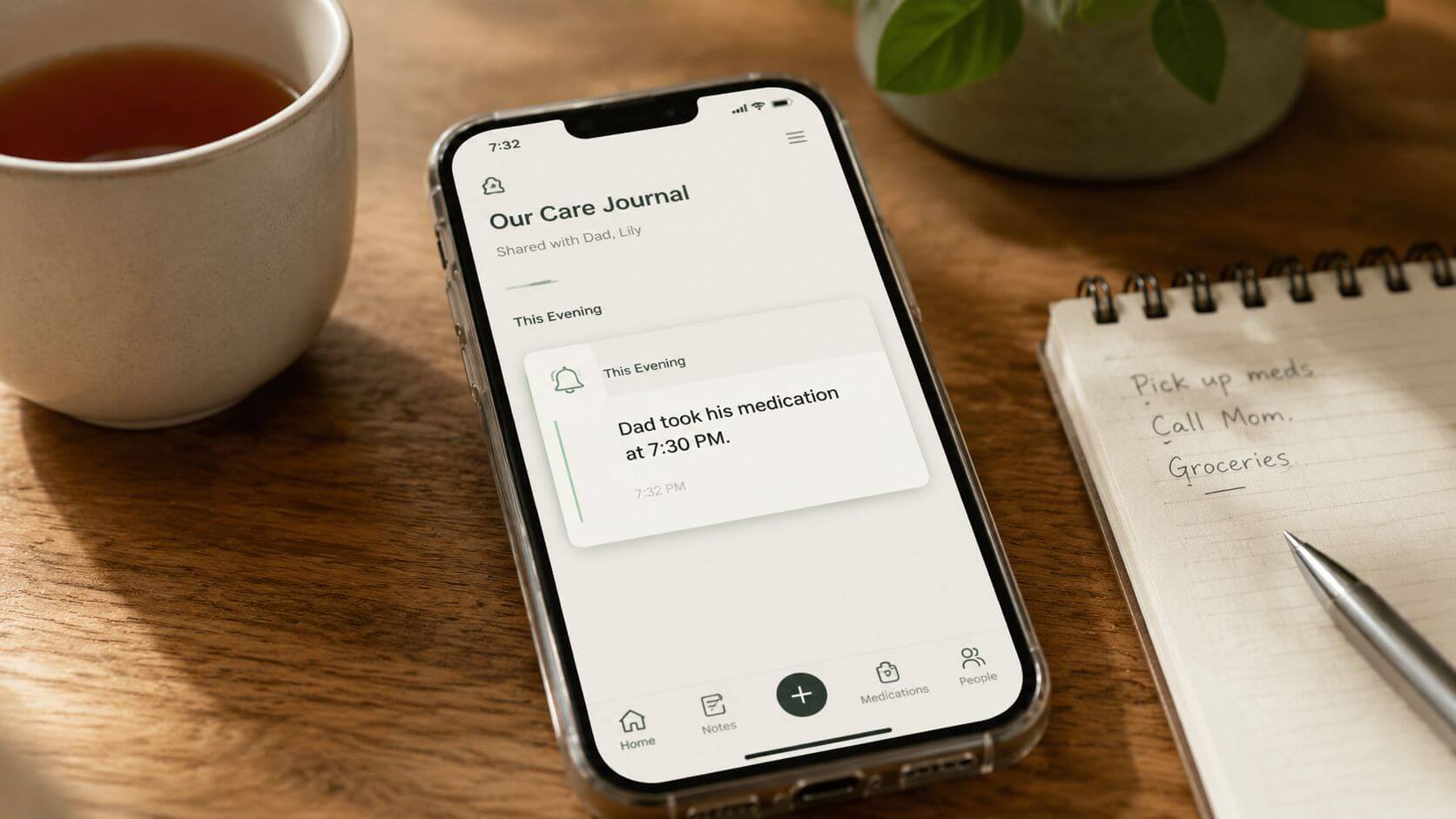
Replace scattered memory with a common trace
The caregiver's mental load corresponds to the anticipation of appointments, medication, procedures and relays. When this information remains in the head of a single person, it becomes the mandatory point of passage for the whole family. It must answer the same questions, find old messages and check what has already been done.
A formulation sums up the desired benefit, to be regarded as an illustration and not as an attributed testimony: "Before, I kept everything in my head or on post-it. With the shared notebook, I write down once and the whole family knows about it. " The relief does not come from a loss of duties. It comes from the decrease of repetitions and the end of the central memory role.
The Ministry of Health describes the Shared Medical Folder as a space for authorised professionals to share information useful for coordination, including background, allergies, ongoing treatments, liaison letters, reports and examination results, as specified in the page dedicated to the Shared Medical Folder. The daily newspaper is not intended to replace it. However, it can retain daily observations that give meaning to a consultation and help prepare a structured transmission.
Good practices to integrate the newspaper into daily routines
An application does not create a habit by its presence alone. In Tribulys, the notebook today does not have dedicated daily reminders. The most realistic advice is to associate taking notes with a gesture already installed, such as the end of a visit, the preparation of medicines or the departure of a practitioner.
A simple method to avoid abandonment
- Choose a stable trigger. After each visit, the intervenor adds a short transmission. After taking the evening, the close friend checks for possible omissions and notes only what deserves to be kept.
- Write for the person who takes over the relay. A useful entry specifies the observation, timing and action. "Fatigue" is less exploitable than "unusual fatigue observed after lunch, proposed rest, stable state at the start".
- Reserve alerts for information that requires reading. If everything becomes urgent, nothing comes out. Alerts must report a change, a risk, a lack of control or a priority task.
- Assign tasks to a person. "Someone has to call the doctor" creates a blurred responsibility. An assigned task, with a deadline and status, reduces duplication.
- Use filters and syntheses. The "to-do", "urgent" and "completed" views facilitate the relay. A summary of the day or week helps the close relative stay informed without asking for a full report.
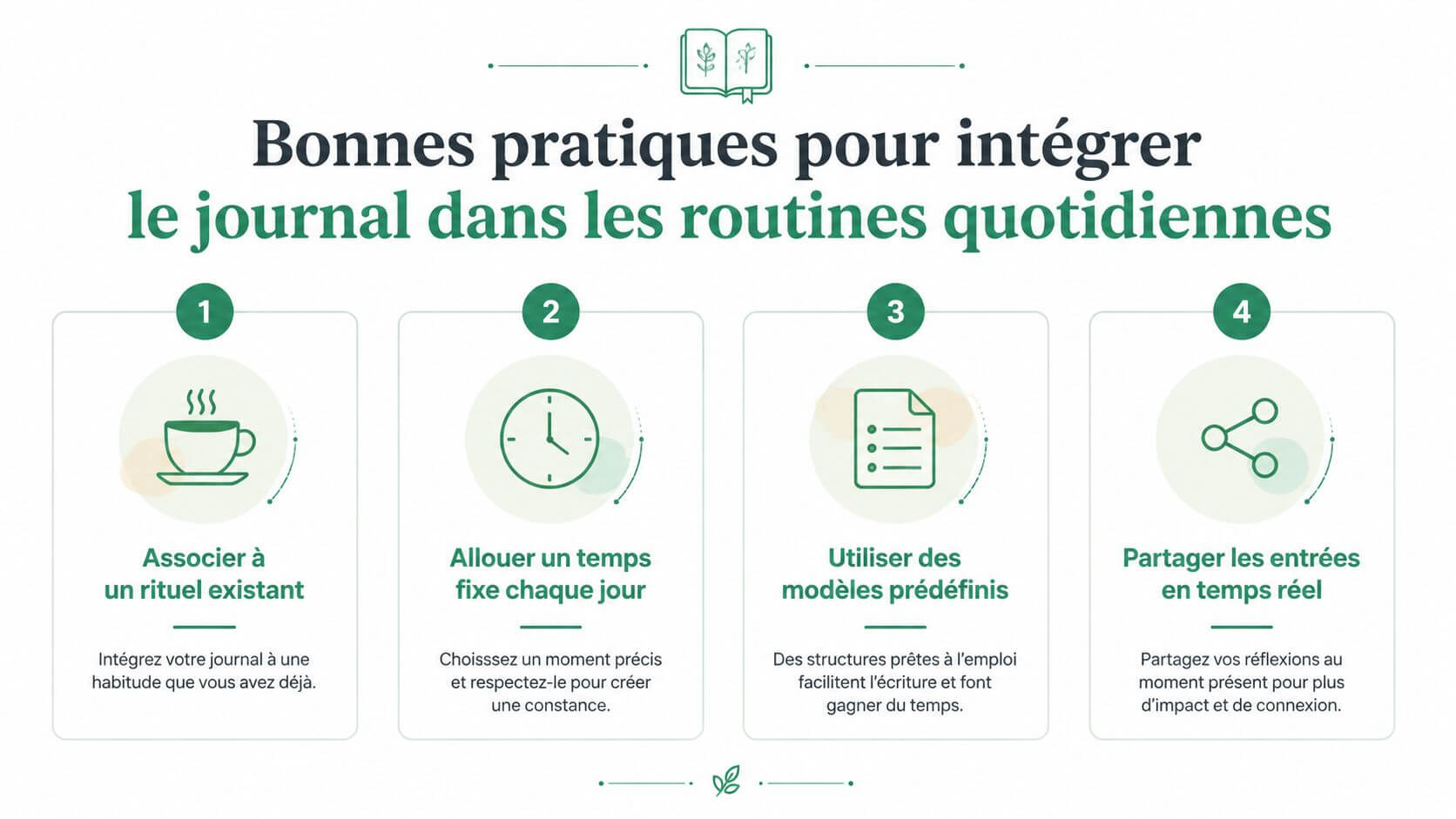
Adopting the tool to the entire tribe
Start with a common vocabulary. A note described, an alert attracts attention, a transmission closes a passage and a task indicates an expected action. This distinction prevents professionals from using the journal as a general conversation space.
Remote carers need synthetic information, not an avalanche of notifications. Liberal professionals must be able to enter quickly after their passage, without filling out a disproportionate form. An effective configuration respects these two constraints, with suitable permissions and short instructions shared at the start.
Manage periods of replacement and respite
The relay is a demanding test for any coordination system. When the primary caregiver is absent, the person taking over must understand the habits, treatments, appointments, vigilance points and the latest developments without depending on a long procurement call.
The CNSA states that a decree of 19 August 2025 in support of home or respite replacement interventions up to six consecutive days, and that the AJPA has been upgraded to 65,80 € per day, with a renewal of the duty until three times, according to its National campaign for carers. These devices make the transmission between the caregiver and the person who replaces him particularly concrete.
Preparing for relay passage
Before the absence, create a readable status sheet. It can bring together key contacts, treatments, appointments, important habits and tasks to be monitored. During the replacement period, the journal keeps daily events instead of leaving them in several notebooks or conversations.
The offline mode account when the speaker is in a poorly covered area. It shall allow the necessary information to be consulted and a transmission to be drawn up and the data to be synchronized with reconnexion. This function is not only for comfort. It prevents the absence of a network from turning a passage into untraceable information.
After the respite, a synthesis allows the primary relative and professionals to quickly resume the thread. A weekly summary, a PDF export or a chronological view can be used as a support, provided that the entries are sufficiently short, dated and understandable.
Daily newspaper as a tool for formal coordination
The digital daily newspaper takes its full value when it becomes a part of the collective functioning, not a space filled only when someone thinks about it. Dated transmissions, assigned tasks, hierarchical alerts and common history give a structure to relays between families, nurses, auxiliaries, doctors and help services.
Some French sources indicate that transmissions have been compulsory since 25 June for the care and assistance services involved with elderly people, which reinforces the place of regular, legible and retrievable entries. In this connection, the newspaper is not a mere organizational comfort. It contributes to the continuity and traceability of the interventions, without replacing the medical file or the regulated professional exchanges.
The last check before choosing
Before adopting an application, check that it offers:
- A exploitable chronology, with author, date, time and context.
- A clear separation of usesbetween notes, alerts, tasks, drugs and messages.
- Differentiated rolesadapted to family members and professionals.
- Data management consistent with GDPR, in particular on accommodation, rights and deletion.
- Unconnected access, if the visits take place in places where the network is uncertain.
- Synthesis or exports, useful during an appointment, relay or re-evaluation.
To deepen the role of the notebook in the home organization, consult this resource on the digital care journalTribulys offers a free essential offer for life up to 5 members, as well as a Family formula intended for extended needs and unlimited members, with shared notebook, schedule, tasks, drug tracking, role permissions and offline operation according to the formula.
The right tool does not erase the complexity of home help. It makes it visible, shared and easier to take over. It is this continuity between people who never cross one another that turns a daily newspaper application into a real coordination medium.
Test Tribulys with your family or workers, starting with a single routine, such as transmission after each visit. Tribulys to create a shared space and make sure that history, alerts and tasks reduce calls, duplicates and lost information.
Put this organisation into practice with Tribulys
Keep your care journal, shared calendar, tasks, medication tracking and emergency information together. Start for free and invite the relatives and professionals involved in your loved one’s care.