
You may be your relative's employee through APA or PCH, with a contract and CESU declarations, or be a assisting employee who retains his or her employment and may request the leave of close care. These two situations concern a phenomenon which affects 8 to 11 million caregivers in Franceof which approximately 61% employed.
Your mother forgets her appointments, your brother goes after her work to check the drugs, and you receive important information by SMS, phone and voice messages. You want to help more, but one question comes up: Can you be paid to accompany your loved one, or are you simply an employee who helps a family member?
The answer depends on the chosen framework. In the first case, the person receiving care becomes your employer. In the second, you remain employed by your company and your role as a caregiver may open up specific rights. Consolidating the two can lead to a bad statement, unrealistic expectations about remuneration or inadequate social protection.
Contents
- Understanding the status of paid family caregiver
- Legal and contractual frameworks
- Social rights, leave and protection
- Tax impacts and social charges
- Concrete coordination scenarios
- Remuneration approaches
- Summary and key resources
Understanding the status of paid family caregiver
The expression paid family worker The first refers to a close relative who signs a contract of employment with the person receiving care. He carries out defined tasks, declares his hours and receives a salary. The second refers to a person who is a relative of the person receiving care. assisting employee, i.e. a person who works for a business while regularly accompanying a parent, spouse or relative in loss of autonomy or disability.
In the first scenario, your loved one is a individual employer. The APA or PCH can contribute to the funding of the aid, depending on the rights open and the rules applicable to the situation. You are not paid simply because you are rendering service to your family. You need to formalize employment, establish working conditions and make social declarations.
In the second scenario, no home help contract is automatically created between you and your loved one. Your employer remains your business. Caregiver leavethe organization of your working time or other measures provided for in labour law and collective agreements.
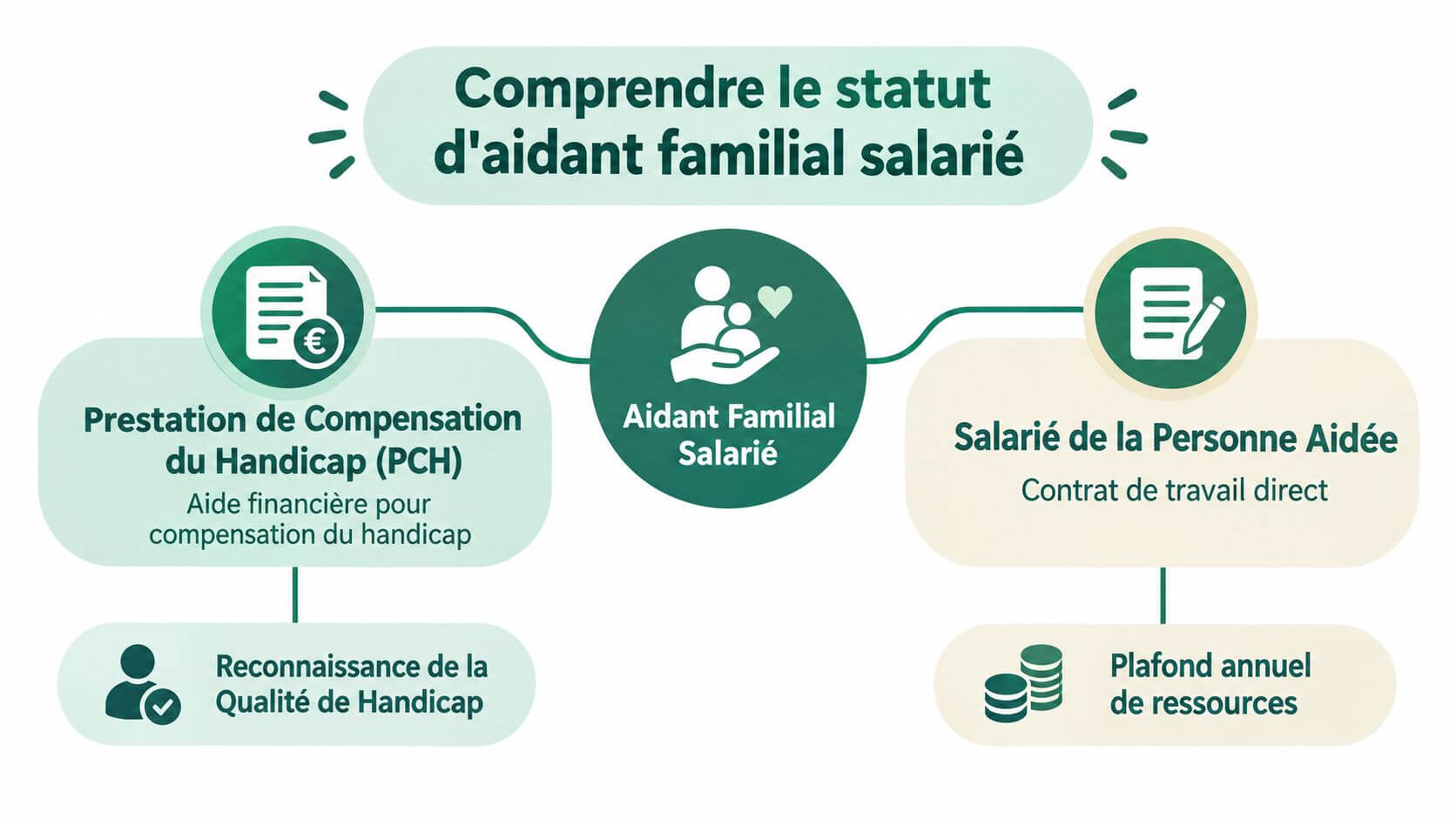
Why this distinction changes everything
| Your situation | Who pays you? | What needs to be checked |
|---|---|---|
| Close home employee | the person receiving care, or his representative | Contract, hours, CESU declarations and financing |
| Employee assisting in employment | Your usual employer | Leave, collective agreement, accommodation and possible compensation |
The subject has become structural. 8 to 11 million caregivers, with 61% in employmentSome estimates thus place carers in almost a fifth of the wage-earner population, while France Travail projects that they could represent one in four employees in 2030These data are presented in the analysis on assisting employees in France.
Practical benchmark: start by writing a simple sentence about your situation. " I want to be hired by my loved one " does not involve the same steps as "I want to keep my job while helping my loved one. "
To deepen the differences between close caregiving, family caregiving and employee caregiving, consult this Guide on Caregiver Status. This clarification will prevent you from requesting the wrong mechanism from the departmental council, your employer or the Urssaf.
Legal and contractual frameworks
In France, there is no stand-alone contract called a "employee family caregiver's contract". common labour law. A university source recalls that "in principle, being a family worker is free of charge", but that a relative may be employed by the person assisted when the person benefits from the APA or the PCH, with declaration of hours to the Urssaf and possible payment in the CESU. You can find this analysis in the legal summary on the recognition of carers.
Funding does not replace the contract
I-I-IAPA the loss of autonomy of an elderly person and may contribute to the financing of a home support plan. PCH meets disability-related needs. In both cases, the benefit is awarded to the person receiving care. It does not automatically transform the relative into an employee and does not guarantee that all the desired hours will be funded.
The file must therefore distinguish three elements:
- Open right, APA or PCH, with its plan and its limits.
- Employment relationship, which specifies the tasks, pace, compensation, and absences.
- Social declaration, which allows for declaring employment and paying contributions.
If the person being assisted cannot manage the formalities alone, a representative may intervene depending on the situation. This does not eliminate the necessity to keep clear and coherent documents.
The role of the CESU
The Universal service employment check, or CESU, facilitates the declaration from the private employer. It is particularly used to declare the hours worked and to calculate the corresponding contributions. The CESU does not exempt one from defining the employment relationship. Informal payments should not be used as a substitute for a contract or a declaration.
The private employer must be able to track the hours worked, the periods of absence, and the payments. The employed relative must keep their pay slips, declarations, and elements that prove the reality of the work. This traceability protects both parties, especially when several family members contribute to the financing or organization.
The caregiver leave fits within another framework. It concerns the person who works for their usual employer and wishes to suspend or adapt this activity to help a relative. It does not represent the salary paid by the person being assisted.
Social rights, leave, and protection
When you reduce your hours to help your mother, two situations may seem similar without producing the same rights. You can be a worker for the person being assisted, who employs you to perform tasks at home. You can also be a caregiver employee, employed by a company and temporarily absent to assist a relative. All coordination hinges on this distinction.
The contract with the person being assisted ties the hours worked to a declared employment relationship. It may open rights to paid leave, retirement, and social protection, depending on the contributions made. It also specifies schedules, absences, and the end of the employment relationship. Therefore, familial ties do not replace the rules applicable to employment.
The caregiver leave pertains to another job
The caregiver leave addresses the employee who helps a relative while keeping a distinct employer. They may suspend their activity or request a reduction in working time, subject to the conditions provided. The associated daily compensation is capped at 66 days, as indicated on the Service-Public.fr page dedicated to caregiver daily allowance.
This leave does not constitute the salary paid by the person being assisted. The two schemes may sometimes follow each other, but they do not involve the same interlocutors or the same documents. Therefore, one must establish a calendar: employment with the relative, leave with the usual employer, followed by periods of resumption or absence.
This organization prevents frequent confusion. The employed relative manages the domestic employment relationship. The usual employer processes the leave request. The CAF, MSA, or another organization then examines the compensation according to the employee's status.
Preserving a career and retirement
The assistance provided to a relative can limit training, travel, extended hours, and promotion opportunities. A reduction in activity can also decrease income and the amount of contributions. Before part-time work or resignation, request a simulation from your retirement fund and check the consequences with your employer.
To remember: the salary paid by your relative and the compensation related to your employment do not cover the same periods. Examine separately the contract, the leave, the contributions, and the household income.
The AJPA can support certain interruptions of activity, but its allocation depends on specific criteria. Do not assume that it automatically accumulates with a home care salary, a pension, or another benefit. An advisor from the CAF, MSA, departmental council, or your retirement fund can review your situation.
Tax impacts and social charges
Paying a family salary creates an employment relationship, with social contributions and declarative obligations. The person being assisted does not simply pay a net sum to their relative. They must take into account the total cost of employment, while the employee must declare the income received according to the applicable tax rules.
The CESU makes management clearer. Reporting hours allows for calculating contributions and producing employment-related documents. It does not eliminate charges and does not convert the APA or PCH into freely available income for the caregiver.
Comparing the three situations
| Organization | Relative's income | Charges and formalities | Point of caution |
|---|---|---|---|
| Free family help | No salary | No employment contract for this help | No remuneration and rights related to these hours |
| Direct employment by the person being assisted | Declared salary | Contract, CESU, Urssaf, and contributions | Available budget, volume of hours, and task tracking |
| Caregiver employee with leave | Salary from the usual employer, potentially interrupted | Request to the employer and claims for compensation | Compatibility with the employment contract and applicable caps |
Do not reason only in monthly net
The truly interesting amount depends on the complete situation. It is necessary to examine the net salary, contributions, leave, travel expenses, the remaining financing for the person being assisted, and any potential effects on other resource-based aids.
The home employment tax credit, when it applies, is reasoned on the side of the home that employs. Its conditions and ceilings must be checked at the time of the declaration. A simulation with the CESU, the tax department or a professional avoids making a decision on the basis of an amount announced orally.
Concrete coordination scenarios
The contract clarifies who pays. It does not say who called the nurse, who accompanied your father to the appointment or who checked the taking of the treatment. In a family, the daily difficulty often comes from the dispersion of information.
A sister receives a message indicating that the nursing passage is advanced. She thinks that her brother warned everyone. The brother, on the other hand, believes that the person who intervenes at home has been informed. The appointment is missed, then each seeks to reconstitute the facts in separate conversations.
Another situation: a dose of medication is prepared in the morning, but no one knows if it has been taken. A remote relative calls, gets an uncertain answer and asks for a new check. Without a common history, the family can hesitate between oblivion and double take.

Help time also becomes a transmission time
The OCIRP and DREES data show the mean input into the assistance between 34 and 39 years, with an average age of caregivers around 44 years. Aid lasts on average 10 years according to the OCIRP, and weekly load may exceed 8.6 hours, the equivalent of one day's work. More than one in six carers devote more 20 hours per week, according the analysis of France Strategy on assisting employees.
These constraints make a system that immediately shows:
- What has been done, with the author and the time of transmission.
- What remains to be done, with a responsible person.
- What's changed, like a medical check-in or an inappropriate appointment.
- What needs to be reported, without burying the information in a thread of messages.
A time-bound care journal, a shared calendar, catch tracking and a visit checklist respond to different problems. Tribulys brings together these functions in a coordination space for caregivers and authorized professionals, with transmissions, tasks, appointments, documents and history of actions.
To organize responsibilities without multiplying calls, you can consult this guide for the coordination of carers. The aim is not to medicalize every family gesture. It is to make useful information visible and to reduce the decisions made to the blind.
Remuneration approaches
Before any steps are taken, separate the question of financing from that of employment. Your loved one must first know what rights he can open. Only then will you be able to define the really necessary hours, the contract and the declaration.
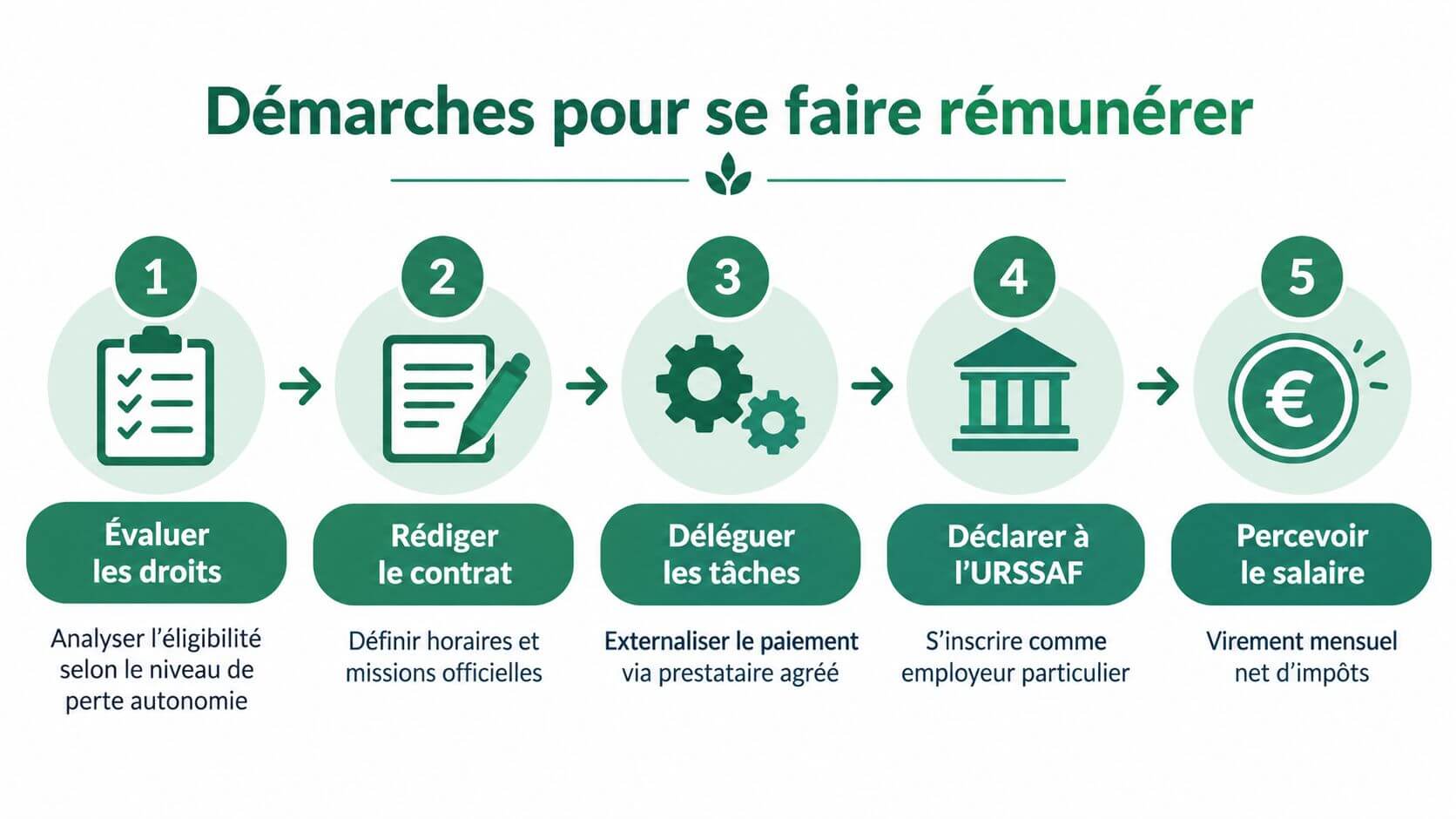
A simple roadmap
Evaluate rights. Contact the departmental council to review the APA if the situation falls within the scope of the loss of autonomy, or the CDMH for a request for PCH in the event of a disability. Collect information on daily needs, assistance already present and those involved.
Clarify tasks. List the acts concerned, the timetables, the periods of presence and the responsibilities. This list avoids an overly vague contract and facilitates the monitoring of the hours financed.
Check the limits. Ask if the relative can be employed in the family configuration concerned, whether certain tasks are excluded from the assistance plan, and how much remains to be financed from its resources.
Formalize employment. the person receiving care, or his or her representative, must take on the role of employer. Write a suitable contract, then proceed with registration and declaration with the CESU and the Urssaf.
Declare each period. Each month, record the hours worked, absences, tasks and amounts paid. Keep the bulletins and supporting documents in a file shared with the people who manage the administration.
The dossier to be prepared
Prepare the APA or PCH notifications, contact details of the person receiving care and his/her representative, task log, proposed schedules and required bank details. If several relatives are involved, clearly identify the person who centralizes the returns.
Do not start with a transfer "waiting to regularise". Late adjustment can complicate contributions, supporting documents and the review of the aid plan. In case of doubt, ask the departmental council or CESU for written confirmation before the first payment.
Summary and key resources
Keep this rule: being a family worker does not automatically mean being an employee. You can help free of charge, be employed by the person receiving care in a declared setting, or remain employed by a company while mobilising close helper rights. The right arrangement depends on the situation of your loved one, your job and the level of assistance needed.
Remuneration requires a contract, hours followed, and declarations. Caregiving leave follows a different logic. In both cases, daily coordination remains crucial to avoid forgetfulness, duplication and incomplete transmissions.
To check which devices can be mobilised, use the official resources of Service-Public.fr dedicated to the rights of carers, get closer to the MSA if you are a farmer and seek advice from a specialized association such as the Association I help you. You will also find a convenient selection in this page on support for family caregivers.
Now do three things: identify your real status, ask for a check of your APA or PCH rights, and then create a shared tracking of hours, appointments, treatments and responsibilities. Tribulys centralizes this information and transmissions between relatives and professionals, invite your family to discover the tool on Tribulys to structure the help around your loved one.
Put this organisation into practice with Tribulys
Keep your care journal, shared calendar, tasks, medication tracking and emergency information together. Start for free and invite the relatives and professionals involved in your loved one’s care.