
In 2022, seven million people regularly accompanied a relative in loss of autonomy or in a situation of disability, without always having a clear framework to organize themselves. Between the notebook left at home, text messages and calls, the information spread quickly. This is precisely where the coordination of home care : structure who does what, when, and with what trace. To lay solid foundations, our guidance on helpers for family caregivers is a good starting point.
Demand is exploding as a result of aging and the desire to stay at home. a study by Drees, these caregivers represent 11% of the population aged five or over. Faced with this reality, organising interventions is no longer a comfort, it is a necessity.
Geosoin, a simple definition
The word geosoin refers to the idea of managing and locating care provided outside the hospital, directly in the person receiving care. It covers two complementary realities. On the one hand, logistical optimization: geocoding of homes, calculation of tours and planning of staff for structures such as home nursing services. On the other hand, human coordination: circulating information between the family and the caregivers who relay.
These two dimensions have the same objective: to ensure continuity of care. A provider who arrives must know what has been done before him. A close relative at a distance must be able to verify that a treatment has been taken. management of home care transforms a multitude of isolated gestures into a readable and shared journey.
Why Coordination Is Needed
The demographic context weighs heavily. The number of dependent elderly people is increasing every year, and keeping at home is an important choice for families. However, human resources are difficult to follow. Based on INSEE projections, about 2,000 health jobs would have to be created every year by 2030, with particular tensions in home help.
This shortage increases the pressure on the loved ones. When professional workers become scarce or succeed each other, the caregiver becomes in fact the route coordinator. Without a tool, this invisible load generates fatigue and avoidable errors: dose given twice, appointment forgotten, information lost. follow-up of home care allows us to regain our hands. Home maintenance of the elderly details the concrete levers to achieve this.
Key functions of a coordination tool
A good system of Coordination of interventions It is based on a few essential bricks. Each one responds to a specific point of friction encountered daily.
- Shared Link Book : each visit leaves a trace dated and identified, searchable by the entire team.
- Monitoring of medicines : confirmation of doses and automatic warning in case of missed dose.
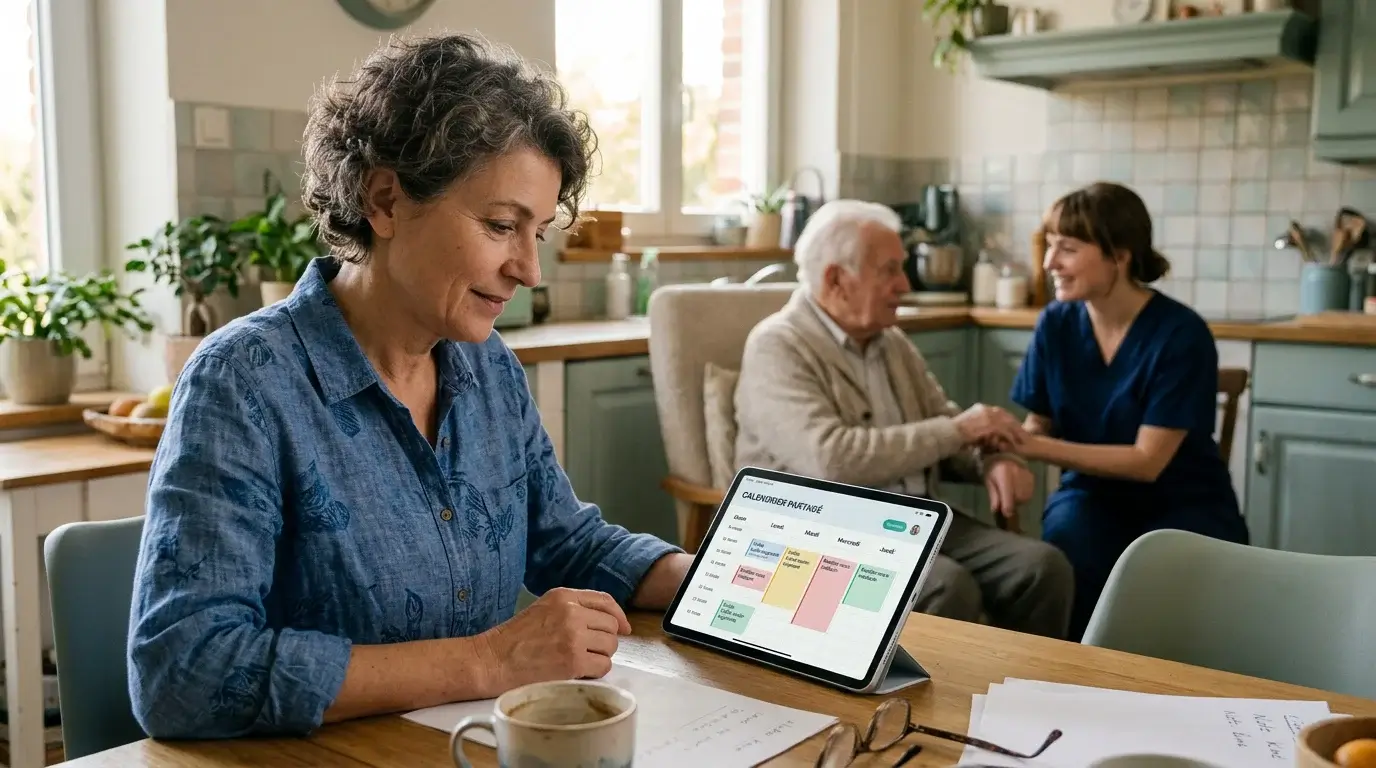
- Shared calendar : medical appointments and combined nursing trips, with reminders for each.
- Passing transmissions The next speaker finds what has been done and closes his visit simply.
- Off-line operation : the tool remains usable without a network and then synchronizes.
We designed our application around these uses. home help schedule centralizes passages and reminders to avoid holes in the organization, rather than multiply scattered threads of discussion.
Bringing together family and professionals
The strength of a geosorin approach lies in its ability to have two worlds of dialogue: relatives and caregivers. Too often, each one advances with its own partial vision. The result: redundancies and blind angles.
The load is not evenly distributed. Drees data44% of caregivers spend less than seven hours a week helping, when others take on a volume close to full-time. A common space allows for a better division of tasks and an objector to each other's involvement.

How to choose your solution
Not all solutions are aimed at the same audience. Some target management structures to optimize tours and staff schedules. Others directly target families who coordinate the day-to-day lives of a loved one. The need for home services continues to grow: an analysis of INSEE anticipates a continuous increase in the number of user households under the sole effect of aging. It is worth equipping yourself with a tool adapted to your situation.
| Criterion | Tools for structures | Our Tribulys application |
|---|---|---|
| Target audience | SSIAD, HAD, EHPAD | Families and caregivers of the same tribe |
| Shared Link Book | Variable | Yes, timed and signed |
| Missed dose alert | Rarely | Yes, automatic |
| Family access | Limited | Yes, by invitation |
| Entry tariff | On request | Free formula up to 5 members |
If you coordinate the care of a family relative, a solution for home living will be more direct than an establishment management software.Home help for the elderly help you identify your priorities before you equip yourself.
Security and data protection
Health information is sensitive. sharing of medical information must be based on a sound framework. Systematically check data hosting and compliance with the European Data Protection Regulation.
For our part, the data are hosted in the European Union and protected in accordance with Regulation 2016/679, with accommodation in France. Access is by nominative invitation, with separate roles for the family and caregivers, so that each member sees only what concerns him.
What to remember
The geosoin, understood as co-ordination of home care, is not a technological gadget: it is a concrete response to a demographic and human equation. Centralizing information, tracing passages and securing treatments reduces errors and relieves loved ones. Before you equip yourself, clarify who uses the tool and for what need: a family does not look for the same thing as a structure. Start small, with the functions that regulate your most frequent frictions, then expand.
Take action with Tribulys
Coordinating the care of a loved one should not be based on scattered WhatsApp wires and a notebook left on the kitchen table. You need a unique space where family and healthcare professionals share the same information, in real time.

Our app brings together time-honoured link book, followed by medications with automatic alert, shared calendar and tribe messaging, all hosted in France and functional offline. The Essential formula is free for life up to five members. Explore our resources for caregivers and create your tribe today.
Frequently Asked Questions
What does the term geosoin mean?
It refers to the management and coordination of home care. It covers both the logistical optimization of carers' tours as well as the sharing of information between relatives and professionals around an assisted person.
Is the geosoin intended solely for professionals?
No. Some solutions target care structures, but others are designed for families. Our application, for example, brings relatives and caregivers together in a single space to organize daily life.
How does a tool reduce the lack of medication?
Each dose is confirmed in the application and an automatic warning is triggered if a dose is missed. The whole tribe then sees the information, which avoids double-takes and omissions, especially in the evening.
Do these solutions work without an internet connection?
The best applications remain usable offline. Ours works without a network and automatically synchronizes the data as soon as the connection returns, which is useful in poorly covered housing.
Are my health data protected?
Always check the hosting and compliance with European Regulation 2016/679. For our part, the data are hosted in France, in the European Union, with nominative invitation access and separate roles according to the members.
Put this organisation into practice with Tribulys
Keep your care journal, shared calendar, tasks, medication tracking and emergency information together. Start for free and invite the relatives and professionals involved in your loved one’s care.