
You do your mother's shopping, you call her doctor, you monitor her medication and you worry at night. However, you never said to yourself: I am a helper. This is the case of millions of people. To better understand your situation and organize this help, our Guide for the Coordination of Caregivers The first step is to know whether or not, you accompany a loved one in loss of autonomy as understood by the public authorities.
The question Are you a helper? In 2022, according to Drees7.1 million people, or 11% of the population aged 5 or over, were providing regular assistance to a relative. Recognition of this role is a prerequisite for access to rights, respite arrangements and appropriate support.
What exactly is a helper?
One close helper is a person who regularly provides non-professional assistance to a member of his or her entourage due to age, illness or disability. This definition, contained in the 2015 Law on the Adaptation of Society to Ageing, does not depend on a specific relationship of kinship or on a minimum number of hours.
The assistance takes a wide variety of forms. Drees distinguishes between three main categories: moral support, covering 95% of caregivers, support for daily life (83%) and financial or material assistance (42%). One third of carers combine the three forms At once.
In other words, you don't need to do medical care to be a caregiver. Listening to, reassuring, managing papers or arranging appointments is enough to take on this role. That's precisely what makes identification difficult.
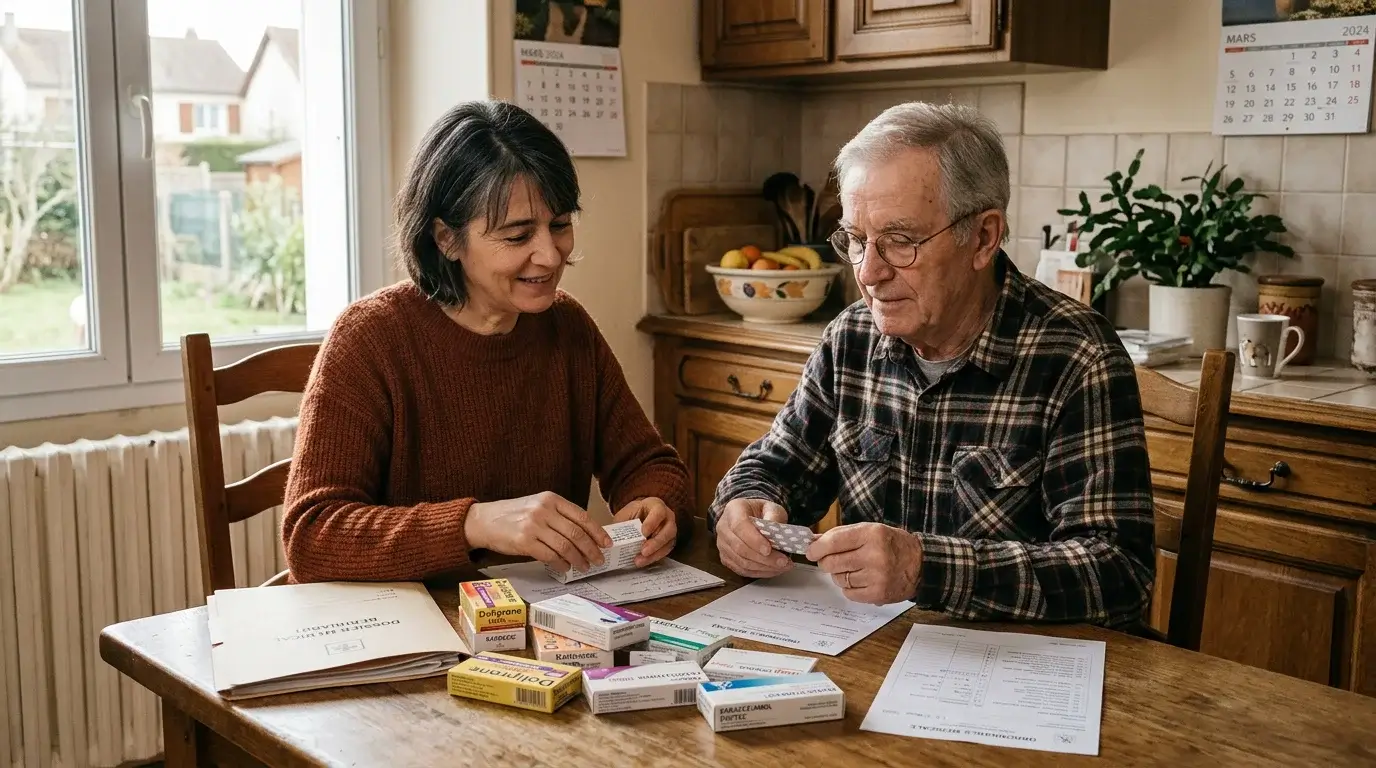
The signs that you're already helping
Many people act by helping themselves without being named this way. Here are some concrete clues that need to alert you:
- You accompany a loved one to his medical appointments or you arrange them.
- You manage his shopping, his meals, his cleaning or his laundry.
- You follow her medication or monitor her health.
- You take care of his administrative and financial procedures.
- You coordinate the passages of nurses, physiotherapists or home care workers.
- You provide him with daily moral support, sometimes at a distance.
If many of these situations speak to you, you are most likely a family helper. The fact of not living together does not change anything. In 2016, according to a OCIRP barometerOn average, 226 km separated the helper from the helper, proof that remote aid is a massive reality.
Why so many caregivers don't recognize themselves as such
Non-recognition is one of the great paradoxes of assistedness. One helps a parent or a spouse "because it is normal", out of love or duty. This role is built gradually, without conscious decision, which prevents putting a word on it.
This invisibility is coupled with silence at work. According to Les Entreprises for the City, only 25% of caregivers inform their employer of their situation, often for fear of being stigmatized. However, recognizing themselves as a helper is the key to gaining access to rights and avoiding exhaustion.
This phenomenon also affects younger and younger people. The same source indicates that the average age of entry into assistance has declined from 39 years in 2021 to 33 years in 2024. Putting the word on your situation is allowing you to seek help. To clarify your role and your first steps, our article on family assistance: starting and organizing (rights) is a useful starting point.
The real weight of daily help
Helping is costly, time consuming and healthy. The time spent varies greatly: according to Drees data relayed by ASH44% of caregivers spend less than seven hours per week, but 11% spend more than 35 hours, equivalent to full-time employment.
The burden is all the more heavy as aid is often based on one person. Three out of ten caregivers accompany their loved ones without any relays, neither family nor professional. This situation is particularly common between spouses: 61% of them are alone in support, according to Drees.
This isolation exposes you to real risks. In 2016, an OCIRP barometer pointed out that almost half of caregivers reported a chronic disease. Recognizing your role allows you to anticipate this exhaustion rather than suffer it.

Your rights once you recognize yourself as a helper
Deciding to help opens up access to several concrete devices. The best known is the caregiving leave, which allows you to suspend or reduce your activity to accompany a relative, with possible compensation under conditions. Our landmarks on the Caregiver leave: conditions and procedures details the eligibility criteria.
Other levers exist: the daily allowance of the caregiver, the respite solutions, the compensation via the disability compensation benefit, or the right to respite linked to the personalized autonomy allowance. At home, these aids often combine with professional services. For a complete overview, see our file on the rights and aids for a home helper.
These devices remain under-used, precisely because too many caregivers do not know that they are entitled to them. The first reflex is to have your status recognised with the actors concerned: treating doctor, social service, or information point dedicated to caregivers.
Compare your situation with the caregiver profiles
To find out where you are, here are the main profiles of caregivers identified by the French public statistics, together with the corresponding data.
| Profile | Share of carers (Drees, 2022) | Key characteristic |
|---|---|---|
| Helping a parent | 35 % | Most common profile |
| Spouse support | 24 % | Almost systematic cohabitation, 61% help alone |
| Assistance to a child | 19 % | Hours often the heaviest |
| Helping a brother or sister | 9 % | A third live under the same roof |
Whatever your profile is, there is a common point: the coordination of information. Know what has been done, by whom, and when, quickly becomes a puzzle between calls, text messages and notebooks left at home. This is where our Guide for the Coordination of Caregivers and our tools make sense, by centralizing exchanges within the same tribe.
Recognising your role in better living
If you regularly accompany a fragile loved one, you are a helper, even without being aware of it and even if your help seems to you "natural". Putting this word on your daily life is not another label: it is the condition for gaining access to your rights, asking for respite and avoiding exhaustion. The first useful gesture is simple: to name your situation, talk to a health professional or social service, and then organize the help rather than carrying it all alone. You are not obliged to wait for the overload to act.
Take action with Tribulys
Recognizing your role as a caregiver is good. No longer wearing it alone is better. The real challenge begins when you need to coordinate family and caregivers around a loved one, without losing the thread of visits, treatments and appointments. Scattering information between messages and calls ends up exhausting you.

We bring together family and healthcare professionals in the same space: time-bound link book, follow-up of drugs with alerts, shared calendar and tribe messaging, all hosted in France and compliant with GDPR. The Essential formula is free for life up to five members. resources for carers to organize you calmly.
Frequently Asked Questions
Do you need a family bond to be considered a caregiver?
No. A caregiver may be a member of the family, but also a friend, neighbour or any person around him. The determining criterion is to provide regular and non-professional assistance to a relative who is losing his or her autonomy.
How many hours does it take to help?
There is no official hourly threshold. Some caregivers help less than seven hours a week, others more than thirty-five. The regularity of the aid is more important than its duration to recognise itself as a helper.
Can we help if we live far away from our loved ones?
Yes, remote help is a common reality. Managing appointments, coordinating stakeholders, or providing moral support by telephone is fully part of the role of caregiver, even without cohabitation.
How do I know if I can get help?
Get close to your attending doctor, a social service or an information point dedicated to caregivers. Depending on your situation, you can claim family leave, respite solutions or certain allowances.
How can aid be better organized on a daily basis?
Centralizing information is essential to avoid oblivion and overload. A coordination tool like ours allows you to share a care journal, an agenda and the follow-up of medications between family and caregivers, in one place.
Put this organisation into practice with Tribulys
Keep your care journal, shared calendar, tasks, medication tracking and emergency information together. Start for free and invite the relatives and professionals involved in your loved one’s care.