
Three in ten caregivers accompany their loved ones without any relay, family or professional. Behind this figure lies an exhausting reality: juggling between medical appointments, nursing passages, treatments and emergencies, often from a simple notebook left at home. To organize all this without losing you, our guide for the coordination of caregivers helps you structure every step of the way. organization of home care transforms a load suffered into a controlled approach.
When several stakeholders work around the same person, the information disperses between text messages, calls and paper notes. No one has an overview then. a study of DREES The informal aid, published in December 2025, now concerns millions of families facing this daily challenge.
What is Home Care Coordination?
The coordination of care means the systematic organization of medical, paramedical and human interventions around an assisted person. The objective: to ensure continuity, avoid redundancy and secure the path of the loved one.
In concrete terms, it is a matter of circulating the right information among the right people at the right time. A nurse must know what the previous passage has done. A doctor must consult the recent constants. The family wants to know from a distance whether the evening treatment has been taken.
There are usually two levels: proximity coordination, which is carried out as close as possible to the home, and support coordination for complex situations involving several pathologies. continuity of care based on a fluid sharing of observations.
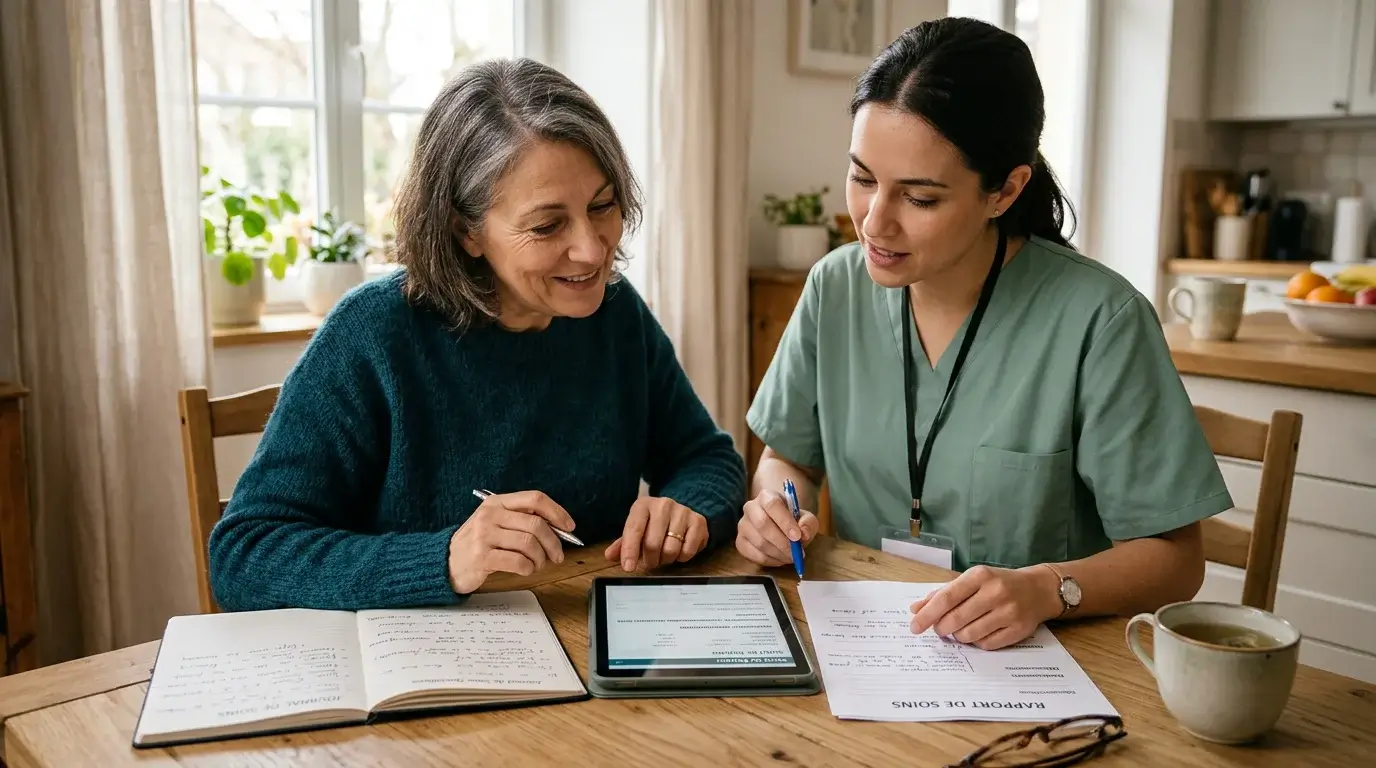
A massive challenge for French families
The ageing of the population and the desire to help keep people at home place their loved ones at the heart of the scheme. DREES estimates that by 2022, 7.1 million people were providing regular assistance to 5 million relatives in ordinary housing.
This assistance takes many forms. Moral support dominates (95% of caregivers), followed by support for daily life (83%) and financial or material assistance (42%). One third of the carers combine the three. The hourly load varies greatly, up to 35 hours or more per week for 11% of them.
The weight of loneliness remains worrying. Three out of ten caregivers accompany their loved ones without any co-help, a situation that rises to 61% among assisting spouses. In response, the State launched in 2019 the strategy "Acting for Caregivers", renewed and strengthened in 2023 according to an opinion of the CNSA.
Who composes the team around the next door
Coordinating first involves identifying the actors. Around an assisted person often gravitate the principal caregiver, other family members, but also professionals with complementary roles.
- The Independent Nurse, pivot of home care, carries out technical gestures and clinical surveillance.
- The physiotherapist intervenes on mobility and rehabilitation.
- The attending physician pilot the care strategy and prescribe.
- The auxiliary of life accompanies daily gestures and meals.
Each acts in its corridor, but the value arises from the connection. To formalize this organization, a personalized care plan clarifies which does what, how often and with what objectives. It is the foundation of a co-ordinated care effective.
Obstacles that sabotage the organization
Why does coordination fail so often? The first enemy is dispersion. The vital information is divided between WhatsApp, SMS, telephone calls and a paper notebook that never leaves home.
As a result, no one has a reliable overview. The caregiver who works at a distance does not know what happened during the day. Treatment can be given twice, or forgotten, for lack of clear trace. These preventable errors generate stress and guilt.
In addition to this, there is the mental load. The caregiver becomes, by default, the sole coordinator of a fragmented care path. Sharing the medical record among authorized providers alleviates this pressure by giving everyone the information they need, without increasing exchanges.
Digital tools that change the situation

Digital moves home coordination to a shared space, accessible at any time. A timed link book replaces the paper book: each visit leaves a dated and signed trace, visible to the entire team.
This centralization responds to a real need. FIFG-Macif investigation In June 2025, the coordination of care was one of the most valued competencies of health care professionals themselves, cited by 87% of them. digital care journal reproduces this logic for all families, with priority alerts and follow-up of medication.
The shared calendar completes the device. Medical appointments and nursing trips come together in the same place, with reminders for the entire tribe. The next speaker knows what has been done and what remains to be done.
Compare coordination approaches
Not all methods are valid. The table below provides an overview of current practices and our Tribulys application on the criteria that matter on a daily basis.
| Criterion | Paper / SMS | General public messaging | Our Tribulys application |
|---|---|---|---|
| Shared overview | No | Partial | Yes, in real time |
| Timed trackability | Limited | Unstructured | Dated and signed by author |
| Missed dose alert | No | No | Automatic |
| Family/caregiving roles | No | No | Access by invitation |
| Data hosting | N/A | Variable | In France, GDPR compliant |
Free solutions such as general mail help, but they do not offer reliable structure or traceability. Our Essential formula, free for life up to five members, fills this void without cost to start.
Good practices to coordinate calmly
Beyond the tools, a few habits make the difference. They reduce friction and secure the path of the loved one.
- Centralize all information in a single space, never scattered.
- Date and Sign each observation to remove any doubt about who did what.
- Anticipate Emergencies with a plug accessible remote treatments and contacts.
- Delegate giving each member the necessary visibility to his or her role.
- Protect data by choosing accommodation in accordance with the European Regulation.
These reflexes transform an improvised organization into coordinated care path, where everyone knows, at any time, where the next of kin is accompanied.
Coordinate better to finally blow
The coordination of home care It is not an administrative constraint: it is the lever that protects both the loved one and the caregiver's health. Centralizing the information, tracing each intervention and sharing a common view reduce errors and reduce the mental burden. Faced with the millions of families who bear this responsibility, often alone, the stake is as human as well as organizational. Start small, with a shared space and clear rules, then gradually widen the circle of stakeholders. An informed team remains a serene team.
Take action with Tribulys
You juggle between calls, text messages and notebooks to organize the passages around your loved one? You deserve a unique space where family and caregivers see the same information, in real time. We designed Tribulys exactly for this: to bring your tribe together around a clear and reassuring follow-up.

With our time-bound binding care journal, automatic alert drug tracking and shared calendar, you'll be back on hand effortlessly. Data are hosted in France and compliant with GDPR. Start with our free life essential formula up to five members: create my tribe for free Just takes a few minutes.
Frequently Asked Questions
What is coordination of care in practice?
It is the organization of medical and human interventions around an assisted person. It aims to ensure continuity of care, avoid duplication and secure the path. It is based primarily on a fluid sharing of information among all stakeholders.
Who can coordinate the care of a loved one at home?
The family caregiver often plays this role by default, in connection with the nurse, the doctor and other professionals. A nurse coordinator can also be appointed. The essential thing is that everyone knows their role and has the same information.
How can I avoid drug forgetfulness?
A structured follow-up with confirmation of each dose severely limits errors. Our application triggers an automatic alert when a dose has not been confirmed. The whole tribe then sees what remains to be done.
Is an application really useful for coordinating?
Yes, because it replaces scattered exchanges with a single space accessible everywhere. Each observation is dated and visible to authorized persons. This reduces the mental burden and facilitates delegation between members.
Are shared health data protected?
They must be done in accordance with European Regulation 2016/679, said GDPR. Our data are hosted in France and access is by nominative invitation. Each member sees only the information corresponding to his or her role.
Put this organisation into practice with Tribulys
Keep your care journal, shared calendar, tasks, medication tracking and emergency information together. Start for free and invite the relatives and professionals involved in your loved one’s care.