
You probably know this scene. It's late in the morning, you look at your phone, and a thought comes back in loop. Has your loved one had good lunch, has he taken his treatment, is he holding the call morally today? Nothing alarming, but not enough certainty to be quiet.
In keeping at home, this grey area uses the helpers faster than the emergency. The emergencies impose an action. The blurry, however, occupies the mind all day long. It is precisely there that the call of courtesy It's gaining value. Not like a simple "quick call to take news", but as a regular, organized gesture, useful to the person receiving care and to all his entourage.
When done well, a courtesy call reassures, creates a link, raises weak signals and avoids finding out too late what is deteriorating at low noise. It also lightens the caregiver's mental load, because it replaces the diffused anxiety with a clear point of contact, with a trace and a sequel.
Contents
- The courtesy call a simple tool to take better care of
- Why Courtesy Call Is A Pillar of Home Retention
- Planning and conducting an effective courtesy call
- Models of concrete messages and scenarios for caregivers
- Trace your calls and follow up with Tribulys
- Turn the courtesy call into a benevolent habit
The courtesy call a simple tool to take better care of
A girl calls her mother in the middle of the day. She doesn't want to watch, let alone control. She just wants to know if the morning went well. Her mother replied with a somewhat tired voice, said that everything was fine, then let go that she had less sleep and didn't want to cook. In two minutes, the call performed three functions. He broke loneliness, gave a mark in the day and revealed a small change of state that no quick message would have allowed to see.
This is often the beginning of a more serene organization. One stops calling randomly, under the influence of anxiety, to set up a meaningful relationship meeting. The call for courtesy becomes then a support point. He's got nothing heavy or administrative. It brings a stable presence and a minimum of watch, without turning the relationship into permanent control.
In practice, the families and caregivers who do best are not the ones who multiply disorderly contacts. These are those who create a simple framework. A benchmark schedule. A way of speaking that respects the person. A few points of attention always present, without having a checklist recite.
Field reference: a good courtesy call leaves the helped person more soothed after the exchange than before.
The classic mistake is to believe that a useful call must be long or very structured. That's not true. A call can be brief and yet rich, provided it is regular, warm and attentive to the details that matter. The tone, silence, energy in the voice, the consistency of the day's story often speak more than a series of closed questions.
Another trap is to reserve these calls at difficult times. In reality, they take all their strength when they also exist in quiet times. This is what makes it possible to know the usual rhythm of the person, and therefore to find out more quickly what comes out of the ordinary. In home care, this continuity changes a lot.
Why Courtesy Call Is A Pillar of Home Retention
We often reduce the courtesy call to a friendly attention. It's too little. In home maintenance, it is a preventive coordination tool. It creates an intermediate observation between two passages, between two appointments, between two moments when someone actually sees the person.
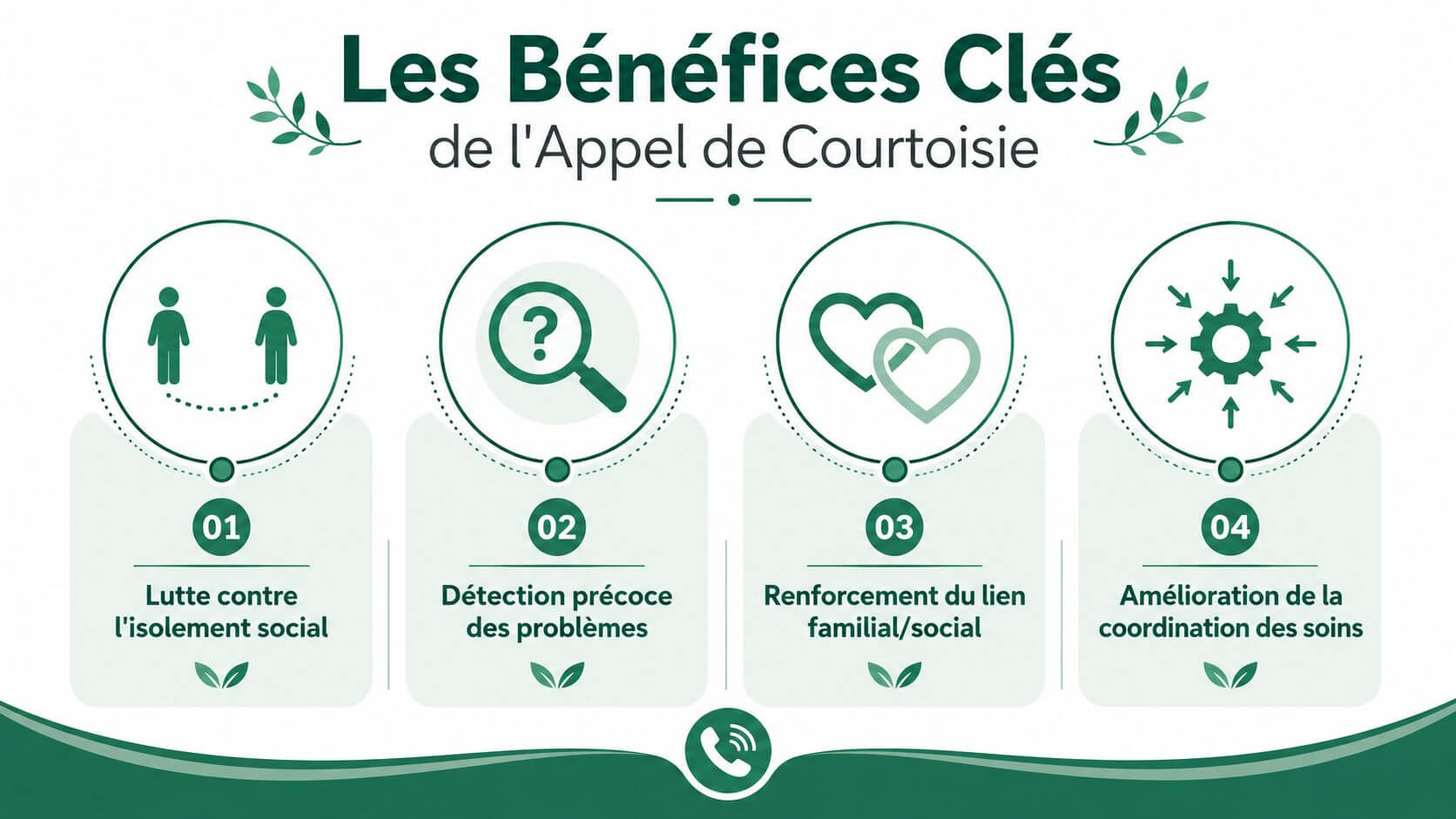
In the field of teleassistance in France, the courtesy call is defined as a planned telephone exchange to provide regular moral support and prevent social isolation. The recommended frequency is at least one call per week to maintain a meaningful social link, as indicated the presentation of Nexecur's courtesy call service.
A Call That Supports Without Infantilizing
The first utility is obvious. The call breaks isolation. But its true strength comes from the way it installs human continuity. An elderly person alone at home does not necessarily spontaneously say that she feels less well. However, if she knows that a call comes back at a time known, with a familiar voice and listening without judgment, she speaks more easily.
This point changes the atmosphere of the follow-up. Instead of being controlled, one creates a relationship of trust. And when this trust exists, the information becomes more reliable. The person dares to say that she is less hungry, that she feels tired, that she fears an exit, that she has had trouble getting up.
For families looking for concrete benchmarks on home organization, resources on keeping an elderly person at home help to put this type of call back into a wider logic of accompaniment.
What a call can capture between visits
The second interest is clinical in the broad sense, even when the call is not medical. A well-conducted call brings back some low signals. No diagnosis. Evidence. A breathless voice. An unusual confusion. An unusual annoyance. A vague complaint that comes back several times. A break in habits.
A call often gets better than a written exchange:
- Emotional state. The person seems to be shot down, irritable, anxious, or on the contrary relieved.
- Energy levelIt responds quickly, slowly, consistently, or with difficulty.
- Continuity of everyday life. The meal, the toilet, the sleep, the movements, the exits, the appointments.
- The ability to apply for aid. Some people minimize face-to-face, then engage more on the phone.
A useful courtesy call does not seek to know everything. It seeks to identify what deserves further attention.
This is why it becomes a coordination pillar. The family caregiver prepares his next passage better. The nurse arrives with a targeted vigilance. The physiotherapist understands that it will take a few minutes to reassess fatigue or mobility. Everyone is gaining in accuracy.
What works and what fails
On the ground, the difference between a helpful call and a tired call is a matter of little.
| Situation | What Helps | What Harms the Exchange |
|---|---|---|
| Single and anxious person | A landmark schedule and a known voice | Unforeseeable calls falling badly |
| Follow-up between visits | Some open questions about the day | A gust of closed questions |
| Dispersed family | Information then shared | Everyone calls without coordination |
| No one's a prick. | A gentle, experience-centred approach | A tone of control or verification |
The approach that works is simple. We talk to a person first, not to a "file." We listen before we play. We connect what is said to the concrete daily. And then the essentials are passed on to the right interlocutors.
The approach that misses is just as recognizable. You call to reassure yourself, you ask questions in series, you cut off the word, you forget to note what counts, then you start again the next day as if nothing were happening. At that time, the call becomes an additional burden instead of being a support.
Planning and conducting an effective courtesy call
A successful call prepares a little, then goes smoothly. If you improvise completely, you risk forgetting the essentials. If you follow a script too tight, the person quickly feels the interrogation. You have to hold both ends. A clear intention, and a natural conversation.
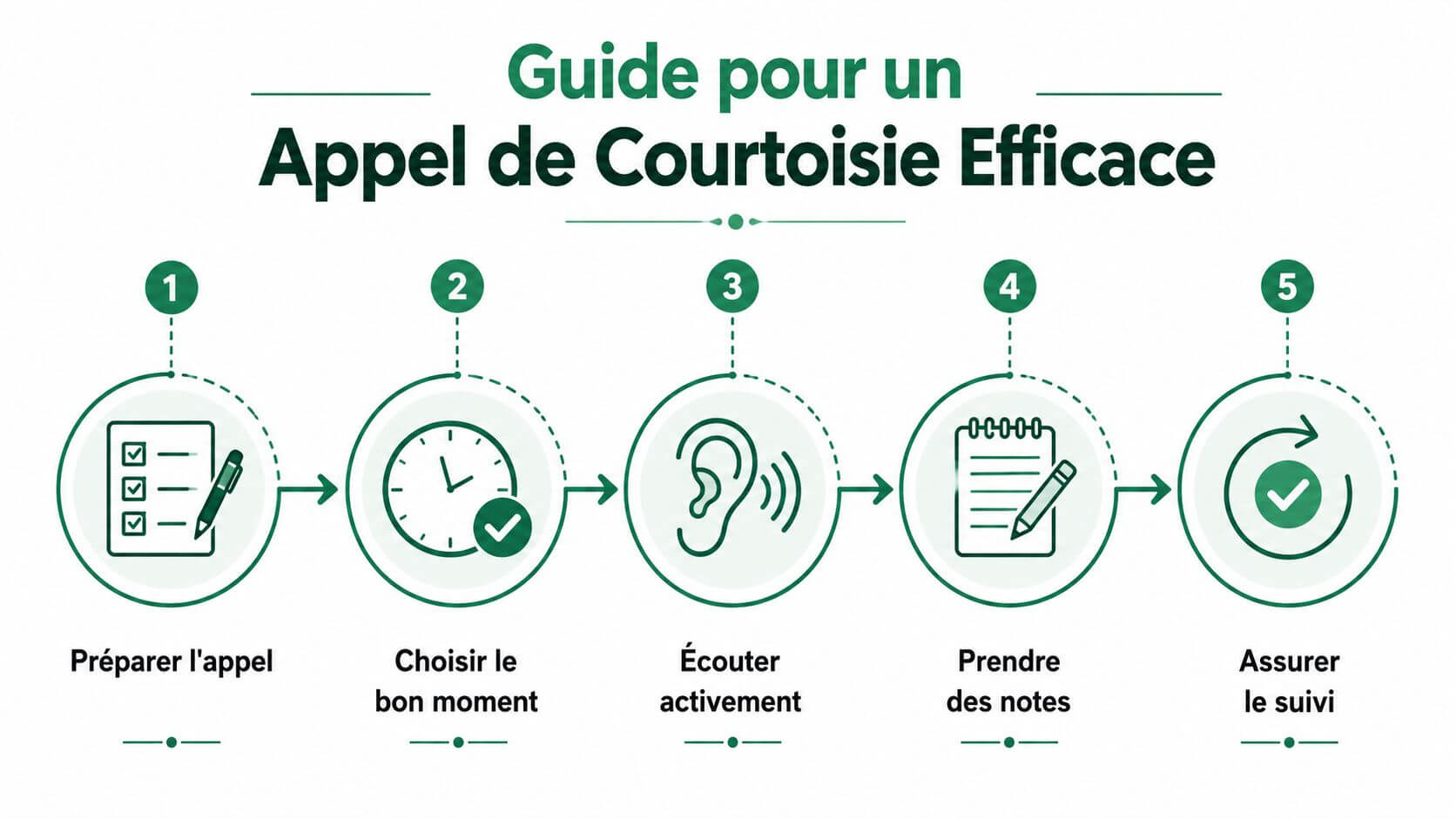
To visualize the overall logic, this support is useful before moving to practice:
Prepare the call without rigidizing it
Start by choosing the right time. Not only according to your schedule. Depending on the pace of the person. Some are more available at the end of the morning. Others speak better after nap or at the beginning of the evening. The right niche is where the exchange can be placed.
Then fix a discreet objective. For example, taking general news, checking how it happened at night, feeling the moral state before an appointment, or reconnecting after a difficult day. Only one main objective is enough. Otherwise, the call goes in every direction.
Professionals who work with a busy schedule have an interest in organizing these points in a clear routine. well-structured home help schedule avoids that follow-up calls are delayed at the last moment or made in haste.
Useful rule: If you're in a hurry, it's better to report a little bit than to make a dispatched call. The person hears immediately when you're not really available.
Some elements to have in mind before composing:
- The recent context. A medical appointment, reported fatigue, a cancelled visit, a change in treatment.
- The right tone of entry. Warm, simple, without dramatizing.
- A point of vigilanceMobility, morale, nutrition, pain, sleep, orientation.
- Possible suite. Who to warn if something deserves follow-up.
A flexible frame in four steps
A simple structure avoids blurred calls. I often use a frame in four steps.
Personal openness
Begin by placing the call within your relationship. “I was thinking of you this morning.” “I am calling to see how you are doing.” This opening is reassuring and gives the conversation a personal touch.Exploration of the Day
Instead of asking, "What's up?", ask a question that calls a story. "How was your morning? "What did you manage to do today? "How was the night? These formulations give substance.Active listening and recovery
When a detail emerges, explore it gently. “You said you spent longer in your armchair. Was that because of tiredness or pain?” “How long have you had less appetite?” A focused follow-up question is more useful than a whole questionnaire.The fence with suite
Finish with security. "Thank you, I get it. "I remember this point for the next passage. "We'll talk this day again. A closed call avoids floating.
Below, a short video can help get into the right posture, especially for tone and speech rhythm.
Questions that really open the door
The best questions are concrete, they talk about the experience, not an abstract state.
| Avoid | Prefer |
|---|---|
| Are you okay? | How have you been feeling this morning? |
| Did you eat? | What did you manage to take today? |
| Are you hurting? | Is there a moment of the day when you were embarrassed? |
| Did you sleep well? | How did the night go, waking up or continuous sleep? |
You can also vary according to your role.
- For a family caregiver. "What made you happy today? "You could have opened the shutters? "Did you want to go out a little?"
- For a nurse or a kine. “Was getting up more difficult than usual?” “Did the discomfort appear before or after physical activity?” “Have you felt more tired since the last visit?”
The key point is listening to what is not directly formulated. A long hesitation. A minimized sentence. A change of tone when talking about food, travel, sleep or a loved one. Often, the important information is there.
Models of concrete messages and scenarios for caregivers
The theory helps. Concrete formulations really unlock the practice. Many caregivers know that they should call more regularly, but don't know how to start without appearing intrusive. Many caregivers know what to check, but seek the right balance between precision and humanity.
Family Caregiver Scenario
Let's take a common situation. Your father lives alone. He cares about his autonomy. He doesn't support questions that are too direct, especially about meals or drugs. If you call and say, "Have you eaten well? Did you take your tablets?", he will often answer "yes, yes" to shorten.
A better entry would be this:
"Hello, Dad, I'm calling you while I have a quiet moment. How was your morning?"
If he answers vaguely, start again on concrete.
Did you get up at your own pace?
Did you manage to prepare something that made you want?
Did you walk a little in the apartment or go out and get some fresh air?
This approach respects the person and gives them space to share their experience. It also helps you hear useful details: “I was not very hungry.” “I sat down for almost the whole morning.” “I lost track of time.” This provides more than a mechanical confirmation.
If a sensitive subject needs to be addressed, go through observation rather than reproach.
- For mealsI feel like cooking weighs more on you these days.
- For medicinal productsYou want to see the simplest moment to take them together?
- For moraleYou look a little less going today, I'm wrong?
Health professional scenario
Between two passages, a follow-up call can avoid finding a problem too late. The tone must remain simple. The professional does not conduct an administrative interview. He checks a real situation.
Example of opening for a nurse:
Good morning, ma'am, I'm calling you to find out how the day has been since I was here.
Example of opening for a physiotherapist:
"Hello, I wanted to hear from you after the session, especially about fatigue and travel."
Secondly, some targeted stimulus is sufficient.
- MobilityDid the chair rise as usual?
- Tolerance after care or sessionDid you feel a particular discomfort after I left?
- General StateDo you feel tireder, or is it stable compared to yesterday?
The professional saves time when he does not seek to cover everything. He identifies an evolution, confirms a stability, or identifies a point to be reviewed in the next passage. This is what makes the call cost-effective in coordination.
When a call confirms that everything is stable, it has already served. It avoids assumptions and trusts follow-up.
Useful messages before and after the call
The SMS or application message does not replace the call. It prepares or prolongs it well.
Before the call
- Sweet message for a loved one
Hello, Mom, I'll call you in the late morning to get some news from you. - Reassuring message if person dreads calls
No worries, I just wanted to have a little time with you. - Professional message
Good morning, ma'am, I will call you today for a quick point between two passages.
After the call
- Confirmation message
Thank you for our exchange. I note that the morning has been quiet and that we mainly monitor fatigue. - Message of support
I'm thinking about you, we'll talk tomorrow at the same time. - Message with concrete sequel
I've noticed your discomfort in the knee, and we'll take it back to the next pass.
These formulations have a simple merit. They reduce ambiguity. The person knows why we call, what we understand, and what will follow.
Trace your calls and follow up with Tribulys
An untrapped call quickly disappears. Whoever's past him thinks he remembers it. The others don't know. And the detail that seemed secondary at the moment can become central two days later. In a home care organization, the value of the call is not just a matter of conversation. It is also concerned with the useful trace Let's keep it.
What to note right after the exchange
The good practice is to note the essentials immediately. Not a long report. A short, dated, usable transmission.
A simple format works well:
- The reason for the appeal. Routine point, recovery after fatigue, followed between visits.
- Perceived State. Moral good, tired voice, discomfort in walking, reduced appetite, restless night.
- The highlight. Knee pain, difficulty raising, anxiety before appointment, possible neglect of treatment.
- The expected outcome. Monitor, recall, transmit to the IDEL, check during the next passage.
Example of useful note:
Call this morning. Moral correct. Says to have been less walking today because of an discomfort to the right knee. To be checked in the next pass.
This logic joins the interest of a shared digital link book, which avoids the dispersion between calls, SMS and isolated messages.
Transforming observation into coordinated action
The real change happens when the information circulates correctly. An observation is of value only if it becomes visible to the right person at the right time.
Let's take three simple cases.
| Observation during the call | Useful action |
|---|---|
| ♪ I feel weaker to get up ♪ | Next pass carer checks mobility and safety |
| I don't really want to eat. | A loved one watches the meals of the day and the next |
| I'm worried about my date. | A helper prepares accompaniment and redrafts instructions |
This shift from observation to action changes everything. The call is no longer an isolated relational bubble. It becomes a link in coordination. It is particularly valuable when several relatives and professionals intervene around the same person.
Note little, but note correctly. A short and clear transmission helps more than a long blurred text.
A simple routine for the whole tribe
The most effective routine is in three steps. Call. Note. Report if necessary. When the whole team adopts this reflex, the quality of the follow-up goes up by a step without weighing up the day.
What works well in the long term:
- A common vocabularyEveryone describes the facts before the interpretations.
- Short notes. Two or three sentences are sufficient if they are precise.
- A clear prioritization. What requires rapid action is highlighted, the rest remains searchable.
- Readable roles. Who recalls, who checks, who accompanies, who observes the next passage.
What creates noise, on the other hand, is the stacking of parallel conversations. A text message to one, a call to the other, a forgotten info in a family group, then a professional who discovers the subject too late. The right tool does not replace the quality of the listening. On the other hand, it avoids that listening is lost.
Turn the courtesy call into a benevolent habit
The courtesy call works when it becomes a light habit. Not a rigid protocol. Not a surveillance. A regular presence, useful, respectful. It is this regularity that reassures the person receiving care, gives references to the family and trusts the work of professionals.
The frequency must be kept in tune with the situation. For some people, a weekly call is sufficient as a stable point of reference. For others, a closer moment is relevant during a fragile period, before returning to a simpler pace. The important thing is not to do a lot of it. It is to do enough to keep a living link and identify changes.
Consent matters as much as the organization. A call, even if well-intentioned, can be experienced as intrusive if it is not explained. It is better to clearly set the framework. Who calls, when, why, and what will eventually be shared with other stakeholders. This transparency protects the relationship and respects privacy. In a coordination environment, it also helps to remain aligned with privacy and access management requirements.
The right marker is simple. If the person feels supported, if the caregiver breathes a little better, and if the team has more reliable information between two visits, the call fully fulfils its function. It is a small gesture. Well thought, well conducted and well drawn, it becomes a real lever of home maintenance.
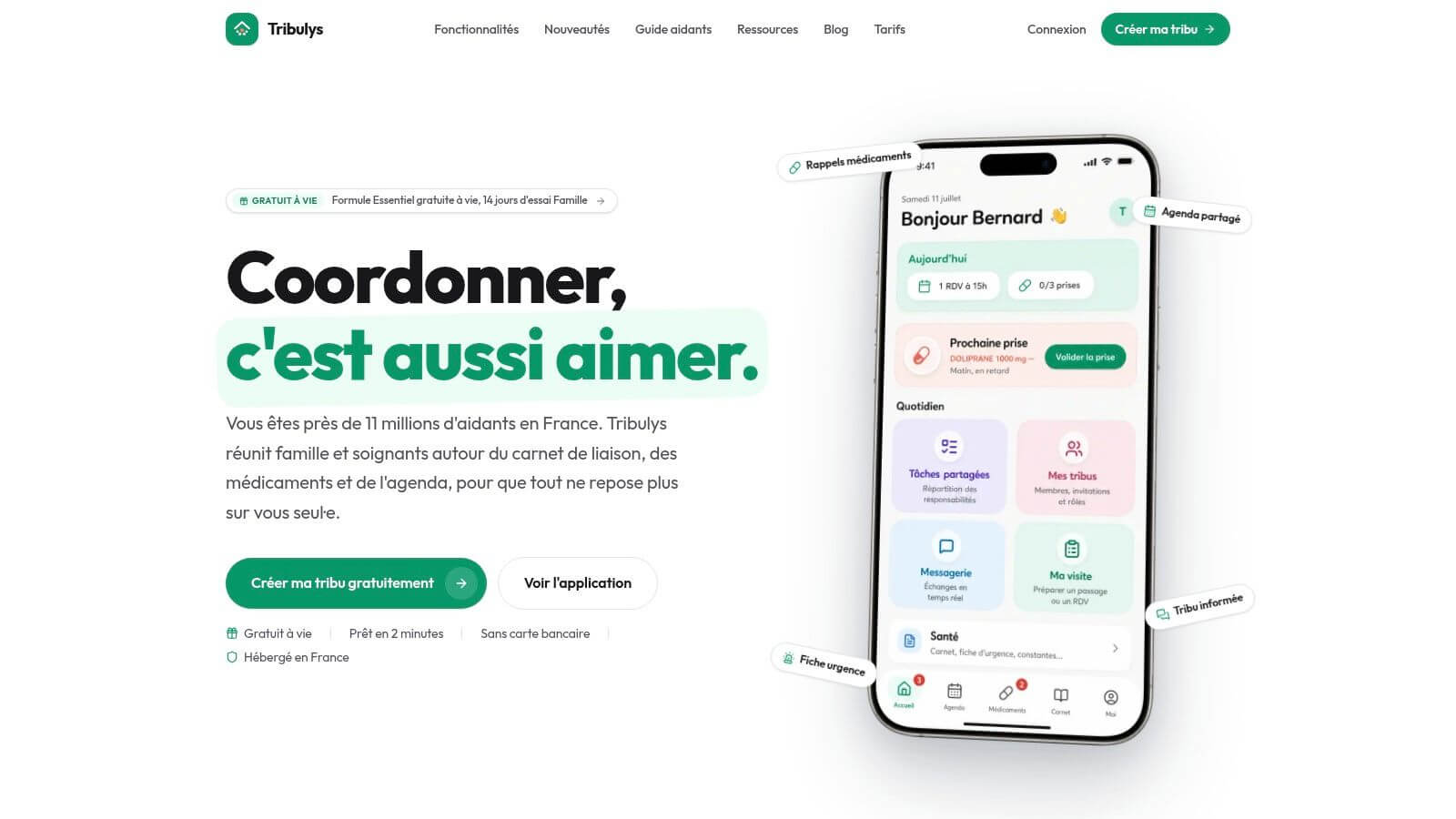
Tribulys helps caregivers and professionals transform every useful call into shared, structured and actionable information. Tribulys, you can centralize the liaison care journal, organize tasks, track passages and reduce the mental burden associated with home coordination.
Put this organisation into practice with Tribulys
Keep your care journal, shared calendar, tasks, medication tracking and emergency information together. Start for free and invite the relatives and professionals involved in your loved one’s care.